Energy Collective blog power policy climate - the conversation happens here
Showing posts with label New Mexico. Show all posts

Monday, April 23, 2007

State Renewable Energy Standards Move Forward - Is a Federal RES Next?

2007 is shaping up to be an active year for Renewable Energy Standard (RES) policies, with RES legislation moving forward in several states this year and both chambers of Congress considering federal legislation.

As reported previously, several states, including Minnesota, New Mexico and Colorado all recently passed legislation increasing their existing, successful state Renewable Energy Standard Policies. In addition, RES policies are moving forward in several new states, including Oregon, Virginia, Indiana and New Hampshire.

  • Oregon's Senate passed SB 838, the Oregon Renewable Energy Act with a bi-partisan 20-10 vote on April 10th. SB 838 requires Oregon utilities to get 5% of their electricity from new renewable energy sources by 2011, 15% by 2015, 20% by 2020, culminating in a 25% by 2025 standard. Small utilities are only required to get 5% of their electricity from renewables by 2020 (currently the cut-off is for utilities serving less than 5% of state load).

  • SB 838 moved to the House last week were the House Energy and Environment Committee heard testimony on the bill during three public hearings. The committee is expected to hold work sessions this week to hear amendments before passing the bill on the House floor. A floor vote is expected by the end of next week.

    See a series of previous posts here at Watthead for more on the Oregon Renewable Energy Act.

  • Virginia became the first state in the South to enact a RES policy on April 4th. Both chambers of the Virginia General Assembly passed an electricity “re-regulation” bill that includes a utility-endorsed, non-binding RES “goal” for 12% of electricity to come from renewables by 2022.

    While a non-binding goal (similar to RES goals currently in place in Vermont and
    Illinois), the policy is notably for being the first in a Southern state setting renewable energy generation goals [excluding Texas I suppose].

    Additionally, Dominion Energy, the state's largest utility has said they plan to meet the goals, and while non-binding, the policy does including financial incentives to meet the goals, which could ensure an effective policy. Every time a utility hits one of the incremental targets, it can increase its base rate of return on equity by 0.5%, increasing the likelihood that utilities will work toward the goals and buy more wind and other renewables.

  • Just one day after Virginia enacted their RES legislation, the New Hampshire House of Representatives passed a Renewable Energy Standard bill with an overwhelming margin of 253-37.

    The RES would require New Hampshire to generate 16 percent of the state's energy from new renewable resources such as wind, solar, biomass and hydro by 2025. Because the state already generates about 6 percent of its electricity from renewable resources, the final share of renewables will be about 22-25 percent by 2025.

    New Hampshire is currently the only state in New England without an RPS, but that looks like it will change soon. The bill now moves on to the state Senate where it is expected to pass with a strong majority. The RES bill also has the support of Governor John Lynch who is expected to sign the bill when it reaches his desk.

  • Indiana is also considering a 10% by 2025 Renewable Energy Standard. The RES bill passed the Indiana House by a vote of 77-20 last week, according to this blurb.

    [Unfortunately, I don't know much more than that about Indiana's bill... Anybody have any more details?]

  • Together, the wide variety of state action on Renewable Energy Standard bills this year should redraw the map of states with mandates supporting for renewable energy development. Currently, 21 states and the District of Columbia have mandatory RES policies in place, while two others have non-binding goals. The inclusion of Oregon, Virginia, New Hampshire and Indiana would push this number to 24 states with mandatory RES policies and 3 with non-binding goals, representing a majority of U.S. states and a vast majority of the United States population and energy consumption (see map below).

    [Image: Current and Proposed State Renewable Energy Standard Policies - April 2007 (Click to Enlarge)]

    And with Congress considering a federal RES policy this year, we could be entering the end game for Renewable Energy Standard policies in the U.S. On the House side, Congressman Tom Udall (D-NM) has introduced a 20% by 2020 national RES bill [see previous post] and Senate Energy and Natural Resources Committee Chairman Jeff Bingaman (also D-NM) has indicated his committee is planning to discuss a 15% by 2020 standard. Senators Harry Reid (D-NV), Olympia Snowe (R-ME) and Dick Durbin (D-IL) have circulated a letter of support for a "strong" federal RES policy which has now been signed by 50 senators.

    The success of state RES policies has clearly proven that an RES is an effective policy for driving renewable energy development and has paved the way (finally) for federal action.

    Read more!

    Wednesday, March 07, 2007

    New Mexico Governor Signs Expanded Renewable Energy Standard

    New Mexico Joins Growing List of States Expanding Successful Renewable Energy Standards

    On Monday, Governor Bill Richardson signed into law Senate Bill 418, which will dramatically increase New Mexico's existing Renewable Energy Standard and put New Mexico at the forefront of states committed to clean energy.

    “I am proud today to sign a bill that will quadruple New Mexico’s use of clean electricity by 2020,” said Governor Bill Richardson said in a press release monday. “Promoting renewable electricity keeps our air clean and it will help New Mexico meet my aggressive greenhouse gas reduction goals. It will also help continue to create new jobs, like those at Advent Solar in Albuquerque, and aid ranchers who want to diversify into the lucrative wind energy market.”

    In 2004 Governor Richardson signed New Mexico’s first Renewable Energy Standard into law. This law, also known as a Renewable Portfolio Standard, mandated that 5% of New Mexico’s electricity come from renewable sources by 2006, increasing to 10% by 2011. Senator Michael Sanchez’s Senate Bill 418 requires that at least 15 percent of an electric utility's power supply come from renewable sources by 2015 and 20 percent by 2020.

    The original 2004 Renewable Energy Standard (RES) only applied to New Mexico's investor-owned utilities. The new expanded RES includes the states public utility district's and municipal and rural electric cooperatives, setting a smaller standard of 5% by 2015 and 10% by 2020 for these consumer-owned utilities.

    The bill passed the Senate unanimously (32-0) and the House by a broad bipartisan vote of 43 to 18.

    New Mexico joins several other states who have recently expanded their existing succesful Renewable Energy Standards including California, Arizona, and Minnesota.

    Colorado is also set to join the list. The Colorado House passed a bill last week that will double the Renewable Energy Standard adopted by Colorado voters in 2004 to 20% by 2020 as well.

    Governor Richardson also signed House Bill 188 on Monday. The bill creates a Renewable Energy Transmission Authority to promote clean energy jobs and help New Mexico both develop our clean energy resources and market them to other states.

    “The Transmission Authority and the Renewable Portfolio Standard work in combination to dramatically position New Mexico to develop our vast renewable energy resources,” said Joanna Prukop Cabinet Secretary for Energy, Minerals, and Natural Resources. “We've just positioned our state to become extremely competitive in all aspects of clean energy development and the benefits that come with it.”

    In the past few weeks Governor Richardson has also signed a major, five state climate change agreement, announced a new Tesla electric car plant for Albuquerque and a biodiesel plant in Clovis, NM.

    “I am proud that both these bills passed with bipartisan support,” said Governor Richardson. “That is because New Mexico is hungry for clean energy and the good jobs that come with this new industry.”

    Read more!

    Tuesday, February 27, 2007

    News From My Backyard: Five Western States Team Up to Battle Global Warming

    Governors of Oregon, Washington, California, Arizona and New Mexico Will Work Together to Set Caps on Greenhouse Gas Emissions

    [From the Oregonian:]

    Oregon will join four other Western states in setting limits on greenhouse gases produced by everything from the car you drive to the power plant that supplies your electricity.

    In taking the action Monday, Oregon, Washington, California, Arizona and New Mexico build momentum for a national strategy to control carbon dioxide and other gases that contribute to global warming. States are increasingly pressing forward on their own amid inaction by the Bush administration and Congress.

    Capping emissions from fossil-fuel burning power plants could also push energy companies toward wind and other renewable energy.

    Gov. Ted Kulongoski helped broker the five-state deal and signed onto it Monday with the governors of the other states.

    [Image: The five western states joining the global warming compact represent about 11% of total United States emissions of global warming pollutants. The five states will set goals and create a strategy to reduce emissions within 18 months.]

    The compact "sends a message to Congress and the White House that if they fail to enact policies at the national level to reduce greenhouse gas emissions and do our nation's part to combat global warming, that states will do it on their own," Kulongoski said.

    The governors said the West is especially vulnerable, as global warming leads to more severe droughts and wildfires; and earlier snowmelt, leaving less water in the heat of summer.

    Each of the states in the western strategy was already acting on its own to address global warming. All the governors who signed the agreement are Democrats, except Gov. Arnold Schwarzenegger of California.

    The strategy has potential to grow to include other states and British Columbia, which has invited West Coast states to join its efforts, said David Van't Hof, an adviser to Kulongoski. He said a primary goal of the strategy is to motivate the federal government to act, and to protect the interests of Western states if it does.

    "Rather than wait for them to act, we're trying to influence where it's heading," Van't Hof said.


    East Coast pact

    The western effort is the second broad regional move to address global warming. Nine Eastern states have already joined to limit emissions from power plants only and create a cap-and-trade system for the plants to buy and sell credits they get for reducing emissions.

    The Western states strategy is general and does not specify how the states will control greenhouse gases. But they will target all the major sources: vehicle exhaust and industrial sources as well, according to the governors and their aides.

    To start out, the states will set goals for slowing the growth of greenhouse gas emissions and then cutting them back. Then, within 18 months, they will establish a strategy for reducing the emissions.

    One option is a cap-and-trade system that limits carbon dioxide released as electricity is generated. It would require utilities that sell electricity in Oregon, for instance, to control the resulting carbon dioxide. If they cannot control it, they might instead buy credits from those that do.

    Utilities could also fund programs to offset their emissions by planting trees to soak up the gases, for example.

    Emissions limits would probably also extend to vehicles in some form, since they produce about a third of carbon dioxide released nationwide. Oregon has already adopted stricter tailpipe standards that reduce vehicle pollution and emissions.

    Limiting power plant emissions will probably push electricity prices up a few percent or more as power companies pay for the controls. But a draft strategy developed in Oregon would channel more money into making homes and businesses more energy efficient, so they would burn less power overall and their bills might decline.

    "You're either behind the curve or you're ahead of it, and this puts Oregon ahead of it," said Jason Eisdorfer, an attorney with Citizens' Utility Board of Oregon. "Oregon is not going to solve global warming itself, but these five states together can make a significant contribution."

    Depending on the approach, the Legislature would probably have to approve greenhouse gas controls. California has already instituted tough limits on carbon dioxide and is talking with the United Kingdom about combining forces in a joint strategy.

    The Western states that joined the strategy Monday together emit about 11 percent of all carbon dioxide nationwide. Experts said that by itself shows that the effort must expand if it's going to have much hope of heading off global warming.

    "Even the U.S., by itself, isn't going to deal with this problem," said Mark Trexler, president of Trexler Climate + Energy Solutions, a Portland consultant who helps companies prepare for global warming regulations.


    Utilities' hope

    Power company officials said Monday they hope the Western states' strategy paves the way for a national system to control greenhouse gases. They said they would prefer a nationwide program to a complicated web of state and regional strategies.

    "It would be nice to have something consistent," said Bekki Witt, a spokeswoman for PacifiCorp, which operates and buys power from 14 coal and natural gas plants.

    The more states are involved, the broader the opportunities will be to buy and sell emissions credits in a way that keeps power prices down, said Dave Robertson, government affairs director at Portland General Electric. PGE is lobbying for national legislation, he said.

    Many leading utility companies are now doing the same.

    By driving up the price of fossil-fuel based power plants, the strategy could shift more efforts toward the development of renewable energy from the sun, wind and waves.

    "It is also a huge economic development opportunity, particularly for those states who are most aggressive in leading the charge toward a clean energy future," Kulongoski said.

    Read more!

    Monday, February 19, 2007

    Tesla Motors to Build Assembly Plant in New Mexico - Will Produce WhiteStar All-Electric Sports Sedan

    New Mexico Governor Investigating Fleet Purchase of 100 WhiteStar Sedans

    [From Green Car Congress:]

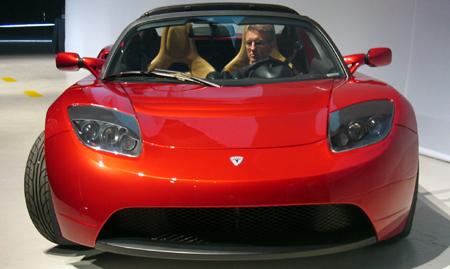
    Tesla Motors [makers of the Tesla Roadster all-electric sports car (pictured left)] will build its new automobile assembly facility in Albuquerque, New Mexico. Construction on the 150,000 square foot plant will begin in April 2007, at the latest.

    The New Mexico plant will be the company’s first assembly facility in the United States, and will produce the WhiteStar, an upcoming four-door, five-passenger all-electric sports sedan.

    New Mexico Governor Bill Richardson has directed the state’s General Services Division, and other appropriate agencies, to investigate the purchase of 100 WhiteStar vehicles for the state fleet over a two year period as a demonstration of the state’s commitment to clean energy.

    Governor Richardson has also invited Tesla Motors Chairman Elon Musk and Tesla Motors CEO Martin Eberhard to work with the state to develop a package of legislation for the 2008 session to encourage and incentivize the purchase of clean energy vehicles, including hybrid and electric vehicles.

    "This is a major step toward making New Mexico a center for 'green' manufacturing. In my role as chairman of the Senate Energy and Natural Resources Committee, I will continue crafting policies at the federal level to ensure that the electric cars like those made by Tesla&madsh;and other companies specializing in cutting-edge renewable energy technologies—will eventually be commonplace. I commend Gov. Richardson, Secretary Homans, Gary Tonjes, Clark Krause and Mayor Chavez for working hard to recruit Tesla to our state."
    —US Senator Jeff Bingaman (D-NM)

    Several states, including Arizona and California, were in talks with Tesla Motors over locating the WhiteStar assembly plant.

    The first cars will roll off the assembly line in the fall of 2009, and Tesla Motors will produce at least 10,000 cars each year. The vehicles will cost $50,000 for the standard model or $65,000 for a premium model with greater performance and range. Tesla Motors begins production of its first vehicle, a zero-emission two seat Roadster, at a facility in England owned by Lotus Cars later this year.

    Tesla Corporate Headquarters will continue to be located in San Carlos, California. Tesla recently announced the opening of an R&D facility in Rochester Hills, Mich., north of Detroit, where it expects to grow to a staff of 60 focused on design and engineering for the WhiteStar.

    Tesla Motors will receive several incentives from the state, including the high wage job tax credit, the manufacturer’s investment tax credit and assistance from the Job Training Incentive Program.

    In addition, Governor Richardson has committed $3.5 million in capital outlay from the 2007 legislative session, and another $3.5 million in capital outlay from the 2008 legislative session. These funds will go to Bernalillo County and be used for building and infrastructure investment related to the facility.

    The state’s Economic Development Department worked closely with the Albuquerque Economic Development Department and the New Mexico Economic Development Partnership to close the deal with Tesla Motors. The city of Albuquerque and Bernalillo County have agreed to assist with development of infrastructure to the site. First Community Bank has agreed to participate as a local lender. SunCal, which recently acquired approximately 57,000 acres on Albuquerque’s west side, pledged at no cost up to 75 acres of land abutting the initial site if the company undertakes a major expansion in the future.

    Who says the electric car is dead?! While Detroit delays on releasing even a plug-in hybrid, citing insufficient battery technology, start-ups like Tesla Motors, Pheonix Motorcars and ZAP march towards the commercial release of electric-vehicles. While pricey, this new generation of EVs will hopefully prove that the electric vehicle, and it's cousin the plug-in hybrid are the viable, clean, and efficient future for transportation.

    Read more!