I just joined the BBC World Service for a live, hour-long program called "Copenhagen: Who is to Blame?" reflecting on the outcomes of the negotiations, including BBC's environmental analyst, a Chinese policy specialist, WWF's Campaign Director, India's Vandana Shiva, and other experts (the podcast is available here, and for a cliffnotes version, start at 39 minutes).
One of the central points I make is that we need to understand what happened at Copenhagen in order to move forward successfully. As I wrote on Saturday in an open letter to Bill McKibben, founder of 350, the failure to achieve "legally-binding" emissions targets is not the Obama administration's fault, but rather the result of a flawed UNFCCC framework. If anything, President Obama should be applauded for bringing together the major emerging economies and hitting the "reset button" on the mitigation negotiation framework.
Indeed, the writing is on the wall: the Kyoto Protocol failed, even with a "legally-binding" agreement among its signatories. As Obama noted in his press conference, "Kyoto was legally binding and everybody still fell short anyway." Copenhagen failed to produce a meaningful treaty, even with overwhelming pressure from the global climate movement and the G-77. If the world moves ahead under this framework yet again in Mexico next year, negotiations will again fail to produce a meaningful treaty.
As Newsweek's Sharon Begley concluded today: "The best chance of reining in emissions of greenhouse gases and avoiding dangerous climate change is to stamp a big green R.I.P. over the sprawling United Nations process that the Copenhagen talks were part of."
What's demanded now is a major departure from the mitigation framework of the past to a renewed focus on the biggest emitters and global investments in low-carbon technology development and deployment -- on the scale of $10.5 trillion the International Energy Agency has called for over the next twenty years -- without which we will fail to avoid the worst consequences of global warming.
David Victor, one of the world's leading energy experts, notes: "With a deal this complicated and difficult, the fewer countries you need to reach an agreement, the better the chances are... A well-managed disaster [at Copenhagen] could be as constructive as the collapse of the 1986 Reykjavik summit between Ronald Reagan and Mikhail Gorbachev, which broke down in the final hours yet helped pave the way for later arms control."
President Obama succeeded at managing the collapse of the Copenhagen negotiations and pressing the reset button. The task now is to strengthen the Senate energy bill to invest at least $15 billion per year in clean energy R&D and around $30 billion per year in clean-tech demonstration and deployment, which can form the basis for a new investment and technology-centered global framework and make the United States a leader in what Thomas Friedman has declared the "Earth Race." Let's hope the administration sees the writing on the wall and advances with a new way forward.

Monday, December 21, 2009
BBC World Service: Who is to Blame at Copenhagen?


Friday, December 18, 2009
Copenhagen: Obama Announces Climate Deal, UNFCCC Crumbles?
 By Jesse Jenkins, Devon Swezey and Yael Borofsky, originally at the Breakthrough Institute
In a late night press conference at the close of the international climate negotiations in Copenhagen, President Obama declared that a "meaningful deal" had been reached with major emitting nations moments before boarding Air Force One and returning to the United States. While the final structure of "the Copenhagen Accord" is still in question, the content and reverberations of President Obama's speech today leave little doubt that the UNFCCC process, for all intents and purposes, is dead. Whether it continues to shamble on like a zombie through sheer force of inertia is yet to be determined...
Breaking free from the auspices of the UN's 190+ nation negotiating framework, major emitters, including the U.S., China, India, Brazil, and South Africa, appear poised to move forward with or without the rest of the UNFCCC nations.
According to a flurry of tweets and reports from observers on the ground in Copenhagen, the leader of the "G77," a large group of developing nations, are crying bloody murder, declaring that the deal "locks countries into a cycle of poverty forever" and saying "Obama has eliminated any difference between him and Bush." The EU is grudgingly signing on to the accord "as better than no accord." And protestors, led by radical activist Bill McKibben, are gathering outside the Bella Center crying "shame on our leaders."
"The President has wrecked the UN (and the planet)," declared a press release from McKibben's 350.org.
Despite the backlash he left behind in Copenhagen, President Obama's remarks at a press conference earlier today appeared firmly rooted in the political and economic realities of climate policy and seemed to embrace many of the tenets of an emerging Climate Realpolitik that could finally spell a new way forward for effective international action on climate change.
In his remarks, Obama succinctly outlined the fundamental tension that has impeded progress on addressing climate change under the UNFCCC process for 17 years.
"Essentially you have a situation where the Kyoto Protocol and some of the subsequent accords called on the developed countries who were signatories to engage in some significant mitigation actions and also to help developing countries. And there were very few, if any, obligations on the part of the developing countries.
Now, in some cases, for countries that are extremely poor, still agrarian and so forth, they're just not significant contributors to greenhouse gases. But what's happened obviously since 1992 is that you've got emerging countries like China and India and Brazil that have seen enormous economic growth and industrialization. So we know that moving forward it's going to be necessary if we're going to meet those targets for some changes to take place among those countries. It's not enough just for the developed countries to make changes. Those countries are going to have to make some changes, as well -- not of the same pace, not in the same way, but they're going to have to do something to assure that whatever carbon we're taking out of the environment is not just simply dumped in by other parties.Under the new pending agreement, a timeline to achieve a "legally binding" international treaty has been dropped and the President said that reaching such an agreement "is going to be very hard and it's going to take some time."
On the other hand, from the perspective of the developing countries like China and India, they're saying to themselves, per capita our carbon footprint remains very small, and we have hundreds of millions of people who don't even have electricity yet, so for us to get bound by a set of legal obligations could potentially curtail our ability to develop, and that's not fair."
President Obama also reminded the world that a "legally binding" international climate agreement is not, in the end, legally binding anyway, while repudiating the notion that "Science" can dictate and bind national economic and political decision-making.
"And the second point that I'd make is that Kyoto was legally binding and everybody still fell short anyway...And so I think that it's important for us, instead of setting up a bunch of goals that end up just being words on a page and are not met, that we get moving--everybody is taking as aggressive a set of actions as they can....I think that as people step back, I guarantee you there are going to be a lot of people who immediately say, the science says you got to do X, Y, Z; in the absence of some sort of legal enforcement, it's not going to happen. Well, we don't have international government, and even treaties, as we saw in Kyoto, are only as strong as the countries' commitments to participate."The framework of the deal appears to essentially be an agreement amongst major emitters to move forward with verifiable domestic actions to reduce carbon emissions and spur clean development, rejecting the abstract emissions targets and timetables that were the hallmark of the Kyoto protocol.
Noting that the deal falls short of many expectations, Obama recognized that technology is our last best hope to bridge the gap between what actions nations are willing (or able) to take today and what climate scientists argue is necessary to avoid the worst consequences of climate change:
"Our hope is that by investing in clean energy, in research, in development, in innovation, that in the same way that the Clean Air Act ended up spurring all kinds of innovations that solved the acid rain problem at a much cheaper and much more rapid pace than we expected, that by beginning to make progress and getting the wheels of innovation moving, that we are in fact going to be in a position to solve this problem. But we're going to need technological breakthroughs to get to the goals that we're looking for."Hopefully, it was only President Obama's visible exhaustion that led him to confuse investments in research and innovation with regulations like the Clean Air Act, that, while successful for their limited purpose, offer no real insight or viable strategy for solving a technology innovation challenge as complex as climate change. If President Obama is serious about embracing technology innovation as a means of accelerating the creation of a clean energy economy and fueling sustainable global development, we hope the President and his advisers will take a fresh look at the kind of strategy necessary to jump-start a clean energy revolution and make clean energy cheap.
Ultimately, we will have to wait and see as the dust settles in Copenhagen whether the first sprouts of a new Climate Realpolitik, focused on the clean technology innovation capable of achieving real climate progress, have emerged. Mainstream green groups like the League of Conservation Voters are already spinning the deal as "a breakthrough" that "provides a path forward towards a binding global treaty in 2010," raising the specter that the UNFCCC may shamble onwards... Stay tuned.
Read more!
Friday, October 09, 2009
Climate Envoy: U.S. Unlikely to Commit to Emissions Target This Year
 Originally posted at the Breakthrough Institute
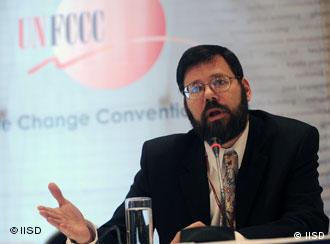
A week of preliminary UN climate talks in Bangkok come to a close today with little concrete progress to show for it. With just two months left until much-anticipated negotiations in Copenhagen, it will be "extraordinarily difficult" for the U.S. to agree to specific emissions reduction targets in an international climate treaty, warns the United States' deputy climate envoy Jonathan Pershing (pictured right).
E&E News's ClimateWire reports (sub. required):
[T]he chief U.S. negotiator acknowledged that the United States may not agree to cut greenhouse gas emissions in a treaty this year until Congress passes its climate legislation.While efforts to drive towards global agreement on binding emissions targets stall and both the United States and key developing nations, including China and India, balk at such proposals, a series of recent recommendations are establishing a growing consensus for an alternative to the targets and timetables approach that has repeatedly failed to make either political or substantive progress.
"It will be extraordinarily difficult for the U.S. to commit to a specific number in the absence of action from Congress," State Department deputy climate envoy Jonathan Pershing said. "The question is open as to how much we can do. It's not really possible to answer."
Some progress was made in Bangkok, said Kim Carstensen, leader of the global climate initiative at WWF. But "on issues that require political breakthroughs, they've not made any real progress," she said. "That means targets, finance, institutions and the legal form of the outcome in Copenhagen."
This emerging climate consensus would scrap the Kyoto Protocol's focus largely-symbolic emissions targets and timetables in favor of specific, actionable national commitments to the two things that actually drive down global emissions: accelerating the deployment of clean energy and the improvement of energy intensity in key sectors of the economy.
Alongside real commitments from the world's rich nations to help provide financial and technical support to speed the diffusion of clean technologies to the world's poorer nations, this more direct framework can build off of policies already underway in key nations, including the U.S., China and India, and result in far more concrete climate action than the empty commitments to symbolic emissions targets.
For more on the Breakthrough Institute's coverage of the Road to Copenhagen, explore our archives here or see these selected posts:
- "Only Technology Policy, Not More Targets and Timetables, Can Save Copenhagen"
- "How to Get Climate Policy Back on Course: New Report Proposes Post-Kyoto Framework for Copenhagen"
- "IEA Sends Message to Copenhagen Delegates: $10 tn Needed to Combat Climate Change"
- "New "National Schedules" Proposal Could Change International Strategy in Time for Copenhagen"
Monday, August 17, 2009
UN Climate Chief: Global Community Needs to Invest $300b Annually in Climate Fight
A quick post this morning...
The global community should be investing $300 billion annually to combat global warming, according to UN climate chief Yvo de Boer (pictured). De Boer, the Executive Secretary of the UN Framework Convention of Climate Change, says the world needs to be spending $100 billion annually to help vulnerable communities adapt to the impacts of climate change, and another $200 billion each year to shift the global energy mix away from fossil fuels.
"The world will need a phenomenal amount of money to change its energy supply from fossil fuels to cleaner sources and to adapt to climate change," de Boer said Friday.
According to a UN Environment Program news update:
With 110 days left until the Copenhagen Climate Conference, only "limited progress" was made at the most recent United Nations climate change talks where financing to cut and cope with climate change proved to be a major sticking point among negotiators. ...
De Boer estimates the annual cost of climate change adaptation at US$100 billion per year. This is the amount needed to cope with natural disasters such as flooding and drought that will result from increased warming. Meanwhile, he pegs the cost of cutting global emissions at US$200 billion annually.
Currently, the draft text contains 200 brackets indicating points of disagreement between negotiators, who differ on who should bear the financial burden of the climate change challenge.A fair and "robust burden-sharing formula" would presumably imply that as the world's richest nation and the world's largest contributor to cumulative global greenhouse gas emissions, the United States would contribute something like 1/4 to 1/3rd of the total global investments required to adapt to and mitigate the climate threat. That would imply $50-66 billion annually to invest in clean energy and energy efficiency and a contribution of $25-33 billion annually to global adaptation efforts, for a total of $75-99b/year.
Nevertheless, De Boer stressed that a U.N. climate pact to be agreed upon in Copenhagen should set up a fair mechanism for raising long-term funds, rather than compel countries to contribute specific amount. "A robust burden-sharing formula is the most important thing."
De Boer also recommended that countries participating in the Copenhagen Conference, open negotiations with some cash on the table, perhaps US$10 billion.
At the G8 Summit in July, UNEP Executive Director, Achim Steiner noted that a successful Copenhagen Summit depended on the political will of world leaders to make good on their Green Economy pledges which entails investing heavily in renewable energies and energy efficiency.
Where exactly is that money going to come from? An excellent question, and one that seems neglected by the Waxman-Markey climate and energy bill now winding it's way through Congress. After political concessions to (attempt to) silence industry opposition, that bill would invest just about $10b annually in clean energy and efficiency and devote just about $1.6b for domestic adaptation efforts and $1.9b for international technology transfer (all values assuming a $15/ton CO2 price, and scale proportionately at other CO2 prices).

The clean energy and efficiency investments in the American Recovery and Reinvestment Act (the stimulus bill) put us in the right ballpark - at least on the mitigation front - investing over $60 billion annually in America's efforts to build a new clean energy economy. But those short-term investments will expire by the end of 2010, and without an effort to build on and extend this critical clean energy spending, the U.S. will be left without sufficient funding to fulfill our fair share of global climate investments.
With the climate advocacy community primarily focused to date on establishing (and protecting already compromised) emissions reduction targets and "caps," the Waxman-Markey bill looks poised to leave the United States a long way from the level of commitment to clean energy and adaptation investments called for the UNFCC Secretariat. We're running out of time to change that picture... Read more!
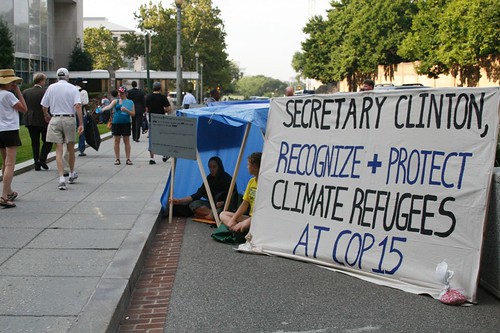
Greetings from the DC Action Factory tent city!
Cross posted from ActionFactoryDC.blogspot.com, post by Kalen Pruss
We are just hours into our 26 hour tent city marathon. We set-up our camp with relative ease, had a not unpleasant chat with the police, and are just now settling down for the long haul. It is quite literally starting to heat up, and despite the cops mandating that we dismantle our overhead tarps, we are doing our best to keep cool. As uncouth as it sounds, at least our project has an end date. For millions of climate refugees across the globe, drought, flooding, disease, or famine make harsh conditions a permanent reality.
It is important, then, that we stand in solidarity with these many millions, and bring their voices to the policy-makers whose decisions will ultimately shape their future. Such action is desperately needed, yet our leaders typically fail in recognizing climate refugees altogether. In high-level talks regarding climate refugees, decision-makers find themselves bogged down in determining even the basic definition of climate refugees (see Morgan's post from last night). It appears that after so much politicking over semantics, world leaders are simply too exhausted to take real steps toward aiding these involuntary migrants.
But according to the International Federation of Red Cross, climate change disasters are currently a bigger cause of population displacement than war and persecution combined: current estimates of the number of climate refugees range from 25 to 50 million worldwide, compared to the official refugee population of 20.8 million. World leaders claim that they do not want to complicate the word "refugee," as if they worry about sullying the term for political exiles. Call them what you will, climate refugees are very real; their stories are harrowing, and their numbers are rapidly growing. The Intergovernmental Panel on Climate Change (IPCC) predict that there will be 150 million climate refugees by 2050.
Our leaders are performing a gross negligence by ignoring the growing refugee crisis caused by global warming. Not only are we destroying their homes with the pollution of the industrial nations, now we are trying to ignore their existence all-together. But we are asking Secretary Clinton to demonstrate a small act of goodwill, take on the mantle of US leadership, and ensure that the world will take action to address the climate refugee crisis in the years to come.
By including language to recognize and protect climate refugees, Clinton will not only take a much-needed moral stance, but also provide for the security of the nation she represents. The millions of people displaced by global warming will inevitably seek asylum elsewhere. Already, rising sea levels caused by climate change are exacerbating tensions between Bangladesh and India, causing India to construct a 2,1000 mile high-tech fence along its border, to cite but one example. The U.S. can expect similar security questions to rapidly arise. Establishing an international process that recognizes, protects, and helps to provide for these refugees will help to prevent a refuge crisis at our own borders.
Currently, there is little or no aid available to climate refugees, unlike conventional refugees protected under current international treaties. The recent, tragic death of Ken Bacon, director of Refugees International, has highlighted his life-long work on refugees, and his recent work in establishing a Climate Refugee Center. Secretary Clinton praised the work of Bacon, even as her department tries to ignore the issue.
Including language recognizing and protecting climate refugees in the Copenhagen agreement is the first step in establishing this process. Secretary Clinton, act now! Otherwise, what will your legacy be?
Follow @actionfactorydc for updates as the protest progresses
Media contact: Kim Huynh/ 904-327-7650
Press conference: Monday, 12:30pm, West entrance to the State Department
For more info: http://www.towardsrecognition.org/
Tuesday, December 09, 2008
Which Path Will the Youth Climate Movement Take?
 By Richard Graves, originally posted at ItsGettingHotInHere.org
The world is halfway through the process to create a global climate treaty to respond to Global Warming. In the halls around me, government, NGO, and UN negotiators are painstakingly working through the process to create a draft text for this treaty. The last decade has been a period where climate campaigners and negotiators knew where they stood, with the Bush Administration blocking progress, the European Union leading on the UN process, and environmental organizations facing off against the Oil, Gas, and Coal industries. Suddenly everything has changed, with Obama’s election, the EU Climate Package failing, and the Canadians having a parliamentary crisis - a financial crisis dragging down the automobile companies - and newly emergent actors like the youth movement, trade unions, and justice advocates showing up onto the global scene.
Nevertheless, with a financial crisis diverting attention from the climate crisis and backsliding among traditional advocates for strong international climate action - there is a lot of frustration and fear on the behalf of many Non-Governmental Organizations. One of the bright spots of the Poznan climate talks has been the arrival of large and energized youth delegations, including representatives of countries such as India, that have inspired many people here. Yet, despite the ever-growing level of international cooperation there remains two paths that this movement could take - that will have major consequences on the outcome of the global negotiations.
Youth have strengths that they bring to these negotiations, but nothing is stronger than the moral voice and clarity they bring to the often intentionally complicated policy discussions that occur at the UN. Youth also have the potential to move, organize, and act on a speed that is matched only by the sophisticated online organizing outfits, like Avaaz.org, that have arisen recently. Young people represent more than the NGO sector and have government delegates, media representatives, youth union reps, and more. They also are willing to call for bold action, develop innovative strategies for advocacy, and have a passion that is palpable to anyone that has spent any time in their presence.
Yvo de Boer, the president of the UNFCCC, in an Inter-generational Inquiry on the role of youth at these negotiations, was asked as to what role young people should play in these talks. He said that too many NGOs have bureaucratized and dropped their banners to put on suits. He said young people must raise the profile of this issue in their home countries, until their governments are forced to listen, if they hope to influence the outcome. For a UN diplomat, it was quite a statement - acknowledged that governments need to be pressured publicly and NGOs were failing to act and remained myopically focused on research, policy expertise, and lobbying meetings.
Yet, it is not entirely clear which path the youth climate movement will take. Many of the delegations represented here have enormous policy teams, drawing students from research universities, that write policy submissions, follow discussions, and lobby delegates. One major proposal, has been for youth to serve as adjunct staff to delegations from Small Island and Developing States that are calling for strong action. Actions often remain rooted in efforts to influence particular policies being debated or discussed. Young people in suits are in abundance everywhere. Will these youth climate activists follow down the path of many NGOs and serve as a next generation of policy analysts, diplomats, and advocates? Will the main focus be on side-events, submissions, interventions, tracking the many ad-hoc working groups, and developing experience with the policy process?
Or will youth climate advocates take another path? Will they develop campaigns that are fearless in their demands, huge in scale, and undertake actions even if it costs them access to delegates or representatives? There are campaigners here, from groups like the Rainforest Action Network (slogan: Environmentalism with Teeth”) that are willing to pick targets and hold people accountable. Avaaz.org and youth delegates last year served as the voice of conscience and fought a bruising battle with delegates from Japan, Canada, and USA last year. Will an international youth climate network serve as a secretariat and liaison group with the UN, or will it coordinate a global campaign that targets fossil fuel companies, politicians, and their lobbyists? Can these young people shake the pillars of power and authority with fearless tactics, digital strategy, mass mobilization, and boots on-on-the ground organizing?
Now, before someone accuses me of promoting a false dichotomy or pigeonholing a movement that embraces a diversity of tactics - I understand that any movement needs a diversity of actors, but the question remains of how the effort, energy, genius, and resources of the youth climate movement will be directed.
To read more about the emerging international youth climate movement, goto youthclimate.org or itsgettinghotinhere.org.
Read more!Tuesday, November 18, 2008
Barack Obama Commits to "New Chapter" on Climate Change
In a prepared video address delivered today at the Global Climate Summit in Los Angeles, CA, President-elect Barack Obama pledged to turn over "a new chapter in America's leadership on climate change."
In the short address, viewed by an audience that includes leaders from around the nation and the world, Obama emphasized the importance of the upcoming international climate negotiations in Poznan, Poland, and said he was "looking forward to working with all nations to meet [the climate] challenge in the coming years."
Obama reconfirmed his campaign commitments to reduce greenhouse gas emissions 80% by 2050 through a national cap and trade program and again pledged to "invest $15 billion each year to catalyze private sector efforts to build a clean energy future."
Convened by California Governor Arnold Schwarzenegger and other US governors on the forefront of global warming solutions, the Bi-partisan Governors Global Climate Summit convenes in Los Angeles today and begins two days of dialog designed to spur global cooperation on climate change in advance of the UN-sponsored talks in Poland next month. To this crowd of climate leaders, Obama said:
"Few challenges facing America -- and the world -- are more urgent than combating climate change. Many of you are working to confront this challenge....but too often, Washington has failed to show the same kind of leadership. That will change when I take office."Watch the short video address below (full transcript below the fold):
Remarks as Delivered:
Let me begin by thanking the bipartisan group of U.S. governors who convened this meeting.
Few challenges facing America – and the world – are more urgent than combating climate change. The science is beyond dispute and the facts are clear. Sea levels are rising. Coastlines are shrinking. We've seen record drought, spreading famine, and storms that are growing stronger with each passing hurricane season.
Climate change and our dependence on foreign oil, if left unaddressed, will continue to weaken our economy and threaten our national security.
I know many of you are working to confront this challenge. In particular, I want to commend Governor Sebelius, Governor Doyle, Governor Crist, Governor Blagojevich and your host, Governor Schwarzenegger –all of you have shown true leadership in the fight to combat global warming. And we've also seen a number of businesses doing their part by investing in clean energy technologies.
But too often, Washington has failed to show the same kind of leadership. That will change when I take office. My presidency will mark a new chapter in America's leadership on climate change that will strengthen our security and create millions of new jobs in the process.
That will start with a federal cap and trade system. We will establish strong annual targets that set us on a course to reduce emissions to their 1990 levels by 2020 and reduce them an additional 80% by 2050.
Further, we will invest $15 billion each year to catalyze private sector efforts to build a clean energy future. We will invest in solar power, wind power, and next generation biofuels. We will tap nuclear power, while making sure it's safe. And we will develop clean coal technologies.
This investment will not only help us reduce our dependence on foreign oil, making the United States more secure. And it will not only help us bring about a clean energy future, saving our planet. It will also help us transform our industries and steer our country out of this economic crisis by generating five million new green jobs that pay well and can't be outsourced.
But the truth is, the United States cannot meet this challenge alone. Solving this problem will require all of us working together. I understand that your meeting is being attended by government officials from over a dozen countries, including the UK, Canada and Mexico, Brazil and Chile, Poland and Australia, India and Indonesia. And I look forward to working with all nations to meet this challenge in the coming years.
Let me also say a special word to the delegates from around the world who will gather at Poland next month: your work is vital to the planet. While I won't be President at the time of your meeting and while the United States has only one President at a time, I've asked Members of Congress who are attending the conference as observers to report back to me on what they learn there.
And once I take office, you can be sure that the United States will once again engage vigorously in these negotiations, and help lead the world toward a new era of global cooperation on climate change.
Now is the time to confront this challenge once and for all. Delay is no longer an option. Denial is no longer an acceptable response. The stakes are too high. The consequences, too serious.
Stopping climate change won't be easy. It won't happen overnight. But I promise you this: When I am President, any governor who's willing to promote clean energy will have a partner in the White House. Any company that's willing to invest in clean energy will have an ally in Washington. And any nation that's willing to join the cause of combating climate change will have an ally in the United States of America. Thank you.
##
Read more!
Thursday, November 13, 2008
IEA Report Confirms Clean and Cheap Energy Needed to Power Global Development
 Cross-posted from the Breakthrough Institute
The stark tone of the International Energy Agency's World Energy Outlook 2008 is a dramatic departure from their normally staid and frequently rosy projections about the world's energy future (I presented highlights from the piece in this proceeding post). The report's opening statement that current world energy trends are "patently unsustainable" will no doubt receive the most attention in headlines across the blogosphere and mainstream news. But in this post, I want to delve deeper into the key statement that follows it:
"It is not an exaggeration to claim that the future of human prosperity depends on how successfully we tackle the two central energy challenges facing us today: securing the supply of reliable and affordable energy; and effecting a rapid transformation to low-carbon, efficient and environmentally benign system of energy supply."While the environmental community focuses primarily on the latter of those two concerns, the IEA appropriately recognizes that the future of human prosperity depends on our ability to tackle both challenges: decarbonizing the energy supply and providing ample and affordable energy supplies to power global development.
In short, the IEA confirms what is perhaps the central challenge of the 21st century: developing clean and affordable energy sources to power the globe.
If we fail to tackle both challenges simultaneously - say by focusing only on expanding supplies of cheap fossil fuels; or by developing clean but costly new energy alternatives - we will consistently fall into what I call the Development Trap: we'll be forced to either sacrifice our climate and ecological security in the name of global development or condemn billions of global citizens to energy poverty and a permanently lower standard of living in the name of climate protection.
As the report lays bare, the battle for climate stability will center principally on the developing world. In the IEA's reference scenario (a frozen policy base case), developing nations (non-OECD countires) are responsible for 97% of projected emissions growth in and all of the projected increase in oil demand by 2030. Three quarters of projected emissions growth will occur in China, India and the Middle East alone (see IEA graph below).
This dangerous projected emissions growth is primarily the byproduct of rapid economic development, as these nations strive to bring billions of citizens a standard of living even approximating those enjoyed in the United States and other developed nations - an effort we can hardly begrudge or vilify. And yet, the projected emissions growth from non-OECD nations alone will swamp any efforts in the developed world to slash greenhouse gas emissions and are enough to dash any hopes of global climate stability.
This is the Development Trap, and the only way to break out of it is to develop clean, affordable and massively scalable energy sources that can power sustainable development in these nations.
If the battle for climate stability centers on the developing world, China is the main front.
This graph from the IEA report illustrates the central role China's robust energy consumption growth will play in the future of global energy dynamics. This graph might as well be titled, "As Goes China, So Goes the World."
Coal is expected to meet over half of China's expected energy growth, a fact that simply must change if the world's climate stability goals are to be achieved. So what will fill the void?
Officials in China, India and other developing nations have consistently made it clear that they will not sacrifice their economic development efforts to curb greenhouse gas emissions, making it clear which side of the Development Trap they'll fall if forced.
These clear messages from developing nations and the stark picture of business-as-usual painted by the IEA should send a clear message to the participants at the upcoming Convention of the Parties (COP) to the Kyoto Protocol in Pozan, Poland, and the critical November 2009 talks in Copenhagen: you must focus explicitly on international cooperation to develop and rapidly deploy clean and affordable energy sources.
While agreements about emissions reduction targets are important, they will be little more than symbolic unless the COP negotiations also yield significant commitments to investment in clean energy research, development and demonstration and establish provisions for rapid technology diffusion and deployment.
Those four D's - clean energy Development, Demonstration, Diffusion and Deployment should be the central focus of the COP negotiations. There's simply no other way out of the Development Trap. Read more!
Friday, November 23, 2007
Industrialized Kyoto Countries Can Meet Reductions, If...
On Tuesday, the United Nations Climate Change Secretariat announced (also here) that although emissions from 40 industrialized countries almost reached an all time high in 2005,
Taken together, the countries that signed and ratified the Kyoto Protocol are projected to achieve reductions on the order of 11 per cent for the first Kyoto commitment period, from 2008 to 2012, provided policies and measures adopted by these countries deliver the reductions as projected. The Kyoto Protocol commits industrialized countries to a 5 per cent reduction target in 2008-2012 compared to 1990 levels.
This statement refers to the 36 States, which are the highly industrialized countries and countries undergoing transition to a market economy, which are the only ones legally bound to meet the emissions reductions. Although their emissions are still rising, mechanisms for reducing emissions are still being put in place, so their impacts have not taken effect yet.
For the totality of Kyoto signatory countries, reductions of 15 per cent are feasible, should additional policies be planned and implemented.
However, the developing countries have non-binding obligations to limit emissions, and combined with two major industrialized emitters who refused to ratify the Kyoto Protocol (The United States of America and Australia) global emissions are likely to continue to rise. Yvo de Boer, Executive Secretary of the UNFCCC, has called on the countries who are major emitters (including the U.S.A., Australia, the developing former Soviet-bloc) to take a greater role in reducing global emissions.
...we should not hide the fact that there is continuing greenhouse gas emissions growth on the part of several countries and that they must do more to reign in their emissions.
According to the International Herald Tribune, "Emissions by the United States, which rejected the Kyoto accord, grew by more than 16 percent from 1990 to 2005, and is projected to rise to 26 percent by 2012. "
The negotiations in Bali, just a few weeks away, will focus on a post-2012 (the year by which reductions need to be met under the Kyoto Protocol) international climate change plan. Although the U.S.A. and Australia are not currently a part of the Kyoto Protocol, this does not prevent them from joining the post-2012 agreements. According to de Boer,
A future, ambitious UN climate change regime needs to continue and expand the central elements of the Kyoto Protocol, whilst making use of other policy tools, such as carbon taxes and other effective policy packages. Only then can we ensure that the type of sweeping emission reductions that science tells us are needed are brought about and that the billions of dollars needed for measures to adapt to the inevitable effects of climate change are generated.
Developing a post-Kyoto agreement will be tricky, especially in reducing emissions from developing countries while ensuring a just transition to an industrial economy, with major emitters like the U.S.A., Australia and China trying to avoid binding reduction goals, and the continued rise in global emissions making it more and more difficult to reach the scientifically necessary emission levels. However, I am hopeful that the negotiations in December will lay out a strong framework for developing this plan, and I am hopeful that the United States youth delegation will get their message across that the the people of the United States are working to reduce emissions, even if our government is not taking the lead.
Cross-posted on It's Getting Hot In Here and Bali Buzz.Read more!