Energy Collective blog power policy climate - the conversation happens here
Showing posts with label EPA. Show all posts

Friday, January 14, 2011

EPA Vetoes Massive Mountaintop Removal Coal Mine

By JW Randolph, originally posted at Appalachian Voices

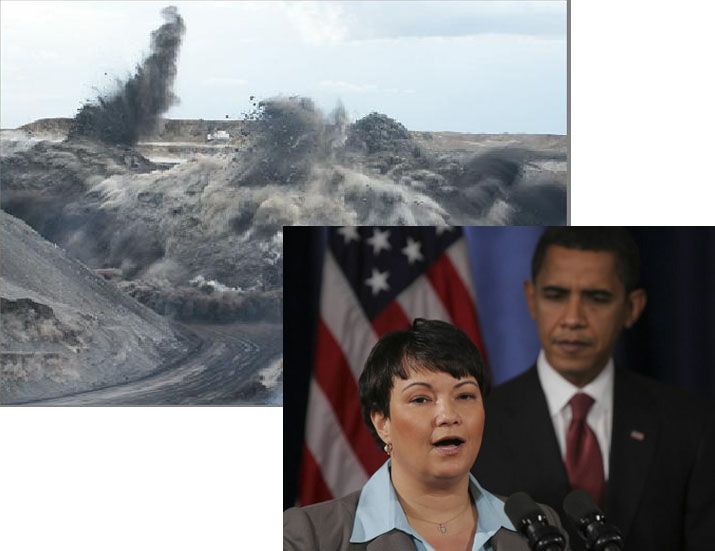
EPA announced Thursday that they will be vetoing the largest mountaintop removal permit in WV history.

Appalachian Voices is thrilled to hear that EPA will be vetoing this permit in order to protect human health and aquatic ecosystems in central Appalachia. EPA's own science has shown that mountaintop removal has permanent negative impacts on Appalachia, and we hope they will continue to stand strong in stopping mine permits that will have a negative impact on the well-being of the central Appalachian land and people.

EPA's Peter Silva hit the nail on the head:

The proposed Spruce No. 1 Mine would use destructive and unsustainable mining practices that jeopardize the health of Appalachian communities and clean water on which they depend. Coal and coal mining are part of our nation’s energy future, and EPA has worked with companies to design mining operations that adequately protect our nation’s water. We have responsibility under the law to protect water quality and safeguard the people who rely on clean water.
The bottom line is that we don't need to poison our streams and our communities in order to mine coal in the central Appalachian region. Three cheers to EPA for doing what is right, even though they faced tremendous political pressure to let this harmful and toxic mine just slide by.

Congress can make these protections permanent, while adding stability and clarity to the process by passing popular bipartisan legislation such as the Clean Water Protection Act (House) and Appalachia Restoration Act (Senate). Recently, 50 members of Congress sent a letter to EPA thanking them for doing the right thing by taking steps to end mountaintop removal. Congressman Rahall (D-WV) also said that legislation to end the practice had more than 400 votes in the House, but that he was the only person blocking the bill. Its time that Representatives like Congressman Rahall and Senator Manchin start protecting their constituents and stop wasting their time and political capital defending a destructive, toxic, and unnecessary practice like mountaintop removal. Its time that our elected officials start thinking less about appeasing the coal lobby and more about protecting Appalachian citizens who live in communities where coal is mined.

In one of his last public statements, Senator Robert C. Byrd said:
It is also a reality that the practice of mountaintop removal mining has a diminishing constituency in Washington. It is not a widespread method of mining, with its use confined to only three states. Most members of Congress, like most Americans, oppose the practice, and we may not yet fully understand the effects of mountaintop removal mining on the health of our citizens.
Ken Ward has more at Coal Tattoo and Jeff Biggers has a beautiful piece at HuffPo called EPA Vetoes Largest Mountaintop Removal Permit: New Era of Civility in the Coalfields? .

Congratulations to every single person who helped make this possible.

Read more!

Friday, October 15, 2010

Daily Dose of Sanity: Turning Headwaters into Toxic Sludge Dumps is Bad for Water and Wildlife -- EPA Administrator

Here's your daily dose of sanity, courtesy of EPA regional administrator Shawn Garvin, who has recommended that the agency veto a Clean Water Act permit for the massive Spruce No. 1 mountaintop removal coal mine in Logan County, W.Va.

Mr. Garvin's commonsensical rationale? Apparently burying several miles of pristine Appalachian headwaters and replacing them with landfill and a toxic sludge dump will adversely impact downstream waters and wildlife.

No sh&#!

The West Virgina Gazette's intrepid Ken Ward Jr. has the story:

EPA has posted a copy of Garvin’s recommendation here, and there are some companion documents online here. The recommendation concludes:
… Region III has determined that discharges of dredged and/or fill material to Pigeonroost Branch and Oldhouse Branch for the purpose of constructing the Spruce No. 1 Surface Mine as currently authorized … would likely have unacceptable adverse effects on wildlife … [the permit] authorizes construction of valley fills and sedimentation ponds and other discharges into Pigeonroost Branch and Oldhouse Branch that will bury approximately 6.6 miles of high quality headwater streams.

… Burial of Pigeonroost Branch and Oldhouse Branch would likely result in effects to downstream waters and downstream wildlife caused by the removal of functions performed by the buried resources and by transformation of the buried areas into sources that contribute contaminants to downstream waters. In addition, currently authorized discharges to Pigeonroost Branch and Oldhouse Branch would be likely to contribute to conditions that would support blooms of algae that release toxins that kill fish and other aquatic life …
The regional EPA administrator also concluded:
… Because construction of the Spruce No. 1 Mine and 11 additional mining operations would increase the percent of the sub-basin that is impacted by mining activity, it can be expected that these water quality effects will likely be exacerbated by these additional mines. EPA believes that the Spruce No. 1 Mine project, in conjunction with the other mining operations either under construction or proposed for the Coal River sub-basin, will be likely to contribute to the significant cumulative loss of aquatic resources and degradation of water quality.
This isn't the end of the line for the controversial mountaintop removal project. EPA took pains to be clear that the agency "has not reached a final decision on this project," and promised to next "reach out to the mining company, the U.S. Army Corps of Engineers, and West Virginia State officials to engage in discussions about potential actions that can be taken to reduce impacts on the environment and to the waters that Appalachian communities depend on for drinking, swimming and fishing."

Here's an idea: don't blow the tops off of mountains and dump their dessicated remains onto your headwaters valleys! We'll see if sanity prevails...

Update: more sanity from 50 members of Congress who wrote the EPA to support a stronger stance on protecting clean waters from the impacts of mountaintop removal mining operations, and to recommend the EPA's veto of the Spruce No. 1 mine. More here.

Read more!

Tuesday, June 29, 2010

EPA’s First Decision Under New Mountaintop Mining Guidelines goes to King Coal

Much-Lauded Strict Mountaintop Mining Guidelines Not So Strict

A guest post by Amanda of the Rainforest Action Network

The U.S. Environmental Protection Agency has given a green light for the Pine Creek mine permit, a mountaintop removal mining site in Logan County, W.Va. This is the first permit decision the EPA has issued under the new mountaintop mining guidelines, which came out last April and were anticipated to provide tougher oversight of mountaintop removal coal mining.

I hoped that the mountaintop removal (or "MTR") guidelines would provide protection for headwater streams by curbing the practice of dumping waste in neighboring valleys to create what is known as valley fills. The Pine Creek permit is the first test of these guidelines, and green lights three new valley fills (each over 40 acres large).

It was anticipated that these guidelines, by requiring mining operators to control levels of toxins in nearby streams, would significantly reduce the dumping of mining waste in valleys, which the EPA said was scientifically proven to contaminate drinking water and wreck ecosystems.

This is a devastating first decision under guidelines that had offered so much hope for Appalachian residents who thought the EPA was standing up for their health and water quality in the face of a horrific mining practice. The grand words being spoken by Administrator Jackson in DC are simply not being reflected in the EPA’s actions on-the-ground. This continues the inconsistent and contradictory decisions that have plagued the EPA’s process on mountaintop removal coal mining all along.

In announcing the new guidelines in April, Administrator Jackson told reporters: “We expect this guidance to change behaviors, to change actions, because if we keep doing what we have been doing, we’re going to see continued degradation of water quality… Minimizing the number of valley fills is a very, very key factor. You’re talking about no or very few valley fills that are going to be able to meet standards like this.”

The Pine Creek Surface Mine permit will allow Coal-Mac, a subsidiary of coal giant Arch coal, to mine through more than 2 miles of streams that are already suffering dangerous levels of pollution from surface mining. Extensive mountaintop removal mining and the subsequent environmental and water quality damage have already ravaged Logan County W.Va., which is the location of the infamous Spruce mine.

Moving forward, it is clear that the EPA cannot end mountaintop removal coal mining pollution without abolishing mountaintop removal all together.

The Pine Creek permit is currently awaiting approval from the Army Corps of Engineers.

Read more!

Wednesday, May 05, 2010

Round One of the EPA "Coal Ash Bowl" Goes to Big Coal

By Matt Wasson, originally posted at Huffington Post

Yesterday, the EPA issued their long-awaited proposal for new rules on how to regulate the disposal and storage of coal combustion waste (CCW), the byproduct of coal-fired power plants.

_DSC0072Since December of 2008, when more than a billion gallons of toxic coal ash spilled into the Emory River from a breached impoundment at the TVA's Kingston Fossil Plant, environmental and industry groups have been waiting with tense anticipation to see how the Administration will approach regulating this highly toxic waste.

As it turns out, they're still waiting. The EPA actually issued two proposals which, as James Bruggers of the Louisville Courier-Journal reported, can be simply (though far from completely) summarized as follows:

One approach would eventually phase out coal ash storage ponds. The other would would allow ash ponds, but only if they have plastic liners.


The EPA will decide which of those approaches to adopt following a 90-day public comment period that began yesterday. While EPA Administrator Lisa Jackson heralded the action as "the first-ever national rules to assure the safe management and disposal of coal ash," reporters like Bruggers and Ken Ward at the Charleston Gazette saw EPA's announcement as more of a "punt."

Environmental groups had a mixed reaction, expressing enthusiasm for the EPA's overall 563-page analysis, which, despite Jackson's apparent ambivalence, provides enormously compelling scientific evidence that should favor the more stringent proposal for regulating CCW under hazardous waste provisions of the Resource Conservation and Recovery Act. But groups also expressed some frustration at the Obama Administration's unwillingness to follow the EPA's analysis to its logical conclusion.

But whichever path the EPA ultimately chooses, Big Coal scores thanks to an issue that was entirely excluded from the scope of both proposals: the virtually unregulated practice of dumping CCW into abandoned mines.

To mix a metaphor, in the great 90-day EPA Coal Ash Bowl that began with a punt, the environmental and public health team is down a star player and Big Coal has the ball on the 50 yard line. It ain't over, but it's gonna be a rough game.


Dumping coal ash waste into abandoned mines- "Beneficial" for whom?

The industry backlash against any regulation of CCW disposal has long centered on the issue of "beneficial use," which typically implies using CCW to manufacture wallboard and other construction materials.

According to its promoters, minefilling is a "beneficial use" because CCW is alkaline and, at least the theory goes, dumping it into abandoned mines will neutralize the acidic mine drainage from active and abandoned mines.

The problem with this theory is that there really isn't any good science to back it up. A study on the water quality impacts of minefilling published by the Clean Air Taskforce in 2007 provided an excellent test of how "beneficial" the dumping of CCW into mine pits actually is. As explained in a more recent and comprehensive report by Earthjustice:

...in two-thirds of all the mines studied, the introduction of coal combustion waste resulted in more severe, long-term water quality contamination than had ever existed at these sites from the mining operation itself. Furthermore, as a practical matter, dumping large quantities of CCW directly into water tables in highly fractured sites under massive quantities of mine overburden makes the prospect of cleaning up resulting contamination far more daunting than halting leakages from conventional landfills and ash ponds.


The pressure on the administration from industry to not designate CCW as a hazardous waste was intense because of the stigma it would put on the use of CCW for "beneficial use" purposes. The unprecedented extent of that pressure from the coal industry was underscored in a letter to the White House signed by 239 public interest organizations from across the country in April. According to the letter:

Industry groups that oppose mandatory federal standards have had nearly 30 meetings with OMB [Office of Management and Budget] on this rule - more than ever before on any single topic. These groups continue to present unfounded claims of power plant closures and exaggerated cost estimates as "fact," thereby fomenting widespread but unwarranted fear of EPA regulations.


Wait... The coal industry presented exaggerated cost estimates to foment unwarranted fear of EPA regulations? Well I never!

That pressure was clearly effective in that, even if EPA chooses to regulate CCW under the hazardous waste provisions, it will not be labeled "hazardous" so as to avoid the dangerous connotations implied by the label.

But the industry pressure was equally effective in taking regulatory control of minefilling out of the hands of EPA scientists, who are no doubt well aware of the bad science underlying the practice and who are generally very serious about their job of protecting public health. In fact, the EPA already weighed in on the issue:

We believe that certain minefilling practices have the potential to degrade, rather than improve, existing groundwater quality and can pose a threat to human health and the environment.


It's statements like this that apparently disqualified the EPA from regulating minefilling, which instead will be subject to a subsequent rule-making process headed up by the Office of Surface Mining, Reclamation and Enforcement (OSM). No timeframe was mentioned for when that rule-making would be initiated.

Putting OSM in charge of developing minefilling regulations, even with input from the EPA, is a huge victory for polluters for a number of reasons. First, the OSM is led by Joseph Pizarchik, nick-named "Coal Ash Joe" by community organizations in Pennsylvania for his unwavering support of minefilling when he was director of the Bureau of Mining and Reclamation in that state. Second, the "scientists" at OSM are a very different breed than those at the EPA.

OSM scientists are generally trained in "reclamation science" at one of the big mine engineering programs at schools like West Virginia University and Virginia Tech. The fundamental premise of reclamation science can be summed up in a statement from Dink Shackleford, past executive director of the Virginia Mining Association, who often said: "We have a chance to improve on God's creation." The science of mining and reclamation starts with a fundamental premise that must not be questioned- that no matter how toxic the pollution, how much mountain we blast away, that we can engineer nature back to as "good as new" or even better.

Viewed through this distorted lens, replacing the remarkably diverse and productive Appalachian hardwood forests with a barren plain covered in exotic grasses dotted with a few pines becomes an ecological benefit because it "improves forestry;" burying the headwaters of streams in millions of tons of mine waste is an ecological benefit because it "helps regulate stream flow;" and the virtually unregulated dumping of mine waste into abandoned mines is a "beneficial use" of coal ash.

There is a lot at stake for the coal industry in how minefilling is regulated because, according to the Earthjustice report, the cost of disposal in minefills is 89-95% less than the cost of disposal in engineered landfills. Also according to Earthjustice, about 25 million tons of CCW - 20% of total annual production - is disposed of in abandoned mines. While the EPA estimates that minefilling accounts for just 7% of CCW disposal, Earthjustice explains that the discrepancy is because, "industry and state regulators are hiding CCW dumping in mines behind the labels 'beneficial use, or 'recycling.'"

This minefilling loophole will become all the more important as EPA rules make regulated disposal of CCW more expensive. As the financial incentives for utilities to exploit this loophole become stronger, the pressure on the Obama Administration to delay action on minefilling, or to implement weak regulations, will become even more intense. Given that current regulations in most states for CCS minefilling are considerably weaker than regulations on disposal of household garbage, minefilling could quickly become the predominant method for CCW disposal.

How Does Minefilling Affect Health and the Environment?

The lede and photo from a story in the Miami Herald from November, 2009, helps put the health hazards associated with coal ash into perspective:

Victims of Toxic Coal Ash dumping by AES Corporation in 2003 and 2004"When I was pregnant, I was dizzy, vomiting and could barely walk," said Maximiliano's mother, Anajai Calcano, 20. "My tooth cracked and fell out. Then my baby was born like that, without arms. Nothing like that had ever happened here before."


By "before," Calcano means before a U.S. power company's coal ash arrived at a nearby port, sitting there for more than two years.


The story goes on to tell how citizens of Arroyo Barril in the Dominican Republican are suing a Virginia-based energy company for a variety of health problems they say resulted from the illegal disposal of coal ash on the shore of the town. The phrase "health problems" hardly does justice to the godawful deformities found in children born of mothers who had abnormally high levels of arsenic in their blood, one of many toxic metals associated with coal ash. Those "health problems" ranged from cranial deformities to missing limbs to organs outside their bodies.

The situation in Arroyo Barril is an extreme example, but it illustrates the general problem of toxic metal contamination of both air and water near coal ash disposal sites. The composition of coal ash includes a high concentration of toxic metals found in coal including arsenic, selenium, chromium, lead and thallium. While conventional disposal of CCW in wet impoundments has had demonstrable impacts on water quality, the practice of minefilling makes the problem of groundwater contamination far worse. According to the Earthjustice report:

The unique geologic characteristics of mines maximizes the risk of contamination from coal ash dumping. Mining breaks up solid rock layers into small pieces, called spoil. Compared to the flow through undisturbed rock, water easily and quickly infiltrates spoil that has been dumped back into the mined-out pits. Fractures from blasting become underground channels that allow groundwater to flow rapidly offsite. Because mines usually excavate aquifers (underground sources of water), the spoil fills up with groundwater. Unlike engineered landfills, which are lined with impervious membranes (clay or synthetic) and above water tables by law, coal ash dumped into mine pits continually leaches its toxic metals and other contaminants into the water that flows through and eventually leaves the site.


There are many cases where water contamination has already been found, according to the Clean Air Taskforce study of 15 minefilling operations in Pennsylvania.

So what's next?

To be fair to the administration, the EPA specifically referenced a 2006 report on minefilling from the National Academy of Sciences as one of the documents that should guide the rule-making on minefilling. The recommendations of that report, as summarized by Earthjustice, include:


  • Generators should pursue safe reuse of coal combustion waste ash before minefilling;

  • Disposal sites must be investigated to determine the quality and location of groundwater, groundwater flow paths, the potential for coal ash to react with minerals or groundwater, etc.;

  • Coal ash must be kept out of groundwater;

  • Monitoring must be designed to detect movement of coal combustion waste contaminants;

  • Deeds must record and fully disclose that coal combustion waste was disposed at the mine site;

  • Bonds must be adequate to clean up any groundwater damaged by coal combustion waste disposal;

  • Public input must be solicited in the development of national regulations and permits issued pursuant to those regulations.


If all of those recommendations were turned into regulations, the problems associated with minefilling would be largely alleviated. But the success of industry in stripping the EPA of regulatory oversight of minefilling provides little confidence that the administration will ignore that pressure when it comes to developing regulations on minefilling.

An even greater concern is that the industry will successfully delay rule-making on minefilling for another decade, the way they were able to delay disposal regulations for years until the TVA disaster woke people up to the hazards of unregulated coal ash storage. If their delay tactics are successful, the financial advantages of minefilling will make it the predominant method of coal ash disposal within a matter of years.

And if the momentum generated by the TVA disaster to regulate coal ash disposal is lost, it's terrifying to think what the next disaster will be that would be needed to motivate agencies to action in the face of enormous industry pressure. As Lisa Evans, an attorney with Earthjustice who has tracked coal ash issues for nearly a decade, told the media in January:

Minefilling coal ash is a slow-motion and invisible counterpart to the TVA catastrophe. There, the destruction was unleashed in a matter of minutes. For communities with water poisoned by the country's hundreds of coal ash mine dumps, the damage has been gradual and largely unseen, but it also presents a grave threat.


People in coal mining regions have suffered pollution of their water and air for decades, and with the EPA finally beginning to crack down on mountaintop removal mining and the disposal of mine waste into streams, what a tragic irony it would be if pollution from valley fills was replaced by even greater pollution from minefills. That's the way it's headed, and it's going to take the involvement of thousands of Americans to counter the coal industry's powerful pressure to keep regulations weak or nonexistent.

This is no time to sit on the sidelines - there are 89 days in the EPA's Coal Ash Bowl, and your help is needed now.

[UPDATE: The link to take action above, "your help is needed now," is not yet set up by the EPA - I will update again as soon as the EPA gets it straightened out]

Read more!

Tuesday, May 04, 2010

EPA Proposes Regulatory Options for Coal Ash

New Rules Would Provide Varying Levels of Protection for NC's Waterways
An update from our friends at Appalachian Voices...

-------------------------------------
CONTACT: Donna Lisenby, Upper Watauga Riverkeeper....828-262-1500
-------------------------------------

The U.S. Environmental Protection Agency unveiled two options today to regulate coal ash waste from coal-fired power plants, amid concerns by environmental groups that one of the options would not be strong enough to protect North Carolina's waterways.

The competing alternatives would provide varying levels of protection to the state's water resources, and could take years to implement.

"Coal ash impoundments have been minimally regulated in the past. These proposed new rules are a long overdue, positive first step towards helping to protect our water and our communities," said Donna Lisenby, Upper Watauga Riverkeeper.

The announcement comes eight months after an independent analysis confirmed that all thirteen of the North Carolina's coal ash ponds adjacent to coal-fired power plants were leaking toxic pollutants into groundwater. Data research conducted by the Upper Watauga Riverkeeper revealed 681 instances where levels of heavy metals and other pollutants ranged from 1.1 to 380 times higher than North Carolina's groundwater standard.

"The time has come for common-sense national protections to ensure the safe disposal of coal ash," said EPA Administrator Lisa Jackson. "We’re proposing strong steps to address the serious risk of groundwater contamination and threats to drinking water and we’re also putting in place stronger safeguards against structural failures of coal ash impoundments. The health and the environment of all communities must be protected."


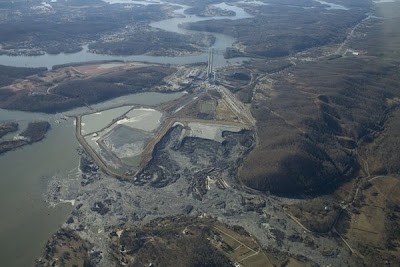
[Aerial photograph of the December, 2009 coal slurry disaster in Kingston, Tennessee. The breached wet coal ash impoundment pond is at center with the TVA's Kingston coal plant above and massive slurry spill below. The Emory River can be seen next to the disaster site. Photo is copyright Antrim Caskey]

The Subtitle C proposal would designate coal ash as a hazardous waste, while Subtitle D would regulate coal ash under a non-hazardous waste designation.

With a hazardous-waste designation, wet coal ash ponds—also known as surface impoundments—would be phased out, a process that would be monitored by the states and by the EPA. Dry ash storage units would require the installation of composite liners, with retrofits of all units due within five years after the rule is finalized.

Subtitle C would also enable the EPA to enforce federal regulations to ensure these requirements are carried out.

Under Subtitle D, or non-hazardous regulation, the EPA would require wet coal ash impoundments to be retrofitted with a composite liner, rather than being phased out. If the disposal site chooses not to comply, the regulation would prohibit receiving additional coal ash, and require the closure of the unit within five years. The closure process and post-closure groundwater monitoring would be self-implemented, with no federal or state oversight.

Both designations would leave in place the rule allowing coal ash to be recycled in what are called beneficial uses, such as drywall, concrete and other construction materials. Both options would also prohibit coal ash disposal in unlined landfills, although disposal in old mining sites would still be allowed.

The announcement comes after the EPA failed to meet self-imposed deadlines in the past concerning the designation of coal ash as a hazardous substance.

"Regulating coal ash as a hazardous waste under Subtitle C is clearly justified by the science and will better protect water resources from toxic coal ash impacts," Lisenby said. "The industry-backed option of regulating coal ash as household waste under Subtitle D is not sufficient to keep arsenic, lead, chromium, cadmium and other toxic heavy metals from contaminating water."

The proposals will be turned over to the public for a 90-day comment period and one or more public and stakeholder hearings, after which the EPA will announce a decision.

"I would want communities to know that I believe, that EPA believes, it is very important to get on with this regulatory process," said Jackson. "There has been lots of discussion already. We've heard from elected officials, from members of congress, from state governments, from private industries. I'd like to hear from public citizens about what they think is the most effective rule."

In December of 2008, one billion gallons of toxic coal ash burst through a dam near a Tennessee Valley Authority power plant in Kingston, Tenn., polluting the Clinch and Emory Rivers and launching the safety of coal ash into the national environmental debate.

The public can make comments on the coal ash regulations, docket #EPA–HQ–RCRA–2009–0640, at www.regulations.gov.

###

See also:

  • EPA's announcement of new coal ash regulation options

  • More on the aftermath of the Kingston Tennessee, TVA coal ash impoundment collapse from WattHead.org

    Read more!
  • Thursday, April 01, 2010

    The Beginning of the End for Mountaintop Removal?

    An update on the mountaintop removal front courtesy of Appalachian Voices. And no, this is thankfully not an April Fools Day post...

    Appalachian Voices Celebrates Historic EPA Action

    The science is in, and the Obama Administration is listening. Today’s issuance of guidance by the Environmental Protection Agency is an absolutely historic step in ensuring that the economy, ecology, and communities of Appalachia are better protected from the devastating impacts of mountaintop removal. Citizens from Appalachia and across America are celebrating.

    As Senator Byrd said:

    “The greatest threats to the future of coal do not come from possible constraints on mountaintop removal mining or other environmental regulations, but rather from rigid mindsets, depleting coal reserves, and the declining demand for coal as more power plants begin shifting to biomass and natural gas as a way to reduce emissions.”

    It is in that vein that we expect Congress to follow the Obama Administration’s lead by passing legislation that will permanently protect our homes and communities from mining waste. The Clean Water Protection Act (H.R. 1310) currently has 167 bipartisan cosponsors in the House of Representatives, and the Appalachia Restoration act (S. 696) has 10 bipartisan cosponsors in the Senate. Change in Appalachia is now inevitable, and the time for Congress to pass this legislation is now!

    UPDATE: I inquired with JW Randolph, legislative associate Appalachian Voices about where exactly the EPA announcement places us on the path towards sane and safe regulation of mountaintop removal and coal mining's impact on Appalachian communities, drinking water and ecosystems. Randolph replied:

    Its a huge step forward, but not quite on par with Congressional passage of legislation now pending in both chambers of Congress that would provide more permanent and lasting protections for communities in Appalachia and other coal producing regions across the country. Here's a few quick reasons why...

    1) EPA's action is a guidance, not a law. A President Palin's EPA could undo this as fast as President Obama's EPA made it happen in the first place. Passing the Clean Water Protection Act (HR 1310) and Appalachia Restoration Act (S 696) this year would make the core goals of this guidance permanent (unless Congress wanted to overturn it of course).

    2) Its geographically focused on a few Appalachia states, and won't affect things like the Kensington Gold Mine in Alaska or other communities dealing with the impacts of surface mining and extraction. Passing the Clean Water Protection Act or overturning the Bush Administration's fill rule (ed. note, more on that here), would provide similar protections for mining communities across the country.

    3) It focuses mostly on valleyfills and mountaintop removal permits, which is HUGE, but to my knowledge (and I'm still reading through the EPA docs) won't deal with things like underground slurry injections which also have an enormous detrimental effect on water quality in Appalachia and downstream.

    So, a GIGANTIC first step in the right direction, an action to be celebrated, a promise fulfilled - absolutely. But we will continue working towards the more permanent protections inherent in passage of Congressional legislation to keep communities in Appalachia and across America safe from the health and environmental impacts of surface mining.
    See also:

    Jeff Biggers at HuffPo: BREAKING NEWS! Appalachians Hail EPA's Great Victory for Clean Water Act and Justice

    Ken Ward Jr. at Coal Tattoo (WV Gazette): Breaking news (NOT an April Fool’s joke): EPA actually does take “unprecedented steps” to reduce damage from mountaintop removal coal mining

    Alliance for Appalachia: New EPA Policy Should Protect Communities from Mountaintop Removal

    WattHead.org: Science Confirms the Abhorrently Obvious: Blowing Up Mountains Damages Environment, Human Health (Jan 7, 2010)

    And the rest of WattHead.org's Mountaintop Removal archives.

    Read more!

    Tuesday, January 19, 2010

    Colbert on the Real Reason We Need to End Mountaintop Removal Coal Mining

    Simple: if we keep this up, we'll have to start calling hillbillies just plain old "billies."

    Steven Colbert skewers the mountaintop removal coal mining in this video clip, featuring an interview with one of the authors of the recent, authoritative scientific review of the environmental and health impacts of this abhorrent practice.

    The Colbert ReportMon - Thurs 11:30pm / 10:30c
    Coal Comfort - Margaret Palmer
    www.colbertnation.com
    Colbert Report Full EpisodesPolitical HumorEconomy


    Author and Appalachia expert Jeff Biggers has more at HuffingtonPost.

    See WattHead.org's mountaintop removal archives to learn more about the practice, or head to ILoveMountains.org.

    Read more!

    Thursday, January 07, 2010

    Science Confirms the Abhorrently Obvious: Blowing Up Mountains Damages Environment, Human Health

    Or should I say, the obviously abhorrent...

    The incredibly destructive coal mining practice known as "mountaintop removal" causes "pervasive and irreversible" damage to human health and the environment, according to an authoritative scientific study released today.

    The comprehensive and far-reaching scientific review, entitled "Mountaintop Mining Consequences", was conducted by members of the National Academy of Sciences and is being published in the prestigious journal Science.

    The study summarized dozens of pre-existing scientific papers analyzing the impacts of mountaintop removal mining, a type of surface coal mining that uses huge amounts of explosives to blast away the tops of mountains to expose coal seams. The resulting debris (aka the former mountain) are typically disposed of through a practice known as "valley fills," where tons of mining debris are dumped into neighboring valleys, burying miles of headwater streams and valley ecosystems.


    According to a press release on the study:

    ...the authors outline severe environmental degradation taking place at mining sites and downstream. The practice destroys extensive tracts of deciduous forests and buries small streams that play essential roles in the overall health of entire watersheds. Waterborne contaminants enter streams that remain below valley fills and can be transported great distances into larger bodies of water.

    Mountaintop removal mining has already buried more than 800 miles of Appalachian streams and destroyed hundreds of square miles of woodlands in one of America's biodiversity hotspots, all while both the U.S. EPA and state environmental agencies have allowed the destructive practice to continue. That's left it to activists to slow these projects down and prevent their irreversible damages.

    The new scientific study condemned federal and state regulation of mountaintop removal mining operations, concluding that “Current attempts to regulate [mountaintop mining and associated valley fill] practices are inadequate,” and that “Regulators should no longer ignore rigorous science.”

    Environmental and Appalachian community advocates hailed the study as a powerful indictment against mountaintop removal mining, according to Appalachian Voices, an environmental non-profit working to bring coalfield residents together to end mountain removal.

    Opponents of mountaintop removal expressed disappointment over the Obama Administration’s fluctuating stance on mountaintop removal, citing inconsistencies with statements made by President Obama about restoring science to a more prominent position in agency decision-making. The new study was released just days after the U.S. Environmental Protection Agency approved the expansion of the largest mountaintop removal coal mine in West Virginia.

    Appalachian coalfield residents have long been aware of the obvious and major impacts mountaintop removal mining has on the health of local communities and verdant Appalachian ecosystems. Appalachian Voices is hopeful that the study will embolden the Obama Administration to take more decisive action to ultimately end the practice.

    In a recent interview the President told the political news organization, Politico, “It’s about listening to what our scientists have to say, even when it’s inconvenient-especially when it’s inconvenient.” Yet last year, the Obama Administration released a multi-agency plan that called for more strict enforcement of laws regulating mountaintop removal but stopped short of prohibiting the practice

    “The scientific study released today comes as little surprise to us living in the Central Appalachian coal mining region,” says Nina McCoy from Martin County, Ky., site of a large coal sludge dam break that overtook the county in 2000. “This should be the evidence the Obama Administration needs to close the floodgates on new mountaintop removal permits and stop the poisoning of our people.”

    The EPA recently told National Public Radio’s Diane Rehm Show that the agency does not believe it has the authority to stop permitting mountaintop removal outright. Critics counter that there are other avenues through which the Administration could effectively end the practice.

    “The EPA has made commendable efforts to reduce the impacts of mountaintop removal on downstream water quality, but this study shows that mitigating and regulating the wholesale destruction of Appalachian Mountains is just not effective,” said Dr. Matthew Wasson, ecologist for Appalachian Voices and director of the campaign to end mountaintop removal on iLoveMountains.org.

    “The President has the power to end mountaintop removal through any number of agency actions,” Wasson added, “and he should call on Congress to pass the Clean Water Protection Act, a bill designed to end mountaintop removal-but the message from this study is that he’s out of excuses for allowing mountaintop removal to continue.”

    Ken Ward Jr. of Coal Tattoo, Andy Revkin of DotEarth at the NYTimes and David Roberts at Grist all have more. See iLoveMountains.org for more resources on mountaintop removal, and to take action.

    [Update, 3:00 pm Pacific time: National Public Radio just carried this story on their evening news. The online version includes a collection of photos documenting the practice of mountaintop removal coal mining.]

    Read more!

    Friday, October 30, 2009

    Breaking: EPA Sit-In to Spark Urgent Action on MTR


    Graveyard of people and places lost to MTR

    Live blog (See release below for more details:)

    2:02 All activists still sitting inside. Outside protest marched under EPA archways chanting loudly and are still causin' a ruckus outside in solidarity. Activists aren't leaving until blasting on Coal River Mountain stops

    1:57 more great photos and accounts from around the country from Jeff Biggers at HuffPo

    1:07 first video looking into the protest in the main lobby (photographers not allowed inside...)

    1:04 from Scott Parkin's twitter: "rally outside holdin strong while sit in still goin"

    12:56 Photos uploaded here


    12:50 Here's the letter WV resident Bo and Chuck tried to deliver to the EPA today. Download PDF

    12:20 pm After 45 minutes, all activists still sitting with arms linked inside EPA main entrance.

    14 Activists Stage a Sit-In at the EPA to Spark Urgent Action on Mountaintop Removal

    Environmentalists Ask EPA to Stop Recent Blasting on Coal River Mountain, WV; Site of Proposed Wind Farm
    WASHINGTON-- As part of a national day of action to stop mountaintop removal coal mining, 14 activists have staged a sit in at 11:30 the EPA. Dozens others are also holding a rally in front. They are asking the EPA to take immediate action to stop the mountaintop removal blasting that began this week on Coal River Mountain, WV, the site of a proposed wind farm.


    While President Obama spent the week trumpeting his administration’s support for clean energy, Massey Energy began dynamiting Coal River Mountain in West Virginia, which is the site of the proposed 328-megawatt wind farm. Coal River Mountain gained national notoriety after a study showed that its peaks and ridges have enough wind potential to provide 70,000 households with electricity, support 700 long-term green jobs and give back $1.7 million in annual county taxes. Massey Energy began dynamiting those peaks this week in preparation for a massive mountaintop removal project.

    Read more!

    Monday, September 14, 2009

    EPA Puts Halt on 79 Pending Mountaintop Removal Coal Mining Permits

    As I reported last week, a moment of truth has arrived for the U.S. Environmental Protection Agency (EPA) and President Barack Obama, who has promised “unprecedented steps” to rein in the devastating practice of mountaintop removal coal mining that is wrecking havoc across wide swaths of Appalachian mountains, valleys and communities.

    Last Friday, EPA announced the preliminary fate of 79 pending permits associated with mountaintop removal coal mining sites across Appalachia: No go! the Agency said, granting stays of execution to every single permit and ruling that none of the 79 permits be streamlined for approval.

    It's a move that coalfield residents and community and environmental activists have cautiously hailed as a sign that EPA may finally be moving to protect Appalachian mountains, valleys and streams - and the communities and ecosystems that call them home - from the ravages of mountaintop removal mining.

    "No amount of "regulation" will make it economically sustainable or environmentally beneficial to blast the top off some of the oldest mountains in the world and dump the waste into headwater streams," said JW Randolph of Appalachian Voices, a leading organization working to end mountaintop removal and protect Appalachian communities.

    Instead of traditional subsurface mining, coal mines utilizing mountaintop removal (MTR) use huge amounts of explosives to decapitate mountains and access the coal beneath, dumping the remains of these once-verdant Appalachian peaks directly on top of neighboring valleys and streams.

    Mountaintop removal mining has already buried more than 800 miles of Appalachian streams and destroyed hundreds of square miles of woodlands in one of America's biodiversity hotspots, all while both the U.S. EPA and state environmental agencies have done little to curtail the practice. That's left it to activists and litigation to slow these projects down and prevent their irreversible damages - until Friday at least.

    This decision is not final, but is part of an ongoing coordination process between the Environmental Protection Agency, the Army Corps of Engineers, and the Department of Interior to deal with a backlog of permits held up by litigation over the past few years. The Army Corps has already green-lighted the permits under their review process but EPA, which must also examine permit applications and determine whether or not they pose a "significant" environmental risk, has promised a more stringent and transparent review of all mountaintop removal valley fill permit applications.

    The initial stay of execution from EPA headquarters indicate that every single one of these pending projects do in fact pose an environmental risk and warrant further review. Regional EPA offices now have 14 days to review and comment on the EPA Headquarters’ recommendations, after which EPA Headquarters can finalize the list of environmentally risky projects.

    As Appalachian Voices explains:

    If the EPA Regional offices agree with the EPA Headquarters’ assessment that these permits have “substantial environmental concerns,” an “enhanced coordination” process will begin, where the EPA and the Army Corps will study each permit on a case-by-case basis. The beginning of each coordination process sets off a 60-day period during which the two agencies must resolve any permit applications. The EPA reserves the right to exercise their veto authority over any of the unresolved permits.

    In the past, the EPA was primarily absent from the approval of mountaintop removal permits, allowing the Army Corps to essentially “rubber-stamp” them. “The whole permitting process had become a bit toothless,” EPA Administrator Lisa Jackson admitted in a recent interview with the Tampa Bay Press. “The Corps of Engineers understands [that] when the EPA has concerns, it’s going to raise them. We’re going to do our jobs.”


    "Bottom line is that, based on their own science, EPA needs to veto every single permit," said Randolph. "How does any MTR/valleyfill operation not have a significant environmental impact? Its insanity. We've been talking about mountaintop removal so long that we can say "burying 10 miles of streams" and not bat an eye. Its just insanity, and its got to stop."

    Read more!

    Wednesday, September 09, 2009

    A Moment of Truth for Appalachia, Obama and EPA on Mountaintop Removal Coal Mining

    A moment of truth has arrived for the U.S. Environmental Protection Agency (EPA) and President Barack Obama, who has promised “unprecedented steps” to rein in the devastating practice of mountaintop removal coal mining that is wrecking havoc across wide swaths of Appalachian mountains, valleys and communities.

    EPA is expected to announce decisions this week on over 100 pending permits for new or expanded coal mining projects utilizing mountaintop removal (MTR), which uses huge amounts of explosives to decapitate mountains and access the coal beneath, dumping the remains of these once-verdant Appalachian peaks directly on top of neighboring valleys and streams.

    Mountaintop removal mining has already buried more than 800 miles of Appalachian streams and destroyed hundreds of square miles of woodlands in one of America's biodiversity hotspots, all while both the U.S. EPA and state environmental agencies have done little to curtail the practice. That's left it to activists to slow these projects down and prevent their irreversible damages.

    But if recent news that the EPA is seeking to revoke the permit for the largest mountaintop removal mining project in West Virginia history is any indicator, the agency may finally be earning the "Protection" part of their name.

    With a self-imposed, September 8th deadline now expired, the EPA is expected to issue an "initial list" this week identifying pending mountaintop removal projects that pose potential environmental concerns.

    The projects under EPA review have already been approved by the U.S. Army Corps of Engineers (the Corps), which has primary responsibility for approving surface mining projects. Any projects that EPA decides will have no "significant" environmental impact will sail forward "without further coordination with EPA," according to agency procedures (kindly explained by Coal Tattoo's Ken Ward Jr. here).

    Projects posing an environmental risk - and any sane person is hard pressed to explain how blowing up a mountain has no environmental impact - will instead show up on a list sent to the Corps, triggering a process of further review and ultimately - if EPA does it's job right - the rejection of some if not all of these proposed mountaintop removal projects under the Clean Water Act.

    For better or worse, the forthcoming EPA list of environmentally risky projects will mark an important step closer to the establishment of clear, public standards for what level of environmental impact the agency will allow or prohibit at MTR sites proposed throughout Appalachia. The EPA has so far avoided establishing any such clear public standard.

    With hundreds of mountaintop removal sites now in the balance, this is the moment of truth for the EPA, Administrator Lisa Jackson, and President Obama to make good on promises to reign in this clearly environmentally devastating practice.

    As EPA Administrator Lisa Jackson explained on National Public Radio last week:

    EPA has committed to reviewing [mountaintop removal mining] projects. It’s been a contentious issue from the start, certainly in Appalachia. We are in the process of reviewing about 84 permits right now that were put on hold by litigation. And in the next few weeks we’re going to have to make a determination under the Clean Water Act as to whether those permits can meet the Clean Water Act standards or whether they should be held up and potentially ultimately vetoed. EPA has the authority to veto the permits. The permits themselves are issued by the U.S. Army Corps of Engineers. So EPA plays sort of an oversight role there.
    As we wait for the EPA's decision on the dozens of pending MTR permits, the Agency moved forward on a seperate front to block the largest proposed mountaintop removal site in West Virginia history in letter sent to the U.S. Army Corp of Engineers late last week.

    Giving Appalachian community activists and mountaintop defenders some hope for the fate of other pending permits, EPA cited "clear evidence" that the project posed risk of environmental damage to urge the Corps to revoke or suspend the Clean Water Act permit for Arch Coal Inc.'s Spruce No. 1 Mine in Logan County, West Virginia.

    As Ken Ward Jr. reports:
    In a five-page letter, [acting regional EPA administrator William E.] Early cited the Spruce Mine's "potential to degrade downstream water quality," the need for the company to give "serious consideration" to reducing valley fill size, and scientific studies that show mine operators cannot effectively replace the environmental functions of streams buried by mining waste.

    Early also cited a series of West Virginia Department of Environmental Protection reports that "indicate that surface mining with valley fills in Central Appalachia is strongly related to downstream biological impairment."
    "I'm pleased EPA is taking seriously the science and the devastation caused by mountaintop removal in a way that the Army Corps has refused until now to do," Joe Lovett, director of the Appalachian Center for the Economy and the Environment, told Mr. Ward.

    According to Ward, Lovett and other environmentalists and Appalachian community activists have been fighting the Spruce Mine since 1998, when it was proposed as a 3,113-acre mine that would bury more than 10 miles of streams in the Pigeonroost Hollow area near Blair. Facing prolonged legal challenge, the project was approved in a slightly smaller size in 2007, when the Corps granted approval for a nearly 2,300-acre mine that would bury more than 8 miles of streams.

    Since June, Arch Coal has been pressuring the Corps to grant approval of the giant Spruce mine, citing a February 4th Circuit Court ruling favorable to mountaintop removal, Ward report. This new EPA action will throw the project back into regulatory uncertainty - and may ultimately spell the end for this massive mountaintop removal project.

    Stay tuned, at www.WattHead.org and at Ken Ward Jr.'s always elucidating Coal Tattoo as this ongoing battle over mountaintop removal unfolds...

    Read more!

    Thursday, June 18, 2009

    EPA Analysis Projects Waxman-Markey Would Not Require Any Emissions Reductions Through 2020

    Originally posted at the Breakthrough Institute

    The Waxman-Markey climate bill (HR 2454) will not require emissions reductions below projected business as usual (BAU) growth in emissions for at least a decade ahead, according to an EPA analysis [pdf]. EPA projects that firms covered under the bill's cap and trade program will opt to purchase over one billion tons of offsets each year from 2012-2020 rather than reduce their own emissions.

    EPA predicts that firms would use 110 - 120 million metric tons (mmt) of available domestic offsets each year between 2012 and 2020 [see graphic, p. 6] and the full 1 billion mmt of international offsets permitted under the cap and trade program [p. 5].

    If offsets are utilized at the levels projected by EPA, cumulative emissions in the sectors of the U.S. economy covered by the Waxman-Markey cap and trade program will be legally permitted to exceed EPA's business as usual emissions rates from 2012-2020 by nearly five billion mmt. If emissions in covered sectors were actually required to fall to the 17% below 2005 levels by 2020 targeted by the legislation, cumulative emissions would be just 49.5 billion mmt, 10.1 billion mmt lower than the levels legally permitted under EPA's projections for offsets utilization.

    EPA_Cumulative_Covered_Sectors.jpg


    However, the EPA analysis was of the early "discussion draft" version of the Waxman-Markey bill and was issued on April 20, 2009. The version of Waxman-Markey passed by the Energy and Commerce Committee (HR 2454) included several changes, including an increase in the permitted quantity of international offsets limit to 1.5 billion metric tons if supplies of domestic offsets fall below the billion tons of domestic offsets also permitted by the bill (see "Climate Bill Analysis, Part III: Waxman-Markey eliminates key offset provision, increasing domestic offset use, lowering allowance prices"). Total offsets would still be limited to 2 billion tons per year. This provision would very likely be triggered -- both EPA and CBO estimate that domestic offset supplies will fall well below 1 billion tons per year.

    EPA has not yet published an updated analysis of the version of Waxman-Markey now heading towards debate on the House floor. However, a brief EPA update [pdf] examines some of the ways the revisions from the discussion draft effect EPA's analysis of the bill. The memo notes that revisions to the bill would lead to an 11% increase in the use of domestic offsets and an unspecified increase in the use of international emissions offsets under the version of the Waxman-Markey bill passed by the Energy and Commerce Committee, relative to their analysis of the discussion draft version of the legislation [p. 2]. The graphics and analysis presented here include the 11% increase in domestic offset usage but does since EPA does not specify the increase in international offset usage, we continue to assume 1 billion tons of international offsets each year. This is therefore a conservative representation of the potential outcomes of Waxman-Markey under EPA's revised assumptions.

    EPA_Annual_Covered_Sectors_2009_2030.jpg


    You can download Breakthrough's calculations based on the EPA analysis here [.xlsx]


    See also: "CBO Projects Waxman-Markey Would Cut Cumulative Emissions by Just 2% Through 2020"


    ===========
    See Breakthrough Institute's ongoing series presenting independent analysis of Waxman-Markey ACES climate bill collected here

    Read more!

    Thursday, April 30, 2009

    Update on Intel Greenwashing

    A few weeks ago, I wrote about Intel Oregon’s outstanding corporate greenwashing efforts, through which the company has sought to maintain a green, eco-friendly image in my home state even while lending its membership and influence to industry associations intent on sinking state-level global warming policy. In the short time since that post was published, much more has happened. For one thing, Intel’s national-level version was, for the second year running, awarded 1st place on the EPA Green Power Partnership’s “Top 50” list of purchasers of renewable energy.

    What does Intel’s receiving this award tell us about their greenwashing strategies? I recently participated in a very productive email exchange with a few of my fellow Northwesterners, in which we discussed what receiving this award really says about Intel. Here are a few things that came out of the discussion:

    One point that emerged was that the very fact that Intel is the nation’s number one purchaser of renewable power, and yet still covers less than half of their power with renewable sources, underscores the truly massive amounts of energy this company consumes. Several finalists on the “Top 50” purchased a much higher percentage of their energy use from renewables than Intel, but couldn’t compete simply because Intel’s energy consumption is so great. This doesn’t mean that Intel doesn’t have the best of intentions when it purchases renewable energy credits. But it does go to show that placement on the “Top 50” list isn’t everything.

    In Oregon, the home of Intel’s largest state-level branch, the company’s massive energy bill has ensured it a place in Industrial Customers of Northwest Utilities (ICNU) – an industry association that, as I explained in my post from a few weeks ago, is heavily involved in fighting global warming policy in this state. Since my last post on the subject, ICNU and its allies have scored a major victory: the idea of a carbon cap has been stripped from Oregon’s Senate Bill 80, rendering the carbon cap concept essentially dead in Oregon this year.

    This happened less than a month after the Cascade Climate Network challenged Intel’s Government Affairs Manager to lobby with us in support of a carbon cap. Intel turned down that challenge, and kept quiet on the cap all during the time the idea was being debated in the legislature. It’s not unrealistic to think that vocal support from Intel – the largest private employer in Oregon – could have made all the difference to the cap’s survival in Oregon. But Intel chose not to get involved, which by default meant letting industry groups like ICNU speak for it.

    It’s great that Intel is purchasing green power. However, the company’s huge energy bills guarantee that it will be involved in state politics which affect (or which Intel believes could affect) corporations’ access to cheap energy. In Oregon, the results of Intel’s political involvement have not been positive; if you factor in the credibility that the company lends to industry groups opposed to global warming policy, Intel is doing far more harm than good this legislative session.

    Can Intel be excused on the basis that they’re devoting all their green efforts to practices like purchasing green power, rather than state-level lobbying efforts? The answer is no, because the choice is a false dichotomy. By and large, the people making decisions about Intel’s energy purchases are not even the same individuals deciding what state-level bills the company will or will not support. Paul Otellini, President and CEO of Intel, is a busy guy: he almost certainly was not even consulted when the Oregon branch of his company formed its position on Senate Bill 80.

    Otellini says of Intel, “Our renewable purchase is just one part of a multi-faceted approach to protect the environment, and one that we hope spurs additional development and demand for renewable energy.” Well, a truly multi-faceted approach to environmental issues should include, if not active efforts to promote state policies that curb pollution, at least withdrawal from industry groups that work to discourage such policies.

    Maybe it's time Paul Otellini checked up on what his company is actually doing in Oregon.

    Read more!