Energy Collective blog power policy climate - the conversation happens here
Showing posts with label West Virginia. Show all posts

Friday, January 14, 2011

EPA Vetoes Massive Mountaintop Removal Coal Mine

By JW Randolph, originally posted at Appalachian Voices

EPA announced Thursday that they will be vetoing the largest mountaintop removal permit in WV history.

Appalachian Voices is thrilled to hear that EPA will be vetoing this permit in order to protect human health and aquatic ecosystems in central Appalachia. EPA's own science has shown that mountaintop removal has permanent negative impacts on Appalachia, and we hope they will continue to stand strong in stopping mine permits that will have a negative impact on the well-being of the central Appalachian land and people.

EPA's Peter Silva hit the nail on the head:

The proposed Spruce No. 1 Mine would use destructive and unsustainable mining practices that jeopardize the health of Appalachian communities and clean water on which they depend. Coal and coal mining are part of our nation’s energy future, and EPA has worked with companies to design mining operations that adequately protect our nation’s water. We have responsibility under the law to protect water quality and safeguard the people who rely on clean water.
The bottom line is that we don't need to poison our streams and our communities in order to mine coal in the central Appalachian region. Three cheers to EPA for doing what is right, even though they faced tremendous political pressure to let this harmful and toxic mine just slide by.

Congress can make these protections permanent, while adding stability and clarity to the process by passing popular bipartisan legislation such as the Clean Water Protection Act (House) and Appalachia Restoration Act (Senate). Recently, 50 members of Congress sent a letter to EPA thanking them for doing the right thing by taking steps to end mountaintop removal. Congressman Rahall (D-WV) also said that legislation to end the practice had more than 400 votes in the House, but that he was the only person blocking the bill. Its time that Representatives like Congressman Rahall and Senator Manchin start protecting their constituents and stop wasting their time and political capital defending a destructive, toxic, and unnecessary practice like mountaintop removal. Its time that our elected officials start thinking less about appeasing the coal lobby and more about protecting Appalachian citizens who live in communities where coal is mined.

In one of his last public statements, Senator Robert C. Byrd said:
It is also a reality that the practice of mountaintop removal mining has a diminishing constituency in Washington. It is not a widespread method of mining, with its use confined to only three states. Most members of Congress, like most Americans, oppose the practice, and we may not yet fully understand the effects of mountaintop removal mining on the health of our citizens.
Ken Ward has more at Coal Tattoo and Jeff Biggers has a beautiful piece at HuffPo called EPA Vetoes Largest Mountaintop Removal Permit: New Era of Civility in the Coalfields? .

Congratulations to every single person who helped make this possible.

Read more!

Friday, October 15, 2010

Daily Dose of Sanity: Turning Headwaters into Toxic Sludge Dumps is Bad for Water and Wildlife -- EPA Administrator

Here's your daily dose of sanity, courtesy of EPA regional administrator Shawn Garvin, who has recommended that the agency veto a Clean Water Act permit for the massive Spruce No. 1 mountaintop removal coal mine in Logan County, W.Va.

Mr. Garvin's commonsensical rationale? Apparently burying several miles of pristine Appalachian headwaters and replacing them with landfill and a toxic sludge dump will adversely impact downstream waters and wildlife.

No sh&#!

The West Virgina Gazette's intrepid Ken Ward Jr. has the story:

EPA has posted a copy of Garvin’s recommendation here, and there are some companion documents online here. The recommendation concludes:
… Region III has determined that discharges of dredged and/or fill material to Pigeonroost Branch and Oldhouse Branch for the purpose of constructing the Spruce No. 1 Surface Mine as currently authorized … would likely have unacceptable adverse effects on wildlife … [the permit] authorizes construction of valley fills and sedimentation ponds and other discharges into Pigeonroost Branch and Oldhouse Branch that will bury approximately 6.6 miles of high quality headwater streams.

… Burial of Pigeonroost Branch and Oldhouse Branch would likely result in effects to downstream waters and downstream wildlife caused by the removal of functions performed by the buried resources and by transformation of the buried areas into sources that contribute contaminants to downstream waters. In addition, currently authorized discharges to Pigeonroost Branch and Oldhouse Branch would be likely to contribute to conditions that would support blooms of algae that release toxins that kill fish and other aquatic life …
The regional EPA administrator also concluded:
… Because construction of the Spruce No. 1 Mine and 11 additional mining operations would increase the percent of the sub-basin that is impacted by mining activity, it can be expected that these water quality effects will likely be exacerbated by these additional mines. EPA believes that the Spruce No. 1 Mine project, in conjunction with the other mining operations either under construction or proposed for the Coal River sub-basin, will be likely to contribute to the significant cumulative loss of aquatic resources and degradation of water quality.
This isn't the end of the line for the controversial mountaintop removal project. EPA took pains to be clear that the agency "has not reached a final decision on this project," and promised to next "reach out to the mining company, the U.S. Army Corps of Engineers, and West Virginia State officials to engage in discussions about potential actions that can be taken to reduce impacts on the environment and to the waters that Appalachian communities depend on for drinking, swimming and fishing."

Here's an idea: don't blow the tops off of mountains and dump their dessicated remains onto your headwaters valleys! We'll see if sanity prevails...

Update: more sanity from 50 members of Congress who wrote the EPA to support a stronger stance on protecting clean waters from the impacts of mountaintop removal mining operations, and to recommend the EPA's veto of the Spruce No. 1 mine. More here.

Read more!

Tuesday, June 29, 2010

EPA’s First Decision Under New Mountaintop Mining Guidelines goes to King Coal

Much-Lauded Strict Mountaintop Mining Guidelines Not So Strict

A guest post by Amanda of the Rainforest Action Network

The U.S. Environmental Protection Agency has given a green light for the Pine Creek mine permit, a mountaintop removal mining site in Logan County, W.Va. This is the first permit decision the EPA has issued under the new mountaintop mining guidelines, which came out last April and were anticipated to provide tougher oversight of mountaintop removal coal mining.

I hoped that the mountaintop removal (or "MTR") guidelines would provide protection for headwater streams by curbing the practice of dumping waste in neighboring valleys to create what is known as valley fills. The Pine Creek permit is the first test of these guidelines, and green lights three new valley fills (each over 40 acres large).

It was anticipated that these guidelines, by requiring mining operators to control levels of toxins in nearby streams, would significantly reduce the dumping of mining waste in valleys, which the EPA said was scientifically proven to contaminate drinking water and wreck ecosystems.

This is a devastating first decision under guidelines that had offered so much hope for Appalachian residents who thought the EPA was standing up for their health and water quality in the face of a horrific mining practice. The grand words being spoken by Administrator Jackson in DC are simply not being reflected in the EPA’s actions on-the-ground. This continues the inconsistent and contradictory decisions that have plagued the EPA’s process on mountaintop removal coal mining all along.

In announcing the new guidelines in April, Administrator Jackson told reporters: “We expect this guidance to change behaviors, to change actions, because if we keep doing what we have been doing, we’re going to see continued degradation of water quality… Minimizing the number of valley fills is a very, very key factor. You’re talking about no or very few valley fills that are going to be able to meet standards like this.”

The Pine Creek Surface Mine permit will allow Coal-Mac, a subsidiary of coal giant Arch coal, to mine through more than 2 miles of streams that are already suffering dangerous levels of pollution from surface mining. Extensive mountaintop removal mining and the subsequent environmental and water quality damage have already ravaged Logan County W.Va., which is the location of the infamous Spruce mine.

Moving forward, it is clear that the EPA cannot end mountaintop removal coal mining pollution without abolishing mountaintop removal all together.

The Pine Creek permit is currently awaiting approval from the Army Corps of Engineers.

Read more!

Friday, April 09, 2010

Senator Byrd Responds to WV Mining Tragedy, Questions Massey Coal's Safety Record

Cross-posted from Appalachian Voices' Front Porch blog

Washington, DC – U.S. Senator Robert C. Byrd, D-W.Va. issued the following statements in response to media inquiries on a number of topics relating to the mining disaster in West Virginia:

“While the situation on the ground this morning is not as encouraging as we had hoped, my prayers continue for those who have lost their loved ones, and for the safe return of the four missing miners and those mine rescue team members who are also risking their lives to save their fellow West Virginians.”

“It is infuriating that in this day and age, and in this country, that such a disaster could still happen. I am sick. I am saddened and I am angry. We have the laws. We have the resources. These tragedies, on this scale, should no longer be happening.”

“Once we learn the cause of this disaster and investigations are completed whether it is wrongdoing by Massey, lack of enforcement by MSHA, or inadequacies with the mine health and safety laws, including the MINER Act of 2006, action will need to be taken.”

LEGISLATIVE CHANGES

“It is premature to say what changes in laws or regulations may be needed until the investigation is underway. But I have called for a reexamination of the health and safety laws that have been put into place and what more may need to be done to avoid future loss of life.”

“I have received a commitment from Senator Tom Harkin, who is a true friend of the coal miner, and who Chairs both the Senate Committee on Health, Education, Labor, and Pensions (HELP), and the Senate Appropriations Subcommittee on Labor, Health and Human Services and Education (LHHS), that a Senate hearing will occur on this overwhelming mining disaster. This will be in addition to the hearings in the House of Representatives that were requested by my West Virginia colleague, Congressman Nick J. Rahall. The House hearings will occur in the House Education and Labor Committee.”

MASSEY RESPONSE

“This has been one of Massey CEO Don Blankenship’s comments following this tragic mining disaster: ‘Violations are unfortunately a normal part of the mining process. There are violations at every coal mine in America, and (the Upper Big Branch Mine) was a mine that had violations.’” (Source: http://www.usatoday.com/news/opinion/editorials/2010-04-08-editorial08_ST1_N.htm.)

“Well for this Senator, the more I learn about the extent of these violations by Massey at the Upper Big Branch Mine alone, the angrier I get. 57 citations in the month of March alone! Closed over 60 times during the past two years to correct problems!”

“To me, one thing is clear – for a company that has had this number of violations at just one coal mine - one must seriously begin to question the practices and procedures of this particular coal company and it needs the most serious scrutiny from the Congress and the federal regulators.”

MINE SAFETY AND HEALTH ADMINISTRATION FUNDING

“Through my efforts as the senior member of the Senate Appropriations Committee, I have been able to increase funding for coal enforcement from $117 million in Fiscal Year 2006, to $159 million in Fiscal Year 2010 – a 36 percent increase. In June 2006, the Senate Appropriations Committee directed MSHA to hire 170 new coal inspectors. Since then, with the funding I have secured, MSHA has hired 444 coal enforcement personnel, including 119 in West Virginia – increasing the number of inspectors and specialists from 568 in January 2006, to 748 in March 2010. I will continue to examine the funding needs of MSHA as this investigation moves forward.

“Media reports have stated that ‘Safety officials warned Congress three months ago that the backlog of violations could undermine a crackdown on repeat offenders. A backlog of some 82,000 violations and $210 million in contested penalties is pending before a review commission. In 2009, companies protested roughly two-thirds of the $141 million in penalties assessed by federal regulators.’”

“I secured additional funding in the Fiscal Year 2010 appropriations bill for the Solicitor of Labor and Federal Mine Safety and Health Review Commission (FMSHRC) to help litigate the fines. President Obama’s budget request for FY 2011 builds on that funding, and I am currently examining whether more funding is needed to help shorten the amount of time to litigate these fines.

The FMSHRC budget increased by $1.7 million in FY 2010 and the Solicitor budget has increased by $28 million in last two years. And at my request, the Appropriations Committee has urged the Department of Labor to use additional resources to litigate mine safety penalties.

“In addition, I have secured $4 million in the last two years to increase spot inspections to enforce dust control limits. This is necessary to reduce the risk of explosions and black lung.”

MARSH FORK ELEMENTARY SCHOOL

“Marsh Fork Elementary School sits at the foot of a Massey Energy mountaintop mining site which includes a pond that holds back hundreds of millions of gallons of toxic coal slurry. Since the Upper Big Branch Mine site is in close proximity to the Massey Energy mountaintop mining site, I inquired as to whether the stability of the impoundment lot could have been compromised as a result of the mine explosion.”

“According to information I received from the Department of Labor, the slurry impoundment, located above the Marsh Fork Elementary School, was inspected on Wednesday and determined by inspectors to ‘be fine.’”

Read more!

Tuesday, January 19, 2010

Colbert on the Real Reason We Need to End Mountaintop Removal Coal Mining

Simple: if we keep this up, we'll have to start calling hillbillies just plain old "billies."

Steven Colbert skewers the mountaintop removal coal mining in this video clip, featuring an interview with one of the authors of the recent, authoritative scientific review of the environmental and health impacts of this abhorrent practice.

The Colbert ReportMon - Thurs 11:30pm / 10:30c
Coal Comfort - Margaret Palmer
www.colbertnation.com
Colbert Report Full EpisodesPolitical HumorEconomy


Author and Appalachia expert Jeff Biggers has more at HuffingtonPost.

See WattHead.org's mountaintop removal archives to learn more about the practice, or head to ILoveMountains.org.

Read more!

Monday, October 12, 2009

Comparing Climate Activists to Suicide Bombers

A group of 20 senior citizens, aged 50 to 88, concluded a 25 mile march to protest mountain top removal coal mining today. Read Coal Tattoo for the full story of this heroic journey.

What's outrageous is the accusations made by Steve Walker, president of Walker Machinery, against two young activists who hung a banner from his building in solidarity with the senior marchers.


Start at 5 minutes in if you don't want to watch it all.

The building's huge sign reads, "CAT: Coal, yes coal - Clean, Carbon Neutral Coal". It is an affront to the people of West Virginia and to reality. The climate activists took it upon themselves to correct the sign, by hanging a more truthful one on top of it, reading: "Yes Coal: Killing West Viginia Communities."

Gabe and David were released "3:00 p.m on $100 personal recognizance" according to the Climate Ground Zero press release.

This gets outrageous when Steve Walker starts talking to a reporter from the WV Metro News. He says, "it's very dangerous, what they did" and then goes on to compare them to suicide bombers.

I'm sorry Mr. Walker, but these kids hung a sheet off a roof. Mountain top removal is a dangerous practice of bombing our communities.


Business Owner: Coal Protests Nothing But a Big Game

Audio Included Steve Walker: Upset with coal protests
Walker Machinery President Steve Walker equates two teenagers charged with trespassing on his company's property in Kanawha County to suicide bombers in the Middle East.

"People fill their heads with this dogma and use them to do their dirty work," said Walker. "While the people that are perhaps older and wiser sit back and watch them."

The boys, ages 18 and 19, were arrested Saturday when they unfurled a banner on the front building of the Walker complex at Belle reading, "Yes Coal -- Is Killing West Virginia Communities."

"I talked to them at the police station, they had no idea about coal mining period," said Walker. "I asked them some questions and all they had was a few talking points."

Walker said the sad part for the teens is they may now face felony charges. Walker is looking into pressing additional charges of breaking and entering, citing evidence the boys broke into the building to get access to the roof.

"They're involved in that group down in Raleigh County with roots tied to eco-terrorists," said Walker. "We worry they may have been in here to sabotage some of our machinery."

Steve Walker ignores the large number of West Virginians involved in the fight against MTR, and he ignored how destructive mining practices and climate change effect everyone. He claims that companies like his care more about mine workers in West Virginia (an ever decreasing number, thanks to big machinery like his) than the people from out of state do. And he feels sorry for that these boys got duped, even as he tried to make up charges that they were trying to break machinery.

Walker is right on one thing: he doesn't know how this is all going to end. The growing movement to stop the most destructive extractive industry in the country is directly challenging the power of the corporations and the corrupt WV government. Its forcing this nation to answer the important question: does getting electricity justify poisoning, impoverishing and killing people in Appalachia?

I give a big thank you to Roland and the marchers, and my full support to Gabe and David for their stunt that apparently stung Steve Walker so much. Keep up the good work.

Read more!

Wednesday, September 09, 2009

A Moment of Truth for Appalachia, Obama and EPA on Mountaintop Removal Coal Mining

A moment of truth has arrived for the U.S. Environmental Protection Agency (EPA) and President Barack Obama, who has promised “unprecedented steps” to rein in the devastating practice of mountaintop removal coal mining that is wrecking havoc across wide swaths of Appalachian mountains, valleys and communities.

EPA is expected to announce decisions this week on over 100 pending permits for new or expanded coal mining projects utilizing mountaintop removal (MTR), which uses huge amounts of explosives to decapitate mountains and access the coal beneath, dumping the remains of these once-verdant Appalachian peaks directly on top of neighboring valleys and streams.

Mountaintop removal mining has already buried more than 800 miles of Appalachian streams and destroyed hundreds of square miles of woodlands in one of America's biodiversity hotspots, all while both the U.S. EPA and state environmental agencies have done little to curtail the practice. That's left it to activists to slow these projects down and prevent their irreversible damages.

But if recent news that the EPA is seeking to revoke the permit for the largest mountaintop removal mining project in West Virginia history is any indicator, the agency may finally be earning the "Protection" part of their name.

With a self-imposed, September 8th deadline now expired, the EPA is expected to issue an "initial list" this week identifying pending mountaintop removal projects that pose potential environmental concerns.

The projects under EPA review have already been approved by the U.S. Army Corps of Engineers (the Corps), which has primary responsibility for approving surface mining projects. Any projects that EPA decides will have no "significant" environmental impact will sail forward "without further coordination with EPA," according to agency procedures (kindly explained by Coal Tattoo's Ken Ward Jr. here).

Projects posing an environmental risk - and any sane person is hard pressed to explain how blowing up a mountain has no environmental impact - will instead show up on a list sent to the Corps, triggering a process of further review and ultimately - if EPA does it's job right - the rejection of some if not all of these proposed mountaintop removal projects under the Clean Water Act.

For better or worse, the forthcoming EPA list of environmentally risky projects will mark an important step closer to the establishment of clear, public standards for what level of environmental impact the agency will allow or prohibit at MTR sites proposed throughout Appalachia. The EPA has so far avoided establishing any such clear public standard.

With hundreds of mountaintop removal sites now in the balance, this is the moment of truth for the EPA, Administrator Lisa Jackson, and President Obama to make good on promises to reign in this clearly environmentally devastating practice.

As EPA Administrator Lisa Jackson explained on National Public Radio last week:

EPA has committed to reviewing [mountaintop removal mining] projects. It’s been a contentious issue from the start, certainly in Appalachia. We are in the process of reviewing about 84 permits right now that were put on hold by litigation. And in the next few weeks we’re going to have to make a determination under the Clean Water Act as to whether those permits can meet the Clean Water Act standards or whether they should be held up and potentially ultimately vetoed. EPA has the authority to veto the permits. The permits themselves are issued by the U.S. Army Corps of Engineers. So EPA plays sort of an oversight role there.
As we wait for the EPA's decision on the dozens of pending MTR permits, the Agency moved forward on a seperate front to block the largest proposed mountaintop removal site in West Virginia history in letter sent to the U.S. Army Corp of Engineers late last week.

Giving Appalachian community activists and mountaintop defenders some hope for the fate of other pending permits, EPA cited "clear evidence" that the project posed risk of environmental damage to urge the Corps to revoke or suspend the Clean Water Act permit for Arch Coal Inc.'s Spruce No. 1 Mine in Logan County, West Virginia.

As Ken Ward Jr. reports:
In a five-page letter, [acting regional EPA administrator William E.] Early cited the Spruce Mine's "potential to degrade downstream water quality," the need for the company to give "serious consideration" to reducing valley fill size, and scientific studies that show mine operators cannot effectively replace the environmental functions of streams buried by mining waste.

Early also cited a series of West Virginia Department of Environmental Protection reports that "indicate that surface mining with valley fills in Central Appalachia is strongly related to downstream biological impairment."
"I'm pleased EPA is taking seriously the science and the devastation caused by mountaintop removal in a way that the Army Corps has refused until now to do," Joe Lovett, director of the Appalachian Center for the Economy and the Environment, told Mr. Ward.

According to Ward, Lovett and other environmentalists and Appalachian community activists have been fighting the Spruce Mine since 1998, when it was proposed as a 3,113-acre mine that would bury more than 10 miles of streams in the Pigeonroost Hollow area near Blair. Facing prolonged legal challenge, the project was approved in a slightly smaller size in 2007, when the Corps granted approval for a nearly 2,300-acre mine that would bury more than 8 miles of streams.

Since June, Arch Coal has been pressuring the Corps to grant approval of the giant Spruce mine, citing a February 4th Circuit Court ruling favorable to mountaintop removal, Ward report. This new EPA action will throw the project back into regulatory uncertainty - and may ultimately spell the end for this massive mountaintop removal project.

Stay tuned, at www.WattHead.org and at Ken Ward Jr.'s always elucidating Coal Tattoo as this ongoing battle over mountaintop removal unfolds...

Read more!

Thursday, March 26, 2009

U.S. Senators Introduce Bipartisan Bill to Halt Mountaintop Removal

The big news on the mountaintop removal front just keeps coming (see recent posts here and here): today, our friends at Appalachian Voices report that two U.S. senators from coal-producing states introduced bipartisan legislation yesterday to protect Appalachian streams, mountains and communities from the devastating impacts of mountaintop removal coal mining.

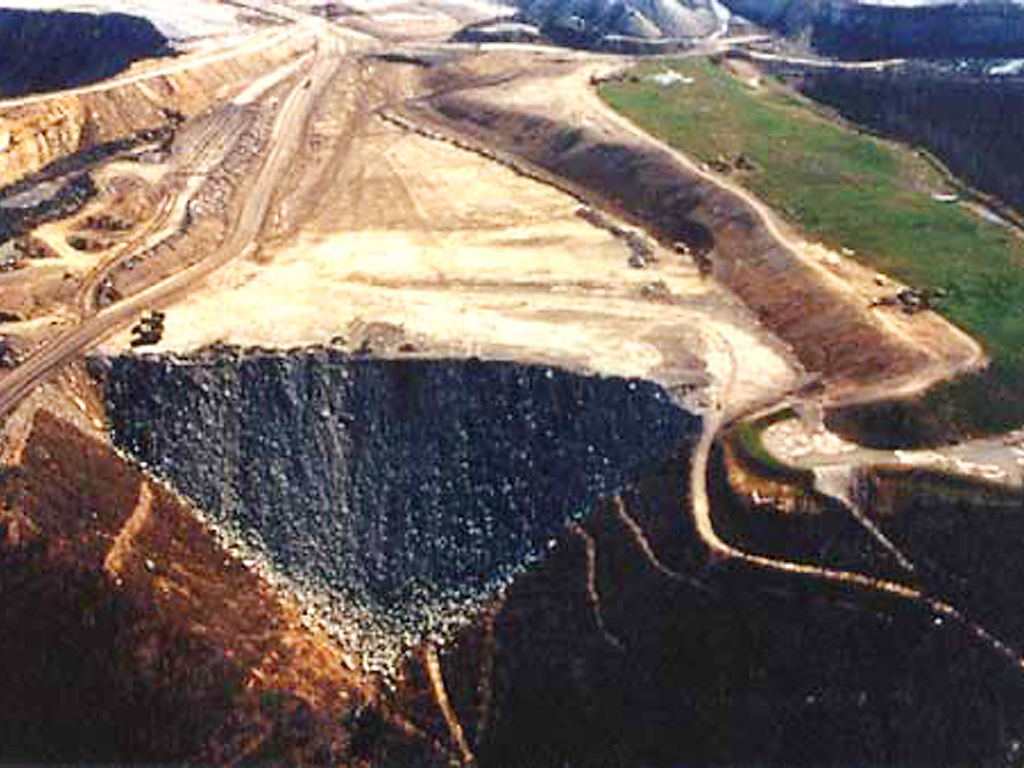
According to a recent press release, Senators Benjamin Cardin (D-MD) and Lamar Alexander (R-TN, pictured at right) introduced the Appalachia Restoration Act (S.696), which would amend the Clean Water Act to prevent the dumping of toxic mining waste from mountaintop removal coal mining into headwater streams and rivers. As incongruous as it seems, this practice of dumping the debris from entire decapitated mountains onto valleys, streams and watersheds (see image below) is commonly allowed under current (lax) interpretations of the Clean Water Act.

"It is not necessary to destroy our mountaintops in order to have enough coal," said Senator Alexander. "Millions of tourists spend tens of millions of dollars in Tennessee every year to enjoy the natural beauty of our mountains-a beauty that, for me, and I believe for most Tennesseans, makes us proud to live [there]."

As AppVoices explains:

Mountaintop removal coal mining is an extreme form of surface mining where explosives are used to blast up to 1000 feet of mountaintop in order to reach thin seams of coal. The remaining rubble, or overburden-which contains toxic heavy metals-is dumped into adjacent valleys, contaminating headwater streams where drinking water supplies originate for millions of Americans. More than 1200 miles of streams and over 500 mountains in the central and southern Appalachians have been devastated due to mountaintop removal.
"My goal is to put a stop to one of the most destructive mining practices that has already destroyed some of America's most beautiful and ecologically significant regions," said Senator Cardin, Chairman of the Water and Wildlife Subcommittee of the Committee on Environment and Public Works. "This legislation will put a stop to the smothering of our nation's streams and water systems and will restore the Clean Water Act to its original intent."

The new Senate bill is a companion bill (although not quite identical) to the Clean Water Protection Act (HR 1310) in the House of Representatives. The House bill was introduced March 4th by Demonctrats Frank Pallone (NJ) and John Yarmuth (KY) and Republican Dave Reichert of Washington and now has now has 134 bipartisan cosponsors. According to Ken Ward Jr. of Coal Tattoo,
Like the Clean Water Protection Act, pending in the U.S. House, the Appalachian Restoration Act would overturn the Bush administration’s changes to the CWA fill rule. But, this bill is much more narrow — it would not affect slurry impoundments, for example.


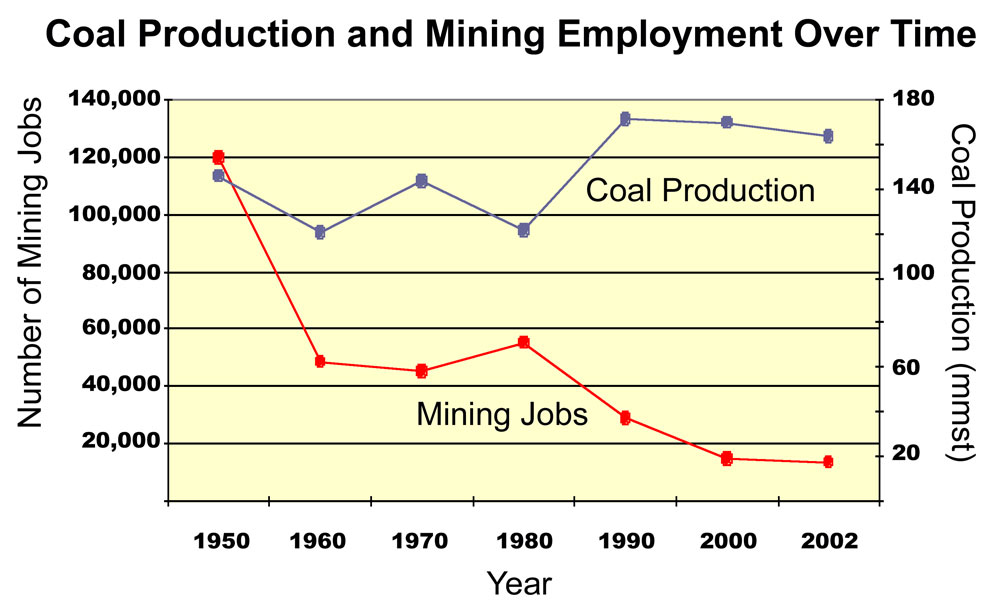
According to AppVoices, a number of recent studies, such as one by the Appalachian Regional Commission, report on the tremendous potential for employment growth in green jobs sectors, while employment in coal has been on a downward trajectory for decades. In West Virginia alone, coal mining once provided over 120,000 jobs, but that number has dropped to less than 20,000, a precipitous decline in employment driven in part by the replacement of traditional underground mining jobs with explosives-intensive and heavy-equipment-reliant mountaintop removal mining practices.


"This is not an either/or choice, it's about saving the environment and creating new jobs," said Dr. Matthew Wasson, Director of Programs at the environmental non-profit group Appalachian Voices. "Mountaintop removal does the same thing to our economy that it does to our mountains. Ending mountaintop removal will allow sustainable, long term economic growth to flourish in Appalachia."

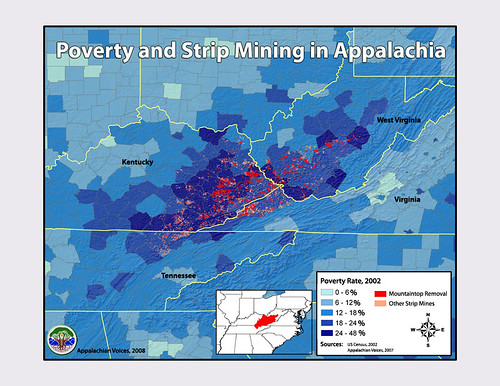
According to U.S. Census Bureau data, counties with a high concentration of mountaintop removal mines are some of the most impoverished in the United States. (See recent post, "Mountaintop Removal Blow-Back" for more on jobs and mountaintop removal mining).


To learn more about the impacts of mountaintop removal coal mining (and to take action), visit ILoveMountains.org.

Related posts:
  • Press release from Appalachian Voices

  • "US Senate Takes on Mountaintop Removal" at ItsGettingHotInHere.org

  • "Senators one-up EPA on mountaintop removal" at Coal Tattoo

  • Read more!

    Wednesday, March 25, 2009

    Mountaintop Removal Blow-Back

    After yesterday's emotional roller-coaster ride on mountaintop removal, fueled by some bad reporting from the AP and two dueling and somewhat contradictory press releases from the EPA, we're happy to run this post from Appalachian Voices' Matt Wasson (originally posted at HuffingtonPost) taking a closer look at what's at stake in the fight over mountaintop removal. Jobs, ecosystems and communities are all on the line, so delve deep with Wasson's posts here...

    If you're a reader of the Huffington Post Green Page then you are almost certainly aware that the Obama Administration signaled a major shift yesterday in how mountaintop removal coal mining will be regulated. In brief, Obama's head of the EPA, announced a decision to delay and review permits for two mountaintop removal mining operations, an action that calls into question more than 100 additional valley fill permits now pending that threaten to bury hundreds more miles of headwater streams and destroy dozens more Appalachian Mountains.

    LINCOLN.-6.07.05

    In making this decision, President Obama also took another step in fulfilling his campaign promise to bring science back to it's rightful place in guiding the decisions of federal agencies. Over the course of eight years, the Bush Administration ignored the advice and analysis of the best scientists and systematically re-wrote the rules to allow companies to dump mine waste indiscriminately into streams. They also sought to allow higher levels of arsenic, selenium and other toxic metals from mine runoff in drinking water.

    Realizing that Bush's policies were wrong from the start, the coal industry and supporters in Congress quickly and conveniently rolled over and died.

    Not.

    Actually, the blow-back was immediate and fierce from the mining industry.

    Here's the response of the National Mining Association:

    This action, which applies to all mining-related 404 permits in the region, puts thousands of mining jobs and coal production in Appalachia at risk. While on the one hand the administration is spending billions in stimulus jobs, it is taking away the highest paying jobs in the region by delaying needed permit approvals. This is not good for jobs or for energy security.

    All of this pressure appeared to elicit an immediate backpedaling by the EPA, which issued a statement last night that seemed to contradict the early media reports. Moreover, West Virginia Governor Joe Manchin quickly took to grandstanding and went straight to Washington today to talk with Administration officials about impacts on West Virginia's economy.

    All of these conflicting reports have left opponents of mountaintop removal with a little whiplash, but they should not be distressed. There is no question that the EPA's move signaled a seismic shift from the Bush Administration's lax enforcement of environmental laws, and the back-pedaling doesn't change the fact that EPA is going to bring actual science back into the permitting process.

    One of the most valuable aspects of all of this is that we now have a very complete picture of the coal industry's justification for why Obama should allow the destruction of the nation's oldest and most biologically diverse mountains, and the pollution of the headwaters of many eastern rivers to continue under the Bush Administration's rules. Here's their reasoning:

    14,000 mining jobs are at risk.

    The savvy Huffington Post reader will probably be thinking: "14,000 jobs? Didn't the auto industry just layoff 100,000 employees? You're telling me that we are turning the oldest mountains in America into a parking lot for the sake of 14,000 jobs?"

    On the surface, this would certainly be a justifiable reaction. The numbers are miniscule compared to the total number of jobs in the region and the numbers we've been hearing about mass layoffs across the country over the past 6 months. According to a report from the Bureau of Labor Statistics,

    Employers took 2,769 mass layoff actions in February that resulted in the separation of 295,477 workers, seasonally adjusted, as measured by new filings for unemployment insurance benefits.

    But this misses a number of important points. In defense of the mining industry, 14,000 fairly high paying jobs mean a lot in this region, which is among the poorest in the country and already suffers rampant unemployment.

    But the most important point is that no jobs are being lost right away as a result of the EPA's decision. Anyone who says otherwise is posturing or bluffing.

    All the EPA's announcement means is that they will temporarily maintain the status quo that has been in place since March of 2007 when a federal district court judge suspended the permitting of most valley fills until the lax Bush Administration enforcement and evaluation standards were improved. There is not a single mine that will be shut down as a result of the EPA's decision.

    Presumably, mountaintop removal enthusiasts are really more concerned that new mountaintop removal mines will not come online as older mines reach the limits of their economically productive capacity and shut down. That is certainly what the author of this post would like to see happen, which may or may not make it a legitimate concern from the coal industry perspective, but it certainly changes the discussion dramatically in terms of impacts on the local economy.

    To be precise, if the EPA cracks down on mountaintop removal permitting what we're talking about is phasing out some proportion of 14,000 strip mining jobs in Appalachia over the next decade. But is this a significant number? Significant enough to justify what Vanity Fair has called "the greatest act of physical destruction this country has ever wreaked upon itself?"

    As an exercise - the EPA is not clear on how far they will go in reining in mountaintop removal - let's look at what might happen if the EPA completely eliminated all forms of surface mining, including mountaintop removal, in Appalachia over the next decade. I have created a number of PDF summaries of studies and reports on this subject that can be downloaded individually for those who want more detail, but here's a quick synopsis.

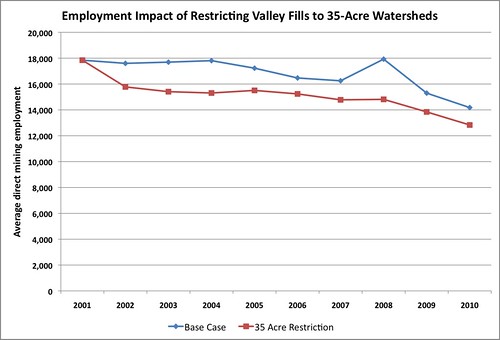
    1. The only study that directly addresses the question of how restricting valley fill permits would affect the economy was conducted by a well-respected coal industry consulting group called Hill & Associates (H&A) in 2001. According to the study, restricting valley fills to watersheds no larger than 35 acres in size (basically cutting the amount of mountaintop removal mining in half) would decrease overall coal production by about 15% in Central Appalachia. This reflects a 65% decrease in mountaintop removal with a 10% compensatory increase in underground mining.

    The employment impact of this change would be 1,345 jobs. Here's a graph showing the difference between a baseline projection and a projection based on restricting valley fills to less than 35 acres (again, meaning mountaintop removal coal production would be reduced by about 65%):
    Employment_HnA_study

    Another important point made by the H&A study is that even if no restrictions on permitting were put in place, both production and employment were projected to decline by 20-25% anyway because the most of the high-quality, easy to get coal is already mined out. Here's a quote from the study:

    "... the general downward trend of total tonnage from the study region under all cases is a result we see across many modeling projects.. [it]is exacerbated toward the end of the 10-year study period by the fact that significant blocks of higher-quality Central Appalachian reserves are starting to be exhausted. The better-quality coals in this region are slowly but surely being mined out."

    A final fascinating aspect of this study was that it also looked at how restricting mountaintop removal would affect the electric rates of consumers that rely on this coal for electricity. The impact would be somewhat less than 1% on electric bills.

    Let me repeat: reducing mountaintop removal by 65% would lead to a wholesale electric rate increase of less than 1% in states relying on this coal and an increase in residential electric rates even smaller than that.

    Here is my summary of the H&A study
    And here is the original study

    2. According to several coal industry insider publications, the decline in coal demand resulting from the recession is likely to lead to many more underground mines being idled. According to the February 16th edition of the Coal & Energy Price Report:

    Given the weak economy and downward pressure on coal prices, in general, the table suddenly has tilted in such a way that more underground mines will be in danger of falling off the cliff. Deep mine operators who have been reluctant to idle mines in the face of a potential forced shut- down of surface jobs might re-think their hesitation.

    Given that underground mines employ 1.5 times as many miners per ton produced as surface mines do, this almost certainly means that EPA's action will actually protect jobs in the short term. But other industry reports show why relying on more mining jobs is a poor response to the economic crisis anyway. Here's a quote from the March 23rd edition of the U.S. Coal Review:

    Most large producers have already announced sizeable trimming efforts, and reductions by smaller operators, while more difficult to estimate, are no doubt taking place. But in the current market environment in which demand is seriously slumping, the cutbacks are expected to continue in fairly big numbers.

    Here is a link to some more excerpts of recent coal industry news

    3. According to a 2005 report from the Appalachian Regional Commission, employment in the mining industry is one of the best predictors of poverty and other elements of "economic distress" in Central Appalachia. Here's an excerpt from the study:

    "Of all the regions in this analysis, Central Appalachia has been one of the poorest performers in relation to the ARC's economic distress measure over time. Furthermore, and unlike all other regions in the U.S., current and persistent economic distress within the Central Appalachian Region has been associated with employment in the mining industry, particularly coal mining."

    But people in Appalachia have long known that it's more than just "coal mining" that's the problem and that mountaintop removal specifically destroys far more jobs than it creates. If mountaintop removal created prosperity it should have done so decades ago. Instead, the counties where mountaintop removal occurs are among the poorest in the nation, with high unemployment rates and rapidly dwindling populations. The stark reality is that few industries want to follow mountaintop removal. After all, what entrepreneur wants to open a new business in a community where massive blasts are cracking the foundations of people's homes, where hundred-year floods are an annual affair, and where the tap water looks like tomato soup and smells like rotten eggs?

    This map, produced by Appalachian Voices, shows the dramatic correlation between mountaintop removal and poverty rates in Central Appalachia:
    PovertyMTRmap

    This ARC study also offered an excellent roadmap for Central Appalachian coal counties looking to improve their economic conditions:

    "The counties that have emerged from distress in the region have consistently had fewer jobs in mining and a greater number of jobs in manufacturing when compared to the counties that have remained persistently distressed."

    The study also said:

    "...regional economic development is most likely to take place when national policies create the conditions to support it. As such, addressing persistent distress would seem to require a renewed national commitment, similar to the one that inspired the establishment of the ARC and the regional development policies of the 1960s."

    Sounds like President Obama is already on the right track with his green jobs and economic stimulus plans (unlike the coal state politicians that have a remarkably single-minded focus on an industry that supplies less than 2% of the jobs, but a much higher proportion of campaign contributions).

    Here is a link to some more excerpts from the 2005 ARC report

    That sums up the first part of the argument why President Obama should ignore the sky-is-falling predictions, disingenuous arguments and plain, old-fashioned rigged numbers that the coal industry and their supporters are throwing at him. The subject of a later post will be all of the opportunities there are and initiatives already underway in Central Appalachia to create new green jobs and diversify the economy beyond such a heavy reliance on coal.

    As a preview, here's a link to another recent study by the Appalachian Regional Commission that came out just a few weeks ago. According to the story by Ken Ward at the Charleston Gazette:

    An estimated 15,000 jobs per year for the next five years could be created, for a total of 60,000 new jobs, the study said. Annual energy bill savings would be almost $800 million, with that amount rising to more than $27 billion per year by 2030, the study concluded.

    Now there's some job numbers that might really start getting out of the economic doldrums.

    More tomorrow...


    Read more!

    Friday, March 20, 2009

    Obama Has the Power to End Appalachia's Agony

    [Updated: 3/20/09 at 2:20 pm PST, see below]

    I'm not sure how, but I missed this excellent editorial in the New York Times on Monday. The Times editorial board seems to have fully grasped the horror and tragedy of mountaintop removal coal mining. Remarking on an upsetting recent court ruling that paves the way for the devastation of more mountains, ecosystems and communities in Appalachia, the ed board writes in "Appalachia's Agony:"

    "The longstanding disgrace of mountaintop mining is now squarely in President Obama’s hands."
    Indeed it is. And it's high time for President Obama, who said during the campaign that he "did not support" the dastardly practice, to direct his administration to take action and end Appalachia's agony. Read on for the full editorial...
    Editorial
    Appalachia’s Agony
    Published March 16, 2009

    The longstanding disgrace of mountaintop mining is now squarely in President Obama’s hands.

    A recent court decision has given the green light to as many as 90 mountaintop mining projects in Appalachia’s coal-rich hills, which in turn could destroy more than 200 miles of valleys and streams on top of the 1,200 miles that have already been obliterated. The right course for the administration is clear: stop the projects until the underlying regulations are revised so as to end the practice altogether.

    Mountaintop mining is just what the name suggests. Enormous machines — bulldozers and draglines — scrape away mountain ridges to expose the coal seams below. The coal is then trucked away, and the leftover rock and dirt are dumped into adjacent valleys and streams.

    Both John McCain and Barack Obama vowed to end the practice during the 2008 campaign — even though no recent administration, Democratic or Republican, has been willing to take on Robert Byrd, West Virginia’s senior senator, or the coal companies, which insist without proof that there is no other cost-effective way to dispose of the waste.

    There is a long and tortured legal history surrounding mountaintop mining, but the essential question is this: Is dumping mine waste into streams a violation of the federal Clean Water Act?

    On its face the answer is yes, but various regulatory maneuvers have allowed this practice to proceed. The worst of these was a 2002 rule by the Bush administration that in effect removed mining waste from the list of the law’s prohibited pollutants. The rule has made it easy for the Army Corps of Engineers to issue mining permits and hard for the courts to deny them.

    A bipartisan group of 119 members of the House recently reintroduced legislation that would redefine mining waste as a pollutant. In so doing, Congress would reassert the original intent of the Clean Water Act and end the practice of dumping waste in valleys and streams. Until that bill becomes law — if, indeed, it ever does — a great deal more damage could occur in Appalachia. Two companies that have been awaiting the court’s go-ahead have now said that they will resume mining operations.

    The Obama White House can prevent that damage. Under the law, the Corps of Engineers can suspend the mining permits in the public interest. This in turn would give the administration time to review the rules and issue new ones that would be more protective of the environment. But the Corps of Engineers, always reluctant to reverse itself and historically friendly to industry, will not act without orders from on high.

    Mr. Obama promised to find better ways of mining coal “than simply blowing the tops off mountains.” The time to do so is now.
    Bravo to the New York Times ed board. You can take action to urge President Obama to put an end to mountaintop removal here.

    Congress also has the power to end mountaintop removal mining by passing the Clean Water Protection Act. Appalachian Voices and other coal-field advocacy groups brought hundreds of citizens to Washington D.C. to lobby for passage of passing the Clean Water Protection Act this week. You can add your voice to theirs here.

    [Update:] Ken Ward Jr. at Coal Tattoo (an excellent blog at the WV Gazette) that we should expect a decision from the Obama Administration shortly:

    President Barack Obama’s top aides will be making a decision “very soon” about what they will do about mountaintop removal, according to congressional testimony today from Nancy Sutley, chairwoman of the White House Council on Environmental Quality.

    Sutley told lawmakers her staff have been meeting with EPA, the Corps of Engineers, the Department of Justice and the Office of Surface Mining, discussing the issue, reviewing the February decision by the 4th U.S. Circuit Court of Appeals, and examining a flood of pending permits at the corps office in Huntington.

    “We’re trying to get a handle on what’s out there and what we may be able to do about it,” Sutley told the House Appropriations Committee’s Subcommittee on Interior, Environment and Related Agencies.

    (H/T to Rob Perks at Switchboard)

    Read more!

    Thursday, March 05, 2009

    "Clean" Coal and "Healthy" Cigarettes - Coal Industry Huckster Won't Admit Burning Coal Causes Climate Change

    Joe Lucas has a hard job. He's the PR huckster that heads up the American Coalition for Clean Coal Electricity, the front group that shills for the coal industry.

    As you can see in the video below, no matter how many times he watches "Thank You for Smoking," Lucas just can't quite pull off the irresistibly charismatic charm of Aaron Eckhart's Nick Naylor, the movie's lead character who spins Big Tobacco's lies so effortlessly. To be fair, when your industry keeps bumbling around, letting off billion gallon toxic coal sludge spills, indescrimantly blasting the tops off of entire mountains, and buying off West Virginia judges, it's hard to stay ahead of reality.

    While he can't pull off the style, Lucas sure is taking notes from Big Tobacco when it comes to his talking points: in an interview on CNN last night, Mr. Lucas refused to answer a simple yes or no question about whether or not the burning of coal contributed to climate change.

    His answer? "I'm not a scientist." Nice dodge!

    Well Joe, neither am I, but I can read, and I'm pretty sure the science is in. The Intergovernmental Panel on Climate Change (which I'm pretty sure includes two or three scientists) stated with greater than 90% certainty that greenhouse gas emissions like the CO2 spewed from coal plants causes climate change. Check out the video below the fold (Lucas's BS is about 2:00 mins in)...


    Mr. Lucas was spurred to defend himself in a comment at Grist, where Kate Sheppard calls attention to his shenanigans.

    There are two sides to every story, and that is certainly the case when it comes to the CNN interview discussed above.

    When the interview aired, CNN played only part of a quote in which I said "I'm not a scientist" when asked whether or not emissions from coal plants contributed to climate change.

    Here's what you didn't hear: I pointed out that the United Nations International Panel on Climate Change (IPCC) has a whole list of things about which there is great certainty, other things about which there is some certainty, and still other things about which there is less certainty. We do know that there has been an increases in greenhouse gas emissions and that some warming has taken place.

    According to the IPCC, the exact extent that human-made emissions will contribute to climate change is less certain. However, the remaining uncertainties do not provide a reason to not take action.

    Especially when you take into consideration the advances that we are making with advanced clean coal technologies to capture and store CO2 from power plants.

    By focusing on technology to ensure a cost-effective means of meeting new emissions standards, we can reduce greenhouse gas emissions, promote energy independence, create jobs and keep energy costs affordable for American businesses and families.
    Ah shucks Joe...

    ...you almost, almost admitted that the industry you shill for is the leading contributor to climate change. Almost. It was a great effort, and I really appreciate it. Really.

    While you're here, Joe, I'm wondering if you can tell me what "advance clean coal technologies" you are working on to stop the unequivocally dirty and horrendously devastating impacts of the mountaintop removal coal mining your industry practices? I assume since you are a proponent of "clean" coal, you are in support of the Clean Water Protection Act introduced in Congress yesterday, which would reinstate sane environmental protections that, you know, prevent the dumping of entire mountains on top of streams and valleys. I assume you'll join me in championing the Clean Water Protection Act to help clean up the coal industry...

    And of course, when you say scientists are "less certain" that "human-made emissions will contribute to climate change" what you really mean is that they are more than 90% certain (rather than 100% certain I guess). Well you are right there. Remember though: this is scientific consensus, and expressions of scientific certainty don't get much stronger than that. Gravity is still a theory, after all.


    Hat tip to Josh Dorner at HuffingtonPost, Kevin Grandia at DeSmogBlog and Kate Sheppard at Grist for being all over this one like a PR huckster on a steaming pile of industry bull$ite

    Read more!

    Tuesday, February 03, 2009

    Blasting Set to Begin Beside World's Largest Toxic Coal Sludge Dam

    Activists Blockade Efforts to Begin Mountaintop Removal and Blasting Beside World's Largest Toxic Coal Sludge Dam

    Originally posted at ItsGettingHotInHere.org and Front Porch blog


    Please help save Coal River Mountain! Call Governor Manchin at 1-888-438-2731 and / or use our simple web form to email the governor.

    Blasting Operation Endangers Community, Destroys Wind Energy Potential

    Citizens of the Coal River Valley, accompanied by supporters from throughout Appalachia and supported by national allies incuding James Hansen, are blocking access to prepare Coal River Mountain for blasting. The blasting would be dangerously near to a nine-billion-gallon toxic coal sludge dam. Massey has begun work on a mountaintop removal operation on Coal River Mountain, with plans to blast over underground mines beside the sludge dam. Residents are advocating for a wind farm on the site as a safe alternative for cleaner energy and long-term jobs.

    "The governor and county legislators have failed to act, so we're acting for them," Rory McIlmoil said. "Someone has to take a stand for common sense. They can't allow the wind potential on Coal River Mountain to be destroyed, and the nearby communities endangered, for only 17 years of coal. There is a better way to develop the mountain and strengthen the local economy that will create lasting jobs and tax revenues for this county, and that's with wind power."

    "I fear for my friends and all the people living below this coal sludge dam," said Gary Anderson, who lives near the site. "Blasting beside the dam, over underground mines, could decimate the valley for miles. The 'experts' said that the Buffalo Creek sludge dam was safe, but it failed. They said that the TVA sludge dam was safe, but it failed. Massey is setting up an even greater catastrophe here."

    In 1972, a sludge dam operated by Pittston Coal Company failed and killed 125 people in Buffalo Creek, W.Va. In 2000, a sludge dam operated by Massey Energy in Martin County, Ky., released approximately 300 million gallons of coal waste that broke through into underground mines. The EPA called that the worst environmental disaster in the Southeast. Then, in December 2008, a coal ash sludge impoundment operated by the Tennessee Valley Authority (TVA) failed near Harriman, Tenn. That disaster released over one billion gallons of toxic sludge that destroyed three homes, damaged twelve more and covered 300 acres.

    Residents have lost faith in their state government and taken their plea nationally. Climate expert James Hansen, the head of NASA's Goddard Institute for Space Studies, said, "President Obama, please look at Coal River Mountain. Your strongest supporters are counting on you to stop this madness."

    "We can't sit by while Massey jeopardizes the lives and homes of thousands of people," said Vernon Haltom of Naoma. "Governor Manchin and the West Virginia Dept. of Environmental Protection have proven that they are unwilling to protect the citizens. What do they expect us to do? Will they wait until we're in body bags to take this threat seriously?" A 2008 report by the federal Office of Surface Mining revealed serious deficiencies in the WVDEP's regulation of coal waste dams (www.wvgazette.com/News/200901110512?page=1&build=cache). In November, WVDEP approved a permit revision allowing Massey to begin the mountaintop removal operation. Despite citizens' objections, DEP denied public participation in its decision process.

    Anderson added, "We need to stop the madness and stop Massey from blowing up our beautiful mountain. We need to go with the better energy option, and that's a wind farm, which is perfect for Coal River Mountain. We could have a green energy future for the country, starting right here."

    For updates, photos and video footage, go to http://climategroundzero.org

    See related stories and posts:

  • "Coal River Mountain can't wait", by Jim Biggers at Grist
  • "Anti-coal activists chain themselves to equipment at Massey operation," from WV Gazette
  • Archives of Tennessee Coal Sludge Disaster (Kingston TVA Spill)

  • Read more!

    Friday, January 30, 2009

    Update from Coal River Mountain

    Here's an update from the Coal River Mountain Wind Team:

    We wanted to write and give you an update on what's happening with the mountain. There has been a lot going on, not much of it in our favor, so we could still use your help in spreading awareness of the campaign and the urgency of the situation. Please continue to share our website and the story of Coal River Mountain with your friends and colleagues, and even write letters to your local newspapers and legislators urging their support for the residents of the Coal River Valley.

    First of all, Massey has begun pre-mining activities below the ridge where the first phase of mining is set to begin. It is hard to determine exactly when they will be set to blast, and for now they have yet to construct a road up to the ridge, but they have shown their intent by clearing the forest and constructing a road and sediment ditches approximately 150 [ft?] below the ridge, so we expect that they will be ready to clear the ridge in the coming weeks, but we'll keep you updated on that.

    We'd like to once again bring attention to the economic report conducted by Downstream Strategies out of Morgantown, WV that we released last December. The report analyzed the economic costs and benefits of going with wind versus mountaintop removal for Coal River Mountain, and concluded that the development of a 328 Megawatt wind farm (enough to power about 70,000 homes) stands as the best economic land use option for the mountain, the communities and the county government. This was the evidence we'd been waiting for, and we truly though for a while that the report couldn't be ignored by state and local leaders.


    This hope was shattered on January 6th when we took the result of the study to the Raleigh County Commission. Instead of embracing the study's conclusions and the opportunity to diversify the local economy and bring in new industries that would help soften the blow of the boom-and-bust cycles of coal, the Commission chose to ignore the merits of the study altogether and instead chose not to "pit one industry against another." Unfortunately, the Commission and the state government are holding tight to that false logic, and so we are now hoping to catch the attention of national leaders who might help us in the fight for the future of the mountain.

    We got a big boost in that effort yesterday when Salon.com published a wonderful and comprehensive article about the campaign written by Appalachian author Jeff Biggers ("The United States of Appalachia"), whose own family home in Indiana has been destroyed by strip-mining for coal. The article gives a great accounting of the campaign since its beginnings, as well as a more comprehensive update on where the campaign now stands [editors note: the Salon article is a must read!]. Salon.com gets nearly 6 million readers a month and so we appreciate Jeff's article and his persistence in spreading awareness for the wind campaign. You can read the article by clicking here.

    We also continue to fight the proposed mining on legal grounds, and on February 10th we will be going before the Surface Mine Board to challenge the permit revision that was approved for the Bee Tree surface mine back in November. The hearing will be held at the Department of Environmental Protection headquarters in Kanawha City (Charleston) at 601 57th St. The hearing will begin at 8:30am, so if you're free please come out and show your support for Coal River Mountain. Here is a link for directions to the hearing.

    That's about it for now, we will keep you updated as things happen and we hope you continue to support us in this effort.


    With warm regards,

    The Coal River Mountain Wind Team


    Read more!

    Friday, December 12, 2008

    BBC Says "Obama's First Real Challenge: Reducing America's Dependence on Coal"

    An interesting look at coal, mountain top removal, and the challenges awaiting President-elect Barack Obama from our friends across the pond at the BBC:

    Read more!

    RFK Jr Condemns Bush Administration's Loot and Run Environmental Tactics and Mountain Top Removal in Bombshell House Testimony

    From our friends at Appalachian Voices:

    The House Select Committee on Energy Independence and Global Warming held an important hearing yesterday on Bush’s 11th hour rule-making (see my previous post here). As most of our readers will know, one of those last minute rule changes is a repeal of the 25 year old Stream Buffer Zone rule - an important guard against the dumping of mountaintop removal mining waste into our streams.

    Robert F. Kennedy Jr gives the most significant and compelling testimony on mountaintop removal mining I have ever seen, and I hope you will take 10 minutes to watch him describe in his own words - and the words of his late father - exactly what is happening to the Appalachian Mountains.


    Unofficial transcript below the fold (starting at about the 3:10 mark)...

    I’ve filed very detailed testimony about some of the worst of these actions, but I just wanted to give you a real life expression of what’s going on. I flew only a few weeks ago over the Appalachian Mountains over eastern Kentucky, and West Virginia mainly, and the Cumberland Plateau. If the American people could see what I saw on that trip, there would be a revolution in this country. We are literally cutting down the Appalachian Mountains, these historic landscapes where Daniel Boone and Davy Crockett roamed. The Appalachians, Chairman, were a refuge during the Pleistocene ice age 20,000 years ago when – where I live and the district Congressman Hall represents was under 2 miles of ice at that time. The rest of North America turned into a tundra where there was no forest. And the last refuge for those forests was the Appalachian Mountains. And when the tundras and glaciers withdrew, all of America was reseeded from the seed stock in those forests. So it’s the mother forest of all north America, and that’s why it’s the most diverse and abundant temperate forest in the world. Because it’s the longest living. And today, these mining companies with the help of their indentured servants in the White House are doing what those glaciers couldn’t accomplish. What the Pleistocene Ice Age couldn’t accomplish which is to flatten the Appalachian mountains and destroys those forests. They’re using draglines, which are 22 stories high. I flew under one of them in a piper cup. They cost 1/2 billion dollars and practically dispense of the need for human labor.

    When my father was fighting strip mining in Appalachia back in the 1960s – I remember a conversation I had with him when I was 14 years old – where he said they are not just destroying the environment, they are permanently impoverishing these communities, because there is no way that they will ever be able to regenerate an economy from these barren moonscapes that are left behind And he said they are doing it so they can break the unions. And that’s exactly what happened. When he told me that there were 140, 000 union miners in WV digging coal out of tunnels in the ground. Today there are fewer than 11,000 miners left in the state, a very few of them are unionized because the strip industry isn’t. They are taking more coal out of WV than they were in 1968, but the difference is back then at least some of that money was being left in that state for salaries and pensions and reinvestment in that communities. Today, virtually all of it is going to leaving the state and going straight up to Wall Street to the big banking houses and to the corporate headquarters of Arch Coal, Massey Coal, and Peabody Coal – mainly Massey coal and then to the big banking houses like Bank of America and Morgan which own these operations.

    95% of the coal in WV is owned by out of state interests which are liquidating the state for cash, literally, using these giant machines and 2500 tons of explosives that they detonate every day, in West Virginia - the power of a Hiroshima bomb once a week. They are blowing the tops off the mountains to get at the coal seams beneath, they take these giant machines and they scrape the rock and debris and rubble into the hollows and into the adjacent river valleys. They flattened out the landscapes, they flatten out the valleys. They have already flattened 400,000 acres of the Appalachian Mountains. By the time they get done, within a decade, if this rule goes through and you don’t succeed in getting rid of it, they will have flattened 2200 miles, - an area the size of Delaware. According to EPA they have already buried 1200 miles of America’s rivers and streams, these critical headwater streams that are critical to the hydrology and to the water quality and to the abundance of wildlife and the forests and the biota of those regions. Its all illegal. You can not in the United States under the Clean Water Act dump rock, debris, and rubble into a waterway without a Clean Water Act permit and you can not get such a permit.

    So, Kentuckians for the Commonwealth, and my good friend Joe Lovett sued the companies in federal court in front of a conservative Republican federal judge, Judge Charles Hayden, and he said during this hearing. He said to the Corps of Engineers Colonel, who was there to testify, “You know this is illegal. It says so in the Clean Water Act. How did you happen to start writing these permits to allow the companies to break the law, and engage in this criminal activity?” The Colonel answered, “I don’t know your honor, we just kind of oozed into it.” And Judge Hayden at the end of that hearing said exactly what I just said. Its all illegal, its been illegal since day one, and he enjoined all mountaintop mining. Two days from when we got that decision lobbyists for Peabody coal and Massey coal met in the back door of the Interior Dept with Gale Norton’s first deputy chief Steven J. Griles, who was a former lobbyist for those companies, and together they re-wrote they interpretation of one word of the Clean Water Act – the definition of the word “fill” to change 30 years of statutory interpretation and make it legal not just in WV, but in every state of this country to dump rock, debris, rubble, garbage, any solid material into any waterway in the united states without a Clean Water Act permit. All you need today, according to the Administration is a rubber stamp from the Corps of Engineers, which in some districts you can get through the mail or over the telephone. Now, the last vestige of protection that we had in WV was a Stream Buffer Zone law that was upheld also by Judge Charles Hayden, which said that you can’t do this if you are within 100 feet of a stream. Well this is the law today that this Administration is trying to get rid of before it leaves office to make it so there is absolutely no way - there is not a single obstacle or impediment - to these companies just coming and flattening the entire Appalachian chain.


    Read more!

    Wednesday, December 03, 2008

    Bush Continues "Loot and Run" Strategy, Wins Approval to Expand Mountain Top Removal

    Like a losing army that loots and then sets fire to a village before retreating, the Bush Administration continues to employ a "loot and run" strategy, gutting as many environmental regulations as they can before leaving office.

    As I reported in October, the Bush Administration has been rushing to codify new mining waste rules that would clear away a critical protection against the devastating practice of mountaintop removal coal mining that is decimating mountains, watersheds and communities across the region. Yesterday, they won approval of the new "Stream Buffer Rule" - I put that in quotes since it's not much of a buffer for streams anymore - which will make it even easier for mining companies to dump "mining waste" - aka the tops of whole mountains! - on top of running streams.


    According to Bush's Interior Department spokesperson crony, Peter Mali, “This rule strengthens protections for streams." Of course, that's the kind of bold-faced lie we've come to know and love from the outgoing administration. In reality, as the New York Times makes clear, "The rule gives coal companies a legal right to" dump mining waste in streams, which, "in the past, they could do only in exceptional circumstances, with special permission from the government."

    But the Bush Administration's scorched earth environmental policy doesn't stop there... According to the Times:

    The Environmental Protection Agency is trying to finish work on a rule that would make it easier for utilities to put coal-fired generating stations near national parks. It is working on another rule that would allow utility companies to modify coal-fired power plants and increase their emissions without installing new pollution-control equipment.
    “This is unmistakably a fire sale of epic size for coal and the entire fossil fuel industry, with flagrant disregard for human health, the environment or the rule of law,” said Vickie Patton, deputy general counsel of the Environmental Defense Fund.

    In fact, the outgoing administration is rushing to complete work on regulations to which President-elect Obama and his advisers object, including new rules dealing with air pollution, auto safety, abortion and workers’ exposure to toxic chemicals, among other issues.

    As the Times also points out, President-elect Obama has voiced criticisms of mountain top removal mining:
    As a presidential candidate, Mr. Obama expressed “serious concerns about the environmental implications” of mountaintop mining.

    “We have to find more environmentally sound ways of mining coal than simply blowing the tops off mountains,” Mr. Obama told one environmental group. At the same time, he proposed a major federal investment in clean coal technology.
    Whatever your views on the promise or merit so-called "clean" coal technology - the capture and storage of greenhouse gas emissions from coal-fired power plants - coal will never approximate clean as long as we continue to decimate mountains, the forest ecosystems that live on them, the streams nearby, and the Appalachian communities that reside downstream.

    This comment line at ILoveMountains.org is still open and you can head over to Change.gov to tell President-elect Obama that one of his first executive actions upon taking office should be to reverse the Bush Administration's "loot and run" environmental provisions and urge Congress to quickly pass the Clean Water Protection Act, which would instate real protections for Appalachian streams, mountains and communities.

    January 20th can't come soon enough...

    Read more!

    Wednesday, November 26, 2008

    Blast! Coal Company Recieves Permit to Destroy Coal River Mountain

    Dark news yesterday coming out of West Virginia. In what may be an effort to sneak in some very bad news before the holiday, the West Virginia Department of "Environmental Protection" (seems like a misnomer today!) granted Massey Energy a permit to begin blasting away Coal River Mountain as soon as the company is ready. Massey plans to decimate the mountain to extract coal using a destructive mining practice know as mountain top removal (see previous posts here for more on the dastardly practice).

    The destruction of Coal River Mountain is more than just a threat to the health of local residents and the area's diverse ecosystem. It's also a direct threat to the new, clean energy economy many West Virginians are trying to build.

    As West Virginian "DanaWV" at ItsGettingHotInHere.org explains:

    Coal River Mountain is slated for a 6,600 acre mountaintop removal site, but local residents have found that it is an ideal site for a wind farm, which would save the mountain from blasting, allow for permanent, safe jobs in the community, as well as provide clean, renewable energy to over 150,000 homes.
    Despite this clearly preferable economic and environmental option, the WV DEP has excluded public comment and moved ahead to grant Massey Coal permission to destroy the mountain.

    According Appalachian Voices:
    Extensive research has shown that Coal River Mountain has enough wind potential to provide electricity for between 100,000 and 150,000 homes, forever, while creating approximately 50 well-paying, permanent jobs in an area long dependent upon sparse, temporary coal mining jobs. The wind farm would also generate as much as ten times more county revenue than the Mountaintop Removal operations would, and in a county with a poverty rate of 18.5%, this additional income would help to stimulate new economic development projects and the creation of new jobs.

    Despite the fact that both the Governor and the DEP have been presented with solid evidence supporting this claim, neither have acted to place a hold on the proposed mining. While Governor Manchin has ignored public opinion in support of a Coal River Mountain wind farm, the DEP has continued to exclude public comment on the mining permits, and now Massey Energy is set to begin blasting. ...

    Now residents fear that the onset of mining, even for this first phase, will result in the loss of an opportunity to diversify the local economy and protect their homes from the negative impacts of Mountaintop Removal mining.

    This video provides a look at threatened Coal River Mountain and the residents of the surrounding area:


    Finally, there's more here, including a call to action, from Appalachain Voices:
    It is time for Governor Manchin to do the right thing. He has been presented by members of Coal River Mountain Watch with research showing that a wind farm is the better economic option for Coal River Mountain. He has been told that the mining that could begin on the Bee Tree permit as early as today would immediately impact 24 Megawatts of wind potential, and therefore at least two permanent jobs related to the operation of the wind farm, and he knows that once a mining operation has begun it is nearly impossible for it to be stopped. His office has also received over 4,000 emails and nearly 500 phone calls calling for the Governor to stop the mining and support wind power.

    The choice being made for Coal River Mountain between wind and Mountaintop Removal was also featured on CNN on October 6th, during which the DEP Secretary, Randy Huffman, stated that “There are only certain things that allow me to deny a permit, and what’s morally right or wrong in mine or someone else’s opinion is not one of those things.” So the citizens, after presenting the moral, environmental and economic arguments in favor of wind power, are now wondering what else they have to do to get the Governor to stand behind them, for while it is in his power to rescind the mining permits and allow a wind farm to be developed, Governor Manchin has so far refused to intervene.

    However, Coal River Mountain Watch, along with concerned residents of the Coal River Valley, continue to ask the Governor to do the right thing for the state and for local residents by preventing the wind potential, and so the opportunity to stabilize and diversify the local economy, from being permanently destroyed by Massey’s Mountaintop Removal operation on Coal River Mountain.

    To express your dismay and indignation over the potential destruction of Coal River Mountain, and ask Governor Manchin to make the choice to respect the residents of Coal River Mountain and invest in a green economy for West Virginia call his office at 1-888-438-2731.

    Read more!