Energy Collective blog power policy climate - the conversation happens here
Showing posts with label gasoline. Show all posts

Thursday, May 05, 2011

Weighing in on the Gas Tax Debate

By Jesse Jenkins and Sara Mansur

Kevin Drum's recent post on the low price elasticity of demand for oil has reignited an old debate over gas taxes and energy innovation.

Drum draws our attention to some "eye popping" figures for price elasticity of demand for oil from the IMF. According to Drum, these elasticities mean that, in the short term, a 50 percent increase in price leads to a 1.2 percent decrease in consumption. In the long term, it leads to a 4.7 percent decrease.

Conservative blogger Jim Manzi rightly points out that, with elasticities as low as these, a gas tax at any politically realistic level is not going to reduce our dependence on fossil fuels.

Specifically, to the extent that we continue to progress in making non-fossil-fuels technology cheaper and more effective for an ever wider array of applications, we can accelerate the ongoing de-carbonization of our economy. The idea of economists to use artificial scarcity pricing to do this is aggressively marketed in blogs, magazines and TV shows, but is extremely unlikely to work, because the current price elasticity of oil is so low. The work of engineers and physical scientists, however, is likely to be determinative.
In response, several bloggers have argued that these elasticities are underestimated, pointing to the unreliability of estimates of long-run price elasticity of oil demand in general and to other literature with higher estimates than the IMF study. While the IMF estimates are low, revised estimates certainly aren't so high as to penalize consumption, particularly in the absence of viable, and cheap alternatives to fossil-fuel based technologies.


This brings us to a second, crucial reason that a gas tax won't solve our dependence on foreign oil. As Matt Hourihan of the Information Technology and Innovation Foundation argues on Andrew Sullivan's blog, price hikes alone won't do much to spur clean energy innovation, mostly because of the risks inherent with nascent, early-stage technologies, risks that private companies aren't willing to bear on their own.

The problem is that just as price changes have to be severe to manifest any impacts on gas consumption, price changes on their own also tend not to do much to inspire the development of radical new tech solutions, unless prices are through the roof. This is mainly due to the high levels of risk and uncertainty that come with new tech: private firms would generally rather seek out low-risk, low-cost alternatives (i.e. more efficient internal processes or capital goods) than to invest time and effort into developing high-risk, initially-high cost alternatives (i.e. hydrogen fuel cells). It takes a real, permanent shock to get any real effects, and suffice to say the American political system is unlikely to ever pass a gas tax high enough to drive these kinds of changes.
Hourihan points to the European example, where, despite significantly higher gas prices than in the US, the population is still dependent on fossil fuels, and high gas prices haven't led to the widespread uptake of electric cars.

But this doesn't mean that a gas tax doesn't have a place in a smart model for a clean energy infrastructure. As Ryan Avent noted last summer, a $5 per barrel oil tax could raise about $40 billion annually. That's the equivalent of about 12 cents per gallon of gasoline -- certainly not enough to seriously alter consumer behavior, but $40 billion in revenues is enough to fund the development and construction of an improved clean energy infrastructure.

As the Breakthrough Institute has previously argued, a low and politically sustainable carbon tax or gas tax or other fee on today's energy consumption, coupled with direct federal investments in innovation, will go a long way towards developing the clean energy infrastructure of the future. In fact, the revenues raised by a carbon or gas tax could be used to fund the public-private partnerships that have so successfully spurred private sector innovation in the past.

The mental model for this effort shouldn't be the high gas taxes of Europe - designed as they are to penalize consumption (and relatively ineffective at doing so). Rather the right precedent is the relatively low gas taxes of the United States, which raise revenues dedicated to the Highway Trust Fund.

The reasons for developing a cleaner, safer, more secure energy system are well known. What we need is a user fee charged for the enjoyment of today's affordable and efficient energy infrastructure, used to generate revenues set aside and specifically tasked with building the affordable, efficient, and improved energy infrastructure of tomorrow.

Whether imposed on oil or gasoline or electricity or on all carbon fuels, such a user fee would amount to pennies on the gallon for consumers. But it would ensure that we dedicate the tens of billions needed nationally to develop and deploy the clean, reliable, and affordable energy sources of tomorrow.

In sum, carbon pricing or gas taxes alone won't lead to breakthrough energy innovations. What will lead us there are directed government investments in energy innovation, in which a smart user fee on energy consumption or carbon emissions can play an important, but fundamentally different (and less central role) as envisioned by conventional cap and trade, carbon tax, and gas tax proponents.

Read more!

Thursday, April 22, 2010

Senate Climate Bill Trio Scrapping Oil and Gasoline Fee?

Originally posted at the Breakthrough Institute

[Update at end of post - 4/22/10 at 5:20 PST]

According to several reports, the trio of senators leading the effort to craft a climate and energy bill for release next Monday are back-peddling from earlier plans to implement a new fee on petroleum-based fuels such as gasoline amidst concerns that any new "gas tax" would trigger voter backlash.

Earlier reports of ongoing, private negotiations on a Senate climate and energy bill led by Senators John Kerry (D-MA), Lindsey Graham (R-SC), and Joseph Lieberman (I-CT) indicated that the trio were planning to drop the 'economy-wide' cap and trade plan included in the House-passed Waxman-Markey bill in favor of a 'three sector' approach to regulating emissions from power plants, industry, and petroleum-based fuels.

A cap would be implemented on the power sector to begin with, with industry phased in at a later date, while the oil sector would be exempted from the plan. Instead, petroleum-based fuels, including gasoline and diesel fuel, would be subject to a "linked fee" that would be tied somehow to the price of carbon pollution credits under the power sector cap and trade program -- in effect, a variable tax on gasoline and other petroleum products.

Now however, the Wall Street Journal reports that Sen. Kerry vehemently declares, "There is no gas tax, there was no gas tax and there will never be a gas tax."

Another Journal article similarly reports:

The senators had been discussing the idea of using an indirect tax on gasoline to substitute for emissions caps on the oil industry, according to people familiar with the discussions. The White House last week said President Obama wouldn't support an increase in the current federal gas tax of 18.4 cents a gallon, and Messrs. Graham and Kerry have disavowed the idea of a gas-tax increase.
As we await the release of the Kerry-Graham-Lieberman senate climate bill next Monday, there's thus little clarity about how, if at all, oil refiners and transportation fuels will fall under the bill's carbon regulations. The transportation sector is responsible for roughly one-third of total U.S. greenhouse gas emissions, the second largest sectoral share after power plant emissions.

UPDATE: Kate Sheppard at Mother Jones is fresh off a conference call with Senator Kerry which revealed a few more details of the yet-to-be-released Senate climate bill. According to Sheppard, Kerry says the bill should now have the backing of at least three of the five big oil majors as well as the Edison Electric Institute, a trade group representing the country's investor-owned utilities. And here's the current scoop on the oil and transportation sector, according to Sheppard:
There will be no fee--or "gas tax"--on transportation fuels. Instead, oil companies would also be required to obtain pollution permits but will not trade them on the market like other polluters. How this would work is not yet clear.
Looks like Kerry et al. are still trying to figure out how to increase the cost of gasoline through carbon fees without calling it a "gas tax." We'll see how that goes...

See also:

Read more!

Friday, February 29, 2008

Oil Hits Record Price. Gas Nearing $4.00. President Bush, Clueless...

Happy Friday! Oil hit record-prices today: $103.05 per barrel. Bully for us...

That tops the inflation adjusted high of $102.53 set in 1980. Oil first inched over $100 to welcome in the new year on January 2nd and has hovered around $100 since then, routinely spiking into new record territory. Now we've blown past the final record: the inflation adjusted highs reached in the '80s.

This news comes as analysts predict $4.00 per gallon gasoline when refiners switch over to reformulated blends in Spring.

Of course, you and I already know that. We see it every time we drive past a gas station, or god forbid, actually pull in to fill up our tanks!

You'd assume President Bush would be clearly aware of the state of gas prices as well, given how much they impact average Americans every day. Well, you might assume that about another president anyway... I wasn't too shocked to learn that President Bush is actually completely clueless that gas prices are soaring towards $4.00!

In a press conference today, he revealed his complete ignorance of what life is like for real Americans on the street in an interview that began with a simple question from Peter Maer of CBS News. Here's the transcript of the exchange, courtesy of NTYimes blog, "the Lede":

Q: What’s your advice to the average American who is hurting now, facing the prospect of $4 a gallon gasoline, a lot of people facing –

MR. BUSH: Wait, what did you just say? You’re predicting $4 a gallon gasoline?

Q: A number of analysts are predicting –

MR. BUSH: Oh, yeah?

Q: — $4 a gallon gasoline this spring when they reformulate.

MR. BUSH: That’s interesting. I hadn’t heard that.
"I hadn't heard of that?!" Seriously?! Well that explains a lot...

Like why President Bush has routinely blocked the US Congress's fiscally responsible attempts to re-invest wasteful oil subsidies to kick-start new sources of clean, homegrown renewable energy.

Three times now, the House of Representatives of the 110th Congress has passed bills that would end wasteful subsidies to oil companies designed to spur domestic oil exploration at a time when oil priced in at about $20.00/barrel. With oil prices at record levels over five times higher than when Bush took office, it's simply fiscally irresponsible to shower an industry recording record profits with taxpayer subsidies while denying the most promising and fastest growing clean, homegrown renewable energy technologies critical incentives that spur their growth.

The House passed their third attempt to correct this irresponsible tax spending and shift funds to extend critical renewable energy and energy efficiency tax credits, as well as support purchases of plug-in hybrid electric vehicles. Perhaps the third time's a charm, but this victory could be short lived, with President Bush again threatening to veto and a Republican-led filibuster in the Senate expected (again!).

But I guess if President Bush doesn't have a clue what oil and gasoline prices are really like these days, he can be forgiven for ignorantly and irresponsibly defending oil subsidies to Exxon, Chevron, ConocoPhillips and friends... These oil companies are incidentally reaping record profits off of the record prices paid by every-day Americans at the pumps, all while the economy tanks... But maybe President Bush doesn't know that either.

So maybe we should go light on President Bush... After all, he doesn't know any better!

But WE, the every day American tax payer do!

WE know that lavishing subsidies on established and highly profitable industries is a pretty poor use of taxpayer money.

We ALSO know that subsidizing the energy industries of the past will not help us solve the energy challenges of the future! To do that, we're going to have to be Energy Smart! We're going to have to invest in new, clean, domestic energy sources like wind, solar, geothermal, energy efficiency, new 100+ mpg plug-in hybrid cars and more in order to have an energy supply that is sustainable, both environmentally AND economically.

WE know better, so let's let the Senate and President Bush know it's time to re-invest! Let your Senators know it's time to be smart with our energy subsidies.

Tell the Senate to pass H.R. 5351 the Renewable Energy and Energy Conservation Tax Act of 2008 so we can take a step towards a sustainable, prosperous and secure America!

[Update: For an excellent video, courtesy of MSNBC via Crooks and Liars, showing a clip of the President's press conference, as well as lots of hooey about why telecoms need immunity for spying on Americans, head here. Gotta love our Commander in Chief. I for one feel safe in his hands...]

Read more!

Wednesday, February 13, 2008

Midwest Oil Refineries Gobble Up Canadian Tar Sands, Spew Greenhouse Gasses

Midwest oil refineries are gobbling up more and more crude oil from Canadian tar sands and are set to belch out up to 40 percent more greenhouse gas emissions in the next decade.

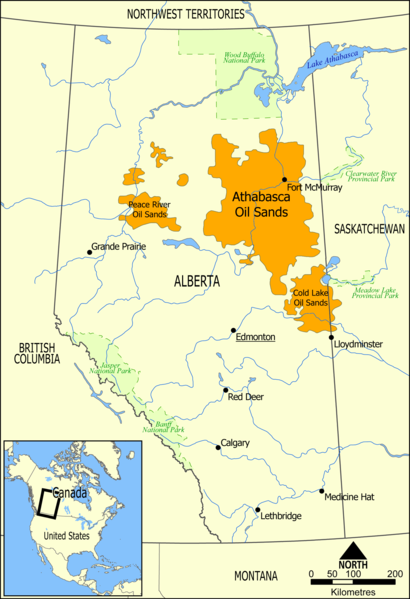
According to the Chicago Tribune, oil refineries across the Midwest are set to expand (see graphic) and are planning on processing heavy crude oil from Canadian tar sands, part of an industry-wide trend to buy more Canadian crude.

Canada has huge reserves of tar-soaked clay and sand known as "tar sands" lying under the swampy forests of northern Alberta. At today's higher oil prices, these tar sands are seen as a profitable and reliable source of oil but they require environmentally devastating mining processes and vast amounts of energy to extract. The resulting heavy crude oil requires also more energy to process at refineries. Researchers have calculated that refining the Canadian tar sands crude produces 15 percent to 40 percent more carbon dioxide emissions than conventional oil, the Tribune reports. (Editors note: I believe this does not include "upstream" emissions resulting from the energy intensive mining processes.)

As the Tribune points out, with no greenhouse-gas regulations currently in place, oil companies face no costs for the extra pollution they will churn into the atmosphere.

"This is a glaring example of how our energy policy and climate policy are at cross purposes," said Judi Greenwald, director of innovative solutions at the Pew Center on Global Climate Change. "Companies are making decisions that really don't make sense on a national level when you fail to take climate change into account."

Increasing reliance on environmentally destructive and carbon-intensive tar sands is a very worrying trend and presents a glaring inconsistency as Midwestern governors, leading presidential candidates and the US Congress all work on policies that will help drive greenhouse gas emissions reductions.

"If carbon isn't considered in these huge investments, we are going to be stuck with a tremendous burden," said Henry Henderson, a former Chicago environment commissioner who now heads the Natural Resources Defense Council's Midwest office.

Like coal-to-liquids synthetic fuels, this un-conventional source of fuel may help reduce reliance on Middle Eastern oil, but only exacerbates global warming. Comprehensive global warming regulations are needed quickly so that decisions about alternative fuels incorporate both concerns about energy independence AND global warming and do not simply trade one huge problem - our oil addiction - for another - accelerating climate change.

Read more at the Chicago Tribune.

[A hat tip to Grist. Graphic from the Chicago Tribune and Wikipeida]

Read more!

Thursday, January 17, 2008

Americans, Congress Critize Delay in Polar Bear Decision

Today the House Select Committee on Energy Independence and Global Warming held a hearing: "On thin ice: the future of the polar bear." The room was full, and there was a fairly good turnout of at least eight Congressmen and women. Children were among those in attendance, their eyes wide as they absorbed the strong words that flew from all sides of the room. Some "polar bears" even made an appearance, positioning themselves for coverage on C-SPAN and holding up signs.

Chairman Markey called the hearing today to press the Department of the Interior about its decision to delay the listing of the polar bear as threatened -- under the Endangered Species Act -- for up to one month, and to simultaneously offer up almost 30 million acres of the Chukchi Sea -- the polar bear's habitat -- for oil and gas lease sales on Feb. 6, before the decision is made. The hearing also provided a forum to learn more about the plight of the polar bear and the potential impacts drilling could have on polar bear populations. Markey called this hearing because people are paying attention; several editorials have been run in major papers in the US (Washington Post, NYTimes, LATimes, etc) regarding the status of this iconic species and our reckless oil habit - - the situation will not continue quietly if such pressure continues. If listed, the polar bear's protection would be linked to the impacts of global warming -- a first in history.

Throughout the course of the hearing it became OVERWHELMINGLY clear that the science surrounding the status of the polar bear is unequivocal. The threats posed to this great creature are tangible, quantifiable and ever increasing as we emit more global warming pollution each day. Congressman Inslee (D-WA) put it the best when he said that the polar bear is the largest canary in the largest coal mine regarding the future of our planet. And it is only with willful ignorance and habitual arrogance that we choose to ignore science for a temporary oil fix from the newly opened northern seas. Not only is drilling in the Chukchi Sea devastating for wildlife, it does nothing to help us move away from our addiction to oil.


Randall Luthi, Director of the Minerals Management Service, spoke in defense of the Chukchi Sea oil and gas lease sale, and Dale Hall, Director of US FWS, spoke in defense of the decision delay. Mr. Hall's own agency received scientific reports which concluded that two-thirds of the polar bears would disappear because of shrinking sea ice by mid-century if steps are not taken to curtail global warming. What additional science does Mr. Hall require, when making the decision about the polar bear? These men offered weak testimony, and attempted to dodge every single direct question posed to them by Congressmen, including questions of oil spill risk and whether the leases would really just be another handoff to the oil and gas industry. Hall further declined to offer Markey any assurance that the decision on whether to list the bear under the Endangered Species Act will occur before the scheduled oil & gas lease sales.

The Department of the Interior is currently allowing our hunger and thirst for oil to surpass all other forms of human value. Dirk Kempthorne - the Secretary of the Interior - has the worst record in history regarding listing species as endangered; he has gone more than 617 days without designating an endangered species, longer than any previous Secretary. His lack of action is not due to a lack of species' needs.

Congressman Markey stated that he will be introducing legislation to delay the Chukchi Sea lease sale until after a decision regarding the polar bear is made...

The bottom line is that Dirk Kempthorne has the power to postpone the oil and gas lease sale decision until after Mr. Hall makes his decision regarding the polar bear. He needs to do this, and he will only do this if enough public attention, and pressure is applied. So please speak up!

Read more!

Monday, May 21, 2007

Gas Prices Hit All Time High - Worse than Oil Shock of 1981

Gas prices in the United States are now higher than any point in history, even when adjusted for inflation.

[From CNNMoney.com:]

Gasoline prices soared to levels never seen before as even the inflation-adjusted price for a gallon of unleaded topped the 1981 record spike in price that had stood for 26 years.

And higher prices could be on the way as Americans get ready to hit the road for the Memorial Day holiday and the start of the summer driving season.

The Lundberg Survey, a bi-weekly gas price tracking service, put the price of a gallon of unleaded at $3.18 in its latest reading released late Sunday, up more than 11 cents from its reading of two weeks ago.

While gasoline had already been in record territory in current dollars, Trilby Lundberg, publisher of the survey, said this is the first time that her survey topped her 1981 record high when adjusted for inflation. The price of $1.35 in 1981 works out to $3.15 in current dollars, she said. The Iran-Iraq war, which started the year before, choked off oil supplies to the global market, causing that spike in prices.

The motorist group AAA does a daily survey of up to 85,000 gas stations, but that reading does not go back to the 1981 spike. It's survey has been showing a series of record high prices in current dollars since May 13, and Monday the average price for a gallon of self-serve unleaded hit $3.196, the ninth straight record high and up from Sunday's record of $3.178.

The AAA survey now shows prices up 4 percent over the course of the last week, along with an increase of 11.8 percent over the last month.

AAA warned in congressional testimony last week it believes that more record prices could be on the way. It is forecasting prices will approach $3.25 a gallon over the next 60 days.

Still AAA is predicting a record number of Americans will be hitting the road holiday weekend, with 38.3 million expected to be traveling 100 miles or more over the Memorial Day holiday, up 1.7 percent from a year ago. And most of those - 32.1 million - will be driving on their trip, according to the motorist group.

Topping post-Katrina records

Before this recent run of record-high gas prices, the highest price ever recorded in current dollars was $3.057 in the AAA survey, which was set Sept. 4 and Sept. 5, 2005, in the wake of Hurricane Katrina. That storm disrupted refinery operations and pipelines and caused a temporary spike, sending prices above the $3 mark for eight days.

The only other time that the AAA national average has topped the $3 mark was in August 2006, after Israel invaded Lebanon and oil futures shot higher. Gas prices then reached as high as $3.036 during that 19-day spike.

The current price increases are due to problems in gasoline supplies and refinery output. The average gas price went above $3 a gallon on May 4, and has been climbing since. Unless prices fall suddenly, Wednesday will mark the longest stretch of $3 gas on the AAA survey's history.

Few states have an average gas price below $3. California had the highest average price, with a gallon of self-serve unleaded costing $3.457, up slightly from the $3.453 reading Sunday after several days of prices slipping slightly there.

New Jersey retained the lead in the race to have the cheapest average gas price, but it is quickly approaching the $3 a gallon threshold itself. The average price there came in at $2.938 a gallon in the Monday reading, up from $2.93 Sunday.

New Jersey is one of only three states with an average price below the $3 mark. The other two - South Carolina and New Hampshire - are both within a penny or less of that mark, after both rose in the latest reading.

Four more states - Alabama, Mississippi, Tennessee and Virginia - became the latest states to cross that $3 a gallon benchmark in the Sunday survey.

While crude oil prices have fallen over the last few weeks and oil supplies are high in the United States, problems at several refineries have crimped gasoline output ahead of the summer driving season.

The refinery problems include fires, power outages, and longer-than-usual maintenance periods.

The run-up in prices is a big concern for store chains, according to the retailers' trade group. Its survey released early Friday found the average consumer believes that the price of gas will reach $3.32 per gallon by Father's Day.

As a result, 40.2 percent of consumers are taking fewer shopping trips, while 37.9 percent told the survey they plan to shop closer to home. In addition, 30.7 percent said they are shopping for sales more often and 23.5 percent are using more coupons.

Perhaps of greatest concern to the retailers, 24.1 percent said they are spending less on clothing, while only one in five have delayed major purchases, such as a car, television or furniture, and 31.1 percent are dining out less.

"Consumers are entering the summer season with a cautious view of increasing gas prices," NRF President and CEO Tracy Mullin said. "To offset the effects of higher prices, more consumers are giving their wallets a little extra cushion by cutting back on discretionary spending or choosing to frequent retailers closer to home."

Interestingly enough, the retailers' survey also found that 32.6 percent have decreased their vacation travel plans this year, despite the AAA survey that projected a record number of Americans on the highways this weekend.

Major retailers were reporting weak April sales even before the recent spike in gasoline prices started earlier this month. Wal-Mart Stores, the world's largest retailer, had its worst sales comparison on record in April as it forecast essentially flat sales at stores open at least a year in May, a closely watched measure of retail strength known as same-store sales.

Overall same-store sales in April were among the weakest on record as other major retailers including Target, Gap, Federated Department Stores and J.C. Penney all reported declines in that key sales measure.

Big Oil went on the defensive Wednesday, getting grilled before a House panel and denying accusations that mismanagement and a lack of competition are the reasons behind this spring's record gasoline prices.


Here comes $4.00 gas!

Read more!