Guest post from Congresswoman Doris Matsui. Cross-posted from www.focusthenation.org.
As a member of the House of Representatives' Energy and Commerce Committee, I just wanted to take a moment out of the hearings we are holding today to discuss the comprehensive climate change bill, and give you a quick update about what is happening here in Washington.
In the last few days alone, more action has been taken on climate change than in the entire eight years of the Bush presidency. On Friday, the Environmental Protection Agency (EPA) announced the findings of their scientific review, which recognized that global warming threatens both public health and public welfare, and that greenhouse gas emissions are influencing everything from crop failures to more intense heat waves that we are seeing in my hometown of Sacramento.
Yesterday, we started hearings in the Energy and Commerce Committee on the comprehensive climate legislation put forth by Chairmen Henry Waxman and Edward Markey. When passed, the American Clean Energy and Security Act will allow our children and grandchildren to live in a country that is more sustainable, more economically viable, and more efficient than the country we live in today.
Today we are celebrating the 39th annual Earth Day, a worldwide celebration designed to inspire awareness and appreciation for the Earth's environment and educating individuals about what they can do to help.
And this weekend, I will be one of hundreds of Californians participating in some way at the California Student Sustainability Coalition Spring Convergence & Focus the Nation Town Hall in San Lois Obispo.
We are closer to making real progress on climate change legislation that ever before, and I hope we all take this opportunity to make this an historic Earth Day.
-Congresswoman Doris Matsui, (D-CA-05)

Wednesday, April 22, 2009
Earth Day Update on Climate Bill Hearings from Congresswoman Doris Matsui


Monday, January 26, 2009
Obama: "No single issue is as fundamental to our future as energy"
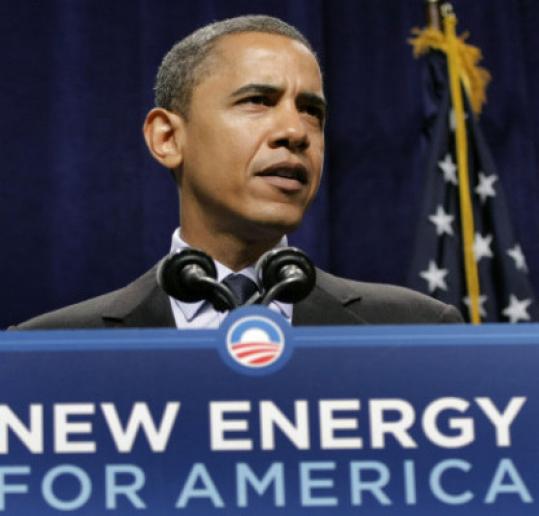 Today, Barack Obama announced several measures to increase America's energy independence and reduce the threat of global climate change. In a speech delivered at the White House, President Obama said, "These are extraordinary times," adding, "At a time of such great challenge for America, no single issue is as fundamental to our future as energy."
After briefly discussing the nation's economic challenges, Obama went on to link today's challenges to our dependence on oil and fossil fuels:
"America's dependence on oil is one of the most serious threats that our nation has faced. It bankrolls dictators, pays for nuclear proliferation and funds both sides of our struggle against terrorism. It puts the American people at the mercy of shifting gas prices, stifles innovation, and sets back our ability to compete.President Obama noted that every US president from Richard Nixon on has promised efforts to secure America's energy independence, saying:
These urgent dangers to our national and economic security are compounded by the long-term threat of climate change, which, if left unchecked, could result in violent conflict, terrible storms, shrinking coastlines, and irreversible catastrophe."
"Year after year, decade after decade, we've chosen delay over decisive action. Rigid ideology has overruled sound science. Special interests have overshadowed common sense. Rhetoric has not led to the hard work needed to achieve results and our leaders raise their voices each time there's a spike on gas prices, only to grow quiet when the price falls at the pump."Mr. Obama said that today, "America has arrived at a crossroads," adding that it is now the nation's time to "choose whether to risk the peril that comes with our current course or to seize the promise of energy independence. And for the sake of our security, our economy and our planet, we must have the courage and commitment to change."
President Obama then promised, "It will be the policy of my administration to reverse our dependence on foreign oil while building a new energy economy that will create millions of jobs."
He recognized that the challenge will not be easy. "I cannot promise a quick fix," he said. "No single technology or set of regulations will get the job done."
Obama then promised to "commit ourselves to steady, focused, pragmatic pursuit of an America that is freed from our energy dependence and empowered by a new energy economy that puts millions of our citizens to work. "
The president then went on to announce what he called "the first steps on our journey toward energy independence," including new investments in Obama's economic stimulus package to harness clean energy, a directive to move forward with new regulations to increase the efficiency of American cars and trucks passed by Congress in December 2007, and a new directive to the Environmental Protection Agency to allow California and 13 other states to set stricter standards for greenhouse gas emissions from the tailpipes of personal vehicles. "Each step," President Obama said, "begins to move us in a new direction, while giving us the tools that we need to change."Here is the remainder of his speech:
"First we must take bold action to create a new American energy economy that creates millions of jobs for our people. The American Recovery and Reinvestment Plan before Congress places a downpayment on this economy.Read more!
It will put 460,000 Americans to work with clean energy investments and double the capacity to generate alternative energy over the next three years. It will lay down 3,000 miles of transmission lines to deliver this energy to every corner of our country. It will save taxpayers $2 billion a year by making 75 percent of federal buildings more efficient. And it'll save working families hundreds of dollars on their energy bills by weatherizing 2 million homes.This is the boost that our economy needs and the new beginning that our future demands.
By passing the bill, Congress can act where Washington has failed to act over and over again for 30 years. We need more than the same old empty promises. We need to show that this time it will be different. This is the time that Americans must come together on behalf of our common prosperity and security.
Second, we must ensure that the fuel-efficient cars of tomorrow are built right here in the United States of America.
Increasing fuel efficiency in our cars and trucks is one of the most important steps that we can take to break our cycle of dependence on foreign oil. It will also help spark the innovation needed to ensure that our auto industry keeps pace with competitors around the world.
We will start by implementing new standards for model year 2011, so that we use less oil and families have access to cleaner, more efficient cars and trucks.
This rule will be a downpayment on a broader and sustained effort to reduce our dependence on foreign oil.
Congress has passed legislation to increase standards to at least 35 miles per gallon by 2020. That 40 percent increase in fuel efficiency for our cars and trucks could save over 2 million barrels of oil every day: nearly the amount of oil that we import from the Persian Gulf.
Going forward, my administration will work on a bipartisan basis in Washington and with industry partners across the country to forge a comprehensive approach that makes our economy stronger and our nation more secure.
Third, the federal government must work with, not against, states to reduce greenhouse gas emissions.
California has shown bold and bipartisan leadership through its effort to forge 21st-century standards, and over a dozen states have followed its lead.
But instead of serving as a partner, Washington stood in their way. This refusal to lead risks the creation of a confusing and patchwork set of standards that hurts the environment and the auto industry.
The days of Washington dragging its heels are over. My administration will not deny facts; we will be guided by them. We cannot afford to pass the buck or push the burden onto the states.And that's why I'm directing the Environmental Protection Agency to immediately review the denial of the California waiver request and determine the best way forward. This will help us create incentives to develop new energy that will make us less dependent on the oil that endangers our security, our economy and our planet.
As we move forward, we will fully take into account the unique challenges facing the American auto industry and the taxpayer dollars that now support it. And let me be clear: Our goal is not to further burden an already struggling industry; it is to help America's automakers prepare for the future.
This commitment must extend beyond the short-term assistance for businesses and workers. We must help them thrive by building the cars of tomorrow and galvanizing a dynamic and viable industry for decades to come.
Finally, we will make it clear to the world that America is ready to lead. To protect our climate and our collective security, we must call together a truly global coalition. I've made it clear that we will act, but so too must the world. That's how we will deny leverage to dictators and dollars to terrorists, and that's how we will ensure that nations like China and India are doing their part, just as we are now willing to do ours.
It is time for America to lead because this moment of peril must be turned into one of progress.
If we take action, we can create new industries and revive old ones, we can open new factories and power new farms, we can lower costs and revive our economy. We can do that and we must do that.
There's much work to be done; there is much further for us to go. But I want to be clear from the beginning of this administration that we have made our choice: America will not be held hostage to dwindling resources, hostile regimes and a warming planet.
We will not be put off from action because action is hard.
Now is the time to make the tough choices. Now is the time to meet the challenge at this crossroad of history by choosing a future that is safer for our country, prosperous for our planet, and sustainable.
Those are my priorities, and they're reflected in the executive orders that I'm about to sign.
Thank you so much for being here."
Sunday, January 25, 2009
BREAKING: Obama Lets California and 13 States Regulate Global Warming Pollution from Cars and Trucks
Obama will also speed efforts to set federal fuel economy standards.
BREAKING NEWS: President Barack Obama will grant California and 13 other states the authority to regulate global warming pollution from cars and light trucks, setting standards that would require cars and trucks sold in those states to achieve higher fuel efficiency.
According to the New York Times:
President Obama on Monday will direct federal regulators to move swiftly to grant California and 13 other states the right to set strict automobile emissions and fuel efficiency standards, two administration officials said Sunday evening.The Washington Post also reports on the story here:
The directive makes good on an Obama campaign pledge and marks a sharp reversal from Bush administration policy. Granting California and the other states the right to regulate tailpipe emissions is one of the most dramatic actions Mr. Obama can take to quickly put his stamp on environmental policy.
The presidential orders will require automobile manufacturers to begin producing and selling cars and trucks that get higher mileage than the national standard, and on a faster phase-in schedule. The auto companies had lobbied hard against the regulations and challenged them in court.
On Dec. 19, 2007, then-EPA Administrator Stephen L. Johnson blocked the efforts of California and more than a dozen other states to limit automobiles' carbon dioxide emissions, arguing that President George W. Bush had addressed the issue by signing a law that same day raising the corporate average fuel-efficiency standard to 35 miles per gallon by 2020. But California's tailpipe emissions rules would have effectively required even greater fuel-efficiency increases, by seeking to cut vehicles' greenhouse gas emissions by 30 percent between 2009 and 2016, something American automakers have resisted.WattHead - Energy News and Commentary has reported on the long, long saga of the California Tailpipe Emissions Standards since California initially adopted the standards back in October 2005. We'll continue to bring you the latest news in this ongoing story.
The Times and Post also report that on Monday, Obama will make further announcements concernign federal efforts to improve vehicle fuel economy, reduce government energy consumption (and save taxpayers money). According to the Times:
The Post again has more detail, clarifying that:In a White House announcement scheduled for Monday morning, Mr. Obama will also direct federal agencies to immediately begin work on making all government buildings more energy efficient, with an eye toward saving as much as $2 billion a year and reducing the emissions of carbon dioxide and other gases blamed for the warming of the planet.
He will also direct the Department of Transportation to immediately begin drafting automobile fuel-economy regulations to comply with a law enacted in December 2007. Former President Bush delayed implementation of the law and left office saying there was not sufficient time to write the rules.
The Bush administration never issued near-term guidelines for tighter fuel-efficiency standards: The Transportation Department circulated a proposal last fall that would have required auto companies to build new cars averaging as much as 31.8 miles per gallon by 2015, compared with the current level of 27.5 miles per gallon, but it announced less than two weeks before Bush left office that it would not issue formal guidelines. ...However, as the Post reports, the waiver allowing California and 13 other states to move forward with regulations on CO2 emissions from cars and trucks may do more to accelerate increased vehicle fuel economy than the federal CAFE standards:
Obama, who has consistently urged U.S. automakers to produce more fuel-efficient cars, is likely to accelerate the timeline for raising the nation's corporate average fuel economy for cars and trucks. The Transportation Department guidelines must be issued no later than April in order to affect the 2011 auto fleet.
Granting a waiver for California to regulate tailpipe emissions would affect nearly half the U.S. auto market. Thirteen other states -- including Maryland -- and the District have already adopted California's proposal, while at least four others have pledged to do so. When EPA rejected the waiver, Obama issued a statement saying the decision "is yet another example of how this Administration has put corporate interests ahead of the public interest. If the courts do not overturn this decision, I will after I am elected president."Happy Sunday!
"Not only is the new president a man of his word, but he's making a dramatic break with the Bush administration's climate policy," said Frank O'Donnell, who heads the advocacy group Clean Air Watch. "It's a powerful signal that science -- and the law -- will guide his administration's decisions. This should prompt cheers from California to Maine."
Read more!
Thursday, December 18, 2008
Obama Taps Green Jobs Champion Hilda Solis as Labor Secretary
 Names Two Strong Climate Scientists to other Posts
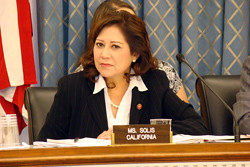
President-elect Barack Obama has tapped green jobs and immigrant rights champion Representative Hilda Solis (D-CA) to head his Labor Department, according to the Associated Press.
Representative Solis was the key sponsor of the Green Jobs Act of 2007 and has been a vocal champion in the House of Representatives for investments in a new, clean energy economy that can spark new innovation and offer pathways out of poverty for millions of Americans.
Upon passage of the Green Jobs Act, Representative Solis, who represents heavily Hispanic portions of eastern Los Angeles County and east L.A highlighted the "opportunity to advance not only the energy security of our nation, but also the economic security of our families. Through targeted job training efforts," she said, "we can support both our nation’s innovation and technological leadership and lift people out of poverty.”
As AP reports, the Democratic congresswoman was just elected to her fifth term . She is the daughter of Mexican and Nicaraguan immigrants and has been the only member of Congress of Central American descent.
[Update: 1:29 PM, PST]: Two other nominations were made public today, both scientists with strong records as climate change advocates.
Dr. Stephen Holdren, a professor at Harvard University and the President and Director of Woods Hole Research Center, a major center of climate science, will head the White House Office of Science Technology and Policy.
Dr. Jane Lubchenco, a prominent environmental scientist and marine ecologist at Oregon State University has been selected to lead the National Oceanic and Atmospheric Administration. Dr. Lubchenco has studied the effects of climate change on marine species and co-chaired Oregon Governor Ted Kulongoski's Advisory Group on Global Warming which recommended actions the state could take to cut global warming pollution.
Official announcements of the appointments are expected from the Obama transition team in the next few days.
Wednesday, November 05, 2008
Waxman Challenges Dingell for Leadership of Influental House Committee
 Cross-posted from the Breakthrough Institute
Representative Henry Waxman (D-CA) plans to challenge venerable Representative John Dingell (D-MI) for chairmanship of the influential House Energy and Commerce Committee, according to a report from Roll Call.
"The move marks a major showdown between two Democratic powerhouses, with implications for a host of major legislation next year from health care to global warming to renewable energy. Waxman currently chairs the Oversight and Government Reform panel."
The House Energy and Commerce Committee has jurisdiction over a wide range of critical issues, including energy policy, health care, interstate commerce issues and most likely global warming policy as well. The committee will no doubt be a critical player in the legislative implementation of President-elect Obama's policy agenda.
Waxman and Dingell have taken two dramatically different stances on global warming and energy during the 110th Congress and a change in chairmanship could reshape the Congressional political landscape on these issues.
Reflecting their differing constituencies, Dingell opposed California (and 15 other states') efforts to set tailpipe emissions standards for greenhouse gases while Waxman led hearings to press EPA Administrator Stephen Johnson on why the agency had blocked California's efforts.
The difference is just as clear when it comes to federal climate policy. In March 2007, Waxman introduced the Safe Climate Act, still the most aggressive proposal for global warming pollution caps in the Congress. In contrast, Dingell and his committee waited until the final hours of the 110th Congress to release a draft outline for economy-wide greenhouse gas regulations.
Roll Call reports that a number of other key House leadership races were also underway, less than 24 hours after the polls closed.
UPDATE:Senate Majority Leader Harry Reid (D-NV) is planning to discuss with Joe Lieberman (I-CT) later this week whether or not to strip the Democrat-turned-Independent-turned-McCain booster of his committee chairmanships. Lieberman currently chairs the Senate Homeland Security and Government Affairs Committee and the Environment and Public Works subcommittee with jurisdiction over global warming regulations.
A hat tip to Brad Johnson at the Wonk Room on this one Read more!
Wednesday, December 19, 2007
The Gift That Keeps On Giving: EPA Hides Behind Weakened Energy Bill to Deny California Tailpipe Standard Waiver
 The weakened energy bill ultimately passed last week and signed into law by President Bush today is the gift that keeps on giving this holiday season.
Today, US Environmental Protection Pollution Agency Administrator Stephen Johnson denied California's petition for a waiver allowing it and a dozen other states (both blue and red) to set greenhouse gas emissions standards for cars and trucks, using the just enacted energy bill to claim that the Bush Administration is already doing its part to combat global warming.
An EPA press release spun it this way:
The Bush Administration is moving forward with a national solution to reduce greenhouse gas emissions from American vehicles. The new energy legislation passed by Congress and signed by President Bush this week provides a federal fuel economy standard that offers environmental benefits, energy security and economic certainty for the nation.OK, now that you've vomited over this steaming pile of bullshite, lets move on...
"The Bush Administration is moving forward with a clear national solution – not a confusing patchwork of state rules – to reduce America’s climate footprint from vehicles," said U.S. EPA Administrator Stephen L. Johnson. "President Bush and Congress have set the bar high, and, when fully implemented, our federal fuel economy standard will achieve significant benefits by applying to all 50 states.”
David Roberts at Gristmill quickly pointed out that Administrator Johnson's arguments are full of more holes than a piece of swiss cheese:
The [EPA] announcement came with a veritable torrent of dishonest spin. Let me try to disentangle some of it.This isn't over, but it'll delay things even longer, as President Bush once again proves he's Climate Energy #1.
1. Johnson leaned heavily on today's passage of the energy bill, saying that a "uniform national standard" is preferable to a "confusing patchwork of state standards."
The "patchwork" line is completely disingenuous. There aren't multiple standards in different states. There's one: California's standard, which other states can choose by law to adopt, or not.
2. Johnson said that he'd had "hours and hours" of briefing from the EPA's "world-class professional staff," which provided him with many "pros and cons" upon which he based his decision.
There's good reason to believe this is false. According to House Oversight Committee chair Henry Waxman (D-Calif.) and other sources, the EPA's professional staff was cut out of the debate (PDF), which proceeded almost entirely on political grounds. Indeed, EPA staff overwhelmingly believes that the waiver should be granted.
3. Johnson asserted that the newly passed CAFE standards (35mpg) are tougher than California's standards, which he said would amount to 33.5mpg.
The reason automakers have lobbied the White House so hard to get this decision is that California's standards are tougher than the new federal standards. The 33.5mpg number appears to have been pulled out of Johnson's rear. Regardless, the Calif. standards were always meant to be ramped steadily up over time, in keeping with their climate change action plan (the current standards go through about 2016). Make no mistake: this is a gift to automakers. [Jesse notes: the 33.5mpg number is the 2016 target for the California standard, which Johnson compares to the 2020 CAFE standard target (35 mpg), which I should also point out is actually only 33.8 mpg because the flex fuel vehicle loophole inserted into the final energy bill decreases the standard by 1.2 mpg... Fun with numbers!]
4. Johnson said he was denying the waiver on the basis of section 209 of the Clean Air Act. He said this request for a waiver was "distinct from all prior requests," in that the previous requests regarded local pollutants, and GHGs are global pollutants. Thus, California does not meet the "compelling and extraordinary conditions" called for by the Act.
This flies in the face of the clear language of the CAA and the just-passed energy bill, both of which explicitly reserve for California the right to exceed federal fuel economy standards. Johnson's legal reasoning has no support outside of Bush administration political appointees.
In short, as Johnson all but admitted, this decision was made based on a "policy preference" of the White House -- exactly what was prohibited by the Supreme Court's ruling in Mass. v. EPA.
Schwarzenegger and state Attorney General Edmund G. Brown Jr. are preparing an immediate lawsuit. Sen. Barbara Boxer said she is "prepared to take all measures to overturn this harmful decision" via legislation. Waxman says his Oversight Committee will immediately launch an investigation into how the decision was made.
Read more!
This Just In: EPA denies CA Clean car standards
EPA Adminstrator Stephen Johnson just announced today that he plans to deny the waiver California applied for to regulate the greenhouse gas emissions from cars, SUVs and Trucks. Citing the new Corporate Average Fuel Economy (CAFE) standards that President Bush signed into law today (the only major redeeming factor to the Energy Bill) Johnson stated that "The Bush administration is moving forward with a clear national solution — not a confusing patchwork of state rules...I believe this is a better approach than if individual states were to act alone."
The newly adopted CAFE standards raise the average miles per gallon the vehicles sold in the U.S. must achieve to 35 mpg. While this creates a substantial jump in efficiency (meaning that in several years, the US will achieve the same efficiency as Chinese vehicles do now), the move to increase fuel economy is distinct from regulating tailpipe emissions. While less gas will be consumed to drive a vehicle under the new standards, regulating emissions as California proposes to do will result in more efficient combustion of gasoline and reductions in emissions above and beyond those the mileage standard will generate.
Although the greenhouse gas emissions released from the tailpipes of cars contribute to global warming, the EPA did not find that the California standard did not "meet compelling and extraordinary conditions" required to merit the waiver.
California Governor Arnold Schwarzenegger responded to this decision in an official statement saying:While the federal energy bill is a good step toward reducing dependence on foreign oil, the President's approval of it does not constitute grounds for denying our waiver. The energy bill does not reflect a vision, beyond 2020, to address climate change, while California's vehicle greenhouse gas standards are part of a carefully designed, comprehensive program to fight climate change through 2050.
In addition to California, Connecticut, Maine, Maryland, Massachusetts, New Jersey, New Mexico, New York, Oregon, Pennsylvania, Rhode Island, Vermont and Washington have all adopted the California emissions standards — have adopted the California emissions standards, and the governors of Arizona, Colorado, Florida and Utah also plan to adopt them.
Despite this setback, work is still moving forward to get additional states to adopt the California emissions standards and to challenge this decision in the courts. Don't worry, this issue is not over - it has just experienced a road block.
Cross-posted on It's Getting Hot In Here
Friday, November 16, 2007
Court Rejects Weak Fuel Economy Regulations, We Want More
 Let’s all thank the 9th Circuit court for stating the obvious. Thursday a three judge panel ruled that 23.5 mpg is not a high enough fuel economy standard for light trucks and SUVs. Why not? The court finally stated explicitly that standards must take greenhouse gas emissions into account. This is not an earth-shattering assertion, but it is progress.
Now that we’ve got that out of the way, we can talk about a complete overhaul of fuel economy regulation. First of all, as long as there are different standards for cars and light trucks/SUVs, the numbers don’t mean a lot. Americans drive light trucks and SUVs as commuter cars, and the current legislation exempts vehicles like the 8,500-lb. Ford Excursion and 10,000-lb. H2. No matter how efficient our cars are, as long as these behemoths are driving alongside them, too much carbon is getting in to the air.
California’s proposed fuel efficiency standards will reduce greenhouse gas emissions from new vehicles 30% by 2016, in line with the overall target of 80% below 1990 levels by 2050. They incorporate not only GHGs coming out the tailpipe but emissions over the lifetime of the vehicle – including those released during production, maintenance and scrapping.
We cannot afford to settle for band-aids. We need real global warming solutions for America, and we need them now.
Tuesday, August 07, 2007
“The Environmental Pollution Agency” - EPA Chief Testifies Before Senate Committee
[By Matthew Maiorana]
Environmental Protection Agency Administrator Stephen L. Johnson was called to testify before the Environment and Public Works Committee on July 26th. The issue? A waiver request that would allow California to regulate vehicle greenhouse gas emissions. Senator Boxer, Chairwoman, believes the issue has been handled in an entirely unsatisfactory manner and demanded an explanation.
This issue will have huge repercussions. There are already 13 states waiting to adopt California’s emission standards (see previous post), something they can only do if California’s waiver is approved.
Under the Clean Air Act, California has the legal ability to increase fuel efficiency standards. However, to do so, it needs permission in the form of a waiver from the EPA. So they asked – in December 2005. Now the EPA says it wont have a decision until December, a full 2 years after the initial request. Even more concerning, Senator Boxer is convinced the Bush Administration is working to make sure California doesn’t receive any waiver, saying it is so obvious “you would have to be born yesterday not to see it.”
When asked the reason the decision has taken so long, Mr. Johnson gave multiple answers, none of which were sufficient for Senator Boxer. Initially, the EPA wouldn’t accept that CO2 can be regulated under the Clean Air Act - that it isn’t pollution. This argument lead to the landmark Supreme Court decision in Massachusetts v. EPA this past April saying that the EPA does have the authority to regulate CO2.
Finding a new excuse, the EPA argued it has received 60,000 letters, “an unprecedented number,” and that they must all be reviewed before making a decision. Boxer came back stating that 54,000 were 2 different mass mailing letters. Even more, those 54,000 were in support of California! Yet, Mr. Johnson insisted it still takes “rigorous analysis.” The questioning then shifted to whether Mr. Johnson has discussed the waiver with the Bush Administration, which he admitted to - but only as part of routine conversations. While avoiding direct answers, he maintained the administration understands it is his decision to make. When Boxer attempted, for sake of clarity, to wrap-up what he said - that nobody in the White House had contacted him regarding the waiver, or given him their opinion - Johnson insisted that “to the best of my recollection” be added.
Senator Boxer later produced an internal document from the Department of Transportation (part of the administration) which read, “if asked our position, we say we are in opposition to the waiver.” When questioned about this, Mr. Johnson refused to condemn the statement, instead saying he wasn’t responsible for what they wrote. When pressured, he said “I defer to the DOT” 4 times in a row. Eventually he admitted to contacting the Department Secretary asking her to check with her constituency on the issue. Boxer came back immediately, “who is her constituency?!” A bit taken aback, Mr. Johnson defined them as interested members of congress and governors. Boxer was appalled, insisting that the duty of the DOT, not being an elected office, is to the American people.Boxer ended by saying “your job is to protect, not to bow down to special interests, or call Rove, or anything else,” insisting that “the Environmental Pollution Agency” has “wasted time on purpose.” She gave her full permission for states to sue the EPA, saying this hearing hasn’t reassured her at all.
To combat the issue, Senators Boxer, Nelson, and Feinstein, have introduced S. 1785, a bill which would set a September 30 deadline for the EPA decision. Representative Jay Inslee (D-Wash) ha also introduced a corresponding House bill, H.R. 3083. The bills would also mandate that all future waiver requests be processed within 180 days.
S. 1785 passed out of the Environmental and Public Works Committee along party lines in last week (10-9) and should be taken up by the Senate when they return from August recess.
Click here to contact your senators and urge them to support S. 1785 and waivers for California and other states that have adopting the tailpipe emissions standards. After being delayed 1.5 years, it is far past time.
Hopefully the waiver will be approved, but Senator Boxer is already fed up with Mr. Johnson. “When history is written," she said to Mr. Johnson, "I think they’ll look back on your tenure as a missed opportunity, and that’s the nicest way I could put it.”
Monday, July 09, 2007
Hawaii and New Jersey Laws Set Mandatory Greenhouse Gas Reductions
States Continue to Lead in Absence of Federal Action
The legislatures of Hawaii and New Jersey both recently passed laws specifying mandatory greenhouse gas reductions, joining California (see previous post) as the second and third states in the nation, respectively, to enact mandatory greenhouse gas laws.
Eleven other states have set greenhouse gas reduction targets and four of them - Maine, Minnesota, Washington and Oregon (see this post) - passed legislation this year setting those reduction targets in state statute, according to this CDM Knowledge Center update on state greenhouse gas laws and actions. The other state targets were issued by governor's executive order.
Like California's similarly named law, Hawaii's Global Warming Solutions Act of 2007 (HB 226 CD1), declares that the state shall reduce greenhouse gas emissions to levels "at or below" 1990 levels by 2020, an estimated 25-30% cut over business-as-usual projections and a roughly 15% cut over current emissions levels. The bill, calls for the state Department of Business, Economic Development and Tourism to update greenhouse gas emission estimates for the base-line year of 1990 and to estimate current emissions. It also establishes a 10-member greenhouse gas emissions reduction task force to draft "practical, technically feasible and cost-effective" ways to do achieve the reductions targets by the end of 2009 and appropriates a half a million dollars in fiscal 2008 and 2009 to pay for necessary departmental and committee work.
The law specifies that rules establishing greenhouse gas emissions limits necessary to meet the 2020 target must be adopted by December 31st, 2011, with monitoring and enforcement of these rules beginning January 1st, 2012.
The bill passed the Hawaii legislature with strong, bi-partisan support, passing by a 48-2 margin in the House and 23-2 in the Senate, according to the Honolulu Star-Bulletin.
Jeff Mikulina, state Sierra Club director and a proponent of the legislation, called global climate change "the greatest threat to Hawaii's prosperity" and "truly the greatest challenge of our generation."
The Legislature's approval is "making a promise to future generations that we're serious about addressing this critical issue," Mikulina said.
Hawaii's Governor Linda Lingle signed the Global Warming Solutions Act of 2007 into law on June 30th, Green Car Congress reports [although I can't find a press release on the signing; the Governor had until July 10th to sign the law, veto it, or let it become law without her signature]. New Jersey's Governor Jon S. Corzine signed a similar greenhouse gas reduction law on Friday, July 7th.
The legislation, the Global Warming Response Act of 2007 (A 3301) also sets a mandatory limit on greenhouse gas emissions not to exceed 1990 levels by 2020, a roughly 20% reduction [over current emissions levels I believe, although this could be business-as-usual 2020 levels; the press release is unclear].
The Act also sets a longer-term target of an 80% reduction in emissions below 2006 levels by 2050, making New Jersey the first state to enact a long-term greenhouse gas emissions limit.
The legislation tasks the Commissioner of the Department of Environmental Protection (DEP) to work with the Board of Public Utilities (BPU), the Department of Transportation (DOT), the Department of Community Affairs (DCA) and other stakeholders to evaluate methods to meet and exceed the 2020 target reductions.
The Department of Environmental Protection is also charged with establishing rules and regulations establishing a greenhouse gas emissions monitoring and reporting program to monitor and report Statewide greenhouse gas emissions no later than January 1st, 2009. DEP will report progress towards the target reductions to the Governor and the Legislature no less than every two years and if necessary will recommend additional actions to reach the targets.
To further reduce emissions, the order calls for the Director of Energy Savings to develop targets and implementation strategies for reducing energy use by state facilities and vehicles fleets.
“In the absence of leadership on the federal level, the burden of reducing greenhouse gases has now fallen upon the states,” Governor Corzine said in a press release. “I’m proud that New Jersey is one of the first among a handful of states that are leading the nation to combat global warming and I hope more states will follow in our model.” [Table source: Green Car Congress]
States continue to out pace the federal government on taking action against the climate crisis.
In addition to these greenhouse gas reduction targets and requirements, 16 states (and two Canadian province) have partnered to develop regional initiatives to cap and trade emissions from the electricity sector.
Ten Northeastern states have partnered to form the Regional Greenhouse Gas Initiative (RGGI) which aims to establish a regional program that would cap and then begin to reduce carbon dioxide emissions from the electricity sector 10% below current levels by 2019, roughly the same as 1990 levels and a 35% reduction over business-as-usual electricity-sector emissions projections (see previous posts here and here).
RGGI has developed a model rule that partner states can adopt to cap electricity sector emissions and participate in a trading program with other RGGI states.
Maine has already adopted legislation authorizing participation in RGGI's cap and trade program, according to CDM's Knowledge Center. The other states must enact authorizing legislation before the RGGI cap and trade program takes effect on January 1st 2009.
While the program initially only applies to the electricity sector, it may be extended to cover other major sources of emissions in the future.
Not to be outdone by the Northeastern states, a partnership of six Western states also formed this year to tackle climate change and develop a regional cap and trade program on electricity-sector emissions.
Originally launched in February 2007 with five members (see previous post), with the inclusion of British Columbia, Manitoba and Utah, the Western Regional Climate Action Initiative (WRCAI) now includes six Western states and two Canadian provinces, making it an international partnership.
Each partner state or province has agreed to identify, evaluate and implement ways to collectively reduce greenhouse gas emissions in the region. The initiative requires partners to set an overall regional goal to reduce emissions, develop a market-based, multi-sector mechanism to help achieve that goal - i.e. a regional cap and trade program - and participate in a cross-border greenhouse gas (GHG) registry. 31 states plus British Columbia and Manitoba launched the GHG registry in May (see previous post).
At this point, the WRCIA states lag behind the RGGI states in developing a concrete cap and trade proposal, although with California leading the way, most of the WRCIA states are pursuing or have already enacted renewable energy standards (see previous posts here and here), regulations on vehicle tailpipe greenhouse gas emissions (see previous posts here, here, and here), emissions performance standards (see previous post here) and other policies designed to reduce greenhouse gas emissions from key sectors (see previous post here).
It is likely that that WRCIA states will link their carbon market with the RGGI states (see previous post and perhaps with other European countries (see ) participating in cap and trade programs as part of their implementation of the Kyoto Protocol.
In addition to these actions, 12 states have now adopted California-style tailpipe emissions standards for greenhouse gases (see previous post) and 23 states now have renewable portfolio standards requiring utilities to increase the amount of renewable energy in their electricity mix (see previous posts here and here). [Image: Twelve states (dark green) have now joined California in enacting tailpipe greenhouse gas emissions standards for cars and light trucks. Five more (yellow) are actively considering joining. (Click to enlarge).]
While federal climate change legislation is clearly a high priority and will ultimately be both more impacting and likely more effective than a collection of state or regional actions, these proactive state efforts to lead the way ahead by enacting policy solutions to the climate crisis should not be dismissed. As this previous post illustrates, states have emissions footprints as large as many other countries, and their actions are not insignificant.
Furthermore, these state actions help drive federal action by serving as 'laboratories of democracy' and create sizable markets that move businesses to develop new products (like efficient cars and trucks).
They may also ultimately encourage federal action in another way: by encouraging large business players to push for standardized federal legislation to preempt a patchwork of state policies. There has already been evidence of this phenomenon as business interests are advocating for a nationwide, economy-wide cap and trade policy that would preempt or replace state and regional policies mandating emissions reductions.
Congress is expected to take up climate change legislation this fall.
Resources
Wednesday, April 25, 2007
Maryland Adopts California Tailpipe Standards, Joins Regional Greenhouse Gas Initiative
Maryland becomes the twelfth state to restrict greenhouse gas emissions from light vehicles and the eleventh Northeastern state to join the Regional Greenhouse Gas Initative.
[From Green Car Congress:]
Maryland Governor Martin O’Malley signed a number of environmental bills into law, including the Maryland Clean Cars Act. This makes Maryland the 12th state to adopt the California Low Emissions Vehicle (LEV) standards which include the greenhouse gas reduction targets for new cars.[Image: Twelve states (dark green), including California, are now under the California emissions standards with their greenhouse gas limits. Five more (yellow) are actively considering joining. (Click to enlarge).]
The signing came on the same day that Environmental Protection Agency (EPA) Administrator Stephen Johnson announced that the agency had opened the public comment process for the waiver that would enable California and the other states to move ahead with regulating greenhouse gas emissions from future new vehicles.
[The EPA has moved forward with granting California and the other LEV states waivers after the recent Supreme Court ruling found that greenhouse gases should be considered criteria pollutants under the Clean Air Act and thus subject to regulation. See previous post.]
Under the regulations, auto manufacturers would be required to reduce the emissions of greenhouse gases by their fleets by around 30% over a period of time. In California, the CO2 reductions are due to begin in 2009. Maryland’s implementation of the standards begins with the 2011 model year.
The week prior, the governor brought Maryland into line with ten neighboring states by joining the Regional Greenhouse Gas Initiative. The governor also signed an Executive Order that establishes a Climate Change Commission charged with developing an action plan to address climate change in Maryland and rising sea levels in the Chesapeake Bay.
[Image Source: Green Car Congress]
Wednesday, April 04, 2007
More on Mass v. EPA Ruling - Implications for State's Action and Congress
[As I wrote in my previous post on the recent landmark Supreme Court ruling on the EPA's authority to regulate carbon dioxide emissions from vehicles, the ruling has big implications for states pursuing their own tailpipe greenhouse gas emissions standards. It also seems to be bolstering Congress's efforts to come up with comprehensive legislation to address climate change.
This New York Times article presents the implications of the Massachusetts v. EPA ruling:]
Yesterday’s Supreme Court ruling on carbon dioxide emissions largely shredded the underpinning of other lawsuits trying to block regulation of the emissions and gave new momentum to Congressional efforts to control heat-trapping gases linked to climate change.
Environmental groups and states that have adopted controls on carbon dioxide emissions from vehicle tailpipes responded with jubilation, while the auto industry and some of its backers, like Representative John D. Dingell, the Michigan Democrat who is chairman of the House Energy and Commerce Committee, offered statements of resigned disappointment.
“This is fantastic news,” said Ian Bowles, the secretary of environmental affairs for Massachusetts, the state that had petitioned the Environmental Protection Agency to control the emissions from cars and trucks, which represent slightly less than one-quarter of the country’s total heat-trapping gases.
The E.P.A. had argued that it had no authority to do so under the Clean Air Act, and that even if it did, such regulation would run afoul of other administration plans to combat climate change. The Supreme Court rejected those arguments.
“You’ve seen the Bush administration hiding behind this argument to avoid action, and this puts that to rest,” Mr. Bowles said.
Pennsylvania’s secretary of environmental protection, Kathleen McGinty, added, “We hope it means any further opposition and challenge to the legal standards will go away and we can get about the job of cleaning up the auto fleet and making a dent in greenhouse-gas pollution.”
The arguments rejected by the court have been invoked in other legal challenges, including a case pending in California in which auto industry trade groups argue against that state’s law controlling carbon-dioxide emissions from cars, and one in the United States Court of Appeals for the District of Columbia Circuit, where electric utilities are fighting the E.P.A.’s authority to regulate their emissions of heat-trapping gases like carbon dioxide.
Both cases had been stayed awaiting yesterday’s ruling.
Some companies may now find new affection for proposals in Congress for a cap-and-trade system to aid emissions control. Under this type of system, companies that had reduced emissions beyond a set limit could sell credits earned by their excess reductions to companies that failed to meet emissions limits.
“This flips the debate from an environment in which Congress must act if there is to be federal action,” said Tim Profeta, the director of the Nicholas Institute for the Environment at Duke University, “to one in which the E.P.A. can act as soon as an administration friendly to the concept is in power.”
“If there is a President Clinton or President McCain,” Mr. Profeta added, “he or she doesn’t have to go to Congress to get action.”
The reaction from Capitol Hill underscored this point.
“While I still believe Congress did not intend for the Clean Air Act to regulate greenhouse gases, the Supreme Court has made its decision and the matter is now settled,” Mr. Dingell said in a prepared statement. “Today’s ruling provides another compelling reason why Congress must enact, and the president must sign, comprehensive climate change legislation.”
Senator Barbara Boxer, Democrat of California and a sponsor of the most stringent of the global-warming proposals currently before Congress, said in a statement: “This decision puts the wind at our back. It takes away the excuse the administration has been using for not taking action to deal with global-warming pollution.”
Another prod for federal action is the likelihood that California will be able to use the new ruling to parry legal challenges to its new law calling for a cut of nearly 30 percent in carbon dioxide emissions on passenger vehicles sold in the state starting in 2016. A dozen other states, including Connecticut, New Jersey and New York, have enacted laws adopting the California standard. These states are home to more than a third of the vehicles sold in the United States.
But before those standards can take effect, the environmental agency must grant the states a waiver.
“I am very encouraged by the U.S. Supreme Court’s decision today that greenhouse gases are pollutants and should be regulated by the federal government,” said Gov. Arnold Schwarzenegger of California, a Republican. “We expect the U.S. E.P.A. to move quickly now in granting our request for a waiver.”
The prospect of separate state and federal emissions standards is one of Detroit’s worst nightmares.
Walter McManus, director of automotive analysis for the Transportation Research Institute at the University of Michigan, argued that the environmental agency was best suited to regulate automotive emissions and fuel economy.
“They are the ones who really have the expertise about fuel economy and greenhouse gases,” Mr. McManus said.
[Graphic credit: NY Times]
Supreme Court Rules On Mass V EPA; Rebukes Bush Administration on Decision Not to Regulate Carbon
 EPA Has Authority Under Clean Air Act; Must Reexamine Decision Not to Regulate Carbon Dioxide
[Sorry for being late to the game on this one. I haven't had time to post in a few days. This is obviously big news! Here you go, from the AP/New York Times:]
The Supreme Court ordered the federal government on Monday to take a fresh look at regulating carbon dioxide emissions from cars, a rebuke to Bush administration policy on global warming.
In a 5-4 decision, the court said the Clean Air Act gives the Environmental Protection Agency the authority to regulate the emissions of carbon dioxide and other greenhouse gases from cars.
Greenhouse gases are air pollutants under the landmark environmental law, Justice John Paul Stevens said in his majority opinion.
The court's four conservative justices -- Chief Justice John Roberts and Justices Samuel Alito, Antonin Scalia and Clarence Thomas -- dissented.
Many scientists believe greenhouse gases, flowing into the atmosphere at an unprecedented rate, are leading to a warming of the Earth, rising sea levels and other marked ecological changes.
The politics of global warming have changed dramatically since the court agreed last year to hear its first global warming case.
"In many ways, the debate has moved beyond this," said Chris Miller, director of the global warming campaign for Greenpeace, one of the environmental groups that sued the EPA. "All the front-runners in the 2008 presidential campaign, both Democrats and Republicans, even the business community, are much further along on this than the Bush administration is."
Democrats took control of Congress last November. The world's leading climate scientists reported in February that global warming is "very likely" caused by man and is so severe that it will "continue for centuries." Former Vice President Al Gore's movie, An Inconvenient Truth -- making the case for quick action on climate change -- won an Oscar. Business leaders are saying they are increasingly open to congressional action to reduce greenhouse gases emissions, of which carbon dioxide is the largest.
Carbon dioxide is produced when fossil fuels such as oil and natural gas are burned. One way to reduce those emissions is to have more fuel-efficient cars.
The court had three questions before it.
The court said yes to the first two questions. On the third, it ordered EPA to re-evaluate its contention it has the discretion not to regulate tailpipe emissions. The court said the agency has so far provided a "laundry list" of reasons that include foreign policy considerations.
The majority said the agency must tie its rationale more closely to the Clean Air Act.
"EPA has offered no reasoned explanation for its refusal to decide whether greenhouse gases cause or contribute to climate change," Stevens said. He was joined by his liberal colleagues, Justices Stephen Breyer, Ruth Bader Ginsburg and David Souter, and the court's swing voter, Justice Anthony Kennedy.
The lawsuit was filed by 12 states and 13 environmental groups that had grown frustrated by the Bush administration's inaction on global warming.
In his dissent, Roberts focused on the issue of standing, whether a party has the right to file a lawsuit.
The court should simply recognize that redress of the kind of grievances spelled out by the state of Massachusetts is the function of Congress and the chief executive, not the federal courts, Roberts said.
His position "involves no judgment on whether global warming exists, what causes it, or the extent of the problem," he said.
The decision also is expected to boost California's prospects for gaining EPA approval of its own program to limit tailpipe emissions of greenhouse gases. Federal law considers the state a laboratory on environmental issues and gives California the right to seek approval of standards that are stricter than national norms.
The case is Massachusetts v. EPA, 05-1120.
My friends over at Energista posted a good analysis of this landmark decision. I'll refer you to the Energista post for more, rather than duplicate their effort.
Here's a summary of the ruling's implications: I want to first note that the Supreme Court has not ruled that the EPA must regulate greenhouse gases (GHGs). The EPA must reconsider its decision not to regulate them. Regardless of what happens next, no one expects it to happen quickly. I doubt if anyone expects the Bush Administration to move on this issue before leaving office.
As Christopher notes, while this ruling will likely have no tangible effect on the Bush Administration's "do nothing" stance on Global Warming, it has important other consequences.
More importantly, the next administration will enter office with an understanding that the EPA has the authority to regulate GHGs. This may not be the best way to regulate them but it will be an option. Most importantly, this case removes a hurdle from California's efforts to develop a forward-looking energy policy (hat tip to MoJo Blog for reminding me of this). The Supreme Court, speaking with a split voice, has now resolved the question of whether the Clean Air Act (CAA) allows for greenhouse gas regulation. It does. A ruling in the opposite direction would have opened many of California's new energy initiatives to challenge.
In particular, this is great news for California, Oregon, Massachusetts and other states that have enacted auto emissions standards for greenhouse gases and are currently facing a court challenge from the auto industry and the Bush Administration. This seems to spell the end of that court challenge. Implementation of the new tailpipe emissions standards has been stalled, pending court decisions.
As Joseph Romm of Climate Progress writes: In 2002, California passed AB32, or the Pavley law, setting standards for automobiles (starting model year 2009) that would cut emissions 30%. The decision was approved by the California Air Resources Board but was put on hold when car industry leaders filed a claim against the state’s authority. (Both Grist and the New York Times go into a little bit more detail.)
This will also bolster Congress' efforts to enact comprehensive climate change legislation. As Romm continues:
The California judge has been delaying his decision in anticipation of Supreme Court’s ruling, and similar cases are pending in several states across the Union. Now that the ruling has been made, their decisions are expected to rapidly fall in sync.
How does this translate into action? Well, it doesn’t necessarily. It means that states wanting automobile emission standards more strict than those set by the federal government are allowed to pursue them. So it removes an obstacle. They have to receive a waiver from the EPA, but are now more likely to be granted one. States do not have to act, but ones that want to, will (and have).It also may fare well for climate legislation. For example, Sen. Dingell (D-Mich.), who has always kept Detroit’s auto interests a priority, said about the verdict: “Today’s ruling provides another compelling reason why Congress must enact, and the president must sign, comprehensive climate change legislation.”
All in all, great news!
[Photo Credit: US Supreme Court website]
Wednesday, March 21, 2007
Bush Administration Proposes Alternative Fuel Standard Act - Gov. Schwarzenegger Encourages Different Approach
 [From Green Car Congress:]
Energy Secretary Samuel Bodman and EPA Administrator Stephen Johnson sent a joint proposal letter to the chairman and ranking member of the House Committee on Energy and Commerce Monday proposing draft legislation requiring 35 billion gallons of alternative motor fuel—15% of projected gasoline use—by 2017.
The new standard would require US ethanol and alternative fuel consumption to reach 10 billion gallons in 2010. Alternative fuel use would then slowly rise through 2014, and ramp up the following three years to reach 35 billion gallons annually in 2017.
The new Alternative Fuel Standard Act, one of the initiatives highlighted by President Bush in his State of the Union address this year (earlier post), would supplant the existing Renewable Fuel Standard component of the Energy Policy Act of 2005. That goal was for 7.5 billion gallons of alternative fuel by 2012.
The Alternative Fuel Standard Act also calls for a credit, banking and trading program that will encourage production of alternative fuels and reduce price volatility.
The legislation, according to Bodman and Johnson, will help meet the goal of reducing gasoline consumption by 20% in 10 years. The remaining 5 percent reduction is expected to come from revisions to the Corporate Average Fuel Economy (CAFE) standards.
In a reaction to the submission of the legislation, California Governor Arnold Schwarzenegger, who has ordered a Low Carbon Fuel Standard for the state of California (earlier post"), cautioned against a policy prescription that (a) specifies a technology outcome and (b) doesn’t address greenhouse gas emissions."While I applaud President Bush’s commitment to increase the production and use of alternative fuels, effective energy policy requires a long-sighted plan that combats global warming, encourages market-based economic growth and reduces our country’s dependence on oil.
—Governor Schwarzenegger
By favoring one technology over another, the Alternative Fuel Standard Act allows government rather than markets and consumers to determine the alternative fuel winners and losers. And by not capping emissions, it potentially enables more global warming since some alternative fuels may produce more greenhouse gas emissions than current fuels.
California has been a global leader on this issue with passage of our Global Warming Solutions Act and the establishment of the Low Carbon Fuel Standard. I encourage President Bush and Congress to pass aggressive legislation that addresses this country’s energy needs realistically and comprehensively."
I tend to agree with the Governator here. We don't need any more of a focus on corn-based ethanol which does very little to achieve the dual policy goals of reduced oil dependence and reduced global warming pollution.
I also agree that it makes little sense to promote an RFS with no attention paid to the well-to-wheels fossil energy input and greenhouse gas emissions intensity of the biofuels.
It would make much more sense to couple a low-carbon fuels standard with policies focused on increasing vehicle fuel economy (fee-bates/gas guzzler taxes and CAFE reform) than to adopt an RFS if our goal is to reduce oil consumption, mitigate climate change, or both.
[Image Credit: GE Fanuc Automation]
Wednesday, March 07, 2007
PG&E to Explore Wave Power in Northern California
[From Green Car Congress:]
Pacific Gas and Electric Company took the first step towards developing generation projects that could convert the abundant wave energy off the coast of Mendocino and Humboldt Counties (California) into electricity by filing two preliminary permit applications with the Federal Energy Regulatory Commission (FERC).
The WaveConnect projects will begin with resource, environmental, and ocean use studies and if developed would use wave energy conversion (WEC) devices to transform the energy of ocean waves into clean, renewable electricity. If fully developed, the projects could each provide up to 40 MW of clean renewable electric supply. [Graphic: Maximum wave energy potential along the Northern California coast is not quite as strong as Oregon sites being explored for wave power. However, wave strength is more constant at Northern California sites and average wave power potential may be better than in Oregon.]
This would be the first application in North America for a project that would allow multiple WEC device manufacturers to demonstrate their devices on a common site, which could help accelerate the development of wave energy technology.
Most of the WEC devices currently being considered by PG&E float on the ocean surface and generate electricity when waves are present. PG&E, as the lead developer, will be responsible for the permitting of the sites and will encourage the participation of multiple WEC device manufacturers in the projects.
Phased development of the sites would proceed if technical results support feasibility, environmental studies show that any significant impacts can be fully mitigated, and stakeholder considerations can be satisfactorily addressed.
Working closely with stakeholders, PG&E will take a leading role in identifying and mitigating any potential impacts to the marine environment in order to maintain the beauty and diversity of coastal waters. PG&E, working with environmental agencies and consultants, will undertake studies of the water resource and its various ecosystems. The project will be designed to minimize effects on the environment, coastal processes, and ocean users.
Tuesday, February 27, 2007
News From My Backyard: Five Western States Team Up to Battle Global Warming
Governors of Oregon, Washington, California, Arizona and New Mexico Will Work Together to Set Caps on Greenhouse Gas Emissions
[From the Oregonian:]
Oregon will join four other Western states in setting limits on greenhouse gases produced by everything from the car you drive to the power plant that supplies your electricity.
In taking the action Monday, Oregon, Washington, California, Arizona and New Mexico build momentum for a national strategy to control carbon dioxide and other gases that contribute to global warming. States are increasingly pressing forward on their own amid inaction by the Bush administration and Congress.
Capping emissions from fossil-fuel burning power plants could also push energy companies toward wind and other renewable energy.
Gov. Ted Kulongoski helped broker the five-state deal and signed onto it Monday with the governors of the other states. [Image: The five western states joining the global warming compact represent about 11% of total United States emissions of global warming pollutants. The five states will set goals and create a strategy to reduce emissions within 18 months.]
The compact "sends a message to Congress and the White House that if they fail to enact policies at the national level to reduce greenhouse gas emissions and do our nation's part to combat global warming, that states will do it on their own," Kulongoski said.
The governors said the West is especially vulnerable, as global warming leads to more severe droughts and wildfires; and earlier snowmelt, leaving less water in the heat of summer.
Each of the states in the western strategy was already acting on its own to address global warming. All the governors who signed the agreement are Democrats, except Gov. Arnold Schwarzenegger of California.
The strategy has potential to grow to include other states and British Columbia, which has invited West Coast states to join its efforts, said David Van't Hof, an adviser to Kulongoski. He said a primary goal of the strategy is to motivate the federal government to act, and to protect the interests of Western states if it does.
"Rather than wait for them to act, we're trying to influence where it's heading," Van't Hof said.
East Coast pact
The western effort is the second broad regional move to address global warming. Nine Eastern states have already joined to limit emissions from power plants only and create a cap-and-trade system for the plants to buy and sell credits they get for reducing emissions.
The Western states strategy is general and does not specify how the states will control greenhouse gases. But they will target all the major sources: vehicle exhaust and industrial sources as well, according to the governors and their aides.
To start out, the states will set goals for slowing the growth of greenhouse gas emissions and then cutting them back. Then, within 18 months, they will establish a strategy for reducing the emissions.
One option is a cap-and-trade system that limits carbon dioxide released as electricity is generated. It would require utilities that sell electricity in Oregon, for instance, to control the resulting carbon dioxide. If they cannot control it, they might instead buy credits from those that do.
Utilities could also fund programs to offset their emissions by planting trees to soak up the gases, for example.
Emissions limits would probably also extend to vehicles in some form, since they produce about a third of carbon dioxide released nationwide. Oregon has already adopted stricter tailpipe standards that reduce vehicle pollution and emissions.
Limiting power plant emissions will probably push electricity prices up a few percent or more as power companies pay for the controls. But a draft strategy developed in Oregon would channel more money into making homes and businesses more energy efficient, so they would burn less power overall and their bills might decline.
"You're either behind the curve or you're ahead of it, and this puts Oregon ahead of it," said Jason Eisdorfer, an attorney with Citizens' Utility Board of Oregon. "Oregon is not going to solve global warming itself, but these five states together can make a significant contribution."
Depending on the approach, the Legislature would probably have to approve greenhouse gas controls. California has already instituted tough limits on carbon dioxide and is talking with the United Kingdom about combining forces in a joint strategy.
The Western states that joined the strategy Monday together emit about 11 percent of all carbon dioxide nationwide. Experts said that by itself shows that the effort must expand if it's going to have much hope of heading off global warming.
"Even the U.S., by itself, isn't going to deal with this problem," said Mark Trexler, president of Trexler Climate + Energy Solutions, a Portland consultant who helps companies prepare for global warming regulations.
Utilities' hope
Power company officials said Monday they hope the Western states' strategy paves the way for a national system to control greenhouse gases. They said they would prefer a nationwide program to a complicated web of state and regional strategies.
"It would be nice to have something consistent," said Bekki Witt, a spokeswoman for PacifiCorp, which operates and buys power from 14 coal and natural gas plants.
The more states are involved, the broader the opportunities will be to buy and sell emissions credits in a way that keeps power prices down, said Dave Robertson, government affairs director at Portland General Electric. PGE is lobbying for national legislation, he said.
Many leading utility companies are now doing the same.
By driving up the price of fossil-fuel based power plants, the strategy could shift more efforts toward the development of renewable energy from the sun, wind and waves.
"It is also a huge economic development opportunity, particularly for those states who are most aggressive in leading the charge toward a clean energy future," Kulongoski said.
Wednesday, January 10, 2007
California Governor Orders Low Carbon Fuel Standard
 Executive Order Requires 10% GHG Reduction on Lifecycle Basis by 2020
[From Green Car Congress:]
California Governor Arnold Schwarzenegger is establishing by Executive Order a Low Carbon Fuel Standard (LCFS) that requires, as an initial goal, a 10% reduction in the greenhouse gas emissions (GHG) intensity of all passenger vehicle fuels sold in California by 2020.
The LCFS requires fuel providers—refiners, importers, and blenders of passenger vehicle fuels—to ensure that the mix of fuel they sell into the California market meets, on average, a declining standard for GHG emissions measured in CO2-equivalent gram per British Thermal Unit (BTU). All relevant greenhouse gases will be included (i.e., CO2, CH4, and N2O) and be measured on a full fuel cycle basis (i.e., upstream feedstock extraction, fuel refining, and transport to market [or well-to-pump stages]).
The LCFS is the world’s first fuel standard targeted specifically at the quantified reduction of greenhouse gas emissions, measured on a full lifecycle basis.
Governor Schwarzenegger:
"Transportation accounts for forty percent of California’s annual greenhouse gas emissions, and we rely on petroleum-based fuels for an overwhelming 96 percent of our transportation needs. This petroleum dependency contributes to climate change and leaves workers, businesses and consumers vulnerable to price shocks from an unstable global energy market. As a world leader in energy efficiency, alternative energy and reducing greenhouse gases, California’s new low carbon standard is an innovative action that will diversify our fuel supplies and establish a vibrant market for cleaner-burning fuels."
[The LCFS] is expected to replace 20% of on-road gasoline consumption with lower-carbon fuels, more than triple the size of the state’s renewable fuels market, and place more than 7 million alternative fuel or hybrid vehicles on California’s roads (20 times more than on the California roads today).
The LCFS will use market-based mechanisms that allow providers to choose how they reduce emissions while responding to consumer demand. For example, providers may purchase and blend more lower-carbon ethanol (e.g., cellulosic ethanol rather than corn ethanol) into gasoline products, purchase credits from electric utilities supplying low-carbon electrons to electric passenger vehicles, diversify into low-carbon hydrogen as a product and more, including new strategies yet to be developed.
A white paper issued in support of the LCFS by the Governor’s office notes that to achieve a 10% reduction in carbon intensity, fuel providers will need to reduce the carbon intensity associated with their fuels from about 97.4 kg of CO2-eq/MMBTU to 87.7 kg/MMBTU:
"While at this time we believe the most likely strategies are E10, E85, switching to cellulosic ethanol, plug-in hybrids, and hydrogen fuel cells, markets will determine whether that mix or others (including options such as biobutanol or biocrude) will be employed to meet the standard."Large-scale use of lower-carbon transportation fuels is necessary to meet the AB32 requirement that GHGs generated in the state be reduced to 1990 levels by 2020. A 10% reduction in the carbon intensity of transportation fuels will contribute 13.4 million metric tons of CO2 reductions, more than half of the 24 million metric tons of CO2 reductions needed to return passenger vehicles and light trucks to 1990 levels.
 [Image source: Green Car Congress]
The Governor’s Executive Order directs the Secretary for Environmental Protection to coordinate the actions of the California Energy Commission (CEC), the California Air Resources Board (ARB), the University of California and other agencies to develop the protocols for measuring the “life-cycle carbon intensity” of transportation fuels. This analysis will become part of the State Implementation Plan for alternative fuels as required by AB 1007 (Pavley, Chapter 371, 2005) and will be submitted to the California Air Resources Board for consideration as an early action item under AB 32.
The ARB will complete its review of the LCFS protocols for adoption as an early action no later than June, 2007. Upon adoption as an early action by the ARB, the regulatory process at ARB will begin to put the new standard into effect. It is expected that the regulatory process at ARB to implement the new standard will be completed no later than December, 2008.
The University of California estimates that the Governor’s greenhouse gas (GHG) emissions goals can increase Gross State Product by about $60 billion and create more than 20,000 new jobs.
Yet another innovative policy designed to reduce greenhouse gas emissions to come out of California.
I remember when Schwarzenegger was first elected and most of the world, including myself, laughed that Californians would elect the Terminator to lead the 8th largest economy in the world. Little did we know, the Governator would not only be an effective governor, but would also become the most aggressive and visible leader on climate change policy in the United States.
California's growing collection of policies designed to reduce the state's carbon emissions presents a much-needed model of what can be - and most desperately needs to be - done at a national level to combat global warming. Mr. Bush, are you paying attention?
I was surprised that the article didn't mention anything about how this policy would interact with the carbon emissions standards that are part of California's stricter auto emissions standards. I would assume that lower carbon content fuels would simply make it easier for automakers to meet the carbon emissions standards (i.e., their vehicles would not have to be quite as fuel-efficient in order to meet the carbon emissions standards). In other words, I would assume that the Low Carbon Fuel Standard and the carbon auto emissions standards are complamentary, and not additive - that is, the auto emissions standard will still be the ultimate driver of GHG reductions from the light duty vehicle fleet in California, and the new LCFS will help reach those emissions targets (shifting some of the burden from automakers to the fuel industry). Both of these policies focused on emissions from the transportation sector will help California meet the overall emissions reductions targets set by AB 32.
As a side note, because the LCFS does shift part of the burden for meeting the vehicle emissions standards from the auto industry to the fuels industry, it will probably help undercut the auto industry's legal assualt on the California Vehicle Emissions Standards (now adopted by several other states across the country).
In the end, this looks like yet another effective carbon reduction policy that we can add to our toolbox of possible policies to combat global warming. California has done the innovating. Now it's time to take these policies to Washington...
Resources:
Read more!