Cross-posted from ItsGettingHotInHere.org
Gentle reader,
In the course of your readings in the blogosphere, your academic research, or your energy-related activism, you will likely see a number of similar and often confusing terms bandied about to describe how much power a power plant can produce (MW vs MWa), how much it generates (KWh vs MWh), how much an appliance consumes (watts vs amps), etc., etc. etc. Furthermore, these units and terms apply to two related but very different concepts - energy and power - which while often used interchangeably in common parlance, have very different technical meanings.
The end result is that all this can all be very confusing as you can often find yourself accidentally comparing apples and oranges, kilowatt-hours and horse power or nameplate capacity and average capacity, etc. Confusing these terms is easy and common and mix-ups can have major consequences for your conclusions (this post was prompted by this one, for example, which confuses energy and capacity, leading to very different conclusions...)
The following is an primer on some of the different units of power and energy and descriptions of power plant generation you may encounter and what they mean. There is a lot here and you may not encounter a need for all of it immediately. However, if you don't have a strong physics background (and that means most of us!), or you (like me) get your kilo-whats-its and mega-whos-its confused sometimes, you may find what follows a useful summary of many of the concepts and units you need to know (and some you probably don't). Use this as reference if you want, for times when you get confused later (and you probably will):
Power vs. Energy - What's the Big Diff? When trying to explain electricity, power and energy, I invariable fall back on analogies to water flows. You see, electricity flows a lot like water, following a path of least resistance, from source to sink, spring to sea. So to understand the difference between power and energy, let's start by taking a bath. Ok, you don't really need to get into the tub (although you can if you want... just keep that laptop dry!), but I think we can all visualize one...
Power, is a measure of the rate at which work can be done, or in our bathtub analogy, the rate at which water can flow out of your faucet. To visualize what power means, think about the size of your faucet. How high can you turn up the water? Bigger faucet = more water flow is possible = more power.
Energy is a measure of the amount of work actually done. In our bathtub analogy, energy is a measure of the water actually in the tub. How many gallons are in their after five minutes?
Power and energy are clearly related. Power x time = energy in fact. Or to put it another way, if your faucet can put out one gallon per minute, and you leave it on for ten minutes, you'll have ten gallons in your tub.
But notice that a quantity of energy doesn't necessarily translate to a certain quantity of power. You could have left your faucet on at a rate of half a gallon per minute for 20 minutes, or a rate of 5 gallons a minute for 2 minutes, and still ended up with the same quantity of water (or energy in our analogy), ten gallons. To convert from energy to power, you'd need to know the length of time over which you sustain that amount of power output. Energy / time = power.
OK, time to get out of the bath and turn on a light (you can dry off first if you want). To understand how power and energy relate to the light bulb, take a look at the top of the light bulb if it's an old incandescent one (before you turn it on or you'll blind yourself silly! And what are you doing with an incan in your house anyway!) or on the base of a compact fluorescent. It probably says something like 100 W for an incan, or 15 W for a fluorescent. W stands for "watt," the basic unit of power (for electricity anyway). The wattage of the light bulb is the rate at which energy needs to be applied to light the bulb to keep it lit, or the rate of energy consumption when the bulb is on. Now leave your bulb on for an hour. How much energy has it consumed? Well, if it's a 100 watt incandescent, it uses 100 watts x 1 hour = 100 watt-hours. The watt-hour, or Wh is the basic unit of energy (at least when talking about electricity... there are other units to confuse you for other kinds of energy, but we'll get to those later).
Note that energy is actually something tangible - in the case of the bath tub example, its the water in the tub; in the case of the light bulb example, it's the room being lit for an amount of time (it's work that's been done). Power is something instantaneous - how much output is it giving right now, how much electricity is it using at this moment - and sometimes a unit of potential (or capacity as we'll get to later) - i.e. what's the maximum rate of flow your faucet will allow, or the maximum amount of power your microwave can use to zap your lunch.
Kilo-who's-its and Mega-what's-its: Units of Power and Energy
Like most units, you can use your latin prefixes to denote different quantities of the unit. For example: 1,000 watts = 1 kilowatt (or 1 kW). 1,000,000 W = 1,000 kW = 1 megawatt (1 MW). 1,000 MW = 1 gigawatt (GW) and so on...
Here's some things units of power are used to describe: what's needed to turn on a lightbulb, a microwave, a stereo or any other electric appliance (usually in watts, or W); the instantaneous output or maximum output of a power plant (i.e. one of the various capacities used to describe a power plant, see below, usually in MW); the power of a car's engine (in the US, usually in horsepower, another unit of power, or in the UK, in familiar kilowatts or KW)...
Same prefix thing applies for energy units: 1,000 watt-hours (Wh) = 1 kilowatt-hour (kWh). 1,000,000 Wh = 1,000 kWh = 1 megawatt-hour (MWh). 1,000 MWh = 1 gigawatt-hour (GWh) and so on...
Here's some things units of energy are used to describe: the amount of energy you consumed in your last month (i.e. on your energy bill, usually in kWh); the yearly output of a power plant (usually in MWh or GWh); the stored energy in a battery or a quantity of fuel like gasoline or hydrogen (usually in kWh or MWh for batteries or in the case of fuel, in another unit of energy like BTUs or jules); the potential energy stored in an object (i.e. the amount of energy that could be released by dropping a brick from the top of a building or the energy that could be released by letting a reservoir of water fall through a dam's turbines); the energy of a moving object over time (i.e. the amount of energy that could be captured by a wind turbine from the moving wind or from crashing waves) ...
Yes, But How Big is That Power Plant?
Good question. By now, I hope you see that that depends on what you mean by "how big?" How much power can it produce? How much power does it produce on average? Each question has a different answer, and each answer uses different units (Head heart yet? Mine does!). Let's take one at a time... Capacity - or how much power can it produce? When you ask about how much power a power plant can produce, you are asking about capacity. If you are talking about the maximum amount of power it can produce, that's a term called "nameplate" capacity (or the maximum engineering rated capacity, so named because it's usually printed on a nameplate plaque at the facility).
Average output or average capacity - how much power does that plant normally produce? You often also see reference to a plant's average capacity, or the average power output of the facility over a given period of time (i.e. over a year or month). While it's not a strict rule, to clarify between nameplate capacity and average capacity, you sometimes see people use the units aMW to refer to average MW. If you see aMW (or sometimes MWa just to be confusing!), that usually denotes average capacity and not nameplate capacity. If you don't see that, you've usually got to rely on context to figure out if someone is talking about nameplate or average capacity (which are often mistakenly interchanged!).
At any given time, the power output of a plant can very between zero and the maximum nameplate capacity of the plant, just like the flow from your bath tub's faucet can vary depending on how far you turn the nob to open the flow. The instantaneous output of a plant is described in units of power, usually as MW.
Nameplate vs average capacity, "capacity factors," and energy, or How much energy does that power plant actually produce? The ratio between the average capacity of a plant and its nameplate capacity is referred to as the plant's capacity factor. For example, a wind farm usually has a capacity factor of around 30-35%, which means over a given year, it runs on average at 30-35% of it's maximum nameplate capacity. That doesn't mean that the wind only blows 1/3rd of the time, or that the plant always operates at 1/3rd of it's maximum capacity, just that on average, the plant puts out 30-35% of it's maximum capacity. So a wind farm with a maximum, or nameplate capacity of 100 MW would usually operate at 30-35 average MW or aMW over a given year. A "baseload" coal or nuclear plant, that runs full-out most of the year (except for outages for repairs) could have a capacity factor of 80-90%. So a 1,000 MW coal plant would operate at an average capacity of 800-900 aMW.
Average capacity / nameplate capacity = capacity factor. Or, using simply algebra: nameplate capacity * capacity factor = average capacity.
Average output relates more closely to energy than nameplate capacity, and either knowing a plant's average capacity or it's capacity factor is critical to determining the real energy generation - and therefor real fuel use, environmental impact, etc - of a power plant. Average capacity * time = the energy consumed in that period of time. In contrast, nameplate capacity * time = the maximum amount of energy a plant could have theoretically produced over that time, had it run full-out the whole time. Since no plant ever runs at full capacity 100% of the time, that later figure is pretty much useless.
For example, a common mistake is to assume that a 1,000 MW wind farm is equivalent to a 1,000 MW coal plant. But as I hope is now clear, if the capacity factor of a coal plant is 80%, it will have an average capacity of 800 aMW and over a year, for example, produce 7,008,000 MWh in a year (800 aMW*8760 hrs in a year). In contrast, a 1,000 MW wind farm with a 33% capacity factor (which is typical) will have an average capacity of
333 aMW and produce only 2,917,000 MWh in a year. (For quick math, you can simply assume it takes 3 times as much wind power capacity to equate to a coal plant's capacity, so 3,000 MW of wind = 1,000 MW of coal).
I'll try to get into more practical applications of all this stuff in a subsequent post (as I try to explain the fatal - and very common - error in this recent post).

Thursday, April 17, 2008
Kilo-who's-its and Mega-what's-its: A Primer on Energy, Power and Capacity


Thursday, December 20, 2007
Hilarious Video: Coal: Cheap, Abundant, Clean ... er, well, Cheap at Least
So I know this is an old video. I first saw it back in August. But in light of the "clean" coal ad blitz these days, this video spoof of a coal ad is just perfect.
Clean Coal USA has bought up the top Google Ad for "global warming" keywords for a while now (another reason you won't see Google Ads here on WattHead). I also just heard that people from the coal front group Americans for Balanced Energy Choices dressed up as Santa spent Tuesday standing at the Capitol South metro stop in Washington D.C. handing out fliers with the tag line "Even Santa is rethinking his position on coal" with a photo of a jolly old saint nick holding a piece of delicious, delicious coal in pristine white gloves. Barf!
So enjoy this parody. Then watch the real clean coal ad that follows and see which one you think is more ridiculous!
Now for the real ad, this one courtesy of GE's "ecomagination" series. This didn't run for that long on TV, given how audaciously absurd it is. I guess GE is simply following the age old wisdom of advertising: when all else fails, sexy sells!
Sunday, December 02, 2007
There’s Something in the Water - Spoken Word Performance Rocks Power Shift
Anyone who attended Power Shift 2007's Saturday keynote presentations/festivities was surely struck by the performance of Youth Speaks poet Just Greg. Greg delivered an inspired and powerful performance of his spoken word piece, "There's Something in the Water" before the pumped up crowd up thousands at Power Shift.
Now, thanks to some digging by Jenny Bedell-Stiles, I can finally post a link to a video of Greg's performance for those who missed out, or who just want to see it again.
Friday, August 17, 2007
WattHead Turns Two Years Old!
 That's right, on August 11th, WattHead turned two years old.
In my first post two years ago, I called on my readers - at that point, just a close group of friends and family - to "Start fighting global warming, like yesterday people!"
Since then, I've gotten a lot better at this whole blogging thing, I've gone from a student studying the issue on the sidelines to a policy analyst and renewable energy advocate working every day on these issues, and WattHead's readership has expanded from a few friends and family to hundreds of people every day.
But in all that time, the message of this blog, the message I've been trying to convey, has changed little: the need to tackle the climate crisis has only grown more certain and more urgent, and the call to begin the transition to a sustainable energy future more relevant than ever.
I'd like to thank everyone who has taken the time to read what I have to say here at WattHead, to thank those who've contributed to the WattHead community with great comments and insights, who've helped spread the word about this blog and who have invited me to participate in other blogs over the years. Thanks for taking what a young student turned young renewable energy advocate and climate change activist has to say seriously, despite my lack of credentials.
Here's to another year of progress towards a sustainable energy future!
Thursday, June 14, 2007
A Little Global Warming Humor - Because We Can't Be All Doom And Gloom, All the Time!
This post departs from the usually serious tone of this blog to offer you a bit of global warming humor. We can't be all doom and gloom about this issue all the time, and if you can't laugh...
For those interested, check out this video (click on the image to follow the link):
We now return to your regularly scheduled blogging...
[A hat tip to Alan Jenkins for this one]
Thursday, May 31, 2007
Dumb Quote of the Day: NASA Chief Says Global Warming Fine By Him
 On an interview this morning on NPR's Morning Edition, NASA chief administrator, Michael Griffin defended NASA's spending on a manned mission to Mars and planned permanent moon base and said that while NASA studies climate change, the agency has no authorization to "take actions to affect climate change in either one way or another."
This excerpt from the NPR interview has got to take the cake as today's Dumb Quote of the Day. Dr Griffin told NRP's Steve Inskeep:
"I have no doubt that … a trend of global warming exists. I am not sure that it is fair to say that it is a problem we must wrestle with. To assume that it is a problem is to assume that the state of Earth's climate today is the optimal climate, the best climate that we could have or ever have had and that we need to take steps to make sure that it doesn't change. First of all, I don't think it's within the power of human beings to assure that the climate does not change, as millions of years of history have shown. And second of all, I guess I would ask which human beings — where and when — are to be accorded the privilege of deciding that this particular climate that we have right here today, right now is the best climate for all other human beings. I think that's a rather arrogant position for people to take."Now, Dr Griffin is presumably a smart guy. So why did he say something so patently dumb on national radio?
Human civilization and the current biological community have evolved and adapted to living in current climatic conditions, which - relative to the changes we are now causing to the global climate - have been stable for tens of thousands of years. A change of ice-age magnitude proportions - several degrees Celsius of warming - would clearly wreak havoc on both human and non-human life. Dr Griffin has to know that, so why would he say something so stupid?
I hope this isn't another example of government scientists towing a party line for the sake of the Bush Administration's political agenda...
Either way, congratulations Dr Griffin - you win today's Dumb Quote of the Day award!
[You can read a full transcript or listen to the interview here - the interesting part is about 4 1/2 minutes in.]
Read more!
Sunday, April 29, 2007
News From My Backyard: Idaho's Green Shift
 Perhaps the nation's most conservative state shares in nation's green shift.
[From the Idaho Statesman:]
Idaho has turned green this Earth Day, but not just because it's spring.
The most conservative state in the union is a part of a remarkable cultural shift toward environmental values.
Consider:
Two years ago, national environmental groups and academics were wringing their hands over an essay, "Is Environmentalism Dead?"
But today Calif. Gov. Arnold Schwarzenegger is on the cover of Newsweek as a green hero. Companies like Wal-Mart are racing to earn the green label and investors are spending billions on alternative energy companies.
Suddenly, green is cool.
"There's no doubt what concentrated people's minds, were the reports on climate change," said Boise native Karl Brooks, a professor of environmental history at the University of Kansas. "It cut through a lot of chatter."
It's about choices
Environmentalism has not been as prominent in American culture since the first Earth Day in 1970, Brooks said. That one-day, nationwide event focused two decades of concern over extensive pollution triggered by the post-war boom.
The laws that provide the foundation of environmental protection in the U.S. — the Clean Water Act, the Clean Air Act, the Endangered Species Act and the National Environmental Policy Act — were all passed by Congress and signed by Republican President Richard Nixon in the day's wake.
But environmentalism became tied closely with the counterculture, hippies, organic foods, and demonstrations, said Doug StanWiens, a history teacher at Timberline High School.
The new environmental culture he sees growing in popularity with his students is very different.
They didn't have to stand in line to buy gas as Baby Boomers did in the 1970s. The experience of the Depression is now two generations back, not a reality for their parents.
"It's not about scarcity or sacrifice," StanWiens said. "The kids haven't seen that. It's about choices."
Timberline senior Sarah Uehling took a class on environmental science on a whim. But she got so into it that she helped convince her parents to take courses in voluntary simplicity.
"I never realized until this class how much one person can make a difference," she said.
Conflicts with industry
For most of the past 30 years, the major way for environmental activists to make a difference was in Congress, state capitals and the courts. They often came in conflict with industries and the communities that depended on them.
Moore Information of Portland, Ore., in a poll released April 12, found 60 percent of Americans think environmental groups are too extreme.
Idaho Conservation League Executive Director Rick Johnson uses Moore for his own polling, and he's seen the numbers.
"When you're picking the people you invite into your home for dinner you would not pick an environmentalist," he said, paraphrasing the polls. "They're stereotyped as whining, shrill, they won't eat the food, they stuff themselves with the vegetables and tell you to turn down the thermostat."
Companies and political opponents worked hard to develop that stereotype, Johnson said. But there was some truth to it.
The new environmental culture is not just generated by environmentalists. It's organic, like StanWien's students who are making new choices.
Getting more concerned
Despite their views on environmental groups, Americans have become even stronger environmental advocates in the past two years, the Moore poll showed.
Forty-nine percent are more concerned about protecting the environment compared to 40 percent who said protecting jobs was more important.
In 2005, the numbers reversed, with 54 percent more worried about protecting jobs to 30 percent for protecting the environment.
StanWiens said many of his students don't see jobs and environment as competing interests. He was at a career fair with students recently and many of the business jobs were environmentally related.
"Increasingly it's jobs and environment," StanWiens said.
Expression of values
The environment nationwide and locally has improved because of the environmental laws passed more than 35 years ago, said Betty Munis, executive director of the Idaho Forest Products Commission, which sponsors an environmental education curriculum used in Idaho schools. People express their environmental values now by buying local and using sustainable materials.
"I think the average person has been taking environmentalism out of the hands of advocates and incorporating it into their lives," Munis said.
[A hat tip to Sightline/Tidepool]
[Image credit: Idaho State University]
Read more!
Sunday, April 01, 2007
Cut The Cord - Powercast Technology Transmitts Electricity Through the Air
 Death of the cell phone charger: a Pennsylvania entrepreneur has developed technology that gives you all the battery juice you need directly from the air.
[From CNNMoney.com/Business2.0 Magazine:]
How much money could you make from a technology that replaces electrical wires? A startup called Powercast, along with the more than 100 companies that have inked agreements with it, is about to start finding out. Powercast and its first major partner, electronics giant Philips, are set to launch their first device powered by electricity broadcast through the air.
It may sound futuristic, but Powercast's platform uses nothing more complex than a radio--and is cheap enough for just about any company to incorporate into a product. A transmitter plugs into the wall, and a dime-size receiver (the real innovation, costing about $5 to make) can be embedded into any low-voltage device. The receiver turns radio waves into DC electricity, recharging the device's battery at a distance of up to 3 feet. 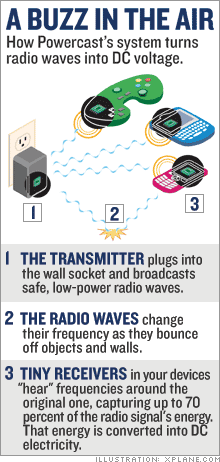 Picture your cell phone charging up the second you sit down at your desk, and you start to get a sense of the opportunity. How big can it get? "The sky's the limit," says John Shearer, Powercast's founder and CEO. He estimates shipping "many millions of units" by the end of 2008.
For years, electricity experts said this kind of thing couldn't be done. "If you had asked me seven months ago if this was possible, I would have said, 'Are you dreaming? Have you been smoking something?'" says Govi Rao, vice president and general manager of solid-state lighting at Philips. "But to see it work is just amazing. It could revolutionize what we know about power."
So impressed was Rao after witnessing Powercast's demo last summer that he walked away jotting down a list of the industries to which the technology could immediately be applied: lighting, peripherals, all kinds of handheld electronics. Philips partnered with Powercast last July, and their first joint product, a wirelessly powered LED light stick, will hit the market this year. Computer peripherals, such as a wireless keyboard and mouse, will follow in 2008.
Broadcasting power through the air isn't a new idea. Researchers have experimented with capturing the radiation in radio frequency at high power but had difficulty capturing it at consumer-friendly low power. "You'd have energy bouncing off the walls and arriving in a wide range of voltages," says Zoya Popovic, an electrical engineering professor at the University of Colorado who works on wireless electricity projects for the U.S. military.
That's where Shearer came in. A former physicist based in Pittsburgh, he and his team spent four years poring over wireless electricity research in a lab hidden behind his family's coffee house. He figured much of the energy bouncing off walls could be captured. All you had to do was build a receiver that could act like a radio tuned to many frequencies at once.
"I realized we wanted to grab that static and harness it," Shearer says. "It's all energy."
So the Powercast team set about creating and patenting that receiver. Its tiny but hyperefficient receiving circuits can adjust to variations in load and field strength while maintaining a constant DC voltage. Thanks to the fact that it transmits only safe low wattages, the Powercast system quickly won FCC approval--and $10 million from private investors. Powercast says it has signed nondisclosure agreements to develop products with more than 100 companies, including major manufacturers of cell phones, MP3 players, automotive parts, temperature sensors, hearing aids, and medical implants.
The last of those alone could be a multibillion-dollar market: Pacemakers, defibrillators, and the like require surgery to replace dead batteries. But with a built-in Powercast receiver, those batteries could last a lifetime.
"Everyone's looking to cut that last cord," says Alex Slawsby, a consultant at Innosight who specializes in disruptive innovation. "Think of the billion cell phones sold last year. If you could get Powercast into a small percentage of the high-end models, those would be huge numbers."
Could Powercast's technology also work for larger devices? Perhaps, but not quite yet. Laptop computers, for example, use more than 10 times the wattage of Powercast transmissions.
But industry trends are on Shearer's side: Thanks to less energy-hungry LCD screens and processors, PC power consumption is slowly diminishing. Within five years, Shearer says, laptops will be down to single-digit wattage--making his revenue potential even more electrifying.
Now this is pretty innovative. I've heard of people working on wireless solutions for bulk power transmission to replace power lines, but with little success (while theoretically possible, it's too difficult to wirelessly transmit high enough wattages safely, if I understand the hurdles correctly). This solution for small wattages over short distances seems like a good application of this kind of technology though.
There's a video of the Powercast technology on display at the CES 2007 conference back in January from CNET here. (And no, this isn't an April Fool's day joke!)
[Image credits: CNNMoney.com.]
[A hat tip to Jenny]






