New innovations in energy storage, transmission, and the integration of variable electricity sources are necessary to enable renewable energy sources to contribute significantly to the U.S. energy supply, according to a new report from the American Physical Society.
Establishing national policies to spur the deployment and adoption of renewable electricity sources, such as wind and solar power, are important, but the scientists warn that research and innovation must also proceed in parallel on better energy storage technologies, new strategies for integrating the varying and intermittent output of these energy sources, and improved technologies for the long-distance transmission of renewable electricity.
According to APS:[W]ithout the focus on storage devices, it will be difficult to meet proposed renewable electricity standards, the report asserts. Wind and solar energy are variable by nature: The sun doesn't always shine, and the wind doesn't always blow. The amount of electricity a consumer has available to complete household chores could change in a matter of seconds, hours or days—placing great importance on the need for robust storage methods.
The report, titled "Integrating Renewable Electricity on the Grid," was released this week by the American Physical Society's Panel on Public Affairs. For more the the report's recommendations, see here.
Another challenge facing the grid involves the long-distance transmission of renewable electricity from places that receive a lot of wind and sun to those that do not. "We need to move faster to have storage ready to accommodate, for example, 20 percent of renewable electricity on the grid by 2020," said George Crabtree, co-chairman of the POPA study panel and a senior scientist at Argonne National Laboratory. "And, by devoting the necessary resources to the problem, I am confident that we can solve it."
The report addresses variability and transmission issues by urging the U.S. Department of Energy (DOE) to increase research on materials to develop energy storage devices and by encouraging the DOE to focus on long-distance superconducting direct current cables to bring renewable electricity to load centers, lessening the chance that power will be disrupted. The report also calls for examining renewable electricity in light of a unified grid instead of one that is fragmented and improving the accuracy of weather forecasts to allow for better integration of renewable electricity on the grid.

Wednesday, November 17, 2010
Scientists: Innovation Needed on Energy Storage, Grid


Thursday, August 19, 2010
Does New Republican Bill Signal Bipartisan Support for Clean Energy Investment?
 By Jesse Jenkins, originally at the Breakthrough Institute
New legislation introduced by Republican Representative Devin Nunes (CA) and backed by several GOP House members would invest billions into renewable energy deployment, signaling an opportunity for bipartisan support for clean energy technology policies.
Over at CNBC, reporter Trevor Curwin has been one of the first to note the significance of the Republican bill, which Nunes' says could "potentially provide hundreds of billions in financing" for renewable energy over the next several decades.
Rep. Devin Nunes' (R-Calif.) who introduced the bill, in late July, wants to use a reverse auction process to allocate future federal oil royalties to the best renewable energy projects and technologies, with the lowest-price-per-megawatt, (MW), bid winning funding.As Curwin notes, Nunes' plan would rely solely on new revenues from oil and gas leasing to fund the renewable energy investments, including the always contentious proposals to open up areas of the Arctic National Wildlife Refuge as well as the development of oil shale resources and expanded offshore drilling. While more offshore drilling enjoyed bipartisan support just months ago, in the wake of the BP Deepwater Horizon disaster in the Gulf, the prospects for new offshore oil and gas production are uncertain.
"It's clear and transparent; the people with the best technology will get the help," Nunes says of the bill, dubbed "A Roadmap for America's Energy Future,"
Depending on how much territory is eventually opened up to drilling, research firms estimate the royalties could be worth $10 billion to $50 billion a year.
But there are other ways to fund the renewable energy investments Rep. Nunes' and his GOP colleagues envision. Curwin quotes my recent suggestion, along with Breakthrough's Yael Borofsky, that a small fee on each barrel of oil sold could do the trick.
A $5 per barrel fee on all oil consumed in the United States, for example, would raise roughly $40 billion annually for critical national investments in clean energy technologies and industries, and would increase gasoline prices by just 12-15 cents per gallon. That's in the regular 'noise' of gas price fluctuations, which have risen or fallen by 15 cents or more on 14 different occasions in the last two years, according to data from the U.S. Energy Information Administration.
Other alternatives include a very modest fee on carbon pollution ($5 per ton would raise roughly $30 billion annually and increase gas prices by less than a nickel per gallon) a wires fee on electricity sales ($10 billion could be raised annually without costing the average household more than $5 per month on their utility bills), the sunsetting of well-worn subsidies for mature energy sources (including oil, coal, corn ethanol and probably even wind power), or some combination of the above.
At the end of the day, the choice of revenue raiser is important, but not the central issue. With representatives on both sides of the aisle now recognizing the importance of national investments in clean, American energy sources, new opportunities for bipartisan progress on clean energy may be possible where efforts to pass contentious cap and trade legislation have repeatedly failed.
As I told CNBC, Nunes' proposal is a positive step forward, a sign that smart investments to boost U.S. clean energy production, spur innovation to reduce the price of emerging clean energy technologies, and strengthen America's clean energy industries and entrepreneurs are all points that can enjoy bipartisan consensus.
On it's own, a program for strategic, competitive deployment incentives to spur clean energy adoption, similar to that proposed by Rep Nunes and his colleagues, could be a key component of a 21st century clean energy strategy.
A comprehensive strategy to make clean energy cheap and abundant and ensure American leadership in clean energy markets would also include key public investments in clean energy research, energy science and engineering education, advanced manufacturing, and enabling infrastructure, each areas that both Republicans and Democrats can support.
Regardless of what you believe about the urgency or importance climate change, we can agree that making more clean, American energy, making it more affordable, and making it right here in the USA are all in the national interest.
See also:
$40 billion for clean tech at 12 cents per gallon? Yeah, why not?
Time to Bury Cap and Trade and Plan Anew
After "Drill, Baby, Drill," Obama Should Embrace Another GOP Energy Plan Read more!
Wednesday, August 18, 2010
Bucking the Debate: Clean Energy Industrial Policies At Work
 By Matthew Stepp, Breakthrough Fellow, originally posted at the Breakthrough Institute
A vigorous debate about whether the U.S. government should invest in and help manage clean energy industries to spur economic growth is unfolding among academics, policy makers and business leaders. Curiously, a handful of federal, state, and local government officials are forging ahead in spite of the national discussion and formulating targeted industrial policies to create vibrant clean energy innovation ecosystems that include manufacturing, material suppliers, customers, and R&D. Cases like Rioglass Solar, a Spanish glass manufacturer expanding operations in Arizona, as well as the considerable growth of the wind industry across the US show how the public and private sector can collaborate and, more importantly, how effective industrial policy can create well-paying, long-term jobs.
This past week Rioglass Solar, which provides curved glass sheets used in solar panels, decided to build a $50 million headquarters and a 130,000 square foot manufacturing plant in Surprise, Arizona. The project will create 100 new jobs at the headquarters alone and many more in the manufacturing plant - a welcome economic boost for the town.
The chief incentive for the American operations expansion? Local, state, and federal officials provided almost $12 million in tax credits and fee reductions to (successfully) lure Rioglass to the area.
Additionally, a recent analysis of the emerging U.S. wind energy industry found that since 2004 over 200 wind turbine component manufacturing facilities have opened and the number of domestic wind energy companies has tripled. The wind industry's installed energy capacity has rapidly grown from 6.7 MW in 2004 to 35,000 MW in 2009 and expansion continues.
In fact, as the report explains, the expansion of the wind industry has been national in scope:"The U.S.'s wind manufacturing ecosystem extends from coast to coast and border to border. There are online or planned facilities in rust belt states like Michigan and Ohio, Midwest states like Kansas and Iowa, where youthful rural populations now have an alternative to moving to urban centers for opportunity, and in Southern states like Texas and Arkansas, where manual labor now has an alternative to unemployment."
The chief incentive for the expansion of domestic wind manufacturing - the $2.3 billion Advanced Energy Manufacturing Tax Credits (AEMC) funded through the 2009 American Recovery and Reinvestment Act -- provided support for 183 individual projects and led to $5.4 billion in private investment.
Both Rioglass Solar and the U.S. wind energy industry are shining examples of how government industrial policy can work. In both cases, specific public investments are being made, not to pursue a narrow technology goal like some skeptics worry, but to ensure that a host of clean technology companies have the ability to innovate, compete, and grow in the global free market.
Thus, the real debate should not be on whether industrial policy is good or bad, but what shape it should take. Local actions in Arizona and the one-time funded federal energy manufacturing tax credit should be just a start.
It's time to kick these policies into high gear and luckily, clean energy industrial policy may have a key advocate - President Barack Obama.
A recent Businessweek article dubbed the President "Clean Energy's Venture Capitalist-in-Chief," thanks to his plans to channel $69 billion in tax credits, low interest loans, grants, consumer tax credits, and R&D to thousands of clean tech companies across the clean energy spectrum through 2011. But while these incentives are critical, their short-term focus will not create the market stability necessary to advance sustained growth in the clean tech sector.
A spokesperson for the American Wind Energy Association (AWEA) explains: "...effective manufacturing incentives [like the AEMC] need to be coupled with a stable, long-term market and even strong programs like [AEMC] can't revitalize the sector if we don't create a market."
The next step for the so-called Capitalist-in-Chief is to make these policies explicit U.S. industrial policy, not just one-time stimulus efforts. Investments and incentives need to be expanded in the long term and centered around growing the "clean energy innovation ecosystems" that are emerging across the country. A long-term strategy would provide a clear signal to private investors that a clean energy economy is a priority for the U.S.
Even with Congress's failure to pass comprehensive energy legislation, a clean energy economy is still a very real possibility once the national debate internalizes already effective industrial policy advances -- as exemplified by wind industry growth and Rioglass Solar -- and focuses on how best to implement sound national industrial policy. Limited local and state policies along with short-term federal funds can only go so far given the competition from countries like China, which may dedicate as much as $740 billion over the next ten years toward building a clean energy industry. It's time for the federal government to consistently and fully support the progress local and state governments are making in order to ensure a robust green economy.
See Below For More on the Breakthrough Institute's series on the National Industrial Policy Debate:
A Needed Debate on Industrial Policy
In Defense of Andy Grove: Toward a More Effective Industrial Policy
In Defense of Bill Gates: Investing in Clean, Cheap Energy
Thursday, April 01, 2010
Solar Power Industry Trends From An Installer's Point of View
Having been in the renewable energy and solar power industries for the last 10 years, I often get asked about what the future holds. Whether you are interested for investment purposes or general curiosity, I would say in the general the future is extremely bright for clean energy. Here are some things that we see coming in the next 5 to 10 years that will shape the markets for the industry, and specifically solar power.
Feed-in-Tariffs Will Proliferate
The most widely used model for encouraging solar power installations now is giving rebates for installed watts. The problem with this model is that it doesn't actually give incentives for producing more clean energy, which after all is the point. Installed watts don't always translate to produced watts due to installation issues and equipment efficiencies.
 (courtesy Sharp Electronics)
This is where feed-in tariffs come in. This actually rewards the solar power producer by paying them a rate for the electricity they feed back in to the grid at 3-4x the actual retail rate. So some homes might be paying $0.11/kw-hr for power but selling power back to the grid for $.45/kw-hr that is produced by their solar panels. This can produce a profit and much faster return on investment for the system.
Most importantly, this method actually encourages clean energy production (instead of just installation) and energy efficiency, since reducing the building's consumption will increase the profitability of the solar power system.
Feed-in tariffs have been wildly successful in Germany, making it number one in terms of installed watts in the world. We have seen several programs in Florida, California, and Ontario get implemented with success over the past 5 years. There are similar initiatives in New Jersey, Michigan, and several other states.
Look for these programs to proliferate over the next decade, driving the demand for all sizes of solar power systems higher.
Solar Components Are Changing Rapidly
The next 5 to 10 years will be shaped in part by the technology advancements that we are seeing now. All solar power systems require additional components like racking, inverters, and sometimes batteries. This is where we are seeing serious shifts in technology.
The advent of the micro-inverter has altered solar power significantly. Before, all systems required a large centralized inverter to alter and condition the power that panels produce so that it can be fed to the grid. This system worked fairly well, but the expense of the inverter and the performance of the panels could negatively affect the project's economics.
 An Enphase Micro-Inverter, with solar panel. (courtesy Enphase)
The micro inverter actually alters and conditions the power directly as it comes out of the panel. This means that power from each panel can be monitored and optimized, and it means that a solar power system of any size is now available. With centralized inverters, which cost upwards of $2000, it made sense to install at least a $10,000 solar power system to cover the cost of the inverter. Now, with micro inverters costing less than $200 in some cases, homeowners can install one panel, and expand as much as they like.
And solar panel manufacturers, like Sunpower, Sharp, and Mitsubishi, are getting into the act and building the inverter right into the panel. This gives much more flexibility to the solar power systems available and open up the market to millions more customers.
Power Storage Will Get Better
One central issue facing all renewable energy sources is storage. After all we need power when the sun's not shining and the wind is not blowing, right? Rapid advancement in this sector will drive growth industry-wide, as century old technology (like lead-acid batteries) will be replaced.
Several universities, including MIT and Stanford, are dedicating tens of millions of dollars to research and development of battery technology. Advancements in the technology are making the batteries lighter, more affordable, and environmentally friendly.
Some of the emerging technologies are in heavy duty Lithium Ion batteries (already used in small electronic applications), and ultra-capacitors. Check out this article for more information on ultra-capacitors.
With these advancements in technology and policy, the future for solar power and renewable energy is indeed bright!
Kriss Bergethon is a solar power professional and writer from Colorado. Read more!
Wednesday, March 31, 2010
The Limits of Earth Hour
 Cross posted from The Real Ewbank.
Of all the news and commentary I read about Earth Hour in Australia, not once did I see a mention of the billions of people that now live in energy poverty. Event organizers and commentators failed to discuss the fact that while millions of people around the world symbolically switched off their lights for one hour, billions are desperate to turn their lights on.
According to the Baker Institute at Rice University:
“…roughly 1.6 billion people, which is one quarter of the global population, still have no access to electricity and some 2.4 billion people rely on traditional biomass, including wood, agricultural residues and dung, for cooking and heating. More than 99 percent of people without electricity live in developing regions, and four out of five live in rural areas of South Asia and sub-Saharan Africa.”
For an event that professes to support climate change solutions, one would think that addressing energy poverty without wrecking our climate would feature prominently in Earth Hour campaigning. So why was energy poverty ignored? And what does this say about the environmental thinking that informed Earth Hour?
 The Earth Hour event spearheaded by the WWF rightly draws attention to the adverse impact of our carbon-intensive energy economies. However, it presents a misleading picture of the cause of climate change and its solutions. Energy consumption it not the problem, it’s the use of specific energy sources like coal, gas and oil that must be stopped. This objective will not be achieved by switching off the lights. It will be achieved by a comprehensive renewable energy policy that seeks to make clean energy cheap, as soon as possible. By asking the community to switch off the lights and other energy consuming devices for one hour, the campaign wrongly communicates electricity consumption as the main cause of climate change.
While supporters of Earth Hour might argue that climate solutions involve more than turning off the lights, the big switch off remains the central message communicated by the event. WWF’s decision to frame climate change as a problem of pollution from energy consumption excludes the other drivers of climate change, including deforestation, agricultural practices, the design of our cities, and structure of our economies, to name a few. The narrow problem definition obscures the multiple causes of climate change, barriers to action, and the creative solutions to address them.
The WWF’s Earth Hour campaign reflects what the Breakthrough Institute’s Ted Nordhaus and Michael Shellenberger call the ‘pollution paradigm’—a mindset where human actions are understood as harmful intrusions that pollute environments that are constructed as pure, natural, distinct and separate from humans. Within this model the aim of environmental action, or in this case Earth Hour, logically seeks to limit and control such intrusions. This paradigm and its tacit assumption that humans are not environment helps explain why the Earth Hour campaign fails to account for the billions who live without energy.
This thinking is still prevalent in environmental thought and action, and has no doubt motivated the anti-Earth Hour backlash. Created by the US based libertarian think tank the Competitive Enterprise Institute, and promoted in Australia by the Conservative Leadership Foundation, Human Achievement Hour seeks to reframe energy use as a symbol of human greatness, not sin. It is a conservative rejection of a moralizing climate change discourse that promotes self sacrifice and the notion that humans ought to be ashamed of enjoying the benefits of a modern economy. Some environmentalists will dismiss the conservative critique that Earth Hour ignores human achievement as more right wing madness, reminiscent of the US Tea Party movement. Yet, the conservative claim is valid, and environmentalists ignore it at their peril.
Of course it’s worthwhile to consider human achievement, but contrary to the Competitive Enterprise Institute’s belief, our civilization’s use of energy is only a partial success. How can we celebrate Human Achievement Hour when so many live without access to electricity? By this measure the Competitive Enterprise Institute is as guilty as WWF for failing to mention the poor (although they do so for different reasons). And the ideological battle between old environmentalism and modern conservatism does nothing more than obscure the challenge of poverty further.
So is their hope for Earth Hour? Can it adapt to account for energy poverty? I think it can. With some simple changes to its messaging, WWF can reframe the event and break out of the narrow environmental thinking that constrains it. By embracing a platform of sustainable development WWF can present the symbolic act as a way of experiencing the energy poverty that billions endure every day. The campaign would then elevate the need to make clean energy cheap to overcome the dual challenges of poverty and climate change.
Regardless of how you spent last Saturday night, whether it involved Earth Hour, Human Achievement Hour, both, or neither, we must ensure that energy poverty receives the attention it deserves in the future. Until renewable energy is cheaper than coal and other fossil fuels, developing nations are destined to build carbon-intensive energy infrastructures, making it more difficult for the world to limit climate changes. We must build a campaign around powering the world with renewable energy so we can celebrate our earth and human achievement every day.
And another thing…
Regardless of whether you agree with the conservative critique of Earth Hour, the arguments put forward by Human Achievement Hour have the potential to appeal to large swathes of the public. It takes no stretch of the imagination to see that people might be attracted to an event that is free from guilt. Does the environment movement really want to be associated with turning the power off, especially now that there is an opponent that has claimed to represent human progress and modern living? The emergence of this group demonstrates that a campaign built on the foundation of a pollution paradigm is limited in its ability to reach new audiences and attract support from across the political spectrum.
Saturday, February 06, 2010
The Cleantech Revolution: “Largest Market Opportunity in the History of the Planet”?
 By Ishan Nath
Cross-posted from LeadEnergy.org
A special three-part series in last week's San Jose Mercury News, entitled "The Cleantech Revolution," highlighted the enormous economic opportunity in the clean-tech sector and warned that the U.S. is quickly falling behind while Asia seeks to gain global market dominance.
In its analysis of the clean technology market, the Mercury's rhetoric is grand and its data convincing. The first part of the series begins:
“Cleantech is poised to be the valley's third great wave of innovation — not just the next big thing, but perhaps the biggest thing ever. Confronting the peril of greenhouse gases and climate change happens to be a multi-trillion-dollar business opportunity.”
The numbers provided support this claim: U.S. yearly utility bills exceed $1 trillion annually and the global energy and transportation market is estimated at $7 trillion. The wind and solar industries -- valued at $80 billion in 2008 -- are projected to triple in 10 years and employ 2.6 million people. Smart-grid technology, according to Morgan Stanley, will grow to $100 billion by 2030 and Cisco Systems believes smart-grid communications infrastructure could be worth $20 billion in the next 5 years.
In a nod to its geographic location, the paper focuses primarily on Silicon Valley's role in the industry. And local experts have a strong take on the subject:
"When it comes to cleantech, we have the largest market opportunity in the history of the planet driven by global climate change, resource constraints and energy independence," said Dallas Kachan, managing director of Cleantech Group. "Silicon Valley is critical to this revolution, but it does not occupy the throne it once did."
"Energy is the biggest opportunity Silicon Valley has ever seen," declared T.J. Rodgers, the founder of Cypress Semiconductor and chairman of SunPower, a leading maker of photovoltaic panels to produce solar energy.
Much of the progress being made in the U.S. can be attributed to venture-capital funding, a development for which the Mercury has encouraging news. Venture capital investment in clean-technology grew from 3% to 25% of overall investment over the last few years, expanding from $908 million in 2002 to $8.5 billion in 2008. Significantly, California garnered 40% of the world's funding in 2009. The Bay Area's 7,000 renewable energy jobs make it the country's biggest hotspot.
So with all this venture-capital flowing in, the American cleantech industry must be in good position, right? Wrong. The Mercury makes a strong appeal for the alarm bells to start going off in Washington about the state of American competitiveness.
The report declares:
“In other tech revolutions of recent decades, Silicon Valley became the uncontested global leader. The region's ability to innovate its way to the top in cleantech, though, is far from guaranteed. Competition is fierce and global, with trillions of dollars at stake.”
True, the Valley has benefited from venture capital funding and has built-in advantages with decades of expertise in semiconductors and software - vital to solar energy production and grid integration strategies - but there are simply too many disadvantages to ignore.
For one thing, the American education system isn't doing the clean energy revolution any favors, as noted venture capitalist Vinod Khosla observes:
"We (in Silicon Valley) don't have a natural advantage in talent — like chemical engineers, fermentation experts, engine designers and physicists."
This statement underscores the urgency for RE-ENERGYSE, the comprehensive energy education proposal from the Department of Energy that a growing number of organizations are mobilizing behind. But solving the problem doesn't end there.
Like several other sources -- including "Rising Tigers, Sleeping Giant," the first comprehensive comparison of Asian vs. U.S. clean-tech competitiveness -- this report outlines the extensive foreign investment in clean-energy, particularly in China. Pointing to annual investment in excess of $100 billion, renewable energy requirements, and tax incentives, the Mercury shows how China has already overtaken the lead in key markets such as solar. Once again, testimony backs the evidence, starting with a prominently supported letter to Energy Secretary Steven Chu.
A group of valley tech executives, including former Intel CEO Andy Grove, recently sent a letter to Chu urging the energy secretary to "sound the alarm bell to make America aware — clearly and unequivocally — of how rapidly other nations, particularly China, are moving on clean energy.
"Unless we move quickly and commit substantial resources on a sustained basis, we risk becoming an energy also-ran, and risk developing a new dependency," said the letter
Only 5 of the world's top 30 wind, solar, and battery companies are in the United States. And on the current trajectory of only about $4 billion in annual federal investment in clean energy R&D -- far below the $15 billion recommended by Nobel Laureate scientists -- that trend will continue:
"Unless there's a dramatic shift in national policy in the United States, the road to success in cleantech most likely goes through Beijing," said Matthew Lewis, spokesman for the San Francisco office of ClimateWorks Foundation, an international philanthropic network that promotes clean energy. "From a policy perspective, they are doing everything right."
And as the U.S. continues not to do everything right, the need for investment remains so acute because the technologies are still so new.
Every aspect of cleantech "needs new science," said Kevin Surace, CEO of Serious Materials.
Without adequate federal funding, this new science will come out of Beijing, as the Chinese aim to use "cleantech as a gold rush that will propel Chinese companies to world-domineering status.”
This prospect need not be seen entirely as a threat as Peggy Liu, founder of the Joint US-China Collaboration on Clean Energy, sees it: "I'm afraid people are setting up China as the enemy," she said. "You need to treat China like a partner."
Liu is probably right: clean-energy development is not a zero-sum game and US-China cooperation could benefit from the competitive advantages in both countries.
But the way it stands right now, the United States is standing still while other countries take advantage of "not just the next big thing, but perhaps the biggest thing ever." Read more!
Tuesday, November 10, 2009
VIDEO: Jumpstart Clean Energy with a National Institutes of Energy
Thanks to Senator Brown's staff for providing this video of the September briefing on the Hill releasing a paper I co-authored with Avi Zevin and Josh Freed of Third Way's clean energy program, "Jumpstarting a Clean Energy Revolution with a National Institutes of Energy" (pdf).
Senator Sherrod Brown of Ohio and Congressman Rush Holt of New Jersey joins Matt Bennett and Josh Freed of Third Way and Ted Nordhaus and Michael Shellenberger of the Breakthrough Institute in this video to call for a dramatic scale-up in federal funding for clean energy innovation and create a new federal institution singularly focused on the kind of research and development that can make clean energy cheap and abundant, enable deep cuts in global warming pollution, and finally secure our nation's energy independence.
For more on the need for a major scale-up in federal R&D investments and the need for a National Institutes of Energy, see archives here.
Friday, October 23, 2009
Friday Factoids: So You Want To Spur a Clean Energy Revolution?
Originally at the Breakthrough Institute
Friday Factoids time again...
As President Obama challenges the U.S. to lead in the global clean energy race today, here's a quick comparison of methods that can drive clean energy deployment. Which do you think will be more effective...
- Average CO2 prices under the cap and trade system that would be implemented by the House-passed Waxman-Markey bill are expected to be roughly $15 per ton average through 2020.
Ignoring for a moment free allocations that could undermine these permits, that will raise the price of coal-fired power plants and natural gas fired power plants against which clean energy must compete by roughly $15 per MWh and $8 per MWh respectively. A typical coal plant emits roughly 1 ton CO2 per MWh and a natural gas plant emits about 40% less. - The production tax credit that has driven the rapid expansion of the wind industry (when it isn't expiring every other year...) drives down the cost of wind power by roughly $20 per MWh.
- Feed-in tariffs responsible for rapid growth of the solar industry in Germany lower the net cost of solar power by over 50 cents per kilowatt-hour, or $500 per MWh. In the U.S., an investment tax credit nocks off a full 30% of the cost of solar projects and state-level incentives offer even greater support in big solar states like California, Pennsylvania and New Jersey. The value of solar renewable energy credits (SRECs) supplied to solar energy generators in New Jersey has averaged well above $400 per MWh over the last few years.
- This year and next, new wind, solar and other renewable energy projects can enjoy a cash grant in lieu of these tax credits worth 30% of the total cost of the projects, funded through the stimulus bill. That incentive is expected to drive up to $10 billion in grants supporting over $33 billion in clean energy projects.
Click to enlarge
*All figures in this post are approximate and meant for comparison purposes only. Read more!
SPEECH: Obama Challenges Americans to Lead in Clean Energy Technology
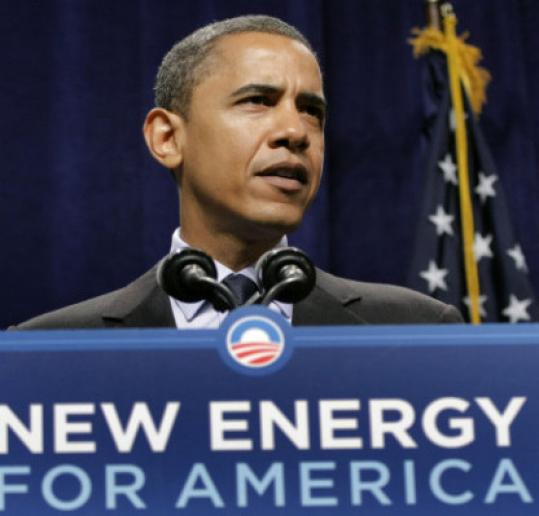 Quick post with the text of President Obama's speech today at MIT, challenging Americans to lead the global economy in clean energy technology.
Once again dead-on rhetoric from Obama, but absolutely no indication that there's a real commitment to the kind of policies that will give the U.S. an edge in the global clean energy race. With China, Japan, South Korea, the EU and many more racing ahead with real policy support for clean energy technology development and demonstration, manufacturing, and direct and targeted incentives for the deployment of a suite of emerging technologies, the economic stakes are high and time is short.
America elected Obama to deliver on his rhetoric. Not to deliver more rhetoric. The Senate is crafting the bill that could win or lose the global clean energy race right now. That bill will either turn Obama’s rhetoric into reality, or prove it nothing much more than inspirational speaking. What’s it going to be?
Here's the text of President Obama's remarks (I've cut out all the introductory remarks and thank yous and yatta yattas...)
REMARKS BY THE PRESIDENT CHALLENGING AMERICANS TO LEAD THE GLOBAL ECONOMY IN CLEAN ENERGY
Massachusetts Institute of Technology
Boston, Massachusetts
12:44 P.M. EDT
THE PRESIDENT: Thank you very much. Please, have a seat. Thank you. Thank you, MIT. ...
[SNIP]
Now, Dr. Moniz is also the Director of MIT's Energy Initiative, called MITEI. And he and President Hockfield just showed me some of the extraordinary energy research being conducted at this institute: windows that generate electricity by directing light to solar cells; light-weight, high-power batteries that aren't built, but are grown -- that was neat stuff; engineering viruses to create -- to create batteries; more efficient lighting systems that rely on nanotechnology; innovative engineering that will make it possible for offshore wind power plants to deliver electricity even when the air is still.
And it's a reminder that all of you are heirs to a legacy of innovation -- not just here but across America -- that has improved our health and our wellbeing and helped us achieve unparalleled prosperity. I was telling John and Deval on the ride over here, you just get excited being here and seeing these extraordinary young people and the extraordinary leadership of Professor Hockfield because it taps into something essential about America -- it's the legacy of daring men and women who put their talents and their efforts into the pursuit of discovery. And it's the legacy of a nation that supported those intrepid few willing to take risks on an idea that might fail -- but might also change the world.
Even in the darkest of times this nation has seen, it has always sought a brighter horizon. Think about it. In the middle of the Civil War, President Lincoln designated a system of land grant colleges, including MIT, which helped open the doors of higher education to millions of people. A year -- a full year before the end of World War II, President Roosevelt signed the GI Bill which helped unleash a wave of strong and broadly shared economic growth. And after the Soviet launch of Sputnik, the first artificial satellite to orbit the Earth, the United States went about winning the Space Race by investing in science and technology, leading not only to small steps on the moon but also to tremendous economic benefits here on Earth.
So the truth is, we have always been about innovation, we have always been about discovery. That's in our DNA. The truth is we also face more complex challenges than generations past. A medical system that holds the promise of unlocking new cures is attached to a health care system that has the potential to bankrupt families and businesses and our government. A global marketplace that links the trader on Wall Street to the homeowner on Main Street to the factory worker in China -- an economy in which we all share opportunity is also an economy in which we all share crisis. We face threats to our security that seek -- there are threats to our security that are based on those who would seek to exploit the very interconnectedness and openness that's so essential to our prosperity. The system of energy that powers our economy also undermines our security and endangers our planet.
Now, while the challenges today are different, we have to draw on the same spirit of innovation that's always been central to our success. And that's especially true when it comes to energy. There may be plenty of room for debate as to how we transition from fossil fuels to renewable fuels -- we all understand there's no silver bullet to do it. There's going to be a lot of debate about how we move from an economy that's importing oil to one that's exporting clean energy technology; how we harness the innovative potential on display here at MIT to create millions of new jobs; and how we will lead the world to prevent the worst consequences of climate change. There are going to be all sorts of debates, both in the laboratory and on Capitol Hill. But there's no question that we must do all these things.
Countries on every corner of this Earth now recognize that energy supplies are growing scarcer, energy demands are growing larger, and rising energy use imperils the planet we will leave to future generations. And that's why the world is now engaged in a peaceful competition to determine the technologies that will power the 21st century. From China to India, from Japan to Germany, nations everywhere are racing to develop new ways to producing and use energy. The nation that wins this competition will be the nation that leads the global economy. I am convinced of that. And I want America to be that nation. It's that simple. (Applause.)
That's why the Recovery Act that we passed back in January makes the largest investment in clean energy in history, not just to help end this recession, but to lay a new foundation for lasting prosperity. The Recovery Act includes $80 billion to put tens of thousands of Americans to work developing new battery technologies for hybrid vehicles; modernizing the electric grid; making our homes and businesses more energy efficient; doubling our capacity to generate renewable electricity. These are creating private-sector jobs weatherizing homes; manufacturing cars and trucks; upgrading to smart electric meters; installing solar panels; assembling wind turbines; building new facilities and factories and laboratories all across America. And, by the way, helping to finance extraordinary research.
In fact, in just a few weeks, right here in Boston, workers will break ground on a new Wind Technology Testing Center, a project made possible through a $25 million Recovery Act investment as well as through the support of Massachusetts and its partners. And I want everybody to understand -- Governor Patrick's leadership and vision made this happen. He was bragging about Massachusetts on the way over here -- I told him, you don't have to be a booster, I already love the state. (Applause.) But he helped make this happen.
Hundreds of people will be put to work building this new testing facility, but the benefits will extend far beyond these jobs. For the first time, researchers in the United States will be able to test the world's newest and largest wind turbine blades -- blades roughly the length of a football field -- and that in turn will make it possible for American businesses to develop more efficient and effective turbines, and to lead a market estimated at more than $2 trillion over the next two decades.
This grant follows other Recovery Act investments right here in Massachusetts that will help create clean energy jobs in this commonwealth and across the country. And this only builds on the work of your governor, who has endeavored to make Massachusetts a clean energy leader -- from increasing the supply of renewable electricity, to quadrupling solar capacity, to tripling the commonwealth's investment in energy efficiency, all of which helps to draw new jobs and new industries. (Applause.) That's worth applause.
Now, even as we're investing in technologies that exist today, we're also investing in the science that will produce the technologies of tomorrow. The Recovery Act provides the largest single boost in scientific research in history. Let me repeat that: The Recovery Act, the stimulus bill represents the largest single boost in scientific research in history. (Applause.) An increase -- that's an increase in funding that's already making a difference right here on this campus. And my budget also makes the research and experimentation tax credit permanent -- a tax credit that spurs innovation and jobs, adding $2 to the economy for every dollar that it costs.
And all of this must culminate in the passage of comprehensive legislation that will finally make renewable energy the profitable kind of energy in America. John Kerry is working on this legislation right now, and he's doing a terrific job reaching out across the other side of the aisle because this should not be a partisan issue. Everybody in America should have a stake -- (applause) -- everybody in America should have a stake in legislation that can transform our energy system into one that's far more efficient, far cleaner, and provide energy independence for America -- making the best use of resources we have in abundance, everything from figuring out how to use the fossil fuels that inevitably we are going to be using for several decades, things like coal and oil and natural gas; figuring out how we use those as cleanly and efficiently as possible; creating safe nuclear power; sustainable -- sustainably grown biofuels; and then the energy that we can harness from wind and the waves and the sun. It is a transformation that will be made as swiftly and as carefully as possible, to ensure that we are doing what it takes to grow this economy in the short, medium, and long term. And I do believe that a consensus is growing to achieve exactly that.
The Pentagon has declared our dependence on fossil fuels a security threat. Veterans from Iraq and Afghanistan are traveling the country as part of Operation Free, campaigning to end our dependence on oil -- (applause) -- we have a few of these folks here today, right there. (Applause.) The young people of this country -- that I've met all across America -- they understand that this is the challenge of their generation.
Leaders in the business community are standing with leaders in the environmental community to protect the economy and the planet we leave for our children. The House of Representatives has already passed historic legislation, due in large part to the efforts of Massachusetts' own Ed Markey, he deserves a big round of applause. (Applause.) We're now seeing prominent Republicans like Senator Lindsey Graham joining forces with long-time leaders John Kerry on this issue, to swiftly pass a bill through the Senate as well. In fact, the Energy Committee, thanks to the work of its Chair, Senator Jeff Bingaman, has already passed key provisions of comprehensive legislation.
So we are seeing a convergence. The naysayers, the folks who would pretend that this is not an issue, they are being marginalized. But I think it's important to understand that the closer we get, the harder the opposition will fight and the more we'll hear from those whose interest or ideology run counter to the much needed action that we're engaged in. There are those who will suggest that moving toward clean energy will destroy our economy -- when it's the system we currently have that endangers our prosperity and prevents us from creating millions of new jobs. There are going to be those who cynically claim -- make cynical claims that contradict the overwhelming scientific evidence when it comes to climate change, claims whose only purpose is to defeat or delay the change that we know is necessary.
So we're going to have to work on those folks. But understand there's also another myth that we have to dispel, and this one is far more dangerous because we're all somewhat complicit in it. It's far more dangerous than any attack made by those who wish to stand in the way progress -- and that's the idea that there is nothing or little that we can do. It's pessimism. It's the pessimistic notion that our politics are too broken and our people too unwilling to make hard choices for us to actually deal with this energy issue that we're facing. And implicit in this argument is the sense that somehow we've lost something important -- that fighting American spirit, that willingness to tackle hard challenges, that determination to see those challenges to the end, that we can solve problems, that we can act collectively, that somehow that is something of the past.
I reject that argument. I reject it because of what I've seen here at MIT. Because of what I have seen across America. Because of what we know we are capable of achieving when called upon to achieve it. This is the nation that harnessed electricity and the energy contained in the atom, that developed the steamboat and the modern solar cell. This is the nation that pushed westward and looked skyward. We have always sought out new frontiers and this generation is no different.
Today's frontiers can't be found on a map. They're being explored in our classrooms and our laboratories, in our start-ups and our factories. And today's pioneers are not traveling to some far flung place. These pioneers are all around us -- the entrepreneurs and the inventors, the researchers, the engineers -- helping to lead us into the future, just as they have in the past. This is the nation that has led the world for two centuries in the pursuit of discovery. This is the nation that will lead the clean energy economy of tomorrow, so long as all of us remember what we have achieved in the past and we use that to inspire us to achieve even more in the future.
I am confident that's what's happening right here at this extraordinary institution. And if you will join us in what is sure to be a difficult fight in the months and years ahead, I am confident that all of America is going to be pulling in one direction to make sure that we are the energy leader that we need to be.
Thank you very much, everybody. God bless you. God bless the United States of America. (Applause.)
END
1:03 P.M EDT
Thursday, October 22, 2009
DIY Solar Part 3: System Components
DIY Solar Part 3: System Components
In our previous posts we talked about the design process and then different kinds of systems to choose from. Now let's talk about the system components that you need to be aware of before tackling a project like this. Many people believe that you just get some panels and wire them into the electrical system. It's not quite that simple.

A typical grid-tie solar power system.
Solar Panels and Film
Of course the most obvious part of the system is the panel. But there are several types of panels to consider.
- Crystalline panels: these are the blue-ish black solar panels that are encased in aluminum and tempered glass to protect them from weather. These are the most common panels and generally the easiest to find. Their advantage is that they can be mounted to nearly any surface and they have the highest efficiency.
- Solar film: these cells look more like rolls of roofing materials than photovoltaic materials. This is probably the future of solar as these are much cheaper to produce. Currently the only solar film that isavailable has to be stuck to a metal roof. This will definitely change in the coming months and years as this technology advances.
Inverters
Solar power makes direct current, or DC power, and your home uses alternating current, or AC, power. An inverter can turn steady stream DC power into wavy AC power. There are several different kinds of inverters and they differ in the kind of wave they create.
- Modified sine wave inverters: create current that resembles connected up and down stair cases, as the inverter creates steps in the current.
- Pure sine wave inverters: these inverters create a nice even up and down sine wave.
- Micro inverters: this is a new development where each panel has its own inverter. This helps in several ways. First it means that you can have a far smaller system to start with since you could wire one panel and one micro inverter and tie into the grid. All other grid-tie inverters require a higher voltage and need at least 1000 watts (or 4 to 8 panels) to work properly. Secondly inverting at the panel means you can use small gauge wire (instead of large diameter wire that DC requires) from the panel to the main power panel, saving money on wire cost.
Sensitive electronics, like entertainment equipment, require a pure wave to operate properly, while smaller electronics, like small kitchen appliances, work just fine with modified wave. Pure sine wave is more expensive but it recommended since we have so many advanced-technology electronics in the home these days like computers, plasma televisions, and stereo equipment.
Charge Controllers
Whenever batteries are present in a solar power system, a charge controller is needed. Most grid-tied system won't have batteries and therefore won't have a charge controller. Controller's are needed because, unlike other power sources that have an off and on switch, solar panels are pretty much 'on' as long as the sun is shining. This can be a problem if the batteries are at full capacity as overcharging them would ruin them. So the charge controller controls how much charge goes into the batteries.

A typical battery-backup grid tie system.
Most controllers are now Multi-Point Power Tracking, or MPPT, units. This a fancy way of saying that the controller optimizes the amperage and voltage in the system to recover the maximum wattage. This is becoming a standard feature and you should not consider a non-MPPT controller.
Control Panels, Disconnects, and Wiring
There are a lot of fuse panels, disconnect switches, and wiring in a solar power system. These are mixed and matched to suit a particular solar power system. Usually there is a disconnect between each component. The wiring can get expensive, so the distances between components should be minimized. DC power runs most efficiently through thick, heavy gauge wire, much like water flows better through larger pipe. The bigger the wire, obviously, the more expensive. So keeping your panels and inverters
Next week we'll talk about system and component costs.
Kriss Bergethon is a writer and solar expert from Colorado. Read more!
Friday, October 09, 2009
National Institutes of Energy Needed to Fill Energy R&D Gap
 Originally at the Breakthrough Institute
Friday factoids time: The U.S. biomedical and pharmaceutical industry invests between 10-20 percent of revenues in R&D and new product development, spending $58.8b on R&D in 2007. The U.S. government adds an additional $30 billion per year investment in biomedical R&D through the National Institutes of Health.
In contrast, the U.S. energy sector invests well below $3 billion annually in R&D in an industry with well over a trillion dollars in annual revenue. The energy sector's R&D spending as a percent of revenues - call that figure the industry's innovation intensity - is just 0.23%. That compares to a national average innovation intensity across all industries of 2.6%, or ten-times greater than the energy-sector's innovation intensity. And it pale sin comparison with the innovation intensity of leading technology and innovation-intensive sectors including biomedical technology (10-20%), information technology (10-15%), and semiconductors (16%).
This downright paltry private-sector energy innovation spending leaves a massive energy innovation gap that the U.S. government barely begins to fill, investing only about $5 billion annually in energy R&D. That's barely more than half the levels spent on public research to pursue clean and affordable energy alternatives during the late 1970s and early 1980s. The scale and urgency of our national energy challenges have clearly grown since then, yet the national commitment to energy innovation has moved in the wrong direction. Public R&D spending on health care ($30b) and defense ($80b) signal the scale of true national innovation priorities and begs the question: when will the U.S. get serious about investments in clean energy innovation? When we do, a new National Institutes of Energy and a major increase in federal energy R&D investments are needed to fill the energy innovation gap and spur a clean energy revolution.
(click either image to enlarge)
For more on a National Institutes of Energy, see our archives here or the following selected content:
- Jumpstarting a Clean Energy Revolution with a National Institutes of Energy - policy report from Breakthrough Institute and Third Way (September 2009).
- "National Institutes of Health: A Model for Jumpstarting Energy R&D"
- "Senator Brown, Leading Energy Think Tanks Push for More Research Investment and New National Institutes of Energy"
- "Jumpstarting a Clean Energy Revolution: A Gathering Global Consensus"
Wednesday, September 23, 2009

Monday, September 14, 2009
EVENT: A National Institutes of Energy: The Clean Energy Revolution Needs R&D

The Breakthrough Institute and Third Way have prepared a new report detailing how the United States can jumpstart a clean energy revolution through investing in research and development and creating a National Institutes of Energy (akin to the NIH) to spur the development of innovative clean energy technologies.
Breakthrough Institute, Third Way, and U.S. Senator Sherrod Brown (D-OH) will be holding a forum detailing the findings of Third Way and the Breakthrough Institute's new paper and describing how a focused program of innovation will help make promising clean energy technologies a reality and create a clean and prosperous energy economy.
Please see the event details below. We hope you can join us for this exciting event!
Event:
A National Institutes of Energy: The Clean Energy Revolution Needs R&D
Date:
Thursday, September 17th
Time:
10:00 - 11:00 am
Coffee will be served
Location:
Dirksen Senate Office Building
SD-G-11
Washington, DC 20002
Please RSVP to rsvp@thirdway.org and indicate this event.
If you have any questions, please contact Jen Pengelly at 202-775-3768 ext. 214 or jpengelly@thirdway.org.
ABOUT THIRD WAY: Third Way is the leading think tank of the moderate wing of the progressive movement. We work with elected officials, candidates, and advocates to develop and advance the next generation of moderate policy ideas. For more information about Third Way please visit www.thirdway.org.
ABOUT THE BREAKTHROUGH INSTITUTE: The Breakthrough Institute is one of America's leading think tanks developing climate and energy policy solutions. Since 2002 Breakthrough has been a pioneering advocate of an innovation-centered approach to the nation's energy and climate challenges, calling for major federal investments to make clean and low-carbon energy technologies cheap and abundant, strengthen America's economic competitiveness and energy security, and slow global warming. For more information, please visit www.thebreakthrough.org
Read more!Tuesday, September 08, 2009
Cheap and Easy Ways to Use Solar Energy
Passive Solar
Passive solar means simply using or blocking the sun's rays to heat or cool your home. This means that using your window coverings wisely can save you a ton on your power bills. Simply closing or angling your blinds to keep direct sunlight out can drop the interior temperature by 10 degrees. Try closing the window coverings on the south side of your house when you leave for the day during the summer months. Without the sun's hot light shining in the windows, your air conditioner won't have to work as hard. And in the winter of course doing the opposite can help heat your house. There tons of great looking blinds, awnings, and window films to help you harness or block the sun's powerful rays.
Exterior Lighting
Lighting the exterior of your home used to be tricky because you had to find a way to get power to the lights. But with the advancement in renewable power technology, these has gotten a lot easier. Solar garden lights, security lights, and area lights now come completely integrated with panel, battery, electronic eye, and lights. Installation is usually as easy as hanging a picture and the prices start at less than $50. So whether you are trying to put some accent lights in your garden, shed some light in your tool shed, or trying to brighten those dark steps, lights powered by the sun are a great alternative.

Portable Chargers
These days we carry so many electronic devices around with us it kind of feels like we are a walking Radio Shack. The hardest part is figuring out how to keep these things charged. Now there are cool-looking portable solar chargers that will keep your iPod or blackberry running in a pinch. They are lightweight, folding, and very durable to handle the rigors of travel and outdoors situations. And if you are indoors and in need of a quick charge most of them will work by simply them putting near a window.
Home and Garden Decor
For your outdoor spaces, solar fountains lend a soothing touch to any setting. All they require is a little water and a sunny spot and they can surround you with pleasant sounds or keep your pond aerated. Solar lamp post lights lend a nice touch to any entry area and tell your arriving guests you have good taste and care about the planet.
Plug and Play Kits
If you need a small power source for your cottage, RV, or to take with you into the wilderness, there are great options out there. There are solar power kits that include the panel, the electronics, instructions, and all the wiring you need to get started. For example, a kit could power a little stereo, light, and charging your phone down at the boathouse or out in the barn. Or they can keep your RV battery charged as you travel around the country. You'll need a screwdriver, the ability to follow instructions, and a sunny place for the panel. Many of the kits start at less than $100 and for $500 you can get a nice little system and expand it later.
So going green doesn't have to break the bank. After all, money is green too right?
Full disclosure: I am an employee of Solar Sphere, which sells products discussed in this post. Read more!
Thursday, September 03, 2009
Wind in Wall Street's Sails: Investment Rushes Into Wind, But Can We Make It Last?
 By Yael Borofsky and Jesse Jenkins, originally posted at the Breakthrough Institute
"The money is coming back,"That's what Ethan Zindler, head of New Energy Finance Ltd, proclaimed to the Wall Street Journal in response to emerging evidence that the government's $3 billion dollar cash grant renewable energy stimulus program is successfully incentivizing private investment in the wind sector.
After falling into the doldrums for the past six-months, the wind industry is roaring back to life thanks to direct public investments enacted in the American Recovery and Reinvestment Act (ARRA), also known as the stimulus bill. A DOE and Treasury-funded cash grant incentive program is helping to grease the pipeline for private investors looking to finance renewable projects, particularly wind farms, slated to begin construction in 2009 or 2010. According to the WSJ, just four weeks into the program $800 million in grants have already been submitted and Wall Street bankers predict that figure to reach $10 billion by the end of 2010.
The cash grant program was created to rescue the clean energy industry, a critical American growth sector, from the malaise of the credit crisis. The tax credits (PTC and ITC) that usually incite clean energy development are worthless in an economic climate where the big financial firms that typically absorb them, on behalf of project developers, are in crisis.
The solution: Congress tucked a two-year cash grant into ARRA worth 30% of qualifying wind, solar, and geothermal project costs, replacing the normal production and investment tax credits. With the money from the program officially flowing since August, the grants are breathing new vigor into clean energy investment, speeding America's economic recovery.
With big players like Morgan Stanley and Citigroup investing $120 million each to finance new wind farms, the wind sector is generating more than clean energy - it's producing clear evidence that public investment really does drive private investment. By covering 30% of a new project's cost, the cash grant program will spur more than two dollars in private investment for every public dollar, successfully leveraging taxpayer money to drive significant private investment in cleaner energy, greater energy security, and accelerated economic recovery.
The projected success of the cash grants, which bankers calculate will lead to 9-15% annual returns per deal, suggests that perhaps, public investment is even more effective at driving private investment than setting an economy-wide carbon price, an oft-suggested strategy to motivate private financing in renewable RD&D.
While this ARRA-funded program has already positively impacted the wind sector (and should have a similar but smaller impact on solar and geothermal), it is important to temper the excitement with prudent acknowledgement that this is a short-term stimulus. A graphic representation of the recent history of wind financing in the U.S. (see below) shows that as successful as the program is shaping up to be, it could prove a fickle friend in the long-term.
Even though the stimulus program appears incredibly effective at coaxing Wall Street to loosen its grip on the capital coffer in the short-term, a long-term deployment strategy, focused on supporting the maturation and development of a suite of clean energy technologies, is essential to sustaining high levels of private investment in the clean energy sector.
In the context of a struggling economy relieved by even the smallest signal that the market is on the upswing, it is difficult to envision the structure of a long-term deployment plan. But it is important to keep in mind three vital factors of any long-term clean energy deployment strategy.
First, the strategy must set forth incentives targeted to individual technologies since all clean energy technologies are not created equal. Incentive levels must buy down the above-market cost of each individual technology so that maximum investment in each technology is possible. Clean energy sources are still more expensive than their entrenched fossil energy competitors - sometimes significantly more so - and private investment in these critical, emerging technologies and industries will always be limited without public investments to help level the playing field.
The objective, however, should not be to create permanently subsidized industries, forever dependent on taxpayer dollars. Instead, clean energy deployment incentives should spur the continual improvement and development of a suite of emerging clean energy sources, driving down cost through economies of scale, learning and experience, and targeted R&D. If a technology fails to come down in price over time - in short, if it will never become cost competitive without permanent subsidy - incentives for that technology should cease.
The goal: clean, cheap energy sources that can competitively and affordably power America's economy - and the world.
Second, a long-term strategy must be consistent. The danger of short-term investments is that their inherent uncertainty has the potential to push renewable energy markets into scarcity mode. Because private investors are motivated to capitalize on what they perceive to be a short-term market, the subsequent rise in commissioned projects leads to high demand for parts. This demand spurt often cannot be met by manufacturers who are not experiencing corresponding capacity expansion. Component scarcity can lead to price increases for key parts, eventually negating the value of both government and private investments by making clean energy more expensive, not cheap, and discouraging additional investment.
Scarcity mode, caused by short-term government investment strategies, has been symptomatic of the wind industry's frustrating boom-and-bust history. This new stimulus program, somewhat like a bad diet, is at risk for perpetuating the cycle because although it drives industry growth initially, it is not designed to make wind energy cheap through the kind of consistent, long-term deployment strategy described above, and thus risks making it more expensive in the short- and long-term.
Finally, any long-term clean energy deployment strategy cannot focus on deployment alone. Unlike short-term stimulus objectives, which tend to revolve around immediate job creation and economic growth, a truly comprehensive strategy should be specifically designed to make a suite of low-carbon technologies cheap and abundant through continued innovation. Investments should be channeled to motivate innovation through sustained, robust R&D, consistently lower prices, and continued improvements in the product.
Additionally, making clean energy cheap, depends upon feeding knowledge and experience gained through deployment, or "learning-by-doing," back into R&D efforts to continually improve the technology and drive down cost. This creates a far more productive cycle than the alternative (boom and bust), enabling further deployment, more learning and experience, and continued innovation. The learning-by-doing cycle is supported by government investments in R&D and targeted, long-term deployment incentives, both necessary catalysts for this process.
The final output of this process: clean, cheap energy.
Denmark's deployment of offshore wind is a perfect example of how learning feedback loops encourage both technology and deployment practice improvements, thus making clean energy cheaper. By capturing the experiential gains of "learning-by-doing" Denmark's coupled deployment and applied research programs are credited with driving significant advancements in wind turbine technology. No amount of time in the lab could replace the knowledge Denmark gained throughout the actual deployment process.
Deployment of clean energy technology is certainly a smart avenue for short-term economic stimulus. But in order to keep high levels of private investment flowing into the wind and other renewable energy sectors, it is more realistic to view deployment as an evolving process instead of as an event. Building viable industries and new technologies capable of export around the world requires a more focused and sustained vision for clean energy technology policy. Long-term deployment policies to drive strong domestic markets, continued innovation, and ever-more-affordable clean energy technologies will be central to the nation's longer-term economic strategy, helping drive a robust clean energy growth sector.
Thus, the current boom in private wind financing will only result in another eventual bust without any consideration for the long-term. While the ARRA cash grant program merits the enthusiastic response it has received from Wall Street and the wind sector, without a subsequent or concurrent long-term deployment strategy, today's gust of growth and profit is fated to turn disappointingly stale.
For more on how to make clean energy cheap, view the Breakthrough Institute's policy recommendations here.
Read more!
Wednesday, September 02, 2009
Eight Cool Things About Solar That Just Might Change the World - Part 2
 By Kriss Bergethon
In the previous post we discussed the changes that are coming to the solar industry. Here are four more things that will change the photovoltaic industry and help solve our energy problem.
5. Utility Scale Solar is Blossoming
Utility scale solar is PV power for the masses, brought to you through your traditional power lines. Usually the power plants are located in desert areas with ample sunshine. They often use a technology called concentrated photovoltaics (CPV) that uses mirrors, tracking devices, and advanced solar panel technology to squeeze (almost) every drop of energy from sunlight. Due to new federal rules on depreciation, generous tax credits, and technological advances, utilities and investors can install these systems profitably. In the next 5-10 years we will probably see the record for largest CPV installation broken several times over. Projects in Colorado, California, and Arizona are already under way and will vie for the nation's largest when complete.
6. Power Is Getting More Expensive
While this isn't necessarily good news, it's certainly overdue. Until we wrap the true environmental cost of producing carbon into the cost of electricity, our environmental picture will not improve. Whether we do that through cap and trade, a carbon tax, or another way, it means that power is going to cost more in the short term. This increased cost will encourage energy efficiency and drive improvement in the production, transportation, and storage of electricity. It will also make solar power look more attractive.
7. Research Will Only Fuel the Revolution
Speaking of innovation, research and development will change the industry in ways we're not even aware of yet. Our wonderful university research programs are driving tremendous changes in the industry. Energy has become a focus of federal and industry dollars, much the way telecommunications and information technology was in the last decade. College programs now emphasize energy efficiency in all aspects of design and engineering, and integrating solar in buildings, vehicles, and even clothing have become the norm. It seems like every week we hear about a breakthrough in solar panels, thin film solar, and battery technology in our university research programs
8. Massive Investment Will Incubate the Next Energy Stars
One sure sign of change to come is when Silicon Valley venture capital gets involved. These funds are only interested in investing in sectors that are rapidly growing and can make gobs of money in a short time. So when you hear they are investing billions of dollars in photovoltaic technology, and a new deal seems to be coming every week, you can bet there are big things on the horizon. These prognosticators may not be right all the time, but you can bet they don't throw their money away at weak prospects. The same guys who made huge bets on Google, Yahoo, and Netscape are now putting their chips on the energy sector, and specifically solar power.
Kriss Bergethon is a writer and solar expert. He and his wife live off the grid in Colorado.
Tuesday, September 01, 2009
Eight Cool Things About Solar That Just Might Change the World - Part 1
 WattHead welcomes new contributor, Kriss Bergethon. An engineer by training now working to educate and empower people with clean energy, Kriss works with SolarSphere.com and will be reporting periodically on solar energy news for WattHead.
Rapid changes in the solar power sector are fueling a green energy revolution. With so much emphasis on solving the global warming puzzle, technology in solar is advancing very quickly and may be the answer we've been looking for. Let's take a look at how this industry is changing so quickly.
1. Solar Panel Prices Are Coming Down - And Fast
The biggest detractor for solar in the past has been simple: it was just too expensive to be practical. Coal generated power was as much as 90% cheaper than solar power. But with the massive investment in production capacity, coupled with the global economic slowdown, prices on solar panels have come down anywhere from 10%-30% in the last 6 months. This means that many projects that were borderline before are now feasible. And the trend appears to be gaining steam. Prices on Sharp solar panels, for instance, have been lowered 3 times since May, bringing their cost into the $4/watt range. Just last year they were closer to $5/watt.
2. Solar Film Will Drive Prices Even Lower
Companies such as FirstSolar, Nanosolar, and Sharp are quickly bringing solar film, also called thin-film solar, to market. We've been promised this amazing technology for years and it seems its finally here. Thin film is manufactured in a way that is similar to printing, and the product often comes in a roll. This is a much more efficient way of producing cells than the traditional solar panel, which was made in a process similar to microchips. We are seeing initial pricing on this new technology in the $1 to $2/watt range.
3. Efficiency is Getting Better
Solar efficiency is the measure of power produced versus the sun's energy that hits the panel. In the past any efficiency over 15% was seen as good, and approaching 20% was great. Now such panels as SunPower's are regularly achieving 22%. That means more bang for buck and more energy produced for every square inch of panel installed.
4. Thin Film Efficiency is Better Too
Solar film is levelling the field on efficiency. Thin film traditionally had efficiencies in the 10% area, roughly half the efficiency of crystalline panels. While that measured quantity has trended up slightly, industry professionals are finding that actual production is higher. This is because the film produces better in diffuse light and partially shaded conditions than panels. In one project in Israel, installers recently found that the thin film solar only required 25% more surface area compared to crystalline panels to produce the same energy. This means that actual efficiency is probably closer to 15% for film.
Next up, Part 2 of our series...
Kriss Bergethon is a writer and solar expert. He and his wife live off the grid in Colorado.
Tuesday, August 11, 2009
Is the Silicon Valley of Clean Energy Growing in China?
 How Baoding, China became the world's first "carbon positive" city.
(by Tyler Burton, crossposted from The Breakthrough Blog)
100 miles southwest of Beijing, a green revolution is underway; and it began, as Peter Ford of the Christian Science Monitor reports, with a "bad case of smelly fish".
Yu Qun (pictured) had only recently been elected mayor of Baoding, China when fish in the region's largest lake began to die by the thousands. In his mind, this could only be the direct result of pollution from the several hundred factories which lined the river's banks. So Mr. Yu took a drastic but, in the long run, incredibly fortuitous step: he closed the factories.
This move cost his city large points at first with the Central Government. His annual economic growth was down almost two percentage points; but Mr. Yu had a plan:
"Polluting first and cleaning up later is very expensive," says the boyish-looking mayor, a former college math teacher. "So we chose renewable energy to replace traditional industry."
In three years, Yu has transformed Baoding from an automobile and textile town into the fastest-growing hub of solar, wind, and biomass energy-equipmentmakers in China. Baoding now has the highest growth rate of any city in Hebei Province. Its "Electricity Valley" industrial cluster - consciously modeled on Silicon Valley - has quadrupled its business.
Of course, Mr. Yu met large resistance at first. Many officials in the provincial and central governments thought he was "impractical", that "renewable energy was 30 or 40 years away..." (Sound familiar?) But Yu persisted, and his persistence paid off.
Such has been the success of his perseverance, and of the advantages that Baoding offered new "green-tech" investors, that the city now houses nearly 200 renewable energy companies. One of them makes blades for wind farms in Texas. Another is providing the solar panels for the largest solar power station in the world, in Portugal.As America struggles to retool its aging manufacturing sector, perhaps one city's success at sloughing off its own burden of pollution can offer inspiration. A word to city planners far and wide: we might do well to look towards our own pragmatic Mr. Yu's. If we dare to make bold choices with a slant towards the future, what can we accomplish in 3 years?
"New energy has become a pillar industry in our city," the mayor says. Within two years, he forecasts, it will have overtaken the auto and textile sectors as the most important mainstay of the local economy.
And what's good for Baoding may be good for the world. By one reckoning, the city is the world's first to go "carbon positive": The carbon saved annually worldwide through the use of equipment made here outweighs the city's own emissions.
Read more!