Public funding and financing for technology-focused clean energy projects present unique political opportunities that other government efforts lack. Unlike pollution regulations and top-down industrial mandates, financing for business has long enjoyed broad support from both ends of the political spectrum. Various policy tools aimed at ramping up federal dollar flow towards clean energy projects include feed-in tariffs, loan guarantees, credit enhancement, direct grants and tax credits. Many of these policies carry the potential for bipartisan support in Congress.
The American Recovery and Reinvestment Act (ARRA) installed probably the greatest federal support for clean technology investment in history. However, as stimulus projects expire, clean technology innovation is approaching a funding cliff that will need to be replenished if Congress is serious about decarbonization. Hypothetical broad-based subsidies and renewable electricity standards will be insufficient in targeting the specific projects required for technological innovation. Vestigial targeting elements of the 2009 stimulus bill have received support from both sides of the aisle. Sec. 1603 of ARRA, for instance, has provided grants for specific clean energy projects in lieu of tax credits. Senators Jeff Bingaman (D-NM) and Olympia Snowe (R-ME) recently co-sponsored a bill (S. 3935) that would extend the tax code calibrations established by the stimulus act. The grants established by this legislation are diverse, but not broad; instead of blanketing industry with blank-check subsidies, they target projects in storage, solar, wind, fuel cell, and other clean energy technologies.
New programs based on tax credits and incentives could also attract Republican co-signers. Sander Levins, the Chairman of House Ways and Means, introduced alternative legislation to cap-and-trade that includes roughly $6.5 billion in tax credits for manufacturing of clean technologies, in addition to extending credits for other alternative fuels. Like S. 3935, Levin’s Domestic Manufacturing and Energy Jobs Act of 2010 would include extensions of stimulus programs, in this case Sec. 48C, another tax credit provision of ARRA. As Daniel J. Weiss reported recently, “the 48C programs is also included in S. 2857, co-sponsored by Bingaman, Hatch, Lugar, and Debbie Stabenow”--two Democrats and two Republicans. Unlike past efforts by Democrats such as health care, in which they crafted legislation and then courted Republicans, programs like S. 3935 and S. 2857 can trace bipartisan support to their original authorship.
These initiatives are certainly smaller-scale than the original and subsequent drafts of the American Power Act, this summer’s climate/energy effort spearheaded by Senators Kerry, Graham and Lieberman. Despite its “tri-partisan” coalition of authors, APA was a stark demonstration of the political intractability of cap-and-trade. Even with a high-profile Republican working on the bill for six months and concessions by Democrats on nuclear and clean coal technology, conservatives in the Senate dropped the bill before picking it up. Instead of pursuing an agenda built around cap-and-trade with ornaments for conservatives, advocates must encourage their lawmakers to draft innovation-focused legislation from the ground up, with across-the-board political support for various traditionally conservative and progressive financing mechanisms.
Americans for Energy Leadership has already publicized an op-ed in Politico by Senators Stabenow (D-MI), Hagan (D-NH), and Udall (D-CO) calling for a new strategy on energy reform. Citing a report by Third Way, they note that “energy innovation is not a partisan issue--it’s an American imperative.” The path to a decarbonized economy cannot find success if either party adopts energy reform as a partisan agenda, used to re-elect their own members and wedge the ranks of the opposing party. Economic growth, energy security and the protection of our soliders are not partisan issues--they are core American goals.

Wednesday, December 01, 2010
Clean Energy Financing: First Steps Towards Post-Partisan Effort


Wednesday, September 23, 2009
Analysis: Over-Allocation of Pollution Permits Would Result in No Emissions Reduction Requirement in Early Years of Climate Program
 By Jesse Jenkins, Ted Nordhaus and Michael Shellenberger, originally posted at the Breakthrough Institute
The large decline in U.S. emissions in 2008 and 2009 due to the economic recession means that if the House-passed Waxman-Markey climate legislation becomes law, the bill's emissions reduction cap will require no reduction of carbon emissions over the first two to five years of the program. The resulting oversupply of emissions permits will allow regulated firms to continue business as usual emissions through as late as 2018, according to a new analysis by Breakthrough Institute based on new Energy Information Administration emissions projections that take into account the impacts of the global recession.
The analysis further establishes that very modest utilization of the offset provisions of the Waxman-Markey bill, as little as one-tenth to one-quarter of the levels of offset utilization projected by the Congressional Budget Office and the Environmental Protection Agency respectively, will allow emissions in regulated sectors of the U.S. economy to proceed at business as usual levels through 2020 or beyond. Depending upon how quickly U.S. emissions recover over the next decade, firms would need to purchase on average as few as 124 million tons of offsets annually in order to comply with the emissions reduction caps through 2020, substantially less than the 526 million and 1,223 million tons of average annual offset utilization between 2012 and 2020 projected this summer by CBO and EPA respectively.
In conjunction with the free allocation of a high percentage of emissions allowances under Waxman-Markey and lower global demand for offsets from recession-hit EU and U.S. firms, substantial over-allocation of emission allowances in the early years of the program, will likely lead to a cap and trade program awash in both cheap emissions allowances and offsets over at least the first decade of implementation. Under such conditions, the functional carbon prices for the first decade or more under Waxman-Markey are likely to hover at or even below the $10 per ton floor on allowance auction prices (rising slowly each year) established by the bill.
The reason for this projected over-allocation of pollution allowances is because the House cap and trade legislation would initially distribute allowances based on 2005 emissions levels, which were much higher than 2008 or 2009 levels. By the time the Waxman-Markey emissions cap would go into effect in 2012, U.S. emissions may still be recovering to pre-recession levels and may remain substantially lower than historic 2005 levels.
To test potential economic and emissions recovery scenarios, Breakthrough Institute used economic recovery forecasts from the EIA and the U.S. Congressional Budget Office (CBO), and greenhouse gas emissions projections from the EIA and U.S. Environmental Protection Agency (EPA), to construct two emissions recovery scenarios -- a "slow recovery" scenario and a "fast recovery" scenario -- to provide a range of outcomes. Under the slow recovery scenario, U.S. emissions remain seven percent below 2005 levels in 2012; under the fast recovery scenario they are three percent below 2005 levels in 2012.
Under the slow recovery scenario, relatively low business-as-usual (BAU) emissions projections and the banking of excess permits by firms means that the Waxman-Markey cap would not require firms to reduce emissions at all -- either themselves or through purchasing offsets -- until 2018. Under the fast recovery scenario, emissions reductions would not be required until 2014.
Slack demand and the resulting low price for pollution permits would create a strong incentive for firms to hedge their future carbon liabilities by buying and banking emissions credits while they are in excess and prices are low, building up a bank of permits for the future while continuing with business-as-usual practices.
Furthermore, even if they utilized just a fraction of available offsets each year, U.S. firms would not be required to reduce their own emissions until even as late as 2030 or beyond. Depending on how quickly the economy recovers and emissions rise, firms would need to use just 6 percent to 25 percent of the total amount of offsets permitted under the House bill for emissions levels to rise at business-as-usual rates through 2020, and only 43 percent to 66 percent of total offsets to continue emissions growth through 2030.
The Waxman-Markey floor on permit prices would prevent the auction price of carbon dioxide in the primary auction market from dropping below $10/ton. However, with the majority of permits given away for free in the first decades of the Waxman-Markey cap and trade program and a substantial over-allocation of permits projected in the early years of the program, the correspondingly slack demand for permits may result in a large secondary market for emissions allocations in which permits trade for substantially less than $10/ton. The result of such an outcome would be a functional carbon price substantially below the nominal $10/ton floor established through the statute for the primary allowance market. Even at the auction floor price, the carbon price is unlikely to be sufficiently high to act as a strong incentive for firms to improve their energy efficiency at above-BAU rates, or to shift to low-carbon power sources. A carbon dioxide price of $40 per ton in the EU in 2008 was not high enough to derail European plans to build 50 new conventional coal-fired power plants over the next five years, for example.
Just six percent of the total offsets permitted under the House legislation would need to be purchased for firms to meet their 2020 emissions reduction requirements, under the slow recovery scenario and 43 percent would need to be purchased by firms to meet their 2030 requirements. Under the fast recovery scenario, 25 percent of the total permitted offsets would need to be utilized for firms to meet 2020 emissions reductions requirements, and 66 percent to meet their 2030 requirements.
Both the CBO and EPA analysis of the ACES legislation project significant utilization of emissions offsets. CBO's relatively conservative offset projections forecast 26% of total permitted offsets will be used through 2020 and 38% through 2030, while EPA's more generous projections forecasts 61% of total permitted offsets will be utilized through 2020 and 64% will be used through 2030.
Under either set of assumptions, the total supply of permits and offsets created under the ACES cap and trade program would legally permit U.S. emissions to continue at BAU rates through most if not all of the next two decades. And with emissions down in the EU and across the globe due to the recession, demand for offsets from the European ETS and other emissions trading programs will be down as well, increasing the likely supply of offsets at affordable prices.
The global recession is expected to drive the biggest annual drop in global greenhouse gas emissions in forty years this year. With full economic recovery in the U.S. and globally likely to take several years, the latest projections from the EIA have revised downwards expected greenhouse gas emissions levels. EIA projects U.S. emissions from the burning of fossil fuels will fall six percent in 2009, after dropping three percent in 2008. Emissions would rebound slightly as the economy begins to recover, rising less than one percent (0.9%) in 2010 in the EIA's projections, but may not fully rebound to historic 2005 levels until well past 2012.
In the slow recovery scenario, U.S. emissions follow the projections in the new EIA Short Term Energy Outlook (September, 2009) report through 2010, before returning to the long-term growth rates projected in the EIA's Annual Energy Outlook 2009 from 2011 through 2030. The fast recovery scenario reflects the more optimistic economic forecasts contained in the CBO's most recent economic forecasts (August, 2009) and slightly higher emissions intensity rates (the amount of CO2 emitted per unit of economic activity) in the EPA's analysis of the ACES legislation.
A full spreadsheet of assumptions and calculations can be downloaded here (.xlsx file). These scenarios are depicted in the graphics below (click any to enlarge).
Wednesday, July 22, 2009
John Stewart: How A Bill Becomes a Horribly Compromised Law - the Story of the ACES Climate Bill
John Stewart does it again, in the way only he can:
| The Daily Show With Jon Stewart | Mon - Thurs 11p / 10c | |||
| Jon Stewart Jizz-Ams in Front of Children - Cap'n Trade | ||||
| ||||
Of course, as Stewart lampoons the ACES bill, he hits so much right on the head. Cap and trade, boring as zzzzz....
| The Daily Show With Jon Stewart | Mon - Thurs 11p / 10c | |||
| Greener Postures | ||||
| ||||
Finally, if that wasn't good enough, the Incredible Secretary Chu is the guest of the day as well. Don't make him angry!
| The Daily Show With Jon Stewart | Mon - Thurs 11p / 10c | |||
| Steven Chu | ||||
| ||||
Read more!
Friday, July 10, 2009
Avaaz Action Factory helps Senators pump it up and make a STRONG climate bill
By Morgan Goodwin
With youth leading the workout routine, and the EPA spotting them with good oversight, the Senate can qualify for the Climate Olympics in Copenhagen.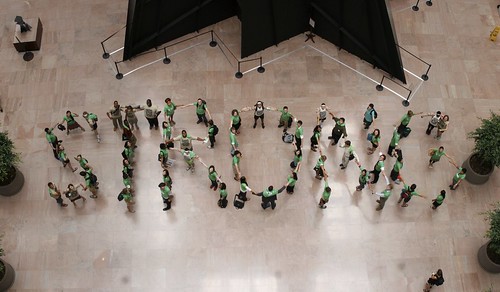

Harder - oversight on coal plants.
Better - Renewable Portfolio Standard and investments in international adaptation.
Faster - emissions reductions targets.
STRONGER - leadership in the Senate and a stronger bill!
Tuesday, July 7th: first EPW hearing on Climate Bill
The Strongmen stormed the capitol! 6 activists in muscle costumes greeted senators going into the hearing, to flex their legislative muscles and strengthen the bill. Despite getting there at 7am for a 10am hearing, too many paid line-sitters were saving seats for lobbyists, preventing the Strongmen from entering. Their presence in the hallway was still impressive because it afforded the opportunity to talk to the press and flex for all the staff. The Strongmen also greeted energy secretary Steven Chu and Senators Kerry and Lugar walking in and out of the Foreign Relations Committee meeting room across the hall. Quote from Senator Kerry: “Stronger Climate Bill? Lets make it happen!”

Tuesday Afternoon: EPW Follow up
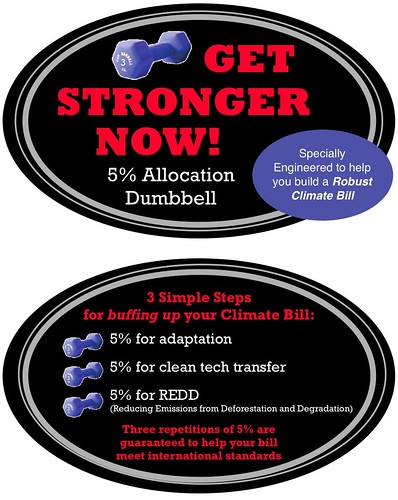
The Action Factory Strongmen visited 18 of the 19 senators offices on the EPW committee that afternoon to do personal workout routines. (Senator Inhoffe was skipped as he is too woefully out of shape to participate.) Workout routines consisted of three easy steps: 4 reps reaching high into the air to hit 40% reductions by 2020, three reps of five for 5% of allocations for international adaptation, 5% for REDD and 5% for clean tech transfer. And finally, since congress needs someone to spot them on the big lifts, we asked the EPA to provide oversight. Strongmen left bar-bells as presents in the offices, as well as teaching the receptionists how to do the workout for their bosses.
Thursday, July 9th: Aerial photo and more office visits:
As part of the Campus Progress lobby day, the Action Factory stepped up to organize a mass-action involving over 60 people in a guerilla aerial photo. Co-organizing with Energy Action Coalition and Chesapeake Climate Action Network, a team of letter captains, 50 volunteers walked into the Senate Hart office building and formed a ‘flash-mob’ spelling out STRONG in front of the baffled police. (See above photo)
This rapid-response call for a STRONG bill was followed by a group of 30 in strongmen outfits, Harder, Better, Faster, Stronger shirts and Powershift09 shirts to visit the offices of primary targets in the fight for a strong climate bill: Senators Levin (D-MI), Snow (R-ME) and McCaskill (D-MO).
The visit to McCaskil’s office was particularly relevant because she has repeatedly expressed concern that the climate bill is ‘too strong’ (to paraphrase). With the Strongmen’s help, Claire can beef up her stance on climate, provide the green jobs Missourians want and the international leadership the world needs.
Avaaz Action Factories: www.actionfactories.org
Avaaz has formed action factories at two strategic locations in Europe and in Washington DC to gather and deploy youth climate activists. Each location houses 15+ 'Youth Climate Fellows' working as a team, and supported by Avaaz.org. These fellows are devoting their summer months to mobilizing stunts, lobbying campaigns, and other actions. The work of these activists will maximize the possibility of achieving a strong binding global climate treaty at Copenhagen, and will raise the expectations and demands of the global public that governments must achieve such a treaty.
Photos Here:
http://www.flickr.com/photos/dc_climate_action/
Media Coverage:
Roll Call - Covers news and gossip on Capitol Hill
http://www.rollcall.com/gallery/1_214/#
Slate.com - Online news magazine with broad national reach and diverse readership
http://www.slate.com/id/2222493/
Free Speech Radio News
http://www.fsrn.org/audio/us-senate-loggerheads-over-clean-energy-legislation/5012
Treehugger.com - national blog on green politics, lifestyle, products and issues
http://www.treehugger.com/files/2009/07/strongmen-capitol.php
Wonkroom - Center for American Progress blog
http://wonkroom.thinkprogress.org/2009/07/09/harder-better-faster-stronger/
CNN - Lou Dobbs - Brief appearance on environmental groups not having a fair fight against big-money lobbyists.
http://www.cnn.com/video/?/video/bestoftv/2009/07/08/ldt.sylvester.homeless.line.holders.cnn