Energy Collective blog power policy climate - the conversation happens here
Showing posts with label waxman-markey. Show all posts

Sunday, December 20, 2009

Earth to Thomas Friedman: Winning the “Earth Race” Requires Federal Investment

Cross-posted from Americans for Energy Leadership

In a major departure from conventional climate wisdom, Thomas Friedman argues in today’s New York Times that the UNFCCC framework is broken and should be replaced by a global competition in the clean-tech industry, which he says the United States can and should lead. “Let the Earth Race begin,” he declares, contrasting this with the long-dominant “Earth Day” strategy:

“This Copenhagen climate summit was based on the Earth Day strategy. It was not very impressive. This conference produced a series of limited, conditional, messy compromises, which it is not at all clear will get us any closer to mitigating climate change at the speed and scale we need…

Today, we need the Earth Race: who can be the first to invent the most clean technologies so men and women can live safely here on Earth… An Earth Race led by America — built on markets, economic competition, national self-interest and strategic advantage — is a much more self-sustaining way to reduce carbon emissions than a festival of voluntary, nonbinding commitments at a U.N. conference.”
Friedman is right. The race to develop competitive clean-tech industries is the critical element with the potential to motivate enough development and deployment of clean technologies – far more than any potential “legally-binding” global emissions treaty, as we’ve seen with the failure of the Kyoto Protocol and the inability of the UNFCCC framework to produce a meaningful treaty at Copenhagen. The International Energy Agency estimates that $10.5 trillion of global investment in clean technology and energy efficiency is necessary over the next 20 years to stay below 450ppm – an unimaginable sum under any UNFCCC treaty.

Moreover, building the long-term political support of a broad segment of the American public requires a national agenda centrally focused on competing in the clean-tech growth industries of the future. As Friedman explains, “If you start the conversation with “climate” you might get half of America to sign up for action. If you start the conversation with giving birth to a “whole new industry” — one that will make us more energy independent, prosperous, secure, innovative, respected and able to out-green China in the next great global industry — you get the country.”

Indeed, countries like China, Japan, and South Korea are already launching massive government investment programs to dominate this industry – not because their priority is reducing carbon emissions, but because they recognize the economic potential. In our recent report, “Rising Tigers, Sleeping Giant,” we found that China, Japan, and South Korea – Asia’s “clean technology tigers” – have already surpassed the United States in the production of virtually all clean energy technologies, an advantage they are solidifying and expanding with direct, large-scale government investment strategies.

As his competitive solution, Friedman repeats his call for a price on carbon. “The goal of Earth Racers is to focus on getting the U.S. Senate to pass an energy bill, with a long-term price on carbon that will really stimulate America to become the world leader in clean-tech,” he writes. “All [Obama] needed to do in his speech was to look China’s prime minister in the eye and say: “I am going to get our Senate to pass an energy bill with a price on carbon so we can clean your clock in clean-tech. This is my moon shot. Game on.”

The Chinese prime minister might just have laughed in Obama’s face. Why? Because a modest carbon price is far too weak to regain American competitiveness in the face of Asia’s massive investment projects. These governments are set to out-invest the United States by three to one in these industries over the next five years – about $509 billion compared to $172 billion in the U.S., assuming passage of the proposed American Clean Energy and Security Act and including current appropriations and stimulus measures.

No wonder Deutsche Bank recently concluded that “generous and well-targeted [clean-tech] incentives” backed by “comprehensive and integrated government plans” in China and Japan will create a low-risk environment for investors and stimulate high levels of private investment. In contrast, Deutsche Bank concluded, the U.S. is a “moderate-risk” country compared to the lower-risk environment of China and Japan, because we rely on “a more volatile market incentive approach that has suffered from a start-stop approach in some areas.” According to another recent report by the China Greentech Initiative, China’s national clean-tech market could eventually grow to $1 trillion annually.

Earth to Thomas Friedman! Winning the “Earth Race” requires major federal investments in clean technology development and deployment. “If the United States hopes to compete for new clean energy industries,” we conclude in “Rising Tigers, Sleeping Giant,” “it must close the widening gap between U.S. and Asian government investments in research and innovation, manufacturing, and domestic market demand. Small, indirect and uncoordinated incentives are not sufficient to outcompete Asia’s clean tech tigers. To regain economic leadership in the global clean energy industry, U.S. energy policy must include large, direct and coordinated investments in clean technology R&D, manufacturing, deployment, and infrastructure.”

Winning the “Earth Race” also requires a national effort in high-tech energy education, and President Obama’s RE-ENERGYSE proposal is a critical first step, especially in the realm of higher education. As my colleague and I wrote in the San Francisco Chronicle, “To win today's clean-energy race, the United States must respond with the same vigorous commitment to education and innovation that won the space race four decades ago. If America does not take immediate action to bridge its energy education gap – and if we fail to make substantially larger investments in our own clean-energy economy – we will effectively cede the clean-energy race to Asia.”

Yet instead of calling for an effort to actually strengthen the Senate bill to match what energy innovation experts say is necessary (including dozens of Nobel Laureates, Brookings Institution, Association of American Universities, Google, and others) – at least $15 billion per year for clean energy R&D, compared to $1.2 billion in the current proposal – Friedman simply calls for passing the bill in its current form. Indeed, he doesn't seem to care whether the bill is strong enough to accomplish much of anything besides a modest price on carbon, as he explained in an op-ed after the passage of Waxman-Markey:
"It is pathetic that we couldn’t do better [than Waxman-Markey]. It is appalling that so much had to be given away to polluters. It stinks. It’s a mess. I detest it. Now let’s get it passed in the Senate and make it law."
That is no strategy to win the "Earth Race." Reflecting on the surge in Afghanistan, Friedman recently wrote, “China, Russia and Al Qaeda all love the idea of America doing a long, slow bleed in Afghanistan.” His point extends here as well: China, Japan, South Korea, and the rest of our competitors would love the idea of America settling on a “pathetic” bill with modest clean-tech investment and pricing.

The United States did not win the space race with a tax on airplanes. We did not invent the Internet by enforcing a cap and trade system on fax machines, nor did we create the personal computer by taxing typewriters. Those who suggest we can simply rely on indirect, market-based mechanisms to achieve a clean energy revolution – including Thomas Friedman – fail to understand the history of technology innovation and competitiveness, and they risk relegating our clean-tech industry to second-class status or worse.

Fifty years ago, in the wake of the launch of Sputnik, the United States launched a massive national effort to lead the space race and win the Cold War. Today, the clean energy race represents one of the greatest opportunities and challenges for American leadership in a generation. If we do not take immediate action to launch a national energy competitiveness project based on large, direct, and coordinated innovation policies, we will effectively cede the clean-energy industry to Asia and other competitors. The mass majority of exports, jobs, tax revenues, and other economic benefits will accrue to foreign countries, and we will miss a historic opportunity to achieve a new era of American leadership. The choice should be clear.

Read more!

Friday, October 30, 2009

Friday Factoids: Climate Bills vs. Expert Consensus on R&D

Originally from the Breakthrough Institute

Friday again already eh? Well that makes it Friday Factoids time...

We'll keep this one short, with just the graphic below comparing the levels of clean energy R&D funding included in the House and Senate climate and energy bills with the strong and growing consensus among energy innovation experts that $15 billion per year in additional funding is needed to achieve national climate, energy and economic objectives.

I've also included the boost in FY2009 Department of Energy (DOE) R&D budgets provided by the economic stimulus bill, the American Recovery and Reinvestment Act. As Google's Dan Reicher warned the Senate on Wednesday: when these temporary stimulus funds dry up, the U.S. could fall of a "funding cliff" unless significantly larger allocations are made for clean energy R&D in Congressional legislation.

Climate_Bills_vs_Expert_Consensus.jpg
(click to enlarge)

Sources:
  • ACES and CEJAPA funding levels are average annual figures over the first ten years of cap and trade (2012-2021) at EPA-projected allowance prices. See this post for (much) more.
  • Read "The Innovation Consensus: $15 Billion for Clean Energy R&D" for a discussion of the expert consensus on the need for $15 billion annually in new clean energy R&D spending, a position converged upon by leading business, policy, academic, and research voices, including Google, the Brookings Institution, Third Way, the Breakthrough Institute, the Association of American Universities and Association of Public Land-grant Universities, and 34 American Nobel Laureates.
  • President Obama pledges to "Invest $150 billion over ten years in energy research and development to transition to a clean energy economy" at WhiteHouse.gov, and initially outlined $15 per year in funding for clean technology from cap and trade revenues in his long-term budget outline.
  • FY2009 ARRA funding for DOE R&D programs is from DOE budget documents here.

Read more!

KPFA Radio: Former Sen. John Warner and WattHead's Jenkins Talk Climate Bill

I joined former Senator John Warner of Virginia on the KPFA Morning Show today to discuss Senate climate and energy legislation, the focus of hearings this week in the the Environment and Public Works Committee. (listen to the full interview below)

Senator Warner, a rare Republican champion of climate action, was the co-sponsor of the 2007 Lieberman-Warner "Climate Security Act." He retired in 2008 after thirty years in the Senate but remains an active advocate of Congressional climate legislation, and is working to convince his reluctant Republican former colleagues to embrace the climate and energy legislation authored by Senators John Kerry (D-MA) and Barbara Boxer (D-CA).

I was honored to join the discussion with Senator Warner (who's spent more time in the Senate than I have on this warming planet). I was also pleased to find consensus with the veteran Republican on the need for final Senate climate legislation to include much greater investments to ensure U.S. innovators, entrepreneurs and businesses invent and commercialize clean energy technologies here in America (is this a sign of a possible bipartisan consensus on greater clean energy R&D funding?).

Agreeing with the strong consensus of energy innovation experts, the former Senator said that the current Kerry-Boxer bill invested too little in clean energy R&D and did not provide enough proactive support for American firms commercializing, manufacturing and installing clean energy technologies, but he noted that final legislation is still taking shape. Hopefully his common-sense attitude on clean energy innovation and technology investment will prevail on Senate Republicans, who so far have resorted to threatening to boycott hearings on the Kerry-Boxer bill, rather than work constructively to ensure the bill includes more funding for American innovators and clean energy firms.

Senator Warner, the long-time Chairman or Ranking Member of the Senate Armed Services Committee and a former Secretary of the Navy, also highlighted the need to avert climate change in order to mitigate future conflicts and humanitarian crises that would sap the resources of the U.S. military. For more on the Senator's views on climate legislation, you can read his testimony before the Environment and Public Works Committee on earlier this week here.

Listen to the full interview here or using the player below. The segment starts at 1:08:00 into the Morning Show.

The Morning Show - October 30, 2009 at 7:00am

Click to listen (or download)

Read more!

The Innovation Consensus: $15 Billion for Clean Energy R&D

$15 billion. That is the figure at the heart of a growing consensus of energy innovation experts, all calling for dramatically larger U.S. investment in clean energy research and development. Writing at theEnergyCollective.com, WattHead.org's Jesse Jenkins highlights mounting calls to address what Google Director of Climate Change and Energy Dan Reicher called "a serious energy R&D short-fall" in the current House and Senate climate bills. As Congress debates energy and climate change legislation, a chorus of voices including policy think tanks such as the Brookings Institution, Third Way and the Breakthrough Institute, as well as a collection of both the nation's top research universities and dozens of Nobel-prize winning scientists have joined leading businesses like Google to converge on a $15 billion increase in annual U.S. energy R&D budgets as a critical component of any final legislation.

Read the full post at theEnergyCollective.com here.

See also:

  • Google Calls for $15bn/year for R&D in Testimony Before Senate EPW Committee

  • "TNR: Brookings' Muro Calls on Senate for More Investment in Clean Energy R&D"

  • "Nation's Leading Universities Echo Calls for $15b/year in Clean Energy R&D; Draw $5b/year Bottom Line for Climate Bill"

  • "34 Nobel Prize Winners Write President Obama Urging Support for Clean Energy R&D"

  • Third Way's Josh Freed: "National Institutes of Health: A Model for Jumpstarting Energy R&D"

  • Read more!

    Tuesday, October 27, 2009

    Kerry-Boxer "Clean Energy Jobs" Bill's Clean Energy Investments a Fraction of Expert Recommendations

    By Jesse Jenkins and Yael Borofsky, originally at the Breakthrough Institute

    The latest draft of the Kerry-Boxer "Clean Energy Jobs and American Power Act" would invest less than $10 billion of the bill's nearly $80 billion in annual cap and trade allowance revenue in clean energy technology, assuming EPA-projected allowance prices (note: all figures in 2009 constant dollars).

    Over a range of likely allowance prices, the bill's clean energy investments could total as little as $8.6 billion and as much as $15.4 billion annually, a fraction of the at least $30-80 billion annually advocated by the Breakthrough Institute and an investment level dwarfed by the $44-66 billion annually China plans to invest in clean energy industries, infrastructure and technology over the next ten years (see graphic below).

    Investments in the kind of clean energy research and development critical to make clean energy cheap and develop the low-cost, commercial clean energy technologies needed to drive deep emissions cuts and secure America's energy independence at an affordable cost will receive just $1.2-2.2 billion annually, over a range of likely allowance prices. That's just $200 million more than the House-passed Waxman-Markey "American Clean Energy and Security Act" (ACES) would invest in R&D at EPA-projected allowance prices. While this is a (very) small step in the right direction, the clean energy R&D investments in Kerry-Boxer still fall far short of filling the massive energy innovation gap and would boost R&D spending by as little as one-tenth of the $15 billion annually advocated by President Barack Obama - as well as a broad range of energy innovation experts, including a recent report by the Breakthrough Institute and Third Way. Funding for R&D under CEJAPA will be about a quarter to half as much as investments currently being made by the economic stimulus package, ARRA.

    With more revenue devoted to ensuring deficit neutrality in the Senate bill, total investments in clean energy technology, broadly defined, are actually $1.2 billion less in Kerry-Boxer than in Waxman-Markey, at EPA-projected prices.

    As the graphics below illustrate, the Kerry-Boxer climate and energy bill does not invest nearly as much as numerous experts have deemed necessary to make clean energy cheap and put us on the path to the clean energy economy, of which President Obama so eloquently speaks. Nor will this level of investment be sufficient to keep the U.S. competitive with Asian and European competitors, particularly China, who are surging past the United States with major direct investments to support their emerging clean energy technologies and industries.

    The first graph focuses on investments in clean energy R&D, only. The second depicts investments in clean energy technology, broadly defined.

    How do you think this draft of CEJAPA stacks up?

    (click any of these to enlarge...)

    KerryBoxer-ComparisonR&D-Graph-10-27-09.png


    KerryBoxer-ComparisonTotalCEInv-Graph-10-27-09.png


    KerryBoxer-ComparisonR&D-10-27-09.png


    KerryBoxer-ComparisonTotalCEInv-10-27-09.png


    Sources and Notes:
    [1] See "Kerry-Boxer Climate Bill Allowance Allocation Breakdown," Breakthrough Institute (Oct. 26, 2009).
    [2] See "Investing in the Next Generation of Energy Technologies," WhiteHouse.gov. President Obama pledges to "Invest $150 billion over ten years in energy research and development to transition to a clean energy economy."
    [3] See "Jumpstarting a Clean Energy Revolution with a National Institutes of Energy," Breakthrough Institute and Third Way (Sept. 2009)
    [4] See "34 Nobel Prize Winners Write President Obama Urging Support for Clean Energy R&D," Breakthrough Institute (July 2009)
    [5] See "Top Energy Scientists Call for $30 Bi Annual Investment in Clean Energy," Breakthrough Institute (Dec. 2007). Call for $30 billion in clean energy technology RD&D investments
    [6] See "Energy Discovery-Innovation Institutes: A Step toward America's Energy Sustainability," Brookings Institution (Feb., 2009).
    [7] See "Budget and Performance," U.S. Department of Energy.
    [8] See "Detailed Summary of Energy Investments in Stimulus," Breakthrough Institute (Feb. 2009).
    [9] See "R&D in the FY2009 Budget," American Association for the Advancement of Science (March 2009).
    [10] See "New Apollo Program," Apollo Alliance (March 2009).
    [11] See "Fast, Clean, & Cheap: Cutting Global Warming's Gordian Knot," Harvard Law and Policy Review. Breakthrough Institute (Jan. 2008).
    [12] See "China's Big Plan to Win the Clean Energy Race," Breakthrough Institute (July 2009)

    Read more!

    Friends of the Earth: Raise Some Hell to Fix the Energy Bill

    Well, it may not be quite as clever (or crude!) as the Daily Show... but here's a message, School House Rock-style, from Friends of the Earth. Like Greenpeace, they're calling on activists to raise some hell and fix the flawed House "clean energy" bill:

    Read more!

    Monday, October 26, 2009

    Kerry-Boxer Climate Bill Allowance Allocation Breakdown

    Originally at the Breakthrough Institute

    Late Friday night, Senator Barbara Boxer's Environment and Public Works Committee released a new draft of the Kerry-Boxer "Clean Energy Jobs and American Power Act" (S.1733), the first version of the legislation to detail how emissions allowances created by the bill will be divvied up. These allowances, which give polluters the right to emit greenhouse gases under the bill's cap and trade program, will be worth nearly a trillion dollars over the first ten years of the program alone.

    Breakthrough Institute staff worked over the weekend to dig through the new legislation and get an accurate picture of the allowance allocation pie [see summary tables and graphics below and click here to download a comprehensive spreadsheet of allowance allocations in both Kerry-Boxer and the House Waxman-Markey/ACES bill. Note: updated after initial posting to convert EPA forecasts to 2009 constant dollars. Hat tip to Jason at 1Sky for catch].

    Overall, the allowance allocation scheme mirrors the bill's House-passed sibling, the American Clean Energy and Security Act (ACES), aka the Waxman-Markey bill (HR 2454) [for a side-by-side comparison of the two bills, click here].

    K-B_Allocations_Chart.jpg

    ACES_Allocations_Chart.jpg
    (click either graphic to enlarge)


    Depending on the value of emissions allowances under the cap and trade program, an average of roughly $70 billion to $126 billion in emissions allowances will be created and distributed on each year under the first ten years of the bill's cap and trade program, 2012-2021.

    Of that value, by far the largest share, roughly 64% of the total allowances, will be distributed for free to shield energy consumers and industry from the higher energy prices driven by the establishment of a price on carbon dioxide and other greenhouse gases under a cap and trade system. This includes both direct rebates to end consumers and low-income energy assistance, as well as free allocations to electric and natural gas utilities (aka "distribution companies"), which they are directed to use "on behalf of" their customers. It also includes direct transfers of billions of dollars in free allowances to various industries, ranging from the relatively defensible (11.3% of allowances to heavy industries vulnerable to international competition), to the pretty indefensible, (e.g. a windfall-profit generating allocation of over 3% of the allowances -- worth at least $2 billion annually -- to the "merchant" operators of conventional coal plants).

    By contrast, only about 13% of the value of allowances will be invested in various clean energy technologies, including incentives for the deployment of carbon capture and storage technology (aka CCS, given 2.2% of permits on average each year), federal, state and local government funds to incentivize renewable energy and energy efficiency (6.4%), and investments in advanced clean vehicle technologies (1.7%).

    Just 1.9% of the allowances are dedicated to critical clean energy research and development (R&D) efforts, which amounts to an investment of just about $1.4 billion annually under EPA-projected allowance prices (in 2009 constant dollars).

    Overall, the "Clean Energy Jobs and American Power Act's" investments in clean energy technologies will total under $9.5 billion per year under allowance prices projected by the EPA.

    4.5% of the allowances will be devoted to various other public purposes, including efforts to adapt to the public health, infrastructure, wildlife and natural resource impacts of an already-changing climate and training programs to expand a skilled energy efficiency, renewable energy and nuclear energy workforce.

    Another 7.5% of the permits will be allocated to fund various supplemental emissions reduction efforts, with the largest share (4.2%) going to fund efforts to slow deforestation overseas. Efforts to reduce emissions in the U.S. agriculture and forestry sectors will receive 1.2% of emissions allowances and 2.1% of the allowances will be devoted to reducing vehicle-miles traveled and emissions in the transportation sector (e.g. through public transit expansion and more proactive metropolitan area transportation planning).

    Just over 10% of the allowances will be set aside to ensure the cap and trade program does not increase the federal deficit (i.e. is "deficit neutral"). This is the largest difference between the allocation scheme in the Kerry-Boxer bill and the House-passed ACES legislation, which dedicated just about 3.1% of the allowances over the first ten years to deficit reduction.

    Senate legislation is given a more rigorous test for budget impacts, with legislation required to have no major impact on the deficit over the next fifty years, while House legislation only examines impacts on the budget over the first ten years. The larger set-aside required to keep the bill deficit neutral means overall allocations for most uses are slightly lower in Kerry-Boxer than in ACES (for the strong-of-heart, see this wonky explanation of Congressional Budget Office scoring rules). Since House-passed legislation would eventually have to be made consistent with Senate budget scoring rules before concurrence and final passage by both chambers, ACES arguably over-promises the allowance allocations, which Kerry-Boxer attempts to correct.

    The following table provides a detailed breakdown of the average annual allowance allocation over the first ten years of the cap and trade program (2012-2021), including percentage of total allowances and the dollar value under three likely allowance prices described below [click here for pdf version].

    K-B_Allowances_Table.jpg
    (click to enlarge)


    You can download a spreadsheet (.xlsx file) detailing allowance allocations under both the Kerry-Boxer (S.1733) and Waxman-Markey/ACES (HR 2454) bills here. Allowances are detailed from 2012-2032 and summarized in several ways to aid comparison and analysis.

    Notes:

    Allowance price scenarios:

    The first allowance price scenario is the floor price for permits established by the legislation, which begins at about $11/ton (in 2009 dollars) in 2012, and rises at 5% per year, resulting in an average allowance price of $13.91 during the first 10 years of the program. Note that carbon market research firm Point Carbon projects that due to modest emissions reduction targets, a slower-than-expected U.S. economy, and the permitted use of large numbers of offsets, allowance prices will likely remain at the allowance price floor through at least 2019. The resulting price is $13.91/ton on average for 2012-2021.

    The second allowance price value is consistent with the EPA's preliminary analysis of Kerry-Boxer, which projects allowance prices unchanged from their analysis of ACES. 2005 constant dollar values reported by EPA have been updated to 2009 constant dollars for ease of comparison. The resulting price is $15.42/ton on average for 2012-2021.

    Finally, to aid comparison with the House's ACES bill, Breakthrough calculated a price roughly consistent with the Congressional Budget Office's (CBO) price estimates under ACES. To provide a higher-range price, this scenario, labeled "CBO-equivalent," projects permit prices 180% higher than the floor price under Kerry-Boxer, which is consistent with proportionate difference between CBO's projections under ACES and the ACES floor price scenario. The resulting price is $25.04/ton on average for 2012-2021.

    On "discrepancies" with Environment and Public Works Committee summary of allowance allocations:

    The Senate EPW Committee published a summary of allowance allocations under S.1733 here. Some percentages reported in this document will differ from those reported in the analysis here, and in fact are somewhat confusing. Here's why:

    Under Kerry-Boxer, allowances for some uses, like deficit reduction, stocking the Market Stability Reserve and other selected uses come "off the top" as a 'set aside' before the percentages reported for most of the other uses are calculated. About 16% of the allowances are set aside off the top in this manner. So when the EPW document (or the bill language) says elsewhere that a given percentage of the allowances are allocated to a particular use, say the allocation of 10.35% of the 2012 allowances to investments in renewable energy and energy efficiency, that is in reality 10.35% of the 84% of permits left over after the 16% of allowances set-aside, or really about 8.7% of the total permits (10.35%*84%).

    This makes determining the true percentage of total allowances created under the bill somewhat challenging, requiring the kind of detailed reading and "spreadsheet work" conducted by Breakthrough here.

    Note that the same was true for ACES, which set aside 1-3% of the permits each year "off the top" to stock the bill's Strategic Reserve pool, but with such a relatively small amount of total permits set aside this way, it did not have as significant an impact on the reported percentages allocated to other uses; Kerry-Boxer by contrast sets aside nearly 16% of permits in this manner, which has a noticeable impact on the percentages reported for other allocations.

    On over-allocation of allowances under Kerry-Boxer:

    Astute observers will note that the sum total of all Kerry-Boxer allowance allocations under this report total to roughly 101% between 2012-2021 (actual value is 100.65%). I've attempted to double check my calculations and identify the source of this over-allocation (potential typo?). However, at this time, it appears that the slight over-allocation may actually be based on an accurate reading of the bill language. It could be a simple oversight, given the complicated calculation of actual percent allocations discussed above. I will update this post if I identify the source of the over-allocation, but given how small it is (just 0.65% of total permits), it should not significant impact any of the figures above.

    Questions: contact Jesse Jenkins, jesse[at]theBreakthrough.org.

    Read more!

    Thursday, October 22, 2009

    Greenpeace: Climate Legislation More Likely to Perpetuate Fossil Fuel Economy than Spur Swift Transition to Clean Energy

    Originally at the Breakthrough Institute

    Climate change legislation recently passed by the U.S. House of Representatives and now under consideration in the Senate will "succeed in perpetuating business as usual and fail to avert catastrophic climate change," according to a new Greenpeace report quietly released yesterday.

    Titled "Business as Usual," the report was prepared on behalf of Greenpeace by David Sassoon, who publishes the climate news site, SolveClimate. It is written as a "plain-spoken" analysis meant to be "a call to action to the President of the United States," according to the document.

    "In order for federal climate legislation worthy of this nation to pass Congress, we see no alternative to active and principled engagement from the Oval Office," Greenpeace writes.

    The report levels five key criticisms of current Congressional legislation, calling attention to what Greenpeace describes as "five points of maximum danger" that the environmental group argues must be addressed to ensure climate legislation is capable of spurring "a swift transition to a clean energy future."

    While we certainly don't share Greenpeace's position on all (most) climate matters, this new report levels a pointed and impassioned critique of current Congressional climate action well grounded in the details of the pending legislation. Here's a 'Cliffs notes' version of the full report below the fold...


    1. "Congress is threatening to preempt the Clean Air Act from regulating greenhouse gas emissions from the biggest sources in the nation."

      Greenpeace is referring to a section of the House-passed Waxman-Markey bill that would prevent the U.S. Environmental Protection Agency from regulating point-source emitters of greenhouse gases under existing provisions of the Clean Air Act (e.g. emissions performance standards or new source review).

      After a 2007 Supreme Court ruling that deemed greenhouse gases were a harmful pollutant, the EPA has been moving ahead with regulations under existing Clean Air Act authority to limit greenhouse gas emissions from major stationary sources such as coal plants. Environmental groups have argued that such regulatory authority is critical to protect public health even if Congress moves to establish a cap and trade system to limit economy-wide emissions of greenhouse gases. "Absent EPA authority," Greenpeace writes, "large loopholes and handouts in both the Senate and House version of the climate bill will make it difficult, if not impossible, for the nation to depart from the trajectory of business as usual for decades. EPA involvement is not an either-or proposition."

      As Greenpeace notes, initial drafts of the Senate's "Clean Energy Jobs and America's Power Act" refrains from limiting EPA's authority to regulate emissions. "This is perhaps the most significant difference between the House and Senate versions of the legislation and a critical issue of paramount importance," Greenpeace writes.

      While the House-passed bill does establish a new emissions performance standard for coal-fired power plants that would eventually require the capture and storage of CO2 emissions, the upcoming standards "grandfather," or exempt, close to 40 new coal plants now in the permitting or construction process, according to Greenpeace.

      Referring to coal plants similarly grandfathered into the Clean Air Act, the report contends, "It is yet another bubble of special case coal plants whose burden will be felt for decades to come and slow the arrival of the clean energy future, unless the EPA remains empowered to do its job on behalf of ordinary citizens."

    2. "[B]oth the House and Senate's [emissions reduction] targets are weak and timid in the short term and wishful thinking in the long term."

      Greenpeace criticizes Congressional climate legislation's 2020 emissions reduction targets - 17% below 2005 levels in the House bill and 20% below 2005 levels in the Senate bill, or just 4-7% below 1990 levels - as "far short both of what science demands and what our European allies have committed to achieve." The EU has committed to cut emissions 20% below 1990 levels by contrast, Greenpeace notes, and the Intergovernmental Panel on Climate Change has recommended cuts of 25-40% below 1990 levels.

      While the Breakthrough Institute has long argued that a focus on emissions reduction targets and not concrete, actionable plans to drive clean energy technology development and deployment is misguided, the report accurately notes that modest emissions targets undermine the carbon price signal intended to drive a transition to cleaner energy sources under the legislation's cap and trade program. Both the U.S. EPA and Congressional Budget Office project carbon prices under the House's Waxman-Markey bill will remain between $10 and $20 per ton for at least the first decade of the bill's cap and trade program - equivalent to a change of just 10-20 cents in a gallon of gasoline, for reference.

      "[W]e are being asked to make a leap of faith," Greenpeace writes, "that a carbon price signal--however weak--will conspire with market forces to squeeze carbon out of our economy. It is impossible to ignore the reality that the weak cap undermines the foundation of the theory, fundamental to its integrity. It is as if we are imposing a price on carbon that nobody really has to pay..."

      With the economic recession driving U.S. emissions levels significantly lower than historic 2005 levels, the House bill's emissions cap may not require any emissions cuts at all for up to five years, likely collapsing carbon prices to at or near the lowest levels permitted by the legislation, according to Breakthrough Institute analysis.

    3. "There is probably no better indication of the persistence of business as usual than the fact that both the House and Senate climate legislation prioritize support for the primary industrial source of greenhouse gases... coal."

      Greenpeace notes that 9% of the value of emissions permits created under the Waxman-Markey bill's cap and trade program are devoted to the coal industry, while just 6% are invested in energy efficiency and renewable energy. This includes not only incentives for the commercial deployment of carbon capture and storage technology at coal-fired power plants, but also billions in windfall-profit generating free allowances for the merchant operators of existing, conventional coal-fired power plants. (see Breakthrough's updated Waxman-Markey allowance allocation summary here.)

      In addition, the House-passed bill establishes a new utility-industry-run Carbon Storage and Research Corporation funded with $10 billion raised from electricity ratepayers over the next ten years. According to Greenpeace, $500 million of this funding is "designated simply for 'administrative expenses' to be spent at the discretion of [the] new corporation's officers."

      Greenpeace accurately notes, "There is no parallel provision in the bill to set up a federally created corporation to support solar or wind or geothermal energy development, even though the House legislation is called the American Clean Energy and Security Act." Likewise, no other low-carbon energy technology enjoys the kind of bonus allowance allocation devoted to CCS deployment under the House bill's cap and trade program.

    4. "Handouts and loopholes are legion."

      Greenpeace notes that the bill's already modest emissions reduction objectives are further undermined by "the set of provisions permitting an enormous number of offsets to substitute for pollution reduction." Both the House and Senate bills allow regulated polluters to purchase up to two billion tons of offsets each year instead of reducing their own emissions.

      "It is as if a man with heart trouble and diabetes who weights 360 points is encouraged by his doctor to pay someone else to go on a diet for him," Greenpeace writes, lampooning the logic of offsetting. "To be fair," the report continues, "the economic thinking behind offsets has a narrow theoretical validity."

      However, actual experience with offset markets indicates that fraud and gaming are difficult if not impossible, from a practical perspective, to eliminate. As Greenpeace writes, "The fact is that the allure of immense profits has mostly produced massive instances of cheating in the offset market, with the environment left to suffer the consequences." Extending their metaphor, they continue, "The fat patient will stay fat; the other man paid to go a diet will do no such thing; and the doctor will walk away satisfied."

      If offsets played a limited role in the functioning of the cap and trade system, likely fraud and policing challenges would potentially be minor issues. But as Greenpeace notes, "The number of offsets pending legislation authorized on an annual basis is truly astonishing: Two billion tons worth. That is equivalent to one quarter of annual US emissions--or the first 75 poinds of flesh our fat man would shed on a diet." Greenpeace accurately notes that the practical implication of such massive offsetting would be to delay any required cuts in actual U.S. industrial emissions "for almost another two decades. If that is not business as usual, nothing is," Greenpeace concludes.

      Greenpeace pointedly notes that some "have found ways to rationalize the offsets as necessary, even playing the role of apologist for bad policy." (Gee, who could they be talking about...). They continue:

      "They make the argument about offsets that there simply won't be enough to go around. ... They are saying, in essence, don't worry, offsets won't be a problem, they don't really exist. ... We would be naive to assume that corporate lobbyists secured authorization for two billion tons of offsets without having a plan for where to find them and how to use them. It is money that no profit-maximizing organization is going to leave on a table unclaimed..."

      Greenpeace identifies hydrofluorocarbon (HFCs), an industrial gas and very potent "super greenhouse gas," and forest preservation projects as potentially huge sources of offsets for U.S. and global markets. Furthermore, as Congressional legislation has moved forward, more and more sources of offsets have been permitted in successive drafts, including expanded agricultural offsets in the House bill and various sources of methane in the Senate bill.

    5. "What is especially dangerous, and frankly Orwellian, is that the American Clean Energy and Security Act and the Clean Energy Jobs and American Power Act both provide insufficient and grudging support to clean energy!"

      Greenpeace finally notes that the bill provides very little effective support for renewable energy. "What state governments and private enterprise are doing to promote the adoption of clean energy already surpasses what the federal government is now proposing to do," the report states.

      The report cites yet another analysis, this one from ICF International, concluding that "existing organic growth of business as usual in the clean energy sector will be enough to surpass the target" in the House bill's renewable electricity standard. After exemptions are included, Greenpeace notes, as Breakthrough has, that the bill's nominal 20% "Combined Efficiency and Renewable Electricity Standard" amounts to a real requirement of less than 10%, "a goal that the states alone will achieve with current RPS policies."

      The report notes the disparity between financial support and direct public investments provided for renewable energy -- and research and development in particular -- relative to incentives for CCS in the House bill, and support for nuclear power expected to be included in the Senate bill . But as Breakthrough has noted, overall investments for all low-carbon energy sources, including CCS, totals just $9 billion per year from allowance revenue in the House bill (at a $15/ton average price) - a figure that appears in the report via a quote from the Brookings Institution's Mark Muro.

      Greenpeace contrasts this level of support, less than one-fifth what Breakthrough advocates, with President Obama's remarks to the UN General Assembly that "the US will move forward with investments to transform our energy economy."

      "The climate bill undermines this aim," Greenpeace contends. The report points to direct and proactive incentives provided for renewable energy deployment in Germany, a feed-in tariff "financed by a modest rate increase spread across the entire population," as an alternative approach to accomplish President Obama's objective "to make clean energy the profitable kind of energy."


    In concluding, Greenpeace notes that a good number of both "optimists" and "apologists" within the climate advocacy community have continued to support, even champion, current Congressional climate legislation.

    "The optimists seem to believe that a price signal, no matter how weak or undermined by handouts and loopholes, will provide the impetus to help us get started to turn the corner on climate change," Greenpeace writes, noting that the Clean Air Act and Social Security legislation are often referenced "as federal measures that started out weak and grew effective over time."

    This historical analogy is "ultimately unpersuasive," Greenpeace contends. "The Clean Air Act, for example, did not send hundreds of billions of dollars in handouts and loopholes to the very polluters it was trying to regulate," the report points out. "The pending legislation does."

    Greenpeace further rejects oft-repeated appeals to, "Don't let perfect be the energy of the good." That line of reasoning is "a good argument used to poor purposes," Greenpeace says, retorting, "Rather, let us stand firm not to adopt legislation that locks in a permanent and endless fossil fuel future, let us insist that this constellation of great leaders be the enemy of impending catastrophe."

    "There are apologists who go a step further than the optimists," Greenpeace continues, those who "argue suddenly that it doesn't matter if you allocate carbon credits for free, rather than auction them; or that offsets might not be [a] bad thing after all; or that the big bet we're placing on technology to capture and bury carbon emissions will actually bring the demise of coal as an energy source."

    Greenpeace writes:

    "There is all manner of spinning--well-intentioned, disingenuous, self-serving--among supporters of climate action, and it has become almost impossible to separate political calculus from scientific necessity. ... Many supporters of climate action find themselves forced to grasp a flimsy hope--that we just need to get something started--anything--and strengthen it later. And so we witness the cheerleading to which we cannot lend our voice. ... Politics as usual will only produce its corollary, business as usual."

    Well there's certainly at least one voice amongst the climate community who won't pull any punches as the Congressional debate moves forward.

    Read more!

    Wednesday, September 23, 2009

    Analysis: Over-Allocation of Pollution Permits Would Result in No Emissions Reduction Requirement in Early Years of Climate Program

    By Jesse Jenkins, Ted Nordhaus and Michael Shellenberger, originally posted at the Breakthrough Institute

    The large decline in U.S. emissions in 2008 and 2009 due to the economic recession means that if the House-passed Waxman-Markey climate legislation becomes law, the bill's emissions reduction cap will require no reduction of carbon emissions over the first two to five years of the program. The resulting oversupply of emissions permits will allow regulated firms to continue business as usual emissions through as late as 2018, according to a new analysis by Breakthrough Institute based on new Energy Information Administration emissions projections that take into account the impacts of the global recession.

    The analysis further establishes that very modest utilization of the offset provisions of the Waxman-Markey bill, as little as one-tenth to one-quarter of the levels of offset utilization projected by the Congressional Budget Office and the Environmental Protection Agency respectively, will allow emissions in regulated sectors of the U.S. economy to proceed at business as usual levels through 2020 or beyond. Depending upon how quickly U.S. emissions recover over the next decade, firms would need to purchase on average as few as 124 million tons of offsets annually in order to comply with the emissions reduction caps through 2020, substantially less than the 526 million and 1,223 million tons of average annual offset utilization between 2012 and 2020 projected this summer by CBO and EPA respectively.

    In conjunction with the free allocation of a high percentage of emissions allowances under Waxman-Markey and lower global demand for offsets from recession-hit EU and U.S. firms, substantial over-allocation of emission allowances in the early years of the program, will likely lead to a cap and trade program awash in both cheap emissions allowances and offsets over at least the first decade of implementation. Under such conditions, the functional carbon prices for the first decade or more under Waxman-Markey are likely to hover at or even below the $10 per ton floor on allowance auction prices (rising slowly each year) established by the bill.

    The reason for this projected over-allocation of pollution allowances is because the House cap and trade legislation would initially distribute allowances based on 2005 emissions levels, which were much higher than 2008 or 2009 levels. By the time the Waxman-Markey emissions cap would go into effect in 2012, U.S. emissions may still be recovering to pre-recession levels and may remain substantially lower than historic 2005 levels.

    To test potential economic and emissions recovery scenarios, Breakthrough Institute used economic recovery forecasts from the EIA and the U.S. Congressional Budget Office (CBO), and greenhouse gas emissions projections from the EIA and U.S. Environmental Protection Agency (EPA), to construct two emissions recovery scenarios -- a "slow recovery" scenario and a "fast recovery" scenario -- to provide a range of outcomes. Under the slow recovery scenario, U.S. emissions remain seven percent below 2005 levels in 2012; under the fast recovery scenario they are three percent below 2005 levels in 2012.

    Under the slow recovery scenario, relatively low business-as-usual (BAU) emissions projections and the banking of excess permits by firms means that the Waxman-Markey cap would not require firms to reduce emissions at all -- either themselves or through purchasing offsets -- until 2018. Under the fast recovery scenario, emissions reductions would not be required until 2014.

    Slack demand and the resulting low price for pollution permits would create a strong incentive for firms to hedge their future carbon liabilities by buying and banking emissions credits while they are in excess and prices are low, building up a bank of permits for the future while continuing with business-as-usual practices.

    Furthermore, even if they utilized just a fraction of available offsets each year, U.S. firms would not be required to reduce their own emissions until even as late as 2030 or beyond. Depending on how quickly the economy recovers and emissions rise, firms would need to use just 6 percent to 25 percent of the total amount of offsets permitted under the House bill for emissions levels to rise at business-as-usual rates through 2020, and only 43 percent to 66 percent of total offsets to continue emissions growth through 2030.

    The Waxman-Markey floor on permit prices would prevent the auction price of carbon dioxide in the primary auction market from dropping below $10/ton. However, with the majority of permits given away for free in the first decades of the Waxman-Markey cap and trade program and a substantial over-allocation of permits projected in the early years of the program, the correspondingly slack demand for permits may result in a large secondary market for emissions allocations in which permits trade for substantially less than $10/ton. The result of such an outcome would be a functional carbon price substantially below the nominal $10/ton floor established through the statute for the primary allowance market. Even at the auction floor price, the carbon price is unlikely to be sufficiently high to act as a strong incentive for firms to improve their energy efficiency at above-BAU rates, or to shift to low-carbon power sources. A carbon dioxide price of $40 per ton in the EU in 2008 was not high enough to derail European plans to build 50 new conventional coal-fired power plants over the next five years, for example.

    Just six percent of the total offsets permitted under the House legislation would need to be purchased for firms to meet their 2020 emissions reduction requirements, under the slow recovery scenario and 43 percent would need to be purchased by firms to meet their 2030 requirements. Under the fast recovery scenario, 25 percent of the total permitted offsets would need to be utilized for firms to meet 2020 emissions reductions requirements, and 66 percent to meet their 2030 requirements.

    Both the CBO and EPA analysis of the ACES legislation project significant utilization of emissions offsets. CBO's relatively conservative offset projections forecast 26% of total permitted offsets will be used through 2020 and 38% through 2030, while EPA's more generous projections forecasts 61% of total permitted offsets will be utilized through 2020 and 64% will be used through 2030.

    Under either set of assumptions, the total supply of permits and offsets created under the ACES cap and trade program would legally permit U.S. emissions to continue at BAU rates through most if not all of the next two decades. And with emissions down in the EU and across the globe due to the recession, demand for offsets from the European ETS and other emissions trading programs will be down as well, increasing the likely supply of offsets at affordable prices.

    The global recession is expected to drive the biggest annual drop in global greenhouse gas emissions in forty years this year. With full economic recovery in the U.S. and globally likely to take several years, the latest projections from the EIA have revised downwards expected greenhouse gas emissions levels. EIA projects U.S. emissions from the burning of fossil fuels will fall six percent in 2009, after dropping three percent in 2008. Emissions would rebound slightly as the economy begins to recover, rising less than one percent (0.9%) in 2010 in the EIA's projections, but may not fully rebound to historic 2005 levels until well past 2012.

    In the slow recovery scenario, U.S. emissions follow the projections in the new EIA Short Term Energy Outlook (September, 2009) report through 2010, before returning to the long-term growth rates projected in the EIA's Annual Energy Outlook 2009 from 2011 through 2030. The fast recovery scenario reflects the more optimistic economic forecasts contained in the CBO's most recent economic forecasts (August, 2009) and slightly higher emissions intensity rates (the amount of CO2 emitted per unit of economic activity) in the EPA's analysis of the ACES legislation.

    A full spreadsheet of assumptions and calculations can be downloaded here (.xlsx file). These scenarios are depicted in the graphics below (click any to enlarge).

    EIA_Emissions_2008-2010.jpg

    Recovery_Scenarios.jpg

    Slower_Recovery.jpg

    Faster_Recovery.jpg

    Slow_Recovery_CBO_Offsets.jpg

    Slow_Recovery_EPA_Offsets.jpg

    Read more!

    Friday, August 21, 2009

    Caught in Forged Letter Fraud, Dirty Coal Front Group ACCCE Throws their Astroturf Contractor Under the Bus

    An update on the story that just keeps on giving: the unfolding saga of the forged letters fraudulently sent by DC lobby firm Bonner and Associates on behalf of dirty coal interests in a deceitful attempt to kill Congressional clean energy and climate legislation.

    In June, employees at Bonner and Associates, on a contract for the dirty coal front group, the American Coalition for Clean Coal Electricity (subcontracted via the Hawthorne Group), sent letters to several Congressional offices fraudulently posing as black, Hispanic, women’s and senior citizen’s groups urging votes against the American Clean Energy and Security Act (the Waxman-Markey bill).

    Now, Brad Johnson at the WonkRoom reports:

    The American Coalition for Clean Coal Electricity (ACCCE) is dumping Bonner & Associates, the Astroturf firm that forged letters to Congress attacking clean energy legislation on its behalf. ... ACCCE spokesman Joe Lucas told National Journal that his organization “did nothing wrong”:

    "We will not be working with Mr. Bonner again. ACCCE did nothing wrong. Looking back, there would be many things we would do differently."

    In fact, ACCCE covered up the fraud and is now throwing Bonner under the bus. The coal coalition had been informed by the Hawthorn Group, its primary contractor, days before the pivotal House vote on the energy legislation. But ACCCE kept silent, failing to notify lawmakers or the defrauded organizations. ACCCE continues to employ the Hawthorn Group and the notorious voter-fraud company Lincoln Strategy Group.
    Makes you wonder, what else is the dirty energy lobby up to...

    Read more!

    Monday, August 17, 2009

    UN Climate Chief: Global Community Needs to Invest $300b Annually in Climate Fight

    A quick post this morning...

    The global community should be investing $300 billion annually to combat global warming, according to UN climate chief Yvo de Boer (pictured). De Boer, the Executive Secretary of the UN Framework Convention of Climate Change, says the world needs to be spending $100 billion annually to help vulnerable communities adapt to the impacts of climate change, and another $200 billion each year to shift the global energy mix away from fossil fuels.

    "The world will need a phenomenal amount of money to change its energy supply from fossil fuels to cleaner sources and to adapt to climate change," de Boer said Friday.

    According to a UN Environment Program news update:

    With 110 days left until the Copenhagen Climate Conference, only "limited progress" was made at the most recent United Nations climate change talks where financing to cut and cope with climate change proved to be a major sticking point among negotiators. ...

    De Boer estimates the annual cost of climate change adaptation at US$100 billion per year. This is the amount needed to cope with natural disasters such as flooding and drought that will result from increased warming. Meanwhile, he pegs the cost of cutting global emissions at US$200 billion annually.
    Currently, the draft text contains 200 brackets indicating points of disagreement between negotiators, who differ on who should bear the financial burden of the climate change challenge.

    Nevertheless, De Boer stressed that a U.N. climate pact to be agreed upon in Copenhagen should set up a fair mechanism for raising long-term funds, rather than compel countries to contribute specific amount. "A robust burden-sharing formula is the most important thing."

    De Boer also recommended that countries participating in the Copenhagen Conference, open negotiations with some cash on the table, perhaps US$10 billion.

    At the G8 Summit in July, UNEP Executive Director, Achim Steiner noted that a successful Copenhagen Summit depended on the political will of world leaders to make good on their Green Economy pledges which entails investing heavily in renewable energies and energy efficiency.
    A fair and "robust burden-sharing formula" would presumably imply that as the world's richest nation and the world's largest contributor to cumulative global greenhouse gas emissions, the United States would contribute something like 1/4 to 1/3rd of the total global investments required to adapt to and mitigate the climate threat. That would imply $50-66 billion annually to invest in clean energy and energy efficiency and a contribution of $25-33 billion annually to global adaptation efforts, for a total of $75-99b/year.

    Where exactly is that money going to come from? An excellent question, and one that seems neglected by the Waxman-Markey climate and energy bill now winding it's way through Congress. After political concessions to (attempt to) silence industry opposition, that bill would invest just about $10b annually in clean energy and efficiency and devote just about $1.6b for domestic adaptation efforts and $1.9b for international technology transfer (all values assuming a $15/ton CO2 price, and scale proportionately at other CO2 prices).


    The clean energy and efficiency investments in the American Recovery and Reinvestment Act (the stimulus bill) put us in the right ballpark - at least on the mitigation front - investing over $60 billion annually in America's efforts to build a new clean energy economy. But those short-term investments will expire by the end of 2010, and without an effort to build on and extend this critical clean energy spending, the U.S. will be left without sufficient funding to fulfill our fair share of global climate investments.

    With the climate advocacy community primarily focused to date on establishing (and protecting already compromised) emissions reduction targets and "caps," the Waxman-Markey bill looks poised to leave the United States a long way from the level of commitment to clean energy and adaptation investments called for the UNFCC Secretariat. We're running out of time to change that picture...

    Read more!

    Friday, July 31, 2009

    Fraud? Identity Theft? Impersonation? All In A Day’s Work

    How many lobbyists does it take to screw in a lightbulb up democracy?

    Turns out, just one. This morning the Charlottesville Daily Progress reported that the lobbying group Bonner & Associates had sent deliberately forged letters to freshman U.S. Representative Tom Perriello from the local NAACP and Creciendo Juntos, stating opposition to the American Clean Energy and Security Act (ACES). In June, two weeks before the House passed the bill, six letters (copies here and here) supposedly sent from these two organizations urged Rep. Perriello to "Please don't vote to force cost increases on us, especially in this volatile economy."

    The author of the letters was identified as an employee with Bonner & Associates, a firm noted for dubious astroturf lobbying, and has lobbied on behalf of utility companies in the past. The firm did not register to lobby on behalf of any company or organization against the cap-and-trade bill.

    “They stole our name. They stole our logo. They created a position title and made up the name of someone to fill it. They forged a letter and sent it to our congressman without our authorization,” said Tim Freilich, who sits on the executive committee of Creciendo Juntos... “It’s this type of activity that undermines Americans’ faith in democracy.”

    Rick Turner, the President of the local NAACP branch responded, saying:

    “I am very appalled as the president that our organization has been misrepresented in this way by this bogus … letter,” Turner said. “I hope that whoever’s behind this will be brought to justice.”

    In fact, Turner said, the NAACP supports the American Clean Energy and Security Act, as he said it would create good-paying jobs for blacks and reduce harmful emissions, particularly in urban areas.

    “Clean energy creates jobs in the urban setting,” he said.

    Events like this make me wonder, what else has been done in the name of legitimate organizations? It turns out, this is not the first time Bonner & Associates has been confronted with dishonest lobbying tactics. In 2002, Bonner and Associates was hired by the Pharmaceutical Research and Manufacturers of America to kill drug reform and used a front group to manipulate local minority organizations to oppose drug reform. In response to the Maryland prescription drug event, Jack Bonner said "It's democracy."

    How are lies and deception 'democracy?'

    Rep. Ed Markey, co-sponsor of ACES announced this morning a congressional investigation of the incidents:

    This fraud on Congress shows that some opponents of clean energy have resorted to forgery and theft to block progress.

    This is an appalling abuse, and Congressman Tom Perriello deserves great credit for seeing through it and casting a vote that will create clean energy jobs in Virginia and throughout the United States. I encourage all Members of Congress to be on the lookout for other suspicious and illegal materials.

    Given that opponents are willing to resort to willful deception, lies and fraud, we must be all the more vocal in demonstrating public support a clean energy economy. We must strengthen our alliances to make sure this kind of organizational identity theft does not divide our movement. We must speak truth to power, like the Avaaz Action Factory is doing today, and make sure that this story is exposed for the scandal it is.

    Cross-posted on It's Getting Hot In Here.

    Read more!

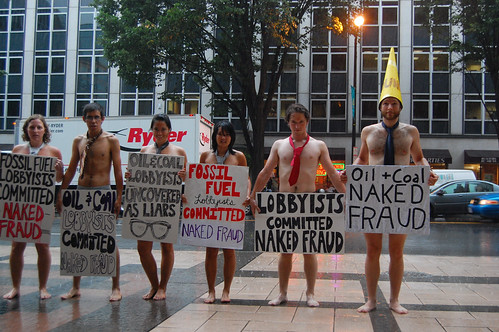
    Action Alert: DC lobbyists use naked fraud to oppose climate bill! Rapid response protest scheduled

    BREAKING NEWS and ALERT from the Avaaz DC Action Factory

    This morning the below story broke: LOBBYISTS FORGED LETTERS TO CONGRESS ON CLIMATE BILL

    Update: see photos from today's protest of this naked fraud here.

    A DC Lobbying firm stole the trademarked logo and organizational name of the NAACP and a community group in Charlottesville, VA and wrote a letter purporting to oppose the ACES bill in the house.

    This is a prime example of dirty money fueling lies in DC. It is an affront to Democracy and a hindrance to passing the climate legislation our country desperately needs. We need to call them out and make this a national story.

    RAPID RESPONSE ACTION:

    What: Picket / Rally outside of the perpetrators' offices. Visuals will include "naked" lobbyists holding signs admitting to "naked fraud" and climate destruction.

    Where: 1101 17th St NW (Near Farragut Square Metro stops)

    When: 2:30 PM, Friday July 31.

    Who: Avaaz Climate Action Factory and YOU!

    For Inquiry: call David Sievers at 301-455-2357 or Morgan Goodwin at 413-884-5240

    Resources: Download and view the forged and fraudulent letters here (NAACP) and here (Creciendos Juntos), [both pdfs].

    Story from the Charlottesville Daily Progress.

    Forged letters to congressman anger local groups
    By Brian McNeill
    Published: July 31, 2009

    As U.S. Rep. Tom Perriello was considering how to vote on an important piece of climate change legislation in June, the freshman congressman’s office received at least six letters from two Charlottesville-based minority organizations voicing opposition to the measure.

    The letters, as it turns out, were forgeries.

    “They stole our name. They stole our logo. They created a position title and made up the name of someone to fill it. They forged a letter and sent it to our congressman without our authorization,” said Tim Freilich, who sits on the executive committee of Creciendo Juntos, a nonprofit network that tackles issues related to Charlottesville’s Hispanic community. “It’s this type of activity that undermines Americans’ faith in democracy.”

    The faked letter from Creciendo Juntos was signed by “Marisse K. Acevado, Asst Member Coordinator,” an identity and position at Creciendo Juntos that do not exist.

    The person who sent the letter has not been identified, but he or she was employed by a Washington lobbying firm called Bonner & Associates.

    Gwynn Geiger Hegyi, a partner with the company, traveled to Charlottesville to apologize to Creciendo Juntos’ chairwoman Dilcia Colindres and sent a letter to Freilich.

    “As I shared with Dilcia when I travelled to Charlottesville last month to personally apologize for the mistake which we discovered and contacted you about, we immediately fired the person on our staff responsible for the error,” Hegyi wrote in the July 22 letter to Freilich.

    Hegyi and others at Bonner & Associates did not return two phone calls Thursday seeking comment for this story.

    More than a ‘mistake’

    In a letter notifying Perriello’s office about the matter, Freilich said he was “offended” by Hegyi’s characterization of the forged letter as a “mistake.”

    “This was not a ‘mistake,’” wrote Freilich, who is also legal director of the Immigrant Advocacy Program of the Legal Aid Justice Center. “This was a deliberately and carefully forged letter that used the logo, address and name of Creciendo Juntos without authorization. Additionally, I understand from Ms. Hegyi that our organization was not the only Charlottesville-area organization whose reputations were used in an unauthorized manner to try to influence Congressman Perriello on this particular vote.”

    After being notified of the bogus Creciendo Juntos letter, staffers in Perriello’s office realized that the wording of the letter sounded familiar.

    The staffers dug through the stacks of thousands of letters, e-mails and faxes Perriello received about the bill — the American Clean Energy and Security Act of 2009 — and found five more forged letters, these purportedly from the Albemarle-Charlottesville branch of the NAACP.

    M. Rick Turner, president of the local NAACP branch, said he checked his organization’s roster and found none of the five people who signed their name to the five faked letters.

    NAACP ‘very appalled’

    “I am very appalled as the president that our organization has been misrepresented in this way by this bogus … letter,” Turner said. “I hope that whoever’s behind this will be brought to justice.”

    In fact, Turner said, the NAACP supports the American Clean Energy and Security Act, as he said it would create good-paying jobs for blacks and reduce harmful emissions, particularly in urban areas.

    “Clean energy creates jobs in the urban setting,” he said.

    The fake NAACP letters were faxed to Perriello’s office from the Arlington headquarters of a company called Professional Risk Management Services Inc. A representative of the company said she had no knowledge of why the fax would have been sent from her office, adding that at least 60 employees have access to the fax machine.

    Perriello’s press secretary, Jessica Barba, said the congressman’s office knows of only the five forged letters, but there may be others they have not yet discovered.

    “There could be more, but these are the only ones that we’re aware of right now,” she said.

    With regards to the Creciendo Juntos letter, it is not known who — if anyone — hired Bonner & Associates to lobby against the bill, which also is known as cap-and-trade legislation. The staffer who the company said was fired may not have been working in any official capacity when he or she created and mailed the forgery.

    Bonner & Associates was founded in 1984 by Jack Bonner and is considered a pioneer in the field of “strategic grassroots,” in which the firm manages grassroots campaigns on behalf of its clients, which have included Fortune 500 companies and national associations in all 50 states.

    Artificial campaign

    The AARP Bulletin reported in 2006 that the “60 Plus Association” hired Bonner & Associates in 2003 to manage what it called an “Astroturf” campaign against prescription drug legislation in Minnesota and New Mexico, meaning that it was an artificial version of a grassroots campaign.

    Bonner & Associates hired callers to identify themselves as members of the 60 Plus Association and urge residents to ask their governors to veto the legislation. Pharmaceutical company Pfizer later admitted that it had paid Bonner & Associates to undertake the campaign, AARP reported.

    An examination of lobbyist disclosure forms filed with the Office of the Clerk of the U.S. House of Representatives shows that Bonner & Associates did not register to lobby on behalf of any company or organization against the cap-and-trade bill.

    However, a lobbying firm only needs to disclose their clients if the client pays them more than $3,000 in a filing period, at least one employee spends 20 percent of their time lobbying, and that employee made at least two lobbying contacts within the filing period. Managing a grassroots campaign might not require public disclosure of lobbying activities or clients.

    Bonner & Associates has disclosed a few clients in recent years. For example, the company took in $150,000 to lobby on behalf of the Electric Utility Shareholders Alliance between 1998 and 2000,
    according to the nonprofit Center for Responsive Politics.

    In a report Wednesday, the Center for Responsive Politics revealed that oil and gas companies greatly increased their spending on lobbying between April and June, primarily because of the
    cap-and-trade energy bill. During the second quarter of 2009, these companies spent $37.7 million on lobbying congress, representing a 30 percent increase over 2008.

    Perriello ultimately voted in favor of the bill, which narrowly passed the House on June 26 in a 219 to 212 vote. The bill is now before the U.S. Senate.

    Perriello’s vote has drawn the ire of some critics who say the measure will increase electricity bill costs and eliminate jobs.

    Barba, however, criticized the bill’s opponents for the forged letters.

    “It’s very unfortunate that opponents of this bill would resort to deception and made-up letters,” she said. “Spreading false information is not healthy for real debate in our democracy. Congressman Perriello voted in favor of the bill because of its potential to create clean energy jobs, which is why the NAACP and many other groups supported the legislation in the first place.”

    Read more!

    Wednesday, July 29, 2009

    DC Climate Bill Update (Via 1Sky)

    Jason Kowalski, a policy expert with climate advocacy group 1Sky, has an excellent and handy update on the climate bill "situation report" from DC. Here's the skinny on upcoming Senate committee timelines, political posturing from critical moderates, and how the health care debate is impacting the climate scene:

    1. Timeline

    Environment and Public Works (EPW) Chairwoman Barbara Boxer (D-CA) has promised the release of her committee's discussion draft on September 8, the first day back from recess. By releasing a discussion draft after recess, EPW has the potential to positively influence other committee processes as titles get marked up before the September 28th deadline. The current schedule:

    • 8/8 - 9/7: Senate August recess;

    • 9/8: EPW discussion draft to be released;

    • 9/8 - 9/25: Committee mark-ups held;

    • 9/28: Majority Leader Harry Reid's (D-NV) mark-up deadline for all Senate Committees with climate jurisdiction.

    2. EPW and Finance Committees

    Aides from the EPW Committee have said that their draft of the bill will not include "detailed language" on allocations, as they may wait until the markup process before they tackle the allowance scheme (like Energy and Commerce Chairman Waxman (D-CA) did in the House).

    Chairwoman Boxer is being pushed by climate champions like Sens. Sanders (I-VT), Lautenberg (D-NJ) and Whitehouse (D-RI) to strengthen short-term emissions reduction targets "beyond 17% by 2020" (in anticipation of attempts at weakening on the floor), while Sens. Carper (D-DE), Baucus (D-MT), and Specter (D-PA) want a more moderate bill from EPW. Carper has specifically said he wants a more "centrist" EPW draft.

    Finance Chairman Max Baucus (D-MT) has been clear that his committee will mark-up the international trade and allocations provisions of the climate bill.

    3. Posturing amongst the Moderates

    Senators have begun posturing in anticipation of what will take place in September. Here's a brief rundown of some public comments we've seen since ACES passed in the House:

    4. How Will Healthcare Delays Affect Climate?

    Though healthcare floor action has been pushed until after the August recess, climate champions are insisting they will hold a vote this year. EPW Chairwoman Boxer and Agriculture Chairman Harkin (D-IA) have promised to stay on track with their committee pieces of the bill, and Foreign Relations Chairman Kerry (D-MA) is denying that the healthcare calendar will have any effect on climate (E&E). The White House is maintaining that both agenda items are the "valued children" of the Administration, and they will continue to press Congress to pass both this year.

    Read more on:

    Bottom line: Wins beget wins. A win on healthcare helps raise the political capital necessary to pass a strong climate bill before Copenhagen.

    Thanks to Jason and 1Sky's Rhiya Trivedi for the update. Check out the 1Sky "Skywriter" blog for frequent updates.

    Read more!