Clearly, the pro-drilling advocates are firm believers in the maxim, 'if at first you don't succeed, try, try again.' Language that would open the Arctic National Wildlife Refuge for oil and gas exploration has found its way into yet another piece of legislature - this time, the Fiscal Year (FY) 2007 Budget Bill.
Last Friday, the Senate Budget Committee under Chairman Judd Gregg (R-NH) voted 11-9 to include ANWR legislation in the FY 2007 Budget mark-up. Senator Dominici (R-NM) and Senator Stevens (R-AK) drafted language for Chairman Gregg to include $3 billion in revenue from ANWR lease sales in the national budget between 2007-2011, according to ANWR.org. President Bush's proposed ’07 Budget, includes $7 billion in ANWR lease revenues within the first 5 years.
The Senate is schedule to hear vote on the 07 Budget on Wednesday, so little time remains to act, once again, to oppose drilling in ANWR.
The ANWR language was attached to the Budget Bill because budgets are immune to filibuster. That means that only a simple majority is necessary to pass the budget and the ANWR drilling language along with it, rather than the 60 votes required to overcome a threatened filibuster.
Sen. Stevens and his pro-drilling cohorts attempted to include ANWR language in the '06 Budget Bill last year, but their attempts failed when moderate Republicans aligned with most of the Senate Democrats to oppose the bill while it included the ANWR language [see previous post and many more linked from that post].
Undaunted, Stevens attempted to slip his ANWR language through with the Defense spending bill in December hoping that the must-pass bill and the impending holiday recess would rush the Senate into passing his legislation [see previous post]. This attempt failed as well when Senate Republican leadership were unable to secure the 60 votes necessary to avoid filibuster.
This time though, they may have a better chance at it. As ANWR.org reports: "Comments from politicians in the last few weeks have indicated that ANWR legislation will have a much easier time in the budget reconciliation process if not bogged down by other controversial issues and be able to be listed as a stand alone measure. Last year's removal of ANWR language in the '06 Budget was blamed on conflict with too many other controversial issues such as Medicaid and Katrina relief."
Still, Senate Democrats have vowed to once again oppose drilling in ANWR. As Planet Ark reports, no matter how much revenue ANWR leases generate (be it $3 billion or $7), "most Senate and House Democrats are against opening the refuge to oil companies."
All nine Democratic members of the Senate Budget panel wrote a letter to Budget Committee's Republican chairman, Sen. Gregg, making their opposition clear and saying, "It is irresponsible to base the country's budget on highly speculative and dubious projections of lease revenues for the coastal plain of the Arctic National Wildlife Refuge."
"We encourage you to reject any requests that are intended to misuse the budget process to open the refuge to oil and gas drilling and exploration," the Democratic lawmakers said.
And the Democracts aren't alone in their opposition. Last week, 24 House Republicans sent a letter to Republican Rep. Jim Nussle, the chairman of the House Budget Committee chairman, urging him to keep Arctic refuge drilling out of the 2007 budget bill, Planet Ark reports.
Wednesday's vote will be the beginning of a long process. Last year, pro-drilling factions waited until the budget reconciliation process to attach drilling language. That started in late October and the battle over ANWR and the budget lasted through to December.
Still, let's nip this one in the bud and make sure that the Senate strikes the ANWR langauge this Wednesday. Act now to oppose ANWR one more time! Write or call your senators. If the pro-drilling faction is relentless, our opposition to their repeated efforts must be relentless as well.
In light of last week's oil spill at Prudhoe Bay, the North Slope's largest ever, it is clear that drililng in ANWR will not have the light environmental footprint that drilling proponents claim. And if America is addicted to oil, drilling in ANWR is not where we want to be headed!

Tuesday, March 14, 2006
ANWR Update - If at First You Don't Succeed ... They're at it AGAIN!


Monday, March 13, 2006
Alaska's North Slope Sees Largest Oil Spill in History
 Alaska officials said on Friday that a broken pipeline at the Prudhoe Bay oil fields on Alaska's North Slope spilled up to 267,000 gallons (6,357 barrels) of crude oil, making it the largest oil spill ever recorded on the state's North Slope, according to a Reuters report.
At least 201,000 gallons (4,785 barrels) spilled at Prudhoe Bay, the largest U.S. oil field, according to officals at the Alaska Department of Environmental Conservation (DEC). The oil spill covered over 1.9 acres of snowy tundra and the extent of the environmental impact remains unknown, according to Leslie Pearson, on-scene coordinator for the DEC.
The spill was discovered on March 2 on the west side of Prudhoe Bay by a worker for field operator BP Exploration (Alaska) Inc., Reuters reports.
According to the report, officials expect cleanup efforts to take four to six weeks. So far, 52,920 gallons (1,260 barrels) of oil had been recovered, according to a news release issued by a state, federal and BP joint emergency response team. The Reuters report continues:
"Although it is a significant spill and it is a large volume, the footprint, being just under two acres, is small," said Pearson.
Alaska's biggest oil spill was the 11 million-gallon Exxon Valdez disaster of 1989. Crude oil from the grounded Exxon tanker spread to 1,300 miles of coastline, including sites in the Chugach National Forest and in three national park units.
The Prudhoe Bay spill forced BP to shut down operations at a gathering center, a facility that separates pumped oil from water and natural gas, and at the approximately 230 wells that feed into it.
The shutdown caused BP to lose about 100,000 barrels of daily production, although the company has been able to divert production of about 5,000 of those barrels through a different pipeline, BP spokesman Daren Beaudo said.
The Prudhoe Bay field normally produces about 470,000 barrels a day, a little more than half of all North Slope oil output. Other major owners of the field unit are ConocoPhillips and Exxon Mobil. "Knowing the impact area and getting it cleaned up, to us, is in a sense the most important thing," said Beaudo, who added that restarting production is less of a priority.
Officials suspect corrosion created a quarter-inch hole in the transit line and the ensuing leak, even though BP said the area of the breach was not registered as vulnerable as part of the company's corrosion-monitoring program.
Opponents of Arctic National Wildlife Refuge oil development said the Prudhoe Bay spill weakens claims that drilling and other operations could be conducted safely.
"By nature, the oil industry is a messy business," said Luci Beach, executive director of the Gwich'in Steering Committee, a group of Athabascan Indians opposed to oil development in the refuge.
Beach, who was in Washington, D.C., to campaign against Congressional attempts to allow drilling in the refuge, said she often encounters arguments that modern oil-field technology has eliminated environmental risks.
"Look at this huge spill. It kind of takes the air out of that argument," she said.
While an oil spill on water, like the Exxon Valdez, is much worse than an oil spill on land - afterall, oil on water spreads out quickly like, well, oil on water - a spill like this is not without its impacts. As the end of the report points out, events like this kind of provide the perfect counter argument to claims by drilling advocates that opening up ANWR to oil exploration will have a minimal environmental footprint. The pipeline and drilling infrastructure will only impact a small area of the land and modern drilling techniques prevent harmful oil spills, they say.
Well, this oil spill sure seems to contradict the latter part of that claim. This seemed to happend rather unexpectedly to BP whose efforts to spot and avoid potential spills caused by pipeline corrosion completely failed to find and prevent this spill, the largest in North Slope history. Somehow that doesn't make me too confident that drilling in ANWR can takeplace without similar environmental damage.
[A hat tip to Treehugger]
Sunday, March 12, 2006
The Planet is Melting - When Will We Wake Up and Listen?!
 Several recent headlines ought to give us all pause. 'The Earth is melting!' they tell us, but are we listening? If we were, we would be crying out, it's time to start fighting global warming, for it may already be nearing the point where it is too late...
The Arctic is Melting
The first in this series of frightening headlines is a reprise of the news that prompted the first post here at Watthead: a new study of the Arctic permafrost confirms the previous warnings this summer from Russian and American researchers that increasing temperatures in the Arctic are melting vast tracts of Arctic permafrost, threatening sea level rise and the release of huge quantities of methane currently locked in the frozen ground. The study forecasts that global warming will thaw and shrink the total area of perennially frozen ground 60 to 90 percent by 2100, according to Discovery News. To give you a sense of scale, the area of permafrost lost by 2100 could match or exceed the total land area of Australia!
The melting of arctic permafrost on this scale will increase the freshwater run-off into the Arctic Ocean by 28 percent and upset ecosystems over wide areas, according to the study. Even more scary though, is that it will also lead to the release of vast doses of greenhouse gases, currently locked up as methane in the frozen ground.
The warnings this summer called attention to an area of Siberian permafrost spanning a million square kilometers - the size of France and Germany combined - that has recently started to melt for the first time since it formed at the end of the last ice age, 11,000 years ago. This portion of the melting Arctic alone, "which covers the entire sub-Arctic region of western Siberia, is the world's largest frozen peat bog and scientists fear that as it thaws, it will release billions of tons of methane, a greenhouse gas 20 times more potent than carbon dioxide, into the atmosphere."
This melting permafrost scenario is exactly the kind of 'tipping point' scenario that climate scientists fear - a delicate threshold where a slight rise in the Earth's temperature can cause a dramatic change in the environment that itself triggers a far greater increase in global temperatures. Increasing Arctic temperatures melt permafrost, releasing billions of tons of methane, rapidly accelerating regional as well as global warming trends. And once this methane gets out of the soil, there's no putting it back. As the Guardian article from this summer makes clear:Climate scientists yesterday reacted with alarm to the finding, and warned that predictions of future global temperatures would have to be revised upwards.
Melting permafrost spawns another smaller feedback scenario: as permafrost thaws, it reveals bare ground which warms up more quickly than ice and snow, and so accelerates the rate at which the permafrost thaws.
"When you start messing around with these natural systems, you can end up in situations where it's unstoppable. There are no brakes you can apply," said David Viner, a senior scientist at the Climatic Research Unit at the University of East Anglia.
"This is a big deal because you can't put the permafrost back once it's gone. The causal effect is human activity and it will ramp up temperatures even more than our emissions are doing."
Greenland's Glacier Loss Accelerating The next headline involves the glaciers of Greenland. According to a recent study published in Science, the amount of ice that Greenland's glaciers dump into the Atlantic Ocean has almost doubled in the last five years because glaciers are moving faster. The study is the first to incorporate recent changes in glacier velocity into estimates of the overall mass of ice being lost for nearly all of Greenland.
Rising surface air temperatures appear to be culprit, causing the increases in glacier speed in the southern half of Greenland, according to the authors of the study. This study's conclusions imply that many estimates of Greenland’s future contributions to sea-level rise could be too low.
According to the study's author, Eric Rignot or the Jet Propulsion Laboratory: "The behavior of the glaciers that dump ice into the sea is the most important aspect of understanding how an ice sheet will evolve in a changing climate. It takes a long time to build and melt an ice sheet, but glaciers can react quickly to temperature changes."
Over the past 20 years, air temperatures in southeast Greenland have risen by 3º Celsius. According to the authors of the study, the warmer temperatures increase the amount of melt water reaching the glacier-rock interface where it then serves as a lubricant that accelerates glaciers’ flow towards the ocean.
Including the increased glacier speeds, the authors calculate that Greenland contributes about 0.5 millimeters per year to global sea level rise, more than two-thirds of which are the result of the faster glacier speeds. Greenland's glacier melt thus contributes over 16% of total global sea level rise, which currently stands at 3 millimeters per year. [See this Green Car Congress article for more]
The Antarctic Ice Sheet is Losing Mass Yes, that's right, not being one to let it's cousin to the North show it up, the Antarctic has begun melting as well. According to a new study performed by researchers at the University of Colorado at Boulder, the Antarctic ice sheet, which harbors 90 percent of all the Earth’s ice, has lost significant mass in recent years, most of it coming from the West Antarctic ice sheet.
The study's findings are particularly significant because they contradict the predictions of the most recent Intergovernmental Panel on Climate Change assessment, completed in 2001, which projected that the Antarctic ice sheet would in fact gain mass in the 21st century due to increased precipitation in a warming climate.
According to researchers from the British Antarctic Survey, the melting of the West Antarctic ice sheet alone, which is about eight times smaller in volume than the East Antarctic ice sheet, would raise global sea levels by more than 20 feet! Such an event would clearly constitute a global disaster and represents one of the worst of the possible 'nightmare' Global Climate Change scenarios. The possible deglaciation of that polar ice sheet as well as that of Greenland, discussed above, are two topics of considerable concern in the recent British report on Avoiding Dangerous Climate Change (see this Green Car Congress post for more).
As GCC points out, Antarctica, the fifth largest continent, is the Earth’s highest, windiest, coldest, and driest land mass. Nearly all - 99.7% - of the frigid continent's surface is covered by a vast ice sheet with an average thickness of two kilometers and a total volume of ~25 million cubic kilometers. Floating ice shelves constitute about 11% of the continent.
[Check out the UC-Boulder press release for an 'enhanced' video podcast discussing the study's ominous findings.]
Warming Arctic Climate Alters Food Chain
Finally, Arctic critters - whales, walruses, seabirds, fish and more - are all struggling to survive the changing climate of the Bering Sea, their northern feeding grounds which have been disrupted, perhaps permanently, by higher temperatures and melting ice, scientists reported this Thursday in the journal Science. The authors of the study, an international research team, concluded that they are witnessing the transformation of an entire ecosystem, not only a concern for those creatures who call the Bering Sea home, but also to Americans as the region is home to almost half of all U.S. commercial fish production.
All in all, the researchers said, the Arctic climate of the northern Bering Sea is in full retreat, yielding to the sub-Arctic system of the south, according to the San Francisco Chronicle.
The changes are "profound" and perhaps irreversible, even if cold weather eventually returns, the researchers said.
According to the Chronicle: Wildlife experts long have worried about the response of single species to the region's fickle weather patterns, which can fluctuate dramatically from one decade to the next. From season to season, they have cataloged puzzling but apparently unrelated die-offs of seabirds, rare algal blooms and odd migration patterns.
Now, after analyzing two decades' worth of wildlife observations, the researchers have tied these previously unexplained die-offs to the climate records which clearly document warmer water currents, rising air temperatures and vanishing ice packs.
Overall, the Arctic is warming at twice the global rate. As a result of such temperature increases, sea ice in the Bering Sea now melts three weeks earlier than in 1997. Last year, Arctic ice retreated further than in 25 years of satellite monitoring, the Chronicle reports.
The researches "put all the pieces of the puzzle together" and found that ecosystems in the Bering Sea, and most likely elsewhere in the Arctic as well, have been thrown into disorder due to increasing sea and air temperatures. As the Chronicle reports: The researchers found that by 2002, Pacific gray whales were fleeing northward to feed in cooler currents, while pink salmon by the millions swarmed into warmer waters the whales had abandoned. Bottom-dwelling species, unable to adapt, were decimated.
As sea ice diminished, breeding grounds for seals were disrupted and populations plummeted. Polar bears started to drown. Walruses, accustomed to diving in the shallows to feed along the sea bottom, found themselves adrift on broken ice floes in waters 6,500 feet deep. The animals starved.
Conclusions Considered individually, each of these recent headlines offer may offer a slight scare to those who are paying attention, but for most, they are likely simply ignored, dismissed as an isolated event, or forgotten in time.
Taken together, however, these headlines, and the dozens of others like them, should make it clear that these are not isolated incidents. Rather, they tell a clear story of a polar regions already feeling the effects of Global Climate Change.
To me, the message is loud and clear: Climate Change is not some far-off concern, merely an issue of eventual concern but one whose arrival is still several decades away, allowing us time to continue to enjoy our fossil-fuel addicted lifestyles while we ponder the best - i.e. the least painful - way to mitigate it's effects. No, the harbingers of Climate Change are already amongst us, and news such as the headlines discussed above ought to remind us that we must begin to act deliberately and rapidly.
Climate Change may not come the day after tomorrow, but neither will it come decades from now, as some assume. For it may already be too late for certain regions, like the Arctic and Antarctic, and the longer we wait to act, the more likely the Earth will pass the next tipping point, hurtling us ever faster along the path towards climactic Global Climate Change.
I've said it before, and I'll say it again, it's time to start fighting global warming, like yesterday, people!
Sorry for the Absence - I'm Back
 I'd like to say sorry to all you regular readers out there (and there's got to be a couple of you, right?!) for my recent absence here at Watthead. Work on my thesis, has been absorbing much of my time lately, as it probably should (it now has an official title though: On the Road to Replacing Oil - Exploring Alternative Transportation Fuels and Energy Sources) .
Additionally, I spent the last week on the road and away from reliable internet access. I headed down to Chico State University in California last Tuesday evening to attend the Western Regional Sustainability Conference. There, my girlfriend, Jenny, and I gave a presentation on our work here at the University of Oregon to institute an optional program that will allow residents of the UO dorms to purchase Green Tags to cover their personal electricity consumption. I then headed on to San Francisco on Thursday for a bit of a visit with family.
I'm back home now and should resume the 'regularly scheduled programming' here at Watthead, assuming my real world commitments don't intrude to much. I hope you stay tuned...
Tuesday, February 28, 2006
Mitsubishi Introduces New Concept-EZ MIEV
 As promised (see previous post), Mistubishi unveiled their Concept-EZ MIEV (Mistubishi In-wheel Electric Vehicle) at the 76th Geneva International Motor Show which started today. The new all-electric 4WD concept vehicle takes advantage of the compact nature of the MIEV architecture to deliver a compact mono-box design with a very roomy interior that comfortably seats five adults.
The Concept-EZ comes on the heels of the equally acronym-happy Concept-CT MIEV, a series-parallel hybrid introduced at the Detroit Auto Show in January. The Concept-EZ showcases an all-electric application of the company’s MIEV architecture for next-generation electric and hybrid vehicles using in-wheel motors and a high energy-density lithium-ion battery system as core technologies.
The EZ is driven by four 20 kW in-wheel motors delivering a combined maximum output of 107 hp (80 kW) and combined torque of 1,600 Nm. The use of the in-wheel motor also allows for a “wheel-at-a-corner” layout for high-stability road-hugging, accoring to Green Car Congress.
The lithium-ion battery system has an output of 24 kW and weighs 150 kg. The battery back is mounted under the floor and the lack of absence of a centerline powertrain due to the MIEV design allows the Concept-EZ to provide a roomy interior despite its compact exterior. According to GCC, the EZ also provides three seating arrangements: [Image: The MIEV EZ in 'lounge mode']
The Concept-EZ accelerates from 0–100 km/h in 11 seconds, and has a cruising range of 120 km (75 miles) with a maximum speed of 150 km/h (93 mph).
The Concept-EZ is the fourth MIEV vehicle Mitsubishi has developed, starting first with the Colt EV in the spring of 2005, followed by the Lancer Evolution and then the Concept-CT. See this previous post for more on Mitsu's MIEV architecture.
[A hat tip to Green Car Congress]
Monday, February 27, 2006
Offshore Wind Power in the U.S. Threatened - Please Act Now
 As many of you may already know, the development of offshore wind power in the United States is in danger. Congressman Don Young (R-Alaska) has started a 'backdoor' legislative effort to restrict the development of offshore wind in the U.S., including the proposed Cape Wind Project.
According to Renewable Energy Access, Congressman Young is seeking to attach an amendment to the Coast Guard Reauthorization Bill scheduled to be discussed in Conference Committee as early as this week. As REA points out, the stated purpose of a Conference Committee is to "resolve differences" between House and Senate Bills, not to introduce entirely new provisions that were not reviewed by either chamber, as is happening in this case. Amendments attached in Conference Committee are difficult to remove as both chambers tend to give important spending bills clearing the Committee an "up or down" vote with no changes.
The Young Ammendment would ban offshore wind farms within 1.5 nautical miles (1.15 statute miles = 1 nautical mile) of a shipping channel or ferry route. The required buffer zone between offshore oil and gas rigs and shipping lanes is only 500 feet, by comparison. According to REA, the entire justification offered for Young's 1.5-mile ban is a recent report in the United Kingdom that identifies an approach on how the possible marine navigation radar risks potentially posed by offshore wind farms should be reviewed. The current UK approach, however, calls for a buffer zone of only 500 meters, about one-third a nautical mile. Additionally, the UK approach smartly rejects a "one size fits all" solution and leaves siting permits for offshore wind farms up to the UK Coast Guard to evaluate each project beyond 500 meters on a case-by-case basis.
An article today in the Cape Cod Times presents a pretty balanced look at the proposed ammendment. As the article points out: "Like most debate swirling around Cape Wind's 130-turbine proposal, the impact of the project on navigation depends mainly on whom you ask. With no precedent in the United States, even those who ply these waters for a living disagree."
While the two largest ferry service providers on the Cape Cod islands support the Young's efforts, other veteran pilots in the area disagree, calling the predicted risks overstated, and the proposed restrictions unwarranted.
''The area they're proposing the turbines, the ships don't go in there anyway,'' said Larry Palmer, 59, a veteran captain and senior pilot with the Northeast Marine Pilot's Association. ''The only thing that the wind farm is going to do,'' he said, ''is provide a good aide from which to navigate.''
With no precedent for offshore wind farms in the United States, it makes sense to look to Europe where they are now becoming common place and have years of real evidence to be examined. As mentioned above, Young claims that his ammendment is drawn directly from regulations in the UK, a claim that the Cape Cod Times reprinted. According to REA, this claim is misleading and innacurate as Young's proposal more than quadruples the size of the UK buffer zone. However, it appears that REA may be mistaken as the Times reports that a draft of new guidelines from the British Coast Guard has suggested that wind farms greater than 2 nautical miles from a shipping lane are ''tolerable.'' Inside 1½ miles, however, the agency reports that the projects may interfere with radar and require ''very close scrutiny.'' The British Chamber of Shipping has reportedly urged that future projects be delayed until guidelines are set.
According to the Times, Cape Wind supporters insist the lesson from Great Britain is that each proposal should be considered on its own merits . ''They explicitly reject a one-size-fits-all, cookie-cutter approach,'' Rodgers said of British policy.
On this point, the U.S. Coast Guard seems to be in complete agreement. 'We didn't comment on the distance, so much as the fact that we'd rather it be less prescriptive,'' said Mike Sollosi, chief of the Office of Navigational Systems with the Coast Guard. In other words, the Coast Guard is concerned about imposing a blanket provision that applies to all projects. ''I'm not saying that 1½ miles is wrong,'' Sollosi said. ''I'm just saying we don't know if it's right or wrong.'' Accoring to the Times, Sollosi also called the UK regulations a bit too specific.
Leaving the authority to judge siting requests on a case by case basis with the experts at the Coast Guard, rather than in the hands of a congressman from Alaska seems to make perfect sense to me.
Additionally, Young's proposed restrictions brush aside all evidence from Denmark who have been pioneers in offshore wind development. As REA points out, an offshore wind farm near Copenhagen sits only .25 nautical miles from an extremely busy shipping lane, and another offshore wind farm in the Baltic Sea is located one nautical mile from the main channel that connects the Baltic Sea with the North Sea. These and other Danish offshore wind farms have had no reports of any problems with sea navigation, according to REA.
Finally, as Greenpeace points out, the Young Ammendment conflicts with the congressional intent of the Energy Policy Act of 2005. The Energy Policy Act directs the Secretary of Interior to develop, in consultation with the Coast Guard and other agencies, “any necessary regulations.” The ammendment undermines that process, which has only just begun.
The Young Ammendment seems to specifically target the proposed Cape Wind project. According to the Cape Cod Times, Young's amendment would doom the Cape project. ''It would remove a substantial area of Horseshoe Shoal from being able to have wind turbines,'' said Mark Rodgers, a Cape Wind spokesman. ''It would no longer be economically viable to build.'' Cape Wind officials insist Young's navigation restriction is unnecessary, according to the Times. Ninety percent of the project would be built in waters shallower than 30 feet, they say.
''I could not be more convinced that this amendment is clearly excessive,'' said Richard Elrick (as quoted in the Times), a 20-year maritime veteran on the sound and former Hy-Line captain. ''You are much more likely to run aground than hit a turbine.''
It's also interesting to note that the Young Amendment was first reported in an article in the Congressional Quarterly on December 5, at which point Young's office denied its existence and called Cape Wind "paranoid," according to REA. In subsequent media reports, Young's office mostly refused public comment or said little about what he was trying to do. It thus appears that Young is not only attempting to go through backdoor legislative methods, he and his office also actively attempted to conceal their efforts, even going to far, it appears, as to lie about their plans.
I would strongly urge you to take action to oppose Young's ammendment and show your support for offshore wind development in the United States. We are already lagging far behind much of the rest of the world in this department and Young's ammendments would only provide further setbacks. Take action now with True Majory and/or Greenpeace or call or write the following senators and representatives who sit on the Conference Committee:
Senators: Daniel Inouye (if you live in HI); Frank Lautenberg (NJ); Gordon Smith (OR); Maria Cantwell (WA); Olympia Snowe (ME); Ted Stevens (AK); Trent Lott (MS).
Representatives: Young (AK), LoBiondo, Coble, Hoekstra, Simmons, Diaz-Balart, M., Boustany, Oberstar, Filner, Taylor (MS), Higgins, Schwartz (PA); Barton (TX), Gillmor, Dingell, Lungren, Daniel E., Reichert, Thompson (MS), Pombo, Jones (NC), and Pallone.
Wednesday, February 22, 2006
News From My Backyard: OSU Researchers Develop Chemical Biodiesel Microreactor
 Researchers at my sister university up north are at it again: Chemical engineering researchers at Oregon State University have developed a tiny new microreactor for biodiesel production that promises to be efficient, fast and portable, according to articles at Green Car Congress (GCC) and the Salem StatesmanJournal. The OSU researchers are now looking for partners to commercialize the microreactor.
The microreactor, developed in association with the Oregon Nanoscience and Microtechnologies Institute (ONAMI), consists of a series of parallel channels, each smaller than a human hair, through which vegetable oil and alcohol are pumped simultaneously, according to GCC. At that tiny scale, the chemical reaction that converts the oil into biodiesel is extremely rapid, almost instantaneous, according to the StatesmanJournal.
According to Goran Jovanovic, the OSU Chemical Engineering professor who developed the microreactor: "This could be as important an invention as the mouse for your PC. If we’re successful with this, nobody will ever make biodiesel any other way.
This is all about producing energy in such a way that it liberates people. Most people think large-scale, central production of energy is cheaper, because we’ve been raised with that paradigm. But distributed energy production means you can use local resources—farmers can produce all the energy they need from what they grow on their own farms.
The challenge is that we’re trying to change a paradigm, moving from centrally-produced energy to distributed energy production, and that’s not easy. But wind and solar energy technologies faced difficulties in their early days. And we’re coming to a place in history where we cannot tolerate the growing uncertainty of petroleum-based energy supplies."
According to GCC, conventional biodiesel production methods involve dissolving a catalyst, such as sodium hydroxide, in alcohol, then agitating the alcohol mixture with vegetable oil in large vats for two hours. The liquid then sits while a slow chemical reaction occurs, creating biodiesel and glycerin. The glycerin is then seperated and can be used to make soaps, but first the catalyst in it must be neutralized and removed using hydrochloric acid.
The new microreactors developed at OSU can produce biodiesel between 10 and 100 times faster than traditional methods, according to Prof. Jovanovic. Jovanovic is also reportedly developing a method for coating the microchannels with a non-toxic metallic catalyst, making the process even more environmentally friendly. This would also eliminate the need for the dissolved chemical catalyst, making the production process even simpler.
Although the amount of biodiesel produced from a single microreactor is a trickle, the reactors can be connected and stacked in banks to increase production. According to Jovanovic, an array of microreactors the size of a small suitcase could produce hundreds of thousands of gallons per year.
Jovanovic is looking to partner with a new or existing company in order to commercialize the technology through the Microproducts Breakthrough Institute at ONAMI. ONAMI is a collaboration involving Oregon’s three public research universities - OSU, Portland State University and the University of Oregon [which I attend] - as well as the Pacific Northwest National Laboratory in Richland, Wash., the state of Oregon and the regional business community.
There seems to be quite a lot of exciting research going on up at OSU on biodiesel and biohydrogen production. I reported last month on a new "microbial fuel cell" also being developed at OSU that uses organic material in wastewater to generate electricity or hydrogen while also cleaning the wastewater. OSU is also at work exploring the use of cyanobacteria, also known as blue-green algae, in biohydrogen production. This project was funded by a $900,000 DOE grant awarded to OSU's Department of Bioengineering last October. What other goodies will come out of OSU's research programs I wonder?
If this new microcreactor array can be succesfully commercialized at a competitive price, it could enable dozens of small-scale on-site biorefineries to pop up at farms, restaurants and other small businesses that produce waste oil, enabling these businesses to supplement their income by producing and marketing biodiesel from what was previously considered a waste poduct. The total amount of biodiesel that could be produced from such waste oils would still only offset a very small percentage of our total petroleum use, but as much of this wase oil that can be utilized, the better.
This method of biodiesel production is clearly simpler than the traditional process, but I wonder how its efficiency compares to other methods. I would hope that it is also more efficient at converting vegetable oils into biodiesel, but I am not sure at this point.
Finally, Green Car Congress also reported this week about a Utah-based start-up company called Domestic Energy Partners that claims to have developed another simplified process for the production of biodiesel from virgin or waste oil. Their process will reportedly support systems that produce as much as 2.25 million gallons per year or as little as needed for a single home. DEP offers very little information about their process so it is unclear if they are using a similar method as the OSU microreactors (or if a patent conflict may come up). Regardless, it seems that we will be seeing simplified biodiesel production methods reaching market soon which could further accelerate the use of biodiesel, which is already growing at a rapid rate, having tripled during 2005.
Tuesday, February 21, 2006
Suggested Reading: Driving the Solution - the Plug-in Hybrid Vehicle (EPRI)
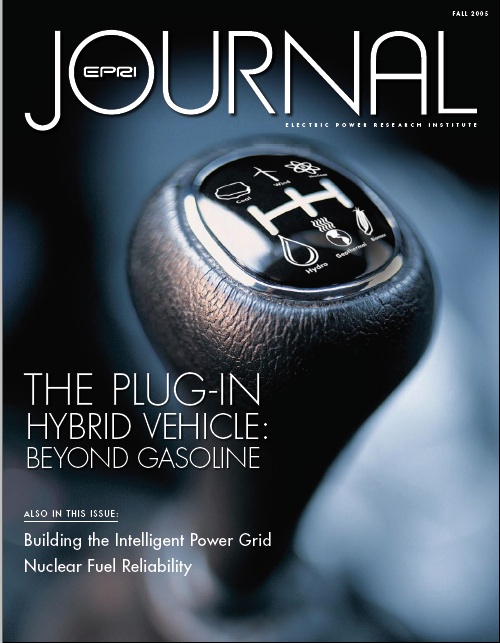
I would highly recommend that anyone interested in an excellent introduction to plug-in hybrid electric vehicles read the article, "Driving the Solution: the Plug-in Hybrid Vehicle," published in the Fall 2005 edition of the Electric Power Research Institute's journal.
EPRI is working with DaimlerChrysler AG on the what will likely be the first commercially available plug-in hybrid, a PHEV version of their popular Dodge Sprinter van (see previous post). As you probably know, I am a strong proponent of of plug-in hybrids as be a near-term solution to dramatically decrease our petroleum addiction and shift much of our transportation energy demand to electricity which in turn opens the possibilty of fueling our transport fleet with a variety of domestical energy sources including renewables (wind, solar, biomass, geothermal). 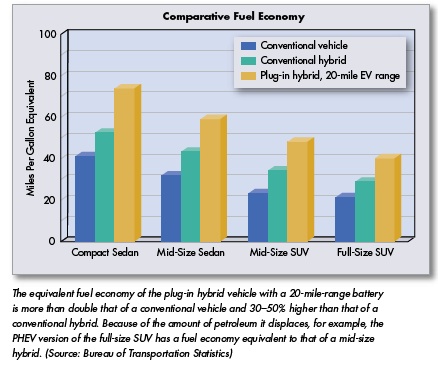
Plug-ins hydrids combine the best of electric vehicles and ICEs - i.e. an efficient zero-emission electric only mode with the extended driving range of an ICE - and I highly suggest reading the EPRI article if you are interested in learning more about this exciting technology. (I've also discussed the incredible potential of plug-ins (and full electric vehicles) before here).
[Graphics from "Driving the Solution: the Plug-in Hybrid Vehicle", EPRI Journal, Fall 2005]