Starting on September 26th, the Portland (Oregon) Water Bureau switched its fleet of diesel-powered vehicles to B99 (a fuel consisting of more than 99% bio-diesel), according to a Bureau press release. The bureau’s diesel-powered fleet has run on B20 (a 20% biodiesel / 80% petroleum diesel blend) since August, 2004.
“This effort makes the Water Bureau’s 84-vehicle diesel fleet the largest in the country running on B99,” says Portland City Commissioner Randy Leonard, “We’re doing our part to increase demand for biodiesel which will help to spur the development of Oregon-based production facilities, reduce greenhouse gas emissions, and reduce our reliance on foreign oil.”
Bureau Administrator David Shaff adds, “We’ve analyzed the fuels and talked to experts on fuels and truck performance. We’ve tested B99. We expect this change to be almost cost neutral. We’re also analyzing performance. The bureau purchases about 100,000 gallons of diesel fuel annually. Diesel vehicles carry stickers saying Powered by Biodiesel.”
In the winter months, the Bureau will modify the percentage of biodiesel to ensure that vehicles and equipment do not experience fuel gelling problems in colder weather, according to City.
According to the press release, the Water Bureau vehicles converting to B99 are the workhorses of municipal public works: backhoes, dump trucks, graders, excavators, water service trucks, welding and crane trucks, pick up trucks, compressors, forklifts, tractors, mowers, generators, work vans, passenger vans and some passenger vehicles. Some older vehicles will remain on B20 and vehicles at the Bull Run maintanence yard will run on a B50 blend, press release reports.
The City of Portland has been one of the more aggressive in the nation in the use of biodiesel. All city-owned diesel vehicles and equipment that use the City’s fueling stations have been powered by a B20 biodiesel blend since 2004, according to the City. Each year the City uses about 600,000 gallons of B20 in approximately 373 trucks, 166 pieces of construction equipment (backhoes, graders, excavators, etc.) and 62 towed units (compressors, generators, etc.), the City says.
According to the City, the conversion to a biodiesel blend began in 2001, when the City of Portland & Multnomah County’s Sustainable Procurement Strategy identified three target areas for improvement: biodiesel, hybrid vehicles, and vehicle purchasing performance standards. Soon after, Multnomah County conducted a one-year pilot study on the use of B20 in their fleet, showing promising results. By the August of 2004, both the City and the County had converted their diesel fleet vehicles to B20.
All City bureaus agreed to absorb the extra cost of switching to biodiesel - about $0.20 per gallon at the time - citing a number of benefits over traditional petrodiesel, including:
In light of the community health and environmental costs associated with these pollutants, the City decided that the price premium for the biodiesel was more than offset by the gains in improving local air quality
Additionally, in July 2006, the Portland City Council voted to approve a citywide renewable fuels standard requiring that all diesel sold in Portland contain 5% biodiesel (B5) and all gasoline contain 10% ethanol (E10), effective July 2007. In an effort to maximize the City’s own use of renewable fuels, they also created a binding City Policy formally requiring that all City-owned:
The city is now also requiring all solid-waste hauling franchisees—businesses awarded franchises by the city for the collection of solid waste—to use B20 biodiesel blends in their refuse vehicles.
The Portland-metro area transit authority, Tri-Met, has also expanded the use of biodiesel, and has used a B20 blend in all 210 of their LIFT service buses, which provide door-to-door service for elderly and people with disabilities, since May 2006 [see previous post].
I'm continually proud to live in the city of Portland. The committment across the board from city officials and leaders to making Portland one of the most sustainable cities in the world has been a source of pride for our city and has had real economic benefits as well, encouraging many 'green-minded' residents and businesses to make Portland their home.
My question now, with the expanded use of biodiesel across the city (and state), is where is it all coming from? Initially, the bulk of biodiesel utilzied in Oregon was provided by SeQuential Pacific Biofuels, who converts used cooking oils to biodiesel in a very efficient process performed in-state at their Salem biodiesel production facility. I'm curious how much of the biodiesel consumed in state continues to be produced in-state/in-region and is sourced from in-state or in-region supplies of used cooking oil, and how much of it comes from soy-based biodiesel from outside of the state. Obviously, the economic development benefits, process efficiency, and environmental benefits of biodiesel use are greater for Oregon when the product is produced in or around Oregon and is based on in-state or in-region feedstocks.
If the region wants to continue to reap the full benefits of the continued expansion of biodiesel consumption, it needs to develop strategies to increase in-region production of both feedstocks and fuels. The Northwest is unfortunately not well suited to soy cultivation. Canola could be grown in the region as a feedstock for biodiesel production, but it presents a problem as canola is closely related to a wide variety of high-value 'boutique' and specialty crops grown throughout much of the Northwest, and concerns about cross-polination have resulted in state policies that currently preclude growing canola in much of Oregon's prime agricultural lands. I know that the State Departments of Agriculture and Energy are working to develop a plan to safely allow some development of canola or other biodiesel feedstocks, if possible, but challanges remain.
But once again, bravo to Portland for this policy!
[A tip 'o the hat to Green Car Congress]

Wednesday, October 18, 2006
News From My Backyard: Portland Water Bureau Using B99 Biodiesel - Largest B99 Fleet In Country


Tuesday, October 17, 2006
California to Link with East Coast RGGI States for Uniform Greenhouse Gas Market
 [From Green Car Congress:]
In order to more efficiently reduce greenhouse gas emissions, California Gov. Arnold Schwarzenegger and New York Gov. George E. Pataki have agreed to explore ways to link California’s future greenhouse gas emission credit market and the Northeastern and Mid-Atlantic states’ Regional Greenhouse Gas Initiative (RGGI) upcoming market.
RGGI is a cooperative effort by Northeast and Mid-Atlantic states to design a regional cap-and-trade program designed to achieve a 10% reduction in greenhouse gas emissions from power plants by 2019.
The RGGI program will implement the nation’s first mandatory cap-and-trade program for carbon dioxide emissions. In addition to New York, other states signing the agreement to implement RGGI include: Connecticut, Delaware, Maine, New Hampshire, New Jersey, and Vermont. The State of Maryland also has adopted legislation to join RGGI by June 2007.
Earlier this year, a model set of regulations to implement RGGI were finalized. New York and the other six states who are participating in RGGI are able to use this model to draft the necessary regulations or legislation to implement this program in their own state. New York plans to propose its draft regulation in the next few months.
RGGI uses a flexible, market-based cap-and-trade system. Each state will issue one emissions credit or allowance for each ton of CO2 emissions allowed under the regional cap. These emissions credits will be traded as commodities.
Last month, Governor Schwarzenegger signed AB 32, California’s landmark greenhouse gas emissions legislation that established a program of regulatory and market mechanisms to achieve real, quantifiable, cost-effective reductions of greenhouse gases. (see earlier post.)
AB 32 requires the California Air Resources Board (CARB) to develop regulations and market mechanisms that will ultimately reduce California’s greenhouse gas emissions by 25% by 2020. Mandatory caps will begin in 2012 for significant sources and ratchet down to meet the 2020 goals.
The two governors discussed ways to link the two efforts to create a uniform carbon trading system.
Gov. Schwarzenegger also announced an executive order directing California Secretary for Environmental Protection Linda Adams to coordinate state climate change policy. The executive order, which will formally be signed on Tuesday, also instructs the secretary to work with the California Air Resources Board to seek to develop a framework that allows California to work together with RGGI. Such an arrangement would help build a large, robust carbon trading market.
This seems like smart policy. As much as possible, integrating the tradable environmental attribute markets - be they for CO2, NOx, SO2, or Renewable Energy Credits (RECs) - creates more robust and efficient trading markets. And, in the absence of unifying federal legislation capping carbon emissions, it's good to see as much cooperation as possible on the state level.
I'm consistently impressed with the leadership of these two Republican Governors (from 'blue' states) on issues pertaining to climate change, renewable energy development, and domestic energy security. Again, I ask you, Mr. President, what's your excuse for inaction?
Wednesday, October 11, 2006
Transition to Low-Sulfur Diesel Fuel Nearing Completion
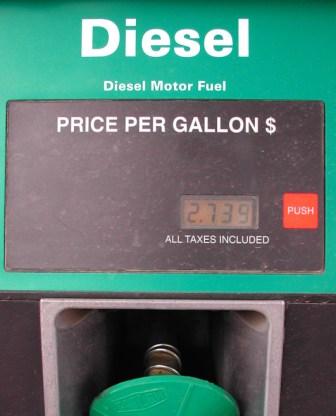 The New York Times reports today that the transition to low-sulfur diesel fuel is proceeding rapidly and trucks, buses and other diesel vehicles across the country can now fill up with the less polluting fuel. Perhaps the most significant revolution in highway fuels since the introduction of lead-free gasoline, the new ultra-low sulfur diesel fuel has just 3% of the sulfur previously found in diesel fuel.
Like lead, sulfur generates air pollution that leads to severe health consequences. Like lead, it also gums up the works of fine-tuned pollution control devices, making it exceedingly difficult to produce cleaner-burning engines.
The new low-sulfur diesel fuel standards call for fuel with an average sulfur content not exceeding 15 parts-per-million (ppm), a 97% reduction from the previous sulfur content standards, 500 ppm.
The transition to low-sulfur diesel began in June 2006 in order to prepare U.S. diesel vehicles for the new stricter Federal Tier 2 emissions standards scheduled to be implemented in 2007. The low sulfur content enables the use of catalyst-based exhaust after-treatment pollution control devices that will further reduce emissions of particulates, oxides of nitrogen, and other diesel exhaust pollutants as the new Tier 2 emissions standards are phased in next year. The new fuel will thus pave the way for new generations of diesel engines that will eventually cut lethal particulate pollution from diesel tailpipes an estimated 95 percent, according to the Times.
The transition to the new fuel is occuring swiftly, according to the Times. As of Sunday, at least 80 percent of the diesel available for trucks and buses has to meet the new standard, the Times reports, and officials of the Environmental Protection Agency said Tuesday that the changeover was occurring so swiftly that 90 percent of the fuel would soon be compatible.
Apparently, the Bush administration is trying to claim this accomplishment as its own, ignoring the fact that the regulation has it's origins in the 1990's and the fact that it became effective in December 2000, before President Bush took office.
According to the Times, in a news conference in Columbus, Ind., the headquarters of Cummins Engine, a major manufacturer of diesel engines, the environmental protection administrator, Stephen L. Johnson, said, “Under President Bush’s leadership, the pumps are primed to deliver clean diesel and a cleaner future for America.”
The Times article continues: Old diesel engines burning the cleaner fuel will reduce dangerous particulate emissions by 10 percent, experts say. New engines with improved controls, which have to be available by Jan. 1, will cut this particulate pollution by more than 95 percent. The rule mandates more improved engines in 2010. It is unclear how soon existing trucks and buses, which often are in use for more than 10 years, will be turned in for newer models.
The new low-sulfur diesel fuel will also pave the way for clean diesel cars and light trucks in the coming years. Diesel vehicles utilize more efficient engines and get better gas mileage than gasoline vehicles, a benefit that has traditionally been offset by higher tailpipe emissions than gasoline vehicles. Diesel vehicles are very popular in Europe, but have had less success in the United States, partly because of perceptions about dirty emissions.
The new fuel is expected to cost 3 cents to 5 cents more per gallon. Like many regulations that took effect in the twilight of the Clinton administration, the diesel rule, covering fuel and the seven million trucks and buses on the roads, was temporarily stayed by the Bush administration.
Then the Environmental Protection Agency allowed it to proceed and in 2004 supplemented it with a similar rule requiring tight controls on engines in off-road equipment like cranes, tractors and construction equipment.
Leading environmental groups linked arms with industry in a chorus of praise for the new fuel and engines to follow. They emphasized the health benefits and the novel wording of the rule. Unlike earlier regulations, the new rule links the development of the new fuel to developing cleaner-burning engines. Richard Kassel, a senior lawyer and air-pollution specialist with the Natural Resources Defense Counsel, said that when planning for the rule began in 1995, gasoline-powered cars outnumbered diesel-powered trucks and buses by 190 million to 6.7 million.
The diesel vehicles emitted 43 percent of the smog- and particulate-forming nitrogen oxides and more than two-thirds of the soot. Even though the diesel-produced particulates were 3 percent of the total particulate matter in the air, most of which was from industrial sources, Mr. Kassel added, “tailpipe particulates are coming out right where we breathe.”
Mr. Johnson said diesel engines had been the workhorses of the economy and the vehicle fleet.
The relatively high sulfur levels in diesel have been a significant obstacle to producing diesel-powered cars that met federal environmental standards.
Several engine and automobile manufacturers have signaled that more high-mileage diesel-fueled cars, a fixture on European highways, may become available.
Allen Schaeffer, executive director of the Diesel Technology Forum, an industry group, said in a conference call Tuesday that the new standard was also significant because it “opens up the door of possibility” to a new generation of light-duty diesel cars and trucks in the United States in the near future.
The environmental agency estimates that when the current truck and bus fleets have been replaced and all are using the heavy-diesel engines that will become standard-issue next year, the new rule will prevent 8,300 premature deaths annually.
In the Clinton and Bush administrations, the development and roll-out of the diesel rule for trucks and buses has been notable for the cooperation among industry, the government and environmental groups, officials of the three groups have said.
Margo T. Oge, director of the office of mobile sources in the agency’s air division, said Tuesday that the speed with which the new fuel became available had exceeded the agency’s expectations.
Carol M. Browner, the administrator who signed the original rule, bristled on Tuesday at the Bush administration’s proprietary attitude.
“The best they can do in environmental policy,” Ms. Browner asked, “is take credit for someone else’s work?”
The new low-sulfur diesel fuel and new diesel vehicles capable of meeting the strict Tier 2 emissions standards will mean that the diesel vehicles of the near future will be significantly cleaner, with emissions comparable to gasoline-fueled vehicles. This will hopefully help overcome the common perception that diesel cars and trucks are "dirty," and will idealy lead to the further market penetration of more efficient diesel vehicles in the North American market.
OPEC to Cut Oil Production By One Million Barrels per Day
 The New York Times reports today that the 11 members of the Organization of Petroleum Exporting Countries have reached an agreement to collectively cut oil production by one million barrels per day in order to halt falling oil prices. After a week of talks, however, the 11 member nations are still negotiating about how the cuts will be divided amongst them.
Edmund Daukoru, the president of OPEC and Nigeria’s oil minister, said today from the Nigerian capital that the cartel’s members were “nearing consensus” about how to share the cuts, the Times reports.
Oil prices rose slightly on the news. At midmorning the benchmark contract for light, low-sulfur crude to be delivered next month was trading on the New York Mercantile Exchange for $58.68 a barrel, a gain of 16 cents, according to the Times.
Today's announced agreement belies the general lack of consensus that has plagued OPEC as the various member countries attempt to address falling oil prices. As the price of oil has fallen by nearly 25 percent since peaking in mid-July at a record-high $78.40/barrel, OPEC members have so far been unable to agree on a common approach to reducing supply and sustaining prices. That has left oil markets around the globe unsettled, according to the Times.
The Times article has more: The prospect of OPEC agreeing to act in concert to keep prices from falling further led the United States energy secretary, Samuel Bodman, to say today that he is seeking talks with the cartel in the next week. “We have continued to encourage OPEC, as well as all producers, to make plenty of oil available, so we can keep our market well-supplied,” Mr. Bodman said in an interview with CNBC.
This is the time OPEC should have been bracing itself for — the first quota cut in two years. Instead, as an analyst from Société Générale noted, “OPEC failed its return to discipline.”
The Organization of the Petroleum Exporting Countries is not a homogenous group, but a collection of countries with divergent political and economic interests. As oil prices more than doubled over the last three years, OPEC members found it easy to agree on a common policy that brought them windfall revenue.
But with prices now falling, that consensus is fraying. Iran and Venezuela have called for a special meeting in Vienna next week to endorse production cuts. Others, like Kuwait and Algeria, have backed the proposal but disagree on how to apportion the cuts. And Nigeria has resisted calls for a special meeting next week, to avoid overshadowing OPEC’s next scheduled conference, to be held in Abuja, the Nigerian capital, in December.
The group’s most influential member, Saudi Arabia, has remained conspicuously silent. The Saudis are understood to support a production cut, but OPEC watchers reason that the country, which accounts for one-third of OPEC’s output, wants to be discreet, with midterm elections in the United States just a few weeks away.
With bickering in the ranks and without clear leadership from Saudi Arabia, analysts are left weighing vague signs to discern what OPEC is up to.
Paul Horsnell of Barclays Capital said, “The Kremlinology of OPEC is back.”
In the last two years, OPEC producers have been steadily increasing their output to meet rising demand for oil and to make up for unexpected shortages in global supplies. That has led the group to raise its total output above 30 million barrels a day, the highest level in more than 25 years.
Now, with supplies aplenty, inventories brimming and demand slowing, OPEC finds itself having to shift its focus to manage a declining price pattern, reducing its production to keep world prices above certain levels.
Because OPEC has not formally reduced its ceiling on output since April 2004, any talk of how to divide the lower production is certain to lead to acrimonious negotiations as countries fight to keep their market share. One option being discussed is to reduce the group’s actual production by a million barrels a day while using the current quotas to calculate each country’s contribution.
Because some producers have been paring their output in recent months, OPEC now produces 27.5 million to 27.8 million barrels a day, depending on estimates. That excludes oil from Iraq, which has no production quota.
Referring to OPEC, Sadek Boussena, a former president of the group and a former oil minister from Algeria, said: “They have had no training for nearly two years. It’s like a football game. Right now, they are warming up for a friendly game. But if prices fall further, it might become vital for them to act.”
OPEC did away with its quotas last year when its members pumped at maximum capacity, but its effectiveness as a cartel comes from allocating output targets to its members and sticking to them.
In the past, quota compliance has proved notoriously difficult, as renegade members would regularly disregard their allocations while pretending to adhere to OPEC agreements.
In the 1980’s, widespread quota violations led to a production war initiated by Saudi Arabia — which basically opened its spigots and flooded the market with oil, leading to a price collapse — to bring recalcitrant members back into line. That is an experience no one in the organization wants to see happen again.
After years of low prices, producers have gotten used to today’s higher prices. They need the higher revenue to finance their booming economies, their huge investments in energy projects and in real estate. Arab gulf countries, led by Saudi Arabia, will spend an estimated $700 billion by 2010, according to the latest report on the region by the International Monetary Fund.
“After two years of free-for-all production, going back to quotas is difficult,” said Manouchehr Takin, an energy analyst at the Center for Global Energy Studies in London. “But they know that if they don’t get back their discipline quickly, if they don’t control the leakage and the cheating, they can lose the market.”
Some countries — including Algeria, Libya and Qatar — are producing way above their nominal quotas and will resist calls to return to the old allocations and give up some of their market share.
For example, Algeria produces 1.4 million barrels a day and aims to raise its capacity to 2 million barrels in coming years. Yet its quota is 894,000 barrels.
From a quite different perspective, Iran, Nigeria, Venezuela and Indonesia are having trouble meeting their quotas but will be loath to give up their allocations.
Venezuela’s production slumped after a devastating strike by oil workers late in 2002 and the country has since found it tough to increase its output to more than 2.5 million barrels a day. Yet it still has a quota of 3.2 million barrels.
And Indonesia, which has a quota of 1.45 million barrels but pumps only 860,000 barrels, too little for its own domestic consumption, has become a net importer of oil.
So deciding where the new quotas should stand will be a real challenge, and OPEC’s ministers studiously avoided the topic for the last two years. But analysts say that the organization cannot put off the discussion any longer.
“Pandora’s box has been opened,” Frédéric Lasserre of Société Générale said.
Tuesday, October 10, 2006
More on Mitsubishi MIEV: Mistu to Sell Electric Car in U.S.
AutoWeek (via Green Car Congress) reports that Mistubishi Motors has again said they plan to sell a small electric car in the United States.
President Osamu Masuko told AutoWeek that the vehicle, powered by a lithium-ion battery, will be launched first in Japan. A hybrid version of the car also might be available, Masuko added.
Timing and sales volume targets were not disclosed but a detailed announcement about the car is expected shortly (stay tuned).
"From an environmental standpoint, we believe the electric car is the way to go because it has zero emissions," Masuko said here last week at a Mitsubishi dealer meeting. "Fuel cell technology is still off in the future. Diesels are big in Europe but not in Japan and the U.S."
Mitsubishi has been testing hybrid and electric cars in Japan for over a year (see previous post). They have used both a two-wheel drive Colt and a four-wheel drive Lancer as test beds for their electric vehicle architecture.In January, Mistu unveiled an electric-dominant hybrid concept car, the Concept-CT MIEV (pictured above) at the Detroit auto show (see this previous post for a rundown of this and other 'green machines' at the Detroit show). They also unvieled a pure electric concept vehicle, the Concept-EZ MIEV, at the Geneva International Auto Show in February.
Both concept vehicles feature Mitsubishi's In-wheel motor Electric Vehicle, or MIEV, architecture (see graphics below, and this previous post for more). [Graphic: Mistubishi's In-wheel motor Electric Vehicle architecture can be applied to any electric drive vehicle architecture, including hybrids, plug-in hybrids, electric vehicles and fuel cell vehicles]
 [Graphic: Exploded view of Mitsubishi's in-wheel motor]
The Concept-CT is an electric-dominant series/parallel hybrid, obtaining the majority of its drive torque via the electric in-wheel motors, which are powered by a 1.0-liter gasoline genset and Li-ion batteries in a conventional series-hybrid configuration. At constant speed, however, the Concept-CT can add engine-powered rear-wheel drive for extra driveability (the parallel-hybrid aspect). The Concept-CT MIEV has four doors but is smaller than Mistu's popular Lancer. Each wheel has its own electric in-wheel motor. The electric motors provide all-wheel drive without a traditional transmission, thus cutting weight and saving on space.  The Concept-EZ (pictured right) is an all-electric compact mono-box design that takes advantage of the space-saving properties of the MIEV archictecture (no transmission, no engine, etc.) to offer a very roomy interior inside a compact body. The Concept-EZ is powered by four in-wheel motors and a 24 kW lithium-ion battery system. The battery back, which weights in at 150 kg, is mounted under the floor and the absence of a centerline powertrain due to the MIEV design allows the Concept-EZ to provide a roomy interior despite its compact exterior.
During a previous interview, Mitsubishi executives told Automotive News that the production version of the MIEV concept might be based on the next-generation Colt, which is due before the end of the decade. A December 2005 article in the Chicago Tribune (sorry, it's in the archives now) reported that Mitsubishi planned to release an MIEV mini-car utilizing lithium-ion batteries to the U.S. market "after 2008."
So, it looks like we can expect Mitsubishi to offer a compact, electric-drive vehicle featuring the core technologies of MIEV and lithium-ion batteries sometime between 2008 and 2010. Stay tuned for more details...
[A hat tip to Green Car Congress, and the Energy Blog]
Wednesday, October 04, 2006
Eye on China: China's Energy Focused on Renewables - Dedicated Fee to Pay for Renewable Energy Costs
 China's top economic planning body, the National Development and Reform Commission (NDRC), announced at the end of June a plan to raise consumer electricity rates by the equivalent of 2.5 US cents per kilowatt-hour, according to Asia Times Online. A tiny fraction of that additional charge, about 0.1 cent per kilowatt-hour, will be used to develop renewable energy sources, a senior NDRC official said weeks later.
This dedicated renewable energy charge is unprecedented, the official said. The money would be used to cover the portion of the above market costs of renewable energy development, the Times reports. The practice complies with the principle enshrined in China's recently enacted Renewable Energy Law that the extra costs of renewable energies should be shared by all end users of electricity across the country. The Renewable Energy Law came into effect in January of 2006.
On April 20, at the second gathering of the State Energy Leading Group, the highest authority in China on energy issues, Premier Wen Jiabao stressed that renewable energy is strategically important, the Times reports. He reportedly urged all government departments to take effective measures to accelerate the development of renewable energies, so as to "lift the share of quality, clean energies in the total energy mix".
China's energy industry is growing at a remarkable rate. According to the Times, the production of primary energy reached 2.06 billion tons of coal equivalent last year, or roughly 47 quadrillion British thermal units (Quads). This is still about half of the 100 Quads of primary energy consumed in the United States, but has grown by 238% since 1978. At the end of 2005, China's total installed electricity capacity exceeded 500 gigawatts, according to the Times. Again this is about half of the United States' installed capacity of about 930 gigawatts, but China's adding generating capacity at the rate of about one large 500 megawatt coal-fired power plant per week!
The Asia Times Online article continues [with a few edits to improve the readibility of their English translation...]: In the past two decades, growth in production supported a 5.16% average annual growth in primary energy consumption. However, gross domestic product (GDP) went up even faster, at an annual average of 9.6%. The result was a supply shortage that short-circuited in 2004, when 24 of the 31 provinces suffered power cuts.
Last year's coal output, a record high and double the 2000 figure, was still not enough to meet market demand. Meanwhile, China's net imports of crude-oil products climbed to 143 million tons, nearly doubling the 76 million tons it imported five years ago.
Domestic energy resources are limited. In per capita terms, China is relatively poor in many energy resources. Its remaining exploitable reserves of petroleum, natural gas and coal equal merely 7.7%, 7.1% and 58.6% of the world averages respectively. At the current speed of extraction, experts say, these energy resources will last just 15, 30 and 80 years respectively. The corresponding world averages are 45, 61 and 230 years.
The situation prompted the country's economic planners to look for alternative energy sources. Renewable energies were high on the wish list.
[Hydropower] has a relatively long history in China, where more than 40,000 small hydropower facilities [produce a total of] 34 million kilowatts [34 gigawatts] in capacity [. China is also home to the largest hydropower facility in the world, the massive 18.2 gigawatt Three Gorges Dam].  Given its grave energy-security concerns, China is stepping up efforts to develop renewable energies. According to the Medium- and Long-Term Program for Renewable Energy Development, prepared by NDRC, renewable energies are expected to account for 16% of the country's total energy mix by 2020. Hydropower capacity will reach 300 million kilowatts, wind power 30 million, biomass energy 30 million, and solar energy 1.8 million.
The program has been scrutinized by the State Energy Leading Group and a revised version will soon be submitted to the State Council, China's cabinet, for final approval.
China has three laws pertaining to energy issues: the Electricity Law, the Energy Conservation Law, and the Renewable Energy Law. The almost unanimous endorsement of the Renewable Energy Law by the National People's Congress (NPC), China's parliament, in February 2005, ahead of schedule, caught many people by surprise. The law became effective on January 1 this year. A dozen or so implementation measures that accompany the law were made public about a month later. And measures for managing a special state fund for renewable energies and measures for giving renewable energy projects discount loans and preferential tax treatment are reportedly being worked out.
Ma Kai, minister in charge of the NDRC, said in July that [the government's agenda for 2006-10 included plans] to enact an Energy Law and revise the Energy Conservation Law.
Relevant government departments vowed to see through the new legislation within two years. The Energy Law will deal with basic and strategic energy development issues in China. It will rely on economic leverage to regulate the energy sector, making sure that extravagant users of energy pay a higher price, and encourage the prospecting and extraction of energy reserves and the development of renewable and new energies, said sources who were closely involved in the drafting work.
Officials in local governments are enthusiastic about promoting renewable-energy projects. Their motives vary, though, from securing a lucrative source of government tax revenues to building up a "green government" image and gaining plaudits for their personal work performance records. The so-called "green GDP" factors now have a considerable bearing on the government's assessment of an official's performance [see this previous post for more on China's new 'green GDP'].
Companies, state-owned or private, domestic or foreign, are also eager to embrace renewable energy projects, for reasons similar to those mentioned above, or out of a belief that the energy sector is a gold mine - or will be in the future. And for some companies, state-owned enterprises in particular, government pressure is also playing a role. On a number of occasions this year, NDRC Deputy Minister Zhang Guobao has said a certain proportion of the products produced by big energy developers would have to come from renewable sources.
A major barrier that has prevented renewable energies from being developed faster is the weakness China has shown in independent technology development. To date, most renewable-energy equipment or components used in China for wind power, biomass or solar energy have been imported, resulting in high costs. 
The push for renewable energies is not entirely driven by energy concerns. Environmental factors are also critical. China ratified the Kyoto Protocol in May 1998. Although it was not obliged by the pact to meet a specific emission-reduction quota, China is making efforts to show that it is a responsible member of the global family. International cooperation is necessary in addressing problems such as duststorms because, more often than not, the dust that sweeps through Beijing a dozen times each year comes from abroad, said an official with the Beijing Meteorological Bureau.
And China has a promise to keep with the upcoming Summer Olympic Games in Beijing. In its bid to host the event years ago, Beijing pledged to stage a Green Olympics, which would be more environmentally friendly than any previous Games. The 2008 Beijing Olympic Games are expected to recruit a diverse selection of renewable-energy technologies. Its main venue, the Olympic Green, is to have 20% of its power supplied by wind-generated electricity.
According to statistics, US$38 billion was invested in renewable-energy development worldwide in 2005. China topped the list with a commitment of $6 billion, which did not include its spending on large hydro projects.
[A hat tip to Renewable Energy Access]
DOD: Wind Power Has No "Unacceptable Impact" on Radar
 The Department of Defense (DOD) has found that none of the 730 wind turbine proposals reviewed so far have presented an "unacceptable imapact" to radar operation, according to Greenwire (sorry, membership required for online article). This conclusion comes despite a recent report which concluded that wind turbines can potentially interfere with military radar.
The news will hopefully mean that the up to 15 wind power projects in the Midwest that have been stalled by the FAA over concerns about effects on local radar installations since this summer (see previous post will now move forward. The stalled projects represent nearly 2,000 megawatts of capacity.
According to Greenwire, the DOD and the Department of Homeland Security have been reviewing projects for potential interference with military and homeland security radars, which has led to the delay of some projects in recent months. And a DOD report released last week described potential effects of turbines on radar performance.
The report recommended that projects be reviewed on a case-by-base basis.
To date, the DOD/DHS Long Range Radar Joint Program Office has reviewed a total of 730 turbine proposals, Greenwire reports, and the office has concluded 540 were not within radar "line of sight," according to spokeswoman Eileen M. Lainez.
Of the remaining 190, "it was determined that while those turbines may be in radar line of sight, construction would not create an unacceptable impact on the ability of our long range air defense and homeland security radars to perform their mission," Lainez said in an e-mail to Greenwire. She also said a number are still under review.
The Greenwire article continues:  Laurie Jodziewicz, a siting specialist with the American Wind Energy Association, said the roughly 10 projects in the Midwest slated to begin construction this year are moving forward after the reviews had created uncertainty about their status.
"The experience on the ground has shown us that wind and radar can coexist, so even in this time of pretty intense scrutiny those projects were allowed to move forward after this intense review," Jodziewicz said.
Jodziewicz said projects that had been delayed but have been able to proceed include PPM Energy's MinnDakota Wind Power Project, a 150 turbine project in the two states that will provide electricity to Xcel Energy customers. PPM announced Sept. 21 that it had broken ground on the project.
Good news for the American wind industry. From what I've heard, the DOD report wasn't all the great - it completely ignored the potential for mitigation technologies that could further reduce the impact of wind on long-range radar, for example, despite the fact that several technologies are being tested for that purpose - so it's good to see that the DOD/Homeland Security has independently reviewed the turbine proposals and found that they pose little or no impact on radar operations.
This whole radar hold-up seems to have been a pretty unnecessary hiccup caused largely by political maneuverings targetting the Cape Wind Project, not the Midwestern wind farms that actually ended up getting hurt by radar-related concerns (see previous post).
Tuesday, October 03, 2006
Hy-Drive Technologies Closes Deal for Sales of On-Board Hydrogen Units
Green Car Congress reports that Hy-Drive Technologies has closed its first sales order from Mining Technologies International (MTI) for a version of the Hydrogen Generation System (HGS) designed for mining equipment. The Hy-Drive HGS injects small amounts of hydrogen gas into the combustion chamber of a regular internal combustion engine, creating an enriched air mixture and a more complete and faster burn of the fuel. This results in reduced emissions, improved fuel efficiency and more engine torque. The hydrogen is generated from distilled water by an on-board electrolyzer that pulls power from the engine’s standard electrical charging circuit.
Company testing indicates an increase in horsepower of up to 6%; an up to 80% reduction of particulate matter; an up to 46% reduction of NOx emissions; and a reduction of up to 98% of carbon monoxide emissions.
The HGS is easy to install and works with any internal combustion engine, all types of fuel and in almost any climate making a versatile solution for any truck fleet. The G2 product measures 11 3/4"w x 13"d x 19 5/8"h.
The C$444,000 (US$393,000) sales order is the first under the exclusive North American marketing and distribution agreement between MTI and Hy-Drive [see earlier GCC post].
Earlier this year MTI purchased 36 HGS units. Testing of those systems on mining equipment showed fuel savings of 27%, in addition to a 99% and 95% reduction in toxic carbon monoxide and hydrocarbon emissions respectively.
Robert Lipic, MTI President and CEO, seemed quite pleased with the Hy-Drive system, saying: With the increasing demands and emphasis for health and safety among the various mining unions, this product is the key to the improved air quality that our customers have been seeking. The fuel savings are just icing on the cake.
The purchase order represents the first utilizing Hy-Drive’s Clean Burn Technology adapted specifically for the mining industry. The unit design will feature a sleeker profile for simplified installation on underground vehicles which are limited by the confined space in a mine. In addition, the mining product will include a steel re-enforced casing which protects the unit from damage caused by falling ore.
In September, Hy-Drive announced that two trucking firms were installing HGS systems on their vehicles. Langford, Inc., a St. Cloud, Minnesota-based trucking firm, is installing the HGS systems throughout its entire fleet. Pollywog Transport of Palmetto, Florida is installing the system on 36 refrigerated trucks within its fleet.
The Pollywog trucks use the Detroit Diesel Series 60 engine with 430-470 hp ratings. In side-by-side operations, HGS-equipped units have achieved up to a minimum of 0.81 mpg improvement and the average has gone from 5.35 mpg to 6.7 mpg—a 25% improvement—which translates into $300 per week per unit.
I imagine it will only be a matter of time before the long-haul trucking industry is all over this technology. Hy-drive seems to have developed an excellent piece of technology here.
And a 25% fuel economy boost for the entire trucking fleet is huge! That would translate into considerable savings.
According to the Transportation Energy Databook, heavy trucks (single unit and combination trucks) consumed just over 36,750 million gallons of diesel in 2002 (a number which has surely grown since then). A 25% increase in fuel economy across the heavy truck fleet would thus translate to almost 9.2 billion gallons of diesel saved, or the energy equivalent of over 220 million barrels of oil (603,340 barrels per day), 3% of total U.S. petroleum consumption in 2002.
That's nothing to scoff at, and represents the potential benefit of just one available technology offering incremental fuel economy benefits. In contrast, the recently proposed nationwide renewable fuels standard is designed to cut petroleum use by just 1-1.6% (about 3.9 billion gallons) by 2012. A fuel savings of 603,000 barrels per day is also almost as much as the the estimated peak production that could be achieved if we were to drill in ANWR (870,000 barrels per day).
And again, this is just one technology offering incremental fuel economy improvements to one sector of U.S. transportation energy consumption. Hy-Drive has a smaller unit in development for use in light vehicles, and a German company is developing one as well, both of which would make great sense for anyone driving many miles (i.e. taxi drivers, delivery vehicles, police cars, ambulances, buses, people with long commutes, etc.. And simply scan the headlines at Green Car Congress any day of the week and you'll likely see yet another technology that offers an incremental fuel economy improvement highlighted in one or more of their posts.
I think that we too often focus on the supply side of the issue - folks variously propose that we'll meet our energy needs in the future by drilling for more oil, ramping up ethanol production, switching to hydrogen, etc. etc. - and neglect the demand side of the equation, which is where our attention should focus first. Let's not forget the incredible potential of fuel economy improvements, which should be the first issue on the table if our country is really going to get serious about domestic energy security and combatting global climate change.
In the transition to a sustainable energy future, we've got to do four things: