Friday, June 24, 2011
5 Reasons I Love the Solar Panel Industry

Labels:
solar panels,
solar power
Monday, June 20, 2011
Webinar - Fukushima and Nuclear Power: Can we live without it?
Live Webcast June 29, 3 PM ET / 12 PM PT
Following the earthquake and tsunamis that tragically impacted Japan in March, the unfolding crisis at the Fukushima nuclear power plant has captured public attention for months. Energy experts are now questioning the long term impact of the Fukushima disaster on nuclear policy, international power generation, and the global carbon picture:
Join The Energy Collective's latest webcast as we seek answers to these questions and discuss nuclear power's role in our energy future. Register here today.
Matthew Wald is a Reporter for the Washington Bureau at The New York Times, covering environmental and energy issues, as well as transportation, aviation and highway safety. Having joined The Times in October 1976 as a news clerk in the newspaper’s Washington bureau, Wald held positions at the New York metropolitan desk, the State Capitol in Hartford, and as a national correspondent, covering a variety of areas including housing and nuclear power, before joining the Washington bureau in September 1996. Wald has covered the Fukushima crisis extensively in the New York Times.
Edward Kee is a VP at NERA Economic Consulting and a specialist in the electricity industry with experience in nuclear power, electricity markets, restructuring, regulation, private power, and related issues. For more than 20 years, he has provided testimony as an expert witness on a range of electricity industry issues in state and federal courts, before the Federal Energy Regulatory Commission, and before other legal and regulatory bodies in the US and around the world. Mr. Kee also provides strategic advice to companies and governments on issues related to the nuclear and electricity industries. Mr. Kee holds an MBA from Harvard University and a BS in Systems Engineering from the US Naval Academy.
Jesse Jenkins is Director of Energy and Climate Policy at theBreakthrough Institute, and is one of the country's leading energy and climate policy analysts and advocates. He is the co-author with Devon Swezey of the "Rising Tigers, Sleeping Giant" report on global clean energy competitiveness strategies, and is currently working on an update to the report. Jesse has written for publications including the San Francisco Chronicle, Baltimore Sun, Yale Environment 360, Grist.org, and HuffingtonPost.com, and his published works on energy policy have been cited by many more. He is founder and chief editor of WattHead - Energy News and Commentary and a featured writer at the Energy Collective.
Marc Gunther is a veteran journalist, speaker, writer and consultant whose focus is business and sustainability. Marc is a contributing editor at FORTUNE magazine, a senior writer atGreenbiz.com, and a lead blogger at The Energy Collective. He's also a husband and father, a lover of the outdoors and a marathon runner. Marc is the author or co-author of four books, including Faith and Fortune: How Compassionate Capitalism is Transforming American Business. He's a graduate of Yale who lives in Bethesda, MD.
Labels:
Clean Energy,
Energy policy,
events,
Japan,
nuclear power,
webcast
Tuesday, June 14, 2011
ACE students offer White House fresh ideas to spur energy efficiency
Shreya Indukuri and Daniela Lapidous, ACE Youth Advisory Board members and juniors at the Harker School in San Jose, CA, paid a visit to the White House yesterday, but they didn't just go for a tour. Through working with ACE, this energy-smart duo is scaling up their efforts to spur efficient energy use in America’s high schools – and sharing their ideas with America’s leaders.
Yesterday, in front of an invite-only audience of CEOs, White House advisors, and utility industry leaders, Shreya and Daniela shared the story of how they reduced their school’s energy use by 13 percent and founded their own non-profit, SmartPowerEd.
They shared a stage with U.S. Secretary of Energy, Steven Chu; Secretary of Agriculture, Tom Vilsack; Director of the Office of Science and Technology, John Holdren; and Chairperson of the White House Council on Environmental Quality, Nancy Sutley.
In their talk, they let our leaders know that young people care about the future and energy use, and that they are ready to get involved with solutions. They closed with two questions for Secretary Chu and others: how are you going to harness the potential of young people? How are you going to prioritize energy education and inspire young people to act?
You can see a video of their talk with White House officials here. More to come from ACE's Emily Adler, who accompanied Shreya and Daniela to the event. What a day!
Thursday, May 26, 2011
How Much Gas Do You Use? Track Gas Use With This New Widget.
As the Memorial Day Weekend approaches, many of us are planning road trips — according to the American Automobile Association (AAA), over 30 million Americans will get in their personal vehicles for a weekend get-away, with many driving hundreds of miles.
Although gas prices have dropped slightly during the past few weeks, they are still a dollar per gallon higher than they were one year ago at this time. These prices have made many of us think hard about the efficiency of our vehicles — how much is it costing us to drive?
We have developed a tool to help you determine the costs of driving your car or truck, including how much carbon dioxide (CO2) your vehicle produces. Carbon dioxide is a key greenhouse gas that is contributing to global warming. Using the tool below, select your state, your car’s gas mileage, and how many miles you drive in a typical year (default values are set to national averages).
This widget — which you are welcome to embed on your webpage — also displays the CO2 emissions that result from a particular amount of driving. Gas price data are automatically updated daily from the AAA.
Labels:
gas prices
Thursday, May 05, 2011
Weighing in on the Gas Tax Debate
By Jesse Jenkins and Sara Mansur
Kevin Drum's recent post on the low price elasticity of demand for oil has reignited an old debate over gas taxes and energy innovation.
Drum draws our attention to some "eye popping" figures for price elasticity of demand for oil from the IMF. According to Drum, these elasticities mean that, in the short term, a 50 percent increase in price leads to a 1.2 percent decrease in consumption. In the long term, it leads to a 4.7 percent decrease.
Conservative blogger Jim Manzi rightly points out that, with elasticities as low as these, a gas tax at any politically realistic level is not going to reduce our dependence on fossil fuels.
Specifically, to the extent that we continue to progress in making non-fossil-fuels technology cheaper and more effective for an ever wider array of applications, we can accelerate the ongoing de-carbonization of our economy. The idea of economists to use artificial scarcity pricing to do this is aggressively marketed in blogs, magazines and TV shows, but is extremely unlikely to work, because the current price elasticity of oil is so low. The work of engineers and physical scientists, however, is likely to be determinative.In response, several bloggers have argued that these elasticities are underestimated, pointing to the unreliability of estimates of long-run price elasticity of oil demand in general and to other literature with higher estimates than the IMF study. While the IMF estimates are low, revised estimates certainly aren't so high as to penalize consumption, particularly in the absence of viable, and cheap alternatives to fossil-fuel based technologies.
This brings us to a second, crucial reason that a gas tax won't solve our dependence on foreign oil. As Matt Hourihan of the Information Technology and Innovation Foundation argues on Andrew Sullivan's blog, price hikes alone won't do much to spur clean energy innovation, mostly because of the risks inherent with nascent, early-stage technologies, risks that private companies aren't willing to bear on their own.
The problem is that just as price changes have to be severe to manifest any impacts on gas consumption, price changes on their own also tend not to do much to inspire the development of radical new tech solutions, unless prices are through the roof. This is mainly due to the high levels of risk and uncertainty that come with new tech: private firms would generally rather seek out low-risk, low-cost alternatives (i.e. more efficient internal processes or capital goods) than to invest time and effort into developing high-risk, initially-high cost alternatives (i.e. hydrogen fuel cells). It takes a real, permanent shock to get any real effects, and suffice to say the American political system is unlikely to ever pass a gas tax high enough to drive these kinds of changes.Hourihan points to the European example, where, despite significantly higher gas prices than in the US, the population is still dependent on fossil fuels, and high gas prices haven't led to the widespread uptake of electric cars.
But this doesn't mean that a gas tax doesn't have a place in a smart model for a clean energy infrastructure. As Ryan Avent noted last summer, a $5 per barrel oil tax could raise about $40 billion annually. That's the equivalent of about 12 cents per gallon of gasoline -- certainly not enough to seriously alter consumer behavior, but $40 billion in revenues is enough to fund the development and construction of an improved clean energy infrastructure.
As the Breakthrough Institute has previously argued, a low and politically sustainable carbon tax or gas tax or other fee on today's energy consumption, coupled with direct federal investments in innovation, will go a long way towards developing the clean energy infrastructure of the future. In fact, the revenues raised by a carbon or gas tax could be used to fund the public-private partnerships that have so successfully spurred private sector innovation in the past.
The mental model for this effort shouldn't be the high gas taxes of Europe - designed as they are to penalize consumption (and relatively ineffective at doing so). Rather the right precedent is the relatively low gas taxes of the United States, which raise revenues dedicated to the Highway Trust Fund.
The reasons for developing a cleaner, safer, more secure energy system are well known. What we need is a user fee charged for the enjoyment of today's affordable and efficient energy infrastructure, used to generate revenues set aside and specifically tasked with building the affordable, efficient, and improved energy infrastructure of tomorrow.
Whether imposed on oil or gasoline or electricity or on all carbon fuels, such a user fee would amount to pennies on the gallon for consumers. But it would ensure that we dedicate the tens of billions needed nationally to develop and deploy the clean, reliable, and affordable energy sources of tomorrow.
In sum, carbon pricing or gas taxes alone won't lead to breakthrough energy innovations. What will lead us there are directed government investments in energy innovation, in which a smart user fee on energy consumption or carbon emissions can play an important, but fundamentally different (and less central role) as envisioned by conventional cap and trade, carbon tax, and gas tax proponents.
Read more!
Labels:
Energy policy,
gasoline
Wednesday, April 27, 2011
Unified Diversity - lessons from PowerShift '11
By Daniela Lapidous, high school junior at the Harker School in San Jose, CA, and member of the ACE Youth Advisory Board
Phew… it’s been a week since one of the most amazing weekends of my life.
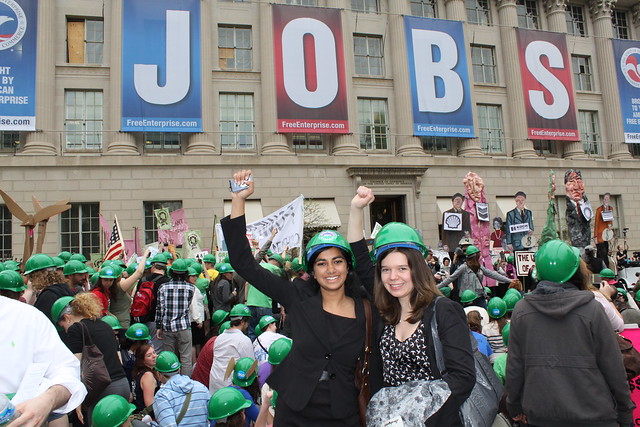
You see, from April 15-18, fellow ACE Youth Advisory Board member Shreya Indukuri and I got the chance to attend PowerShift in Washington, D.C. and it was INCREDIBLE!

Basically, it was a gathering of about 10,000 inspiring young people rallying for clean energy action - you can read more about our trip on the blog post Washington D.C.'s awesome regional educator, Daisy, wrote up.
Besides the details of who we met and what we said, I guess one thing I still marvel at when I look back at the experience is the unified diversity we saw there. (Attack of the oxymorons!)
The thousands of college students there came from all walks of life – from all parts of the country – from all racial, ethnic, and socioeconomic backgrounds. We don’t listen to the same music, we don’t all say “hella”, and we probably don’t even have the same definitions of what being completely “green” looks like – but we were all there, being united by the issue of clean energy! Who expected that?
The fact is, everyone should have expected that, because the issue of climate change and clean energy deserve to unify us all.
Shreya and I met people who are being affected by these issues now. We met Cassie, a 17 year-old activist from Southern California who got asthma because of pollution-emitting factories in her city. We met countless people who live next to toxic waste, who have seen extreme weather, and who are seeing pollution destroy their communities. We heard stories of people in Appalachia who are suffering enormously because of mountaintop removal (for the sake of coal mining!).
Climate change and dirty energy are not issues that will "someday" affect our "grandchildren" - they are right here, right now. It's only a matter of time before they show up on all of our doorsteps and force us to work together, whether we like it or not.

There was also the diversity of people we met outside of PowerShift. We met Aneesh Chopra, the Chief Technology Officer of the US, and Arun Majumdar, the director of ARPA-E (an innovative energy research department of the government).
Let’s face the facts: Shreya and I are still high school juniors. We are from California, and we do not wear business clothes on a regular basis. We have APs next week and prom in two weeks. We are very different from the high-level executives we were lucky enough to meet.
But hearing about a low-cost, very effective solution to energy efficiency – the smart meters that we are installing at high schools – was positive for everyone! Mr. Chopra and Mr. Majumdar were both impressed that we saved 13% off our school’s energy bill in one year and they want all of the schools in the country to get involved.
No matter how different you are, passion and simple solutions can inspire and connect people – “environmentalists” and “non-environmentalists” alike. When you share your story, people are inspired to craft their own.
So, go – it’s not hard to find a diverse group of people, or a diverse group of problems, or a diverse world out there… but it’s your job to find the one way to communicate climate change in a way that will unify your audience.
You, the reader, and I are probably pretty different, too. But we're also pretty alike, because Shreya and I are average students who just sat in an ACE assembly two years ago and were inspired to act. Last weekend, we couldn’t believe we were standing in front of the White House as part of this chain of events. The fact is – this could be you. This WILL be you, because - since you're reading this - we're connected by at least a spark of inspiration to act on climate change.
Now get offline and... go unify some diversity or something! Read more!
Monday, April 25, 2011
Interactive Map: All the World's Nuclear Reactors
Cross posted from Climate Central.
To better understand the state of the nuclear power industry, Climate Central has built the following interactive map of nuclear facilities as reported by the World Nuclear Association. This map shows every nuclear reactor that has ever been connected to the electric grid, as well as a number of plants (though not all) that are planned. The table beneath the map — which will fill in once you press “play” — shows how many power plants have been built during each decade.
How To Use This Map:
Toggle the different categories of power plants (operating, shut down, etc.) on and off by using the check boxes at the bottom right. Multiple reactors are typically co-located, so you might not see them unless you deselect other categories. To learn more about a reactor, click on it to see its vital statistics, as well as a link to the World Nuclear Association, where you can find more facts about each.
Click “Play” to watch how the global nuclear power industry has changed over time, with reactor startups and retired reactor shutdowns. Note that while the timeline is playing, you cannot check or uncheck the boxes.
This data was last updated prior to the nuclear crisis at Japan's Fukushima Daiichi power plant. Since then a number of power plants have been shut down in Japan, and a few in Germany are also temporarily closed.
Why did most countries stop building power plants in the 1990s and 2000s?
The table beneath the map tells a dramatic story: 391 reactors were built between 1970 and 1990, but only 92 were built between 1990 and 2010. In the United States, where 104 reactors currently provide electricity, only five reactors have been built since 1990. Why?
Many point to the Chernobyl disaster in 1986 (see Mike Lemonick's story on the fact that this event is still unfolding), and the Three Mile Island Accident in 1979 as reasons that the public turned against nuclear power. Yet, in the United States, the nuclear industry was already slowing down before Three Mile Island.
In the U.S., many orders for new nuclear power plants were cancelled in the late '70s and '80s largely because the costs of building plants were more expensive than coal or natural gas-fired power plants. One important reason that costs escalated was growing public opposition to building new plants, and unresolved safety and cost questions about radioactive waste disposal and plant decommissioning. These concerns increased legal costs and dramatically extended the time required to build a nuclear plant. Thus, construction costs escalated. Another important reason is that the massive size of nuclear reactors and lack of standardization in technology required each power plant to be more or less custom-built.
Europe’s drive to build nuclear power plants was largely spearheaded after the oil embargos of the 1970s, with France playing a major role — today France generates about sixty percent of its electricity from nuclear reactors. New orders, though, fell off in the late 1980s for similar reasons as in the United States: high costs and public opposition. The Chernobyl accident, which resulted in radioactive fallout across Europe, further deepened public opposition.
Today, China and India are the only countries pursuing nuclear power on a significant scale: India has plans for another 18 power plants, and China has 110 in the pipeline. It remains to be seen whether the costs of building nuclear reactors in these countries will be less than they were in the U.S., or whether the crisis at Japan’s Fukushima facility will scuttle plans for many of these plants. Some experts have been advocating for small modular reactors as a less costly way of generating nuclear power, but those have remained on the drawing board.
How much carbon dioxide pollution have nuclear power plants avoided?
If the few hundred nuclear reactors on the map had not been built, other power plants would likely have been constructed, the majority of which would have been powered by fossil fuels. How much carbon dioxide (CO2) would these plants have emitted?
We can’t know for sure, but by using data from the map and making a few basic assumptions, we can get a rough estimate. The data includes the lifetime and generating capacity of every nuclear power plant that has ever been built.
Today, nuclear power plants worldwide operate on average about 80 percent of the time. In earlier years, they were shut down for longer periods, with closer to a 55 percent in service rate. Given these operating percentages, let’s assume for estimation purposes that nuclear power plants throughout their entire history have operated on average at 70 percent of their capacity. In that case, the nuclear power industry globally has produced about 60 trillion kilowatt hours of electricity.
If these power plants had not been built, let’s assume the electricity would have been generated instead from a mix of coal, natural gas, and hydropower in the proportions that these are used today (roughly 2:1:1). Given how much CO2 these sources emit on average per kilowatt hour (natural gas: 907 grams of CO2; coal: 590 grams; hydropower: 0 grams), we can estimate that each kilowatt-hour of nuclear power avoided about 600 grams of CO2 from entering the atmosphere.
That means that the nuclear industry has avoided emissions of about 40 billion tons of CO2. That is one third more CO2 than humans put into the atmosphere every year from burning fossil fuels. It is also about one-twelfth of the cumulative CO2 people have added to the atmosphere during the past 160 years from burning coal, natural gas, and petroleum. This is a rough estimate, yet it shows that nuclear power has played a major role in lowering CO2 emissions.
The clear question for society — and one that is highly debated — is whether the risks and costs of nuclear power outweigh the industry’s significant potential to offset fossil fuels.
Map Data and Disclaimer
The data was obtained from the World Nuclear Association’s online database, which can be accessed from their website. Many countries have “planned” reactors that are not shown on this map. Furthermore, the location of some planned reactors, especially in China, is only approximate. Read more!
Labels:
nuclear power
Thursday, April 14, 2011
Election Season or Innovation Season?
I'm reminded recently of Daffy Duck fighting with Bugs Bunny, the duck demanding that it's Rabbit-Hunting Season and Bugs refuting that it's Duck Season. In this cartoonish analogy, President Obama is both Bugs and Daffy, in a shouting match with himself. It's either Investment Season or Election Season. It apparently can't be both.
There's a reason Energetics' subline is "A blog on climate, energy and politics." As frustrating as it sometimes is, the pursuit and achievement of goals on the path towards decarbonization and a clean energy future depend heavily on the institutional intricacies set up by our political landscape. The political infrastructure in place establishes the ability of our nation to invest in our future. President Obama's speech at George Washington University yesterday illustrated this notion, and his stump speech that ostensibly kicked off his 2012 campaign was often inspiring in its liberalism and rhetorical embrace of innovation economics.
The America I know is generous and compassionate. It’s a land of opportunity and optimism. Yes, we take responsibility for ourselves, but we also take responsibility for each other; for the country we want and the future we share.In place of "jobs," the President could have easily said "a national infrastructure renovation" or "a clean energy economy." All three are true, but the politics of the game will probably guarantee that jobs are the key focus of his speeches from now until at least November 2012.
...
I will not sacrifice the core investments we need to grow and create jobs.
Like Bugs vs. Daffy though, there is some trickery at play. The President is calling this moment Investment Season when it's shaping out to be anything but. The sweeping and not entirely insincere verbiage dedicated by the President to investing in a "future we want" is undercut by the recent budget debacle, where we see funds for innovation, science and research cut across the board. The Breakthrough Institute crunches the thoroughly uninspiring numbers, and while investments levels for FY2012 aren't quite as low as they would be if Congressional Republicans had their way, more often not the President and his allies came away on the losing end of the draw.
I believe the President would be better served by a more ambitious agenda, one that aims to significantly increase investments in our nation's transportation grid, energy infrastructure, education and technological robustness. Indeed, I wish Obama would act exactly like he said he would in his 2011 State of the Union address. Instead, we have conflicting messaging coming from his podium. "Invest in our future" is sidelined by "live within our means" and calls for the government to tighten its belt like millions of families across the country. Economists agree this is a red herring -- now is not the time to worry about the deficit, but instead a time to rebuild a nation whose citizens, infrastructure and resources will guide it out of debt in the future.
The President is going to win next year. But a victory without a bold agenda will ill-serve the needs of an American economy desperately crying for the investments it's been robbed of for decades. Obama need not fret whether it's Investment Season or Election Season. It's both. Investing in America's future is good politics, and Obama's characteristically hopeful and progressive political rhetoric needs a policy backbone that seriously invests in the future we want. Read more!
Labels:
Barack Obama,
innovation