PhysOrg reports today that researchers from the Max Planck Institute for Nuclear Physics have made a surprising discovery: plants naturally release methane, a greenhouse gas. This discovery goes against all previous assumptions and adds a new wrinkly to our understanding of how gases which influence the climate are exchanged between the biosphere and atmosphere.
Equally surprising was the finding that the methane formation is not hindered by the presence of oxygen. This discovery is important not just for plant researchers but also for understanding the connection between global warming and increased greenhouse gas production.
Methane is the greenhouse gas which has the second greatest total effect on climate, after carbon dioxide (CO2), and has aproximately 20 times the heat absorbing climate change potential per molecule than CO2. The concentration of methane in the atmosphere has almost tripled in the last 150 years. As the article points out, only part of the methane uptake in the atmosphere is due to industrial activities connected to energy production and use. More important for the increase of methane in the atmosphere is the increase in so-called "biogenic" sources, e.g., rice cultivation or domestic ruminants related to the rise in the world's population. In fact, nowadays the methane in the atmosphere is largely of biogenic origin.
Until now, it has been assumed that biogenic methane is formed during the anaerobic decomposition of organic material in the absence of oxygen which occurs in land fills, sewage treatment plants, wetlands, in rice patties and in the digestive tracts of animals (i.e. cow farts!). According to previous estimates, these sources make up two-thirds of the 600 million tonnes worldwide annual methane production, as the article reports.
The article reports that scientists from the Max Planck Institute for Nuclear Physics have now discovered that plants themselves produce methane and emit it into the atmosphere, even in completely normal, oxygen-rich surroundings. The researchers made the surprising discovery during an investigation of which gases are emitted by dead and fresh leaves. Then, in the laboratory and in the wild, the scientists looked at the release of gases from living plants like maize and ryegrass. In this investigation, it turned out that living plants let out some 10 to 1000 times more methane than dead plant material undergoing aerobic (oxygen-exposed) decomposition. According to the article, the researchers were then able to show that the rate of methane production grew drastically when the plants were exposed to the sun.
Although the scientists have some first indications, PhysOrg reports that it is still unclear what processes are responsible for the formation of methane in plants. The researchers from Heidelberg assume that there is an unknown, hidden reaction mechanism, which current knowledge about plants cannot explain - in other words, a new area of research for biochemistry and plant physiology (obviously this is a discovery with exciting implications for the field of botany and plant physiology).
In terms of total amount of production worldwide, PhysOrg reports that the scientists' first guesses are between 60 and 240 million tonnes of methane per year. That equates to about 10 to 30 percent of present annual methane production. The largest portion of that - about two-thirds - originates from tropical areas, according to the report, because that is where the most biomass is located. The evidence of direct methane emissions from plants also explains the unexpectedly high methane concentrations over tropical forests, measured only recently via satellite by a research group from the University of Heidelberg.
The article also questions why such a seemingly obvious discovery would only come about now, 20 years after hundreds of scientists around the globe started investigating the global methane cycle? "Methane could not really be created that way," responds Dr. Frank Keppler. "Until now all the textbooks have said that biogenic methane can only be produced in the absence of oxygen. For that simple reason, nobody looked closely at this."
The fact is that, in order to determine the quantity of emissions, scientists indeed have to make very careful measurements, as the article discusses. The researchers from Heidelberg conducted most of their experiments in methane-free air, in order to factor out the high natural background of methane. Furthermore they used isotope analysis to show beyond doubt that this was an undiscovered process of methane production. By "looking closely" - despite established opinion - they made a discovery that will require textbooks to have their passages about methane production rewritten.
The article concludes by mentioning the the continued laboratory work and field and remote sensing studies that will be required to better quantify the strength of these methane emissions. The findings also raise the exciting question as to what role the biosphere has played in methane production throughout the earth's history, as well as what kind of influence rising global temperatures and carbon dioxide concentration have on the production of methane from plants. The answers to these questions obviously have important implications for our understanding of the feedback mechanisms between climate change and greenhouse gas production.
[An obvious hat tip to PhysOrg]

Wednesday, January 11, 2006
Plants - The Forgotten Methane Source


Monday, January 09, 2006
Why Ski Resorts Should Install Wind Turbines
 Imagine if you had a piece of property that sat in a very high wind area with average wind speeds of 15 miles per hour (at 10 meters) or better blowing every day. Now also imagine that you ran a business on that property that consumer quite a bit of energy and had a not very green reputation to boot. Let's also add that there are significant financial incentives available in your state for renewable energy installations that could help finance over half the cost. Now why wouldn't you want to install a few wind turbines?
Well that's exactly the question that owners and operators of ski resorts around the country ought to be asking themselves.
If you've ever looked closely at a wind resource map (and who would do that, really?! well ... me, sadly), you might have noticed that it looks an awful lot like a topgraphic map, with colorations for high wind areas defining recognizable ridgelines and mountain peaks. Usually, those peaks are very inaccessable and lack any power distribution infrastructure, much less demand center. Additionally, concerns about deforestation and environmental impact might discourage installation of wind turbines.
Well that's not the case for the mountain peaks in and around ski resorts which already have power infrastructure, a high demand and don't have to worry much about environmental footprint (the ski resort's footprint has already done the damage).
On a recent trip to Mt Bachelor, Oregon's finest ski and snowboard resort, I was sitting on a chair lift hunkering down to ward off the chilly wind when I was struck by the idea that there ought to be 10 kW wind turbines at the tops of each lift. This inspired me to run the numbers on such an idea upon returning home. Here's what I came up with:
A Bergey 10 kW Excel-S wind turbine (including inverter and energy management) costs $22,770 at the Alternative Energy Store. The 100 foot tower will set you back another $8,464 and let's assume installation costs about $5,000 per turbine (can anyone out there corroborate this estimate?). That gives you a total cost of just over $36k per turbine (installed - $36,234 to be exact).
Estimating how much power a turbine will produce in a given year is a tough game but Bergey provides a chart with estimates for given wind speeds on their brochure for the Excel turbines. The chart unfortunately only goes up to 14 mph and the average wind speeds (at 10m) at a ski resort would likely be more like 15 mph or better (i.e. a 'class 6' or 'outstanding' wind site). The chart says each turbine would yield 2,130 kWh per month if mounted on a 100' tower so lets bump that up to 2,400 to represent the higher average wind speed. That yields 28,800 kWh per year per turbine.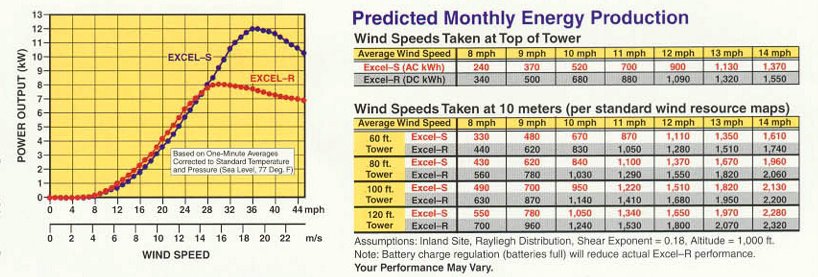
That's actually relatively close to EERE's U.S. Consumer's Guide to Small Wind Electric Systems which gives the following formula to estimate annual production: Annual Expected Output = 0.01328*(Diameter of Blades in ft)^2*(Wind Speed at Hub Height in mph)^3. The Excel has a diamater of 22 ft and the wind speed at 100' (about 30m) in a class 6 site is about 17 mph so the formula gives us 0.01328*22^2*17^3 = 31,578 kWh per year, not to far off from our estimate of 28,800 kWh.
Let's go with the smaller of the two to err on the conservative side. However, there's a few site-specific adjustments to make. Bergey's estimates are for 1,000 ft elevation and at the kinds of elevations you'd see at ski resorts (lets say about 7,000 ft), the air density is only about 80%. However, the wind is likely more reliable on the side of mountain peak than at a normal site so lets give our figure a 10% increase to represent the higher expected capacity factor (that's probably quite conservative). Our total estimate is then 28,800*.80*1.1 = 25,344 kWh per turbine per year.
To go with the example of Mt. Bachelor Ski Resort, let's assume they install 8 of these turbines at the tops of each of their 8 express lifts. That will set them back $289,872.00 for install costs. Maintanence has been estimated to generally cost about 1 cent per kWh produced but do to more extreme weather conditions at our site, let's assume that cost goes up by a third to 1.3 cents per kWh. Property costs are nill because the ski resort already owns the land.
Let's also assume a slightly shorter lifespan than normal - 25 years (rather than the 30+ normally expected) - do to the site's weather conditions. In that lifespan then, the 8 turbines will produce (25,344 kWh * 8 =) 202,752 kWh per year and thus (202,752*25 years =) 5,068,800 kWh total.
That will set them back $65,894.00 in maintanence costs over the lifetime of the turbines. It will also produce significant revenue:
Each kWh of power they produce on site is one kWh less of retail rated power they don't have to buy. In Oregon, that's about 7 cents a kWh (its higher elsewhere which would make significant difference in the packback scenario here). They would also be eligable for the 1.9 cents per kWh Federal Production Tax Credit for the first 10 years of the project and could likely negotiate to sell the Green Tags that go with the power produced by the project for, let's say, 5 cents per kWh for the first 5 years. Averaged over the life of the project, that's 1.76 cents per kWh in production incentives plus 7 cents in avoided retail costs for a total of 8.76 cents per kWh of revenue or just over $444,000.
Remember, this cost the folks at Mt. Bachelor $289,872.00 in install costs and $65,894.00 in maintanence for a total cost of $355,766.00. The net profit is thus over $88k or a net return on investment of 24.81%. That's not bad for a 25 year investment and clearly profitable in the long run. But 25 years is a pretty long payback period for some businesses to stomach. Luckily for them, there are also considerable incentives avialable for them to take advantage of.
In Oregon, for example, an Oregon Office of Energy Public Benefits Fund provides grants equal to 19% of project costs, a Bonneville Environmental Fund grant is available to cover another 33% of the costs and a state Business Energy Tax Credit covers 35% of (probably the remaining) costs. A federal grant is available as well that can cover up to 25% of the costs but I'm going to assume it doesn't stack with the state grants (not necessarily true, but I'm erring on the safe side). Low interest guaranteed loans are available too and no need to worry about paying higher property taxes do to the wind installation either - there's a property tax exemption for renewable energy (and energy efficiency) installations in Oregon. Not all states offer as many incentives as Oregon, but many do - see the Database of State Incentives for Renewable Energy (DSIRE) for a full state-by-state list of all available incentives.
All in all, with the Public Benefits Fund grant, the BEF grant and the state business tax exemption, the costs of our Mt. Bachelor example could be defrayed by almost $200,000 ($199,431.94 to be exact) or over half of the total system costs (including maintanence)!
When you add the incentives to the picture, the investment suddenly becomes very lucrative - you're total profit becomes $303,692.00 off of an out of pocket investment of only $156,334.00 for a net return on investment of 194.26%! That's a pretty staggering return on investment and I don't see why any sane business person wouldn't jump at that chance. The payback period for this investment is only 7.9 years.
Plus, the 'green-washing' PR benefits for ski resorts of installing wind turbines would add another large but incalculable benefit for the company. Ski resorts don't exactly have the best 'green' reputation and have done a lot in recent years to try to clean up that image (a large banner hangs over the stairway to the dining room at the local Willamette Pass ski area that reads; "Sustainable Slopes Initiative", and highlights their recycling program or some such, for example) and installing wind turbines fits right into this picture.
In fact, Jiminy Peak Ski Resort in Massachusettes seems to have recently gotten the same idea. They're taking it one step farther and actually installing a 320 ft tall 1 MW turbine at their ski area, according to a Renewable Energy Access post back in November.
Wind power scales up nicely and their larger scale investment has an even better payoff. The REA post says the turbine will set the ski resort back $2 million, forcing them to take out a $1.5 million loan. However, the turbine is expected to produce 2.5 million kilowatt hours per year, or almost a third of their power.
At that rate, Jiminy execs expect the turbine to pay off the loans and initial investment in 7 years, providing nothing but profit for the remainder of its 30 or so years after that.
At the Oregon-style power rates we talked about above (i.e. 8.76 cents per kWh including green tags and the PTC), 2.5 million kWh per year for 30 years would yield total revenue of $6.57 million on an investment of $2 million for a total return on investment of $4.57 million or 228.5%! Even better than the small scale wind scheme outlined above.
In summary, with avialable incentives and consistently high wind speeds, ski resorts have every reason to invest in installing wind power on their property. The investment could yield a return of 200% or more over 25-30 years, a very strong long-term investment opportunity. I hope to see more ski resort operators getting with the picture and joining Jiminy in installing small or large-scale wind turbines soon.
Scotland University Installs Solar Powered LED Lamposts With Wi-Fi

The BCC reports that the University of Abertay in Dundee, Scotland will install six new lamposts that use light-emitting diode (LED) technology to provide bright light using low power derived from built-in solar cells. The lamposts will also incorporate wireless internet routers to provide public wi-fi access and will be installed on the roof of a university building. The university also has plans to install up to 4,000 more in a student village to be built soon, according to the article.
The lamps are produced by the Singapore-based company, StarSight and are reffered to as the 'StarLight Lighting System.'
They are distributed in Scotland by Kirkxaldy-based Compliance Technology (CTL) who have exlusive European distribution rights for the lighting system.
Calum McRae, of CTL, said: "With only a fraction of the installation and running costs of conventional street lights, [cities] could use smart lampposts to provide street light while selling internet access to local residents, or even providing it free in areas of need. The new photovoltaic technology which will be showcased in Dundee will mean that no local community needs to be without reliable, economic street lighting, with the added benefit of wi-fi technology outside their front doors.
Mary Cowie, director of the University of Abertay Centre for the Environment (ACE), said, "The pilot scheme will involve not only ACE but students from the University of Abertay who will be able to play a hands-on role in shaping the technology of tomorrow."
The centre will be involved in testing the technology and assessing its social, environmental and economic impact, according to the article.
Green MSP Robin Harper had these words to say about the project: "This is a truly exciting and innovative project with huge possibilities in sustainability terms, and in reducing environmental impact."
According to the BBC article, CTL said three other city councils in Scotland had already expressed interest in installing the lamps: Orkney, Perth and Kinross, and Dumfries and Galloway.
This is an excellent idea combining three of my favorite technologies that I hope will soon become ubiquitious: LEDs, Wi-Fi, and solar power.
If these lamps truly cost "only a fraction of the installation and running costs of conventional street lights" then I hope to see these popping up all over the world. If that were the case, there would be no reason not to install these lamps when old street lamps expire or when new developments are built. Of course, it could all be marketing hype but time - and this demo project - will tell.
I also know that a number of cities, including Portland, Oregon, are working on plans to install a city-wide Wi-Fi grid for residents and these street lamps could be a perfect component for such a system.
It seems like there is a considerable market for these devices. I wonder if they are being distributed in the U.S. ... If I had a pile of money lying around, I'd consider negotiating exclusive rights to distribute this system in North America if noone has done so already...
[A hat tip to Treehugger]
Sunday, January 08, 2006
Wind Power 2005 in Review, Outlook for 2006 and Beyond

I thought this was an excellent summary of the current state of the wind power industry (with a North American focus) from the folks at Renewable Energy Access:
Wind Power 2005 in Review, Outlook for 2006 and Beyond
By Godfrey Chua, Research Director, Emerging Energy Research
The North American wind power market is at last entering a period of sustained growth. Both the US and Canada achieved record installations of wind power projects in 2005, and both are poised for steady growth moving forward. And coupled with this growth a new competitive element has emerged that will further define the North American market in the years to come: turbine supply leverage.
According to a just-released study by Emerging Energy Research entitled US/Canada Wind Power Markets and Strategies 2005-2010, the record year for US wind power installations in 2005 is a direct result of the extension of the production tax credit (PTC), first at the end of 2004 and further extended to 2007 through the passage of the Energy Policy Act of 2005. This three-year horizon will break the boom and bust cycle that has plagued the US wind industry. And the passage of new state level portfolio standards, as well as amendments to existing standards, are also enhancing the long-term prospects of the US market.
In Canada, there is increasing dynamism in the wind power market as a result of recent federal and provincial efforts to promote it. Between 2004 and 2006, provincial governments and utilities will have issued RFPs for 6,000 MW of renewable energy; results so far show that the lion's share will be awarded to wind projects. The national government also extended the wind power production incentive program to April 2010. As a result, like the US, the Canadian wind power market will see steady growth ahead.
Boosted by renewable RFP activity, utilities expand activities in wind power
Driven by a variety of factors, including generation mix, RPS, green marketing, and least cost resource considerations, utilities in the US and Canada are procuring more wind power than ever. This trend is highlighted by a proliferation of renewable RFP activity and a growing roster of utilities becoming active in wind power.
While RPS programs have become a key driver, more than half of ongoing activity derives from efforts not directly related to an RPS mandate. EER's new study identifies wind project pipelines of at least 13,000 MW in the US have been identified across the country. While the most activity has traditionally been centered in the western US, the Northeast has shown a dramatic increase over the last year. Texas, having doubled its RPS, will overtake California in 2006. The fastest growth rates are expected occur in new states implementing RPS, such as New York and Colorado, as well as those learning to exploit tremendous untapped wind resources, such as the Dakotas, Illinois, and other Midwest and Pacific Northwest states.
The increased development activity and interest in the Canadian wind power market is the result of growing demand from power purchasers and a clear signal of their commitment to the technology. While the Canadian market remains small with only a handful of experienced wind IPPs, a slew of new entrants backed by major energy companies have entered the market and are poised to capitalize upon the market growth. The provincial initiatives have resulted in an RFP pipeline that is nearly 6,000 MW, with activity centered in Ontario, Quebec, Manitoba, and New Brunswick. Hydro-Quebec alone has issued RFPs for 3,000 MW of wind energy, providing a key anchor for the market in the years to come.
Wind IPPs and developers enter a new level of competition in US and Canada
Wind IPP and developer competition in both the US and Canada entered new dimensions in 2005. The industry has scaled and consolidated, and companies have shifted along the value chain throughout 2005. The result is a level of competition and market activity that the industry has never seen before.
Amidst these dynamics, another competitive element has emerged that will further define the North American market in the years to come: turbine supply leverage. With past boom and bust cycles in the US-caused by the PTC-discouraging investments in local manufacturing, industry scaling has had the inevitable side effect of creating a turbine supply shortage. According to EER's study, this shortage has constrained wind IPPs and developers in their ability to realize their projects and, ultimately, to create value. Some wind IPPs have discovered that, by taking the financial risk and locking in turbine supply early, even before projects in their own pipelines may be ready, they can achieve growth and build market share by using these turbines as leverage into late stage projects from other developers.
The bottom line is that scale continues to drive competitive advantage. Attributes such as a good track record, capability to deliver large-scale projects, and market reach that is able to span multiple markets, are now par for the course. Building an edge in the competition for power purchase agreements entails taking these attributes to an even higher level and, at least for the near-term supply and demand scenario, simply having the wind turbines with which to build wind plants.
Unlike the US market, which was launched by pioneering developers and independent companies, the Canadian market is already comprised of companies backed by large energy firms and industrial concerns that bring with them financial resources and commercial credibility. SaskPower and other leaders such as Vision Quest and Axor have significant operations behind them. In addition, heavy hitters invested in emerging wind IPPs-TransCanada with Cartier Wind Energy Group, and Brascan Power, which purchased Superior Wind Power in 2005-also point to the role major energy companies will continue to have in the growth of the industry, and the challenge and increased competition ahead for the existing market leaders. The nascent market does include one notable foreign entrant in Spanish wind IPP Acciona/EHN.
Wind turbine shortages shift emphasis towards manufacturing capacity
The North American wind turbine market saw record growth in 2005; installations surpassed record levels seen in 2001 and 2003, with the majority of them onshore. From an industry that finally broke US$3 billion in 2005, the market is expected to more than double to just under US$7.5 billion in 2010. These figures, detailed in the EER study, factor significant price increases implemented for projects in 2006 and beyond, but also take into consideration greater vendor competition that will arise as local manufacturing capacity and new turbine models are introduced in the coming years. Improved competition will, however, not be sufficient to reduce prices to the extent they have risen for 2006.
Simply put, market share in 2005 was determined more by manufacturing capacity than by competitive strategies or items such as cost and product positions. All wind turbine vendors active in North America in 2005 sold-out of available capacity and therefore market share has been determined by how many turbines could be manufactured and delivered. The demand was even stronger than anticipated, and as a consequence, a turbine shortage transpired and availability became an important criterion for selection.
To this end, the North American wind turbine market is dominated by GE Energy. In the US, the firm enjoyed annual market shares ranging from 45% to as much as 60% in 2005. Behind GE is Vestas, having consolidated its position with the acquisition of NEG Micon, which leads in Canada, installing all the turbines in that market in 2005.
Supply chain is a constraint to turbine supply
Today's turbine constrained market makes control of the supply chain especially critical. Wind turbine vendors have attributed the lack of turbines to certain pinch points in the supply chain, such as gearboxes, castings, and blades. Ownership of or at least close ties with key suppliers in these areas is therefore important for ensuring a wind turbine vendor is able maximize production and thereby their sales potential and market share.
Component suppliers, for their part, have been reluctant to establish new manufacturing facilities due to the boom and bust cycle in the US. However, high demand for turbines has encouraged suppliers such as Winergy, Hansen, and LM Glasfiber to increase capacity through other means. For the most part, capacity has been increased as a result of planning foresight during the design of their manufacturing facilities.
In the wind turbine market, the door is wide open for those with the risk appetite, and Gamesa, Suzlon, and Clipper are stepping through. All three are building manufacturing facilities in the US, and in so doing bring substantial local manufacturing capacity online to compete with dominant GE Energy. The risk taking is paying off. EER research shows that demand for Gamesa's machines has been so strong the vendor has indicated it may still have to rely on capacity from Spain to maximize order volume. Suzlon is sold-out through 2007. Clipper, for its part, has had a successful initial public offering and many are watching the company and its technology closely. Siemens, as predicted, re-entered the market by capturing FPL's business, and is the next most likely candidate to set up manufacturing facilities in the region.
North American wind energy market outlook to 2010
The record year in 2005 could not have arrived soon enough, as 2004 was a brutal year for wind power in North America. However, as soon as better days arrived, a turbine supply shortage limited growth and inevitably brought higher prices. And more challenges lie ahead. The US will face a significant risk of a slowdown in 2008, as the current PTC is effective only until the end of 2007. In Canada, environmental permitting, unviable projects, and lack of turbines are three primary variables that may lead to lower growth.
Still, wind energy has reached an entirely new level in North America. Wind IPPs are stronger than ever and additional manufacturing capacity is on the way. The business environment is favorable-record natural gas prices, RPS in US states proliferating and RFPs building momentum in Canadian provinces, and an extended PTC in the US and WPPI in Canada-combine to shore up prospects. Looking forward, US and Canadian wind power markets are expected to see stable growth and heightened overall activity.
North American wind power is expected to see a more than fourfold increase in wind power plants in operation by 2010. The US is expected to grow from just over 6,700 MW to over 28,000 MW by 2010. Starting from a lower base of nearly 450 MW in 2004, Canada's wind power base will grow even more quickly to over 6,200 MW by 2010.
[About the author and the related report...
Godfrey Chua is Research Director of Emerging Energy Research's US/Canada Wind Energy Advisory Service. This article is based on findings from EER's new 286-page market study, US/Canada Wind Power Markets and Strategies 2005-2010, released in December 2005 and now available for purchase. Emerging Energy Research is an independent research and advisory company based in Cambridge, Massachusetts, US. For more information, visit www.emerging-energy.com through the following link or contact them by email at eer@emerging-energy.com]
Wind power has truly become a mature and competitive power generation industry with sustained growth. It is no longer faced with generating sufficient demand but rather with ensuring sufficient manufacturing capacity, a great sign that the industry has grown considerably.
The renewal of the Production Tax Credit (PTC) until 2007 will have a great impact on the wind industry, ending years of uncertainty and boom and bust cycles where the PTC expired every year and then lay dormant for a year while lobbyists tried to get it renewed (not exactly the certainty you are looking for in an investment scenario). That seems to be the best thing to come out of the 2005 Energy Bill (amidst a lot of other garbage, in my opinion). It's time to start lobbying now, though, for an extension of the PTC out to 2009 or 2010. Insuring a long window of time that we can be certain the PTC will be around will make the industry look much more favorable to investors.
I'm really hoping that Oregon will get with it and enact a Renewable Portfolio Standard sometime soon as well. We have a number of wind developments in state with more on the way but the extra legislative push to encourage development wouldn't hurt.
Saturday, January 07, 2006
New York Governor Pataki Calls for Development of Plug-in Hybrids and More

New York Governor George Pataki provided a preview of his coming legislative initiatives for his final year in office in his final State of the State address last Wedensday. The speech was viewed by many analysts as a first step in a campaign for the Presidency.
The governor's speech included a number of talking points for the transportation and energy sectors. Pataki said he will propose a series of programs and initiatives, including:
The following are excerpts from the energy and transportation section of the speech: "For more than a decade, we in New York have been aggressively pursuing the solutions to one of our generation’s greatest challenges -- reducing our dependence on expensive, polluting, terrorpromoting foreign oil.
We don’t have to look far for evidence that the time to transition away from foreign oil is now – it is right there on the gas pumps and in our home heating bills.
Not just here in New York, but across the nation, our reliance on foreign oil is hampering the financial freedom of our working families and their employers; it is hurting our economy, damaging our environment and enriching regimes that support, harbor and encourage the terrorists who threaten our national security.
...
The entire world is now grappling with the question “where will we get the energy to power the global economy of the 21st century without causing irreparable damage to our natural environment?”
Let’s make New York the place where that defining question is answered. Let's make New York the worldwide center for clean, renewable energy research, product development and job creation. Let’s attract companies from around the world that are developing the clean, renewable energy sources of the future – let’s make the entire state a tax free zone for this growing industry.
...
We cannot address the issue of oil dependency without talking about transportation.
...
Our transportation system is still over 90 percent dependent on petroleum products. The huge price increases we have seen at the pump are likely to get worse as developing countries like China and India consume an increasing amount of oil.
...
This comprehensive strategy to reduce dependence on foreign oil [see bullet points above], will allow us to seize the future today and create the clean energy technologies that can be exported around the world tomorrow. The time to prepare for a future powered by clean energy sources is now -- not just here in New York, but across our entire nation.
We’ve shown time and again that when New York leads, others follow. Let’s act this year to make New York State the energy independence capital of America, and set the stage for a cleaner environment and an even stronger, more prosperous New York for the next generation."
Exhibiting leadership not seen at the national level, Governor Pataki also recently originated the Regional Greenhouse Gas Initiative (RGGI), the first regional, mandatory cap-and-trade program to control carbon dioxide emissions in the United States. Participants include the Northeastern states of Connecticut, Delaware, Maine, New Hampshire, New Jersey, New York, and Vermont.
Beginning in 2009, RGGI will stabilize carbon dioxide emissions from power plants in the region at current levels through 2015, and reduce emissions by 10% from current levels by 2019, according to Green Car Congress. RGGI also aims to achieve reductions through energy efficiency and through greenhouse gas emission reduction projects outside of the power sector.
If we aren't seeing proactive leadership from the White House of Congress, its good to at least see regional leadership on a sustainable energy agenda, even if they tend to be limited to 'blue states' like California and New York.
Still, all this from a Republican ... what's your excuse George?
[A hat tip to Green Car Congress]
Welcome New Readers - Please Stick Around For a While

There seems to be quite a lot of new readers poking around here today, thanks to a couple prominent links from The Oil Drum and Worldchanging to my post on Thomas Friedman's strong call for a sustainable energy agenda in yesterday's New York Times.
I'd like to give a hearty welcome to any first time readers out there (ok, and to you returning readers as well ... I love you guys too) and urge you to please stick around and paruse the archives for any other posts you may be interested in. I hope that some of you return in the future.
Until then, welcome to WattHead. I hope you enjoy your stay,
~Jesse Jenkins
Ford Debuts 'Reflex' Diesel-Electric Hybrid Concept Muscle Car

Ford will unveil its new Reflex diesel-electric hybrid concept muscle car at the North American International Auto Show (Detroit auto show) this month. It will join the growing ranks of exciting new hybrid and electric concepts debuting at the Detroit show including the new 2007 Camry hybrid and Mitsubishi MIEV Concept-CT discussed earlier here at WattHead.
Looking a bit like the non-hybrid Iosis concept unvieled last year at the 2005 Frankfurt Auto Show (at least on the exterior), Ford hopes that the Reflex will be one of the stars of the Detroit show and will make the case that small cars can be bold, American and innovative.
And innovative the Reflex is. According to AutoWeek, Reflex features a diesel-electric hybrid system using diesel, electric and solar power. This combination of power can deliver maximum fuel economy – up to 65 mpg, says Ford – without compromising performance.
The front wheels are powered by the diesel-electric hybrid system with the 1.4 liter turbodiesel engine assisted by an electric motor, according to AutoBlog. The rear axle is also powered by an additional electric motor providing this low-slung muscle car with all-wheel-drive capability. I was unable to find any word on the combined horsepower or torque for the Reflex.
The car's electric energy is stored in a new-generation lithium-ion battery pack, rather than the nickle-metal-hydride batteries found in all current commercial hybrid models. According to AutoWeek, Ford was the first manufacturer to produce a vehicle using this type of battery system when it introduced the Ford Ka research vehicle back in 2000. I hope to see Li-ion batteries make their way into production hybrid models soon as their higher energy densities and greater discharge ranges will mean lighter batteries with equal capacity (or larger capacities with equal weights, an important component of plug-in hybrids).
The batteries are charged both by the regenerative braking standard in all hybrids as well as by a pair of solar panels mounted on the roof of the Reflex.
The concept also incorporates ground rubber from scrap athletic shoes, called Nike Grind, as insulation to reduce noise and vibration in the car’s interior, adding to the car's 'green' features.
AutoWeek reports that the interior uses a 2+1 backseat configuration. Gull-wing style doors open upwards to reveal seatts covored by a transparent mesh that offers maximum airflow for comfort and along with the glass roof is supposed to make the interior seem larger than it is. The cockpit also comes alive with keyless activation: at the touch of a button, the instrument cluster controls appear in a blue hue as the light-emitting diodes (LEDs) switch on.
The Reflex's safety features include inflatable safety belts and Ford's 'BeltMinder' for backseat passengers. The inflatable safety belt helps reduce injury risk to second-row occupants and the BeltMinder alerts the driver when second-row occupants are not buckled up.
Now, the Reflex is quite definitely just a PR stunt that will never make it into real production. However, this is the case with most concept cars and it is good to see Ford innovating in this direction for a change. Hopefully some of the components of this car will make it into production models.
I am especially excited to see the incorporation of a diesel-electric hybrid drivetrain and lithium-ion batteries into the Reflex. Both of these technologies should see much wider use in production models. Also, its interesting to see Ford using the solar panels, which are likely the Solartech panels released last year.
Someday in the future we will actually see a hybrid (hopefully plug-in) muscle car on the market. It seems clear to me that trends are clearly headed that direction eventually. In the mean time, we can join Jacob Gordon of Treehugger and drool over this concept car.
[A hat tip to Treehugger. Thanks for a chuckle-filled post, Jacob]
Friday, January 06, 2006
Thomas Friedman on a Sustainable Energy Future - 'Green is the New Red White and Blue!'

Since I seem to be in the mood to reprint other peoples words today, here's another:
Pulitzer Prize-winning New York Times foreign affairs columnist, Thomas Friedman, went all out today in the Times' opinion section, passionately defending the importance, and of all things, machoism, of being green and a sustainable energy future.
If you are regularly an internet ready of the Times (as I am), you'll sadly find the article (which appears on page A23 of the hardcopy version) locked up behind their 'Times Select' subscription. Fortunately, I've got a hardcopy right here and I'll excerpt some of the best parts below the fold:
The following is from "The New Red, White and Blue" by Thomas Friedman, which appears in the January 6th edition of the Times [any typos are my own as I'm retyping this, I apologize]:
"As we enter 2006, we find ourselves in trouble, at home and abroad. We are in trouble because we are led by defeatists - wimps, actually.
What's so disturbing about President Bush and Dick Cheney is that they talk tough about the necessity of invading Iraq, torturing terror suspects and engaging in domestic spying - all to defend our way of life and promote democracy around the globe.
But when it comes to what is actually the most important issue in U.S. foreign and domestic policy today - making ourselves energy efficient and independent, and environmentally green - they ridicule it as something only liberals, tree-huggers and sissies believe is possible or necessary
Sorry, but being green, focusing the nation on greater energy efficiency and conservation, is not some girlie-man issue. It is actually the most tough-minded, geostrategic, pro-growth and patriotic thing we can do. Living green is not for sissies. Sticking with oil, and basically saying that a country that can double the speed of microchips every 18 months is somehow incapable of innovating its way to energy independence - that is for sissies, defeatists and people who are ready to see American values eroded at home and abroad.
Living green is not just a "personal virtue," as Mr. Cheney says. It's a national security imperative.
The biggest threat to America and its values today is not communism, authoritarianism or Islamism. Its petrolism. Petrolism is my term for the corrupting, antidemocratic governing practices - in oil states from Russia to Nigeria to Iran - that result from a long run of $60-a-barrel oil. ....
... there's a huge difference between what these bad regimes can do with $20-a-barrel oil compared to $60-a-barrel oil. It is no accident that the reform era in Russia under Boris Yeltzin, and in Iran under Mohammad Khatami, coincided with low oil prices. When prices soared again, petrolist authoritarians in both societies reasserted themselves.
We need a persident and a Congress with the guts not just to invade Iraq, but to impose a gasoline tax and inspire conservation at home. That takes a real energy policy with longterm incentives for renewable energies - wind, solar, biofuels - rather than the welfare-for-oil-companies-and-special-interests that masqueraded last year as an energy bill.
Enough of this Bush-Cheney nonsense that conservation, energy efficiency and environmentalism are some hobby we can't afford. I can't think of anything more cowardly or un-American. Real patriots, real advocates of spreading democracy around the world, live green.
Green is the new red, white and blue.
Amen Thomas.
It's high time that energy efficiency, conservation and renewables ceased to be a fringe-issue for greenies, tree-huggers and enviros.
A sustainable energy future is about a sustainable economy, about creating high-paying jobs in innovation and technology, about clean skies and healthy cities, about national security, about avoiding quagmires like Iraq.
Sometimes I feel like renewables, efficiency and conservation make so much sense, it just makes me sick that more isn't being done...
Anyways, it's great to see an article like this in a mainstream and widely read- albeit liberally-biased - newspaper.