 As promised (see previous post), Mistubishi unveiled their Concept-EZ MIEV (Mistubishi In-wheel Electric Vehicle) at the 76th Geneva International Motor Show which started today. The new all-electric 4WD concept vehicle takes advantage of the compact nature of the MIEV architecture to deliver a compact mono-box design with a very roomy interior that comfortably seats five adults.
The Concept-EZ comes on the heels of the equally acronym-happy Concept-CT MIEV, a series-parallel hybrid introduced at the Detroit Auto Show in January. The Concept-EZ showcases an all-electric application of the company’s MIEV architecture for next-generation electric and hybrid vehicles using in-wheel motors and a high energy-density lithium-ion battery system as core technologies.
The EZ is driven by four 20 kW in-wheel motors delivering a combined maximum output of 107 hp (80 kW) and combined torque of 1,600 Nm. The use of the in-wheel motor also allows for a “wheel-at-a-corner” layout for high-stability road-hugging, accoring to Green Car Congress.
The lithium-ion battery system has an output of 24 kW and weighs 150 kg. The battery back is mounted under the floor and the lack of absence of a centerline powertrain due to the MIEV design allows the Concept-EZ to provide a roomy interior despite its compact exterior. According to GCC, the EZ also provides three seating arrangements: [Image: The MIEV EZ in 'lounge mode']
The Concept-EZ accelerates from 0–100 km/h in 11 seconds, and has a cruising range of 120 km (75 miles) with a maximum speed of 150 km/h (93 mph).
The Concept-EZ is the fourth MIEV vehicle Mitsubishi has developed, starting first with the Colt EV in the spring of 2005, followed by the Lancer Evolution and then the Concept-CT. See this previous post for more on Mitsu's MIEV architecture.
[A hat tip to Green Car Congress]

Tuesday, February 28, 2006
Mitsubishi Introduces New Concept-EZ MIEV


Monday, February 27, 2006
Offshore Wind Power in the U.S. Threatened - Please Act Now
 As many of you may already know, the development of offshore wind power in the United States is in danger. Congressman Don Young (R-Alaska) has started a 'backdoor' legislative effort to restrict the development of offshore wind in the U.S., including the proposed Cape Wind Project.
According to Renewable Energy Access, Congressman Young is seeking to attach an amendment to the Coast Guard Reauthorization Bill scheduled to be discussed in Conference Committee as early as this week. As REA points out, the stated purpose of a Conference Committee is to "resolve differences" between House and Senate Bills, not to introduce entirely new provisions that were not reviewed by either chamber, as is happening in this case. Amendments attached in Conference Committee are difficult to remove as both chambers tend to give important spending bills clearing the Committee an "up or down" vote with no changes.
The Young Ammendment would ban offshore wind farms within 1.5 nautical miles (1.15 statute miles = 1 nautical mile) of a shipping channel or ferry route. The required buffer zone between offshore oil and gas rigs and shipping lanes is only 500 feet, by comparison. According to REA, the entire justification offered for Young's 1.5-mile ban is a recent report in the United Kingdom that identifies an approach on how the possible marine navigation radar risks potentially posed by offshore wind farms should be reviewed. The current UK approach, however, calls for a buffer zone of only 500 meters, about one-third a nautical mile. Additionally, the UK approach smartly rejects a "one size fits all" solution and leaves siting permits for offshore wind farms up to the UK Coast Guard to evaluate each project beyond 500 meters on a case-by-case basis.
An article today in the Cape Cod Times presents a pretty balanced look at the proposed ammendment. As the article points out: "Like most debate swirling around Cape Wind's 130-turbine proposal, the impact of the project on navigation depends mainly on whom you ask. With no precedent in the United States, even those who ply these waters for a living disagree."
While the two largest ferry service providers on the Cape Cod islands support the Young's efforts, other veteran pilots in the area disagree, calling the predicted risks overstated, and the proposed restrictions unwarranted.
''The area they're proposing the turbines, the ships don't go in there anyway,'' said Larry Palmer, 59, a veteran captain and senior pilot with the Northeast Marine Pilot's Association. ''The only thing that the wind farm is going to do,'' he said, ''is provide a good aide from which to navigate.''
With no precedent for offshore wind farms in the United States, it makes sense to look to Europe where they are now becoming common place and have years of real evidence to be examined. As mentioned above, Young claims that his ammendment is drawn directly from regulations in the UK, a claim that the Cape Cod Times reprinted. According to REA, this claim is misleading and innacurate as Young's proposal more than quadruples the size of the UK buffer zone. However, it appears that REA may be mistaken as the Times reports that a draft of new guidelines from the British Coast Guard has suggested that wind farms greater than 2 nautical miles from a shipping lane are ''tolerable.'' Inside 1½ miles, however, the agency reports that the projects may interfere with radar and require ''very close scrutiny.'' The British Chamber of Shipping has reportedly urged that future projects be delayed until guidelines are set.
According to the Times, Cape Wind supporters insist the lesson from Great Britain is that each proposal should be considered on its own merits . ''They explicitly reject a one-size-fits-all, cookie-cutter approach,'' Rodgers said of British policy.
On this point, the U.S. Coast Guard seems to be in complete agreement. 'We didn't comment on the distance, so much as the fact that we'd rather it be less prescriptive,'' said Mike Sollosi, chief of the Office of Navigational Systems with the Coast Guard. In other words, the Coast Guard is concerned about imposing a blanket provision that applies to all projects. ''I'm not saying that 1½ miles is wrong,'' Sollosi said. ''I'm just saying we don't know if it's right or wrong.'' Accoring to the Times, Sollosi also called the UK regulations a bit too specific.
Leaving the authority to judge siting requests on a case by case basis with the experts at the Coast Guard, rather than in the hands of a congressman from Alaska seems to make perfect sense to me.
Additionally, Young's proposed restrictions brush aside all evidence from Denmark who have been pioneers in offshore wind development. As REA points out, an offshore wind farm near Copenhagen sits only .25 nautical miles from an extremely busy shipping lane, and another offshore wind farm in the Baltic Sea is located one nautical mile from the main channel that connects the Baltic Sea with the North Sea. These and other Danish offshore wind farms have had no reports of any problems with sea navigation, according to REA.
Finally, as Greenpeace points out, the Young Ammendment conflicts with the congressional intent of the Energy Policy Act of 2005. The Energy Policy Act directs the Secretary of Interior to develop, in consultation with the Coast Guard and other agencies, “any necessary regulations.” The ammendment undermines that process, which has only just begun.
The Young Ammendment seems to specifically target the proposed Cape Wind project. According to the Cape Cod Times, Young's amendment would doom the Cape project. ''It would remove a substantial area of Horseshoe Shoal from being able to have wind turbines,'' said Mark Rodgers, a Cape Wind spokesman. ''It would no longer be economically viable to build.'' Cape Wind officials insist Young's navigation restriction is unnecessary, according to the Times. Ninety percent of the project would be built in waters shallower than 30 feet, they say.
''I could not be more convinced that this amendment is clearly excessive,'' said Richard Elrick (as quoted in the Times), a 20-year maritime veteran on the sound and former Hy-Line captain. ''You are much more likely to run aground than hit a turbine.''
It's also interesting to note that the Young Amendment was first reported in an article in the Congressional Quarterly on December 5, at which point Young's office denied its existence and called Cape Wind "paranoid," according to REA. In subsequent media reports, Young's office mostly refused public comment or said little about what he was trying to do. It thus appears that Young is not only attempting to go through backdoor legislative methods, he and his office also actively attempted to conceal their efforts, even going to far, it appears, as to lie about their plans.
I would strongly urge you to take action to oppose Young's ammendment and show your support for offshore wind development in the United States. We are already lagging far behind much of the rest of the world in this department and Young's ammendments would only provide further setbacks. Take action now with True Majory and/or Greenpeace or call or write the following senators and representatives who sit on the Conference Committee:
Senators: Daniel Inouye (if you live in HI); Frank Lautenberg (NJ); Gordon Smith (OR); Maria Cantwell (WA); Olympia Snowe (ME); Ted Stevens (AK); Trent Lott (MS).
Representatives: Young (AK), LoBiondo, Coble, Hoekstra, Simmons, Diaz-Balart, M., Boustany, Oberstar, Filner, Taylor (MS), Higgins, Schwartz (PA); Barton (TX), Gillmor, Dingell, Lungren, Daniel E., Reichert, Thompson (MS), Pombo, Jones (NC), and Pallone.
Wednesday, February 22, 2006
News From My Backyard: OSU Researchers Develop Chemical Biodiesel Microreactor
 Researchers at my sister university up north are at it again: Chemical engineering researchers at Oregon State University have developed a tiny new microreactor for biodiesel production that promises to be efficient, fast and portable, according to articles at Green Car Congress (GCC) and the Salem StatesmanJournal. The OSU researchers are now looking for partners to commercialize the microreactor.
The microreactor, developed in association with the Oregon Nanoscience and Microtechnologies Institute (ONAMI), consists of a series of parallel channels, each smaller than a human hair, through which vegetable oil and alcohol are pumped simultaneously, according to GCC. At that tiny scale, the chemical reaction that converts the oil into biodiesel is extremely rapid, almost instantaneous, according to the StatesmanJournal.
According to Goran Jovanovic, the OSU Chemical Engineering professor who developed the microreactor: "This could be as important an invention as the mouse for your PC. If we’re successful with this, nobody will ever make biodiesel any other way.
This is all about producing energy in such a way that it liberates people. Most people think large-scale, central production of energy is cheaper, because we’ve been raised with that paradigm. But distributed energy production means you can use local resources—farmers can produce all the energy they need from what they grow on their own farms.
The challenge is that we’re trying to change a paradigm, moving from centrally-produced energy to distributed energy production, and that’s not easy. But wind and solar energy technologies faced difficulties in their early days. And we’re coming to a place in history where we cannot tolerate the growing uncertainty of petroleum-based energy supplies."
According to GCC, conventional biodiesel production methods involve dissolving a catalyst, such as sodium hydroxide, in alcohol, then agitating the alcohol mixture with vegetable oil in large vats for two hours. The liquid then sits while a slow chemical reaction occurs, creating biodiesel and glycerin. The glycerin is then seperated and can be used to make soaps, but first the catalyst in it must be neutralized and removed using hydrochloric acid.
The new microreactors developed at OSU can produce biodiesel between 10 and 100 times faster than traditional methods, according to Prof. Jovanovic. Jovanovic is also reportedly developing a method for coating the microchannels with a non-toxic metallic catalyst, making the process even more environmentally friendly. This would also eliminate the need for the dissolved chemical catalyst, making the production process even simpler.
Although the amount of biodiesel produced from a single microreactor is a trickle, the reactors can be connected and stacked in banks to increase production. According to Jovanovic, an array of microreactors the size of a small suitcase could produce hundreds of thousands of gallons per year.
Jovanovic is looking to partner with a new or existing company in order to commercialize the technology through the Microproducts Breakthrough Institute at ONAMI. ONAMI is a collaboration involving Oregon’s three public research universities - OSU, Portland State University and the University of Oregon [which I attend] - as well as the Pacific Northwest National Laboratory in Richland, Wash., the state of Oregon and the regional business community.
There seems to be quite a lot of exciting research going on up at OSU on biodiesel and biohydrogen production. I reported last month on a new "microbial fuel cell" also being developed at OSU that uses organic material in wastewater to generate electricity or hydrogen while also cleaning the wastewater. OSU is also at work exploring the use of cyanobacteria, also known as blue-green algae, in biohydrogen production. This project was funded by a $900,000 DOE grant awarded to OSU's Department of Bioengineering last October. What other goodies will come out of OSU's research programs I wonder?
If this new microcreactor array can be succesfully commercialized at a competitive price, it could enable dozens of small-scale on-site biorefineries to pop up at farms, restaurants and other small businesses that produce waste oil, enabling these businesses to supplement their income by producing and marketing biodiesel from what was previously considered a waste poduct. The total amount of biodiesel that could be produced from such waste oils would still only offset a very small percentage of our total petroleum use, but as much of this wase oil that can be utilized, the better.
This method of biodiesel production is clearly simpler than the traditional process, but I wonder how its efficiency compares to other methods. I would hope that it is also more efficient at converting vegetable oils into biodiesel, but I am not sure at this point.
Finally, Green Car Congress also reported this week about a Utah-based start-up company called Domestic Energy Partners that claims to have developed another simplified process for the production of biodiesel from virgin or waste oil. Their process will reportedly support systems that produce as much as 2.25 million gallons per year or as little as needed for a single home. DEP offers very little information about their process so it is unclear if they are using a similar method as the OSU microreactors (or if a patent conflict may come up). Regardless, it seems that we will be seeing simplified biodiesel production methods reaching market soon which could further accelerate the use of biodiesel, which is already growing at a rapid rate, having tripled during 2005.
Tuesday, February 21, 2006
Suggested Reading: Driving the Solution - the Plug-in Hybrid Vehicle (EPRI)
I would highly recommend that anyone interested in an excellent introduction to plug-in hybrid electric vehicles read the article, "Driving the Solution: the Plug-in Hybrid Vehicle," published in the Fall 2005 edition of the Electric Power Research Institute's journal.
EPRI is working with DaimlerChrysler AG on the what will likely be the first commercially available plug-in hybrid, a PHEV version of their popular Dodge Sprinter van (see previous post). As you probably know, I am a strong proponent of of plug-in hybrids as be a near-term solution to dramatically decrease our petroleum addiction and shift much of our transportation energy demand to electricity which in turn opens the possibilty of fueling our transport fleet with a variety of domestical energy sources including renewables (wind, solar, biomass, geothermal). 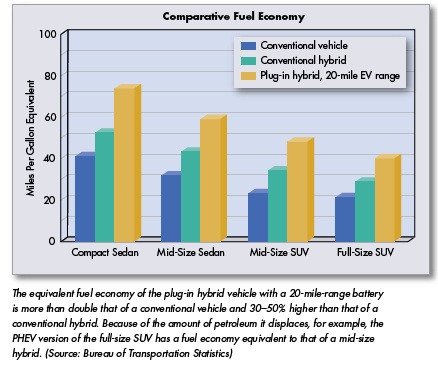
Plug-ins hydrids combine the best of electric vehicles and ICEs - i.e. an efficient zero-emission electric only mode with the extended driving range of an ICE - and I highly suggest reading the EPRI article if you are interested in learning more about this exciting technology. (I've also discussed the incredible potential of plug-ins (and full electric vehicles) before here).
[Graphics from "Driving the Solution: the Plug-in Hybrid Vehicle", EPRI Journal, Fall 2005]
Bush Discusses Energy Plans - Outlines Proposals to Help Wean U.S. Off Oil Addiction
 Yahoo News reports that President Bush delivered another address on Monday discussing his energy plans. Saying the nation is on the verge of technological breakthroughs that would "startle" most Americans, President Bush used a two-day trip to energy-related locations to outline his energy proposals to help wean the country off foreign oil.
On Monday, the President paid a visit to a solar manufacturer, United Solar Ovonic (see picture), in Auburn Hills Michigan and the battery center of Milwaukee-based auto-parts supplier Johnson Controls Inc. Bush plans to round out his trip by visiting the Department of Energy's National Renewable Energy Laboratory in Golden, Colorado on Tuesday.
Echoing his remarks on energy during the State of the Union address (see previous post), the President pointed out that less than half the crude oil used by U.S. refineries is produced in the United States, while 60 percent comes from foreign nations. Some of these foreign suppliers have "unstable" governments that have fundamental differences with America, he said.
The article continues: Bush is focusing on energy at a time when Americans are paying high power bills to heat their homes this winter and have only recently seen a decrease in gasoline prices.
One of Bush's proposals would expand research into smaller, longer-lasting batteries for electric-gas hybrid cars, including plug-ins. He highlighted that initiative with a visit Monday to the battery center at Milwaukee-based auto-parts supplier Johnson Controls Inc.
During his trip, Bush is also focusing on a proposal to increase investment in development of clean electric power sources, and proposals to speed the development of biofuels such as "cellulosic" ethanol made from wood chips or sawgrass.
Energy conservation groups and environmentalists say they're pleased that the president, a former oil man in Texas, is stressing alternative sources of energy, but they contend his proposals don't go far enough. They say the administration must consider greater fuel-efficiency standards for cars, and some economists believe it's best to increase the gas tax to force consumers to change their driving habits.
During his visit to Johnson Controls' new hybrid battery laboratory, Bush checked out two Ford Escapes — one with a nickel-metal-hybrid battery, the kind that powers most hybrid-electric vehicles, and one with a lithium-ion battery, which Johnson Controls believes are the wave of the future. The lithium-ion battery was about half the size of the older-model battery. In 2004, Johnson Controls received a government contract to develop the lithium-ion batteries.
On Tuesday, Bush plans to visit the Energy Department's National Renewable Energy Laboratory in Golden, Colo., to talk about speeding the development of biofuels.
The lab, with a looming $28 million budget shortfall, had announced it was cutting its staff by 32 people, including eight researchers. But in advance of Bush's visit, Energy Secretary Samuel Bodman over the weekend directed the transfer of $5 million to the private contractor that runs the lab, so the jobs can be saved.
The department "has been informed that the NREL lab director will use these funds to immediately restore all of the jobs that were cut earlier this month due to budget shortfalls," the department said in a statement Monday.
"Our nation is on the threshold of new energy technology that I think will startle the American people," Bush said. "We're on the edge of some amazing breakthroughs — breakthroughs all aimed at enhancing our national security and our economic security and the quality of life of the folks who live here in the United States."
Later Monday, Bush visited the United Solar Ovonic plant, which makes solar panels, in Auburn Hills, Mich., outside Detroit. "This technology right here is going to help us change the way we live in our homes," Bush told reporters.
Bush said he was impressed with the growing commercial uses of solar energy.
"Roof makers will one day be able to make a solar roof that protects you from the elements and at the same time, powers your house," Bush said. "The vision is this — that technology will become so efficient that you'll become a little power generator in your home, and if you don't use the energy you generate you'll be able to feed it back into the electricity grid."
Rep. Ed Markey, D-Mass., questioned Bush's energy policies Monday, saying the administration also supports subsidies for luxury SUVs.
"This single tax subsidy dwarfs anything being done for hybrid batteries," Markey said in a news release.
As a complement to Bush's travels, six Cabinet officials are crisscrossing the nation this week, appearing at more than two dozen energy events in more than a dozen states.
This article presents a pretty balanced review of the President's new energy proposals. As I pointed out in my analysis of Bush's State of the Union remarks on energy, while these new energy initiatives are certainly a step in the right direction, they are hardly bold, nor do they completely forgive lack of leadership on this issue in the past or the administration's continued hypocracies - as Rep Markley points out, how can we take the President seriously when he says he wants to lead the country away from our oil addiction while he continues to subsidies the purchase of SUVs or while he says nothing about raising fuel efficiency standards or implementing a gas tax, probably the two most effective measures that could be taken to promote conservation and efficiency and wheen our nation off of oil?
I'm glad the article focuses on the funding issues for the National Renewable Energy Lab as well. It's great to see NREL get its funding back, but it is also important to remember that $28 million of Bush's Advanced Energy Initiative (AEI) budget requests go to simply reinstating the previous budget cuts to the NREL. Incidentally, that $28 million is almost as much as the total budget devoted to advanced battery research ($30 million), and dwarfs the increase in funds to that research due to the AEI ($5 million).
This also points out how little Bush's initiative is really doing to promote plug-in hybrids, despite all the talk - the talk certainly doesn't hurt, but in the end, a $5 million increase to advanced battery research is chump change compared to other budget items including research spent on the still-far-off hydrogen economy - Bush called for a $53 million increase in funding for hydrogen research, ten times what he has devoted to batteries. Let's not even start comparing AEI spending to the cost of the Iraq War...
Finally, Bush used his latest national radio address last friday to discuss the nuclear component of his energy proposals. Heiko has coverage of the address here
[Another hat tip to Jenny]
Sunday, February 12, 2006
News From My Backyard: Renewable Fuel Standard Passes Washington State House
 Green Car Congress reports today that the Washington State House of Representatives has just passed a new renewable fuel standard (HB 2738) that mandates a 2% minimum annual sales of biodiesel within that state, and a minimum 2% ethanol content for all gasoline sold in the state.
According to GCC, the legislature opted for the 2% sales standard for biodiesel rather than mandating 2% content in all diesel sold (as they did with ethanol) out of concerns for possible fuel quality issues such as those that occurred in Minnesota following that state’s enactment of a 2% biodiesel content requirement for all diesel.
The article continues: The bill is designed to boost in-state production of renewable fuels, and the bill ratchets up the minimums once the state has the proven ability to meet lower tier biodiesel and ethanol requirements. For biodiesel, the sales requirement climbs to 5%; for ethanol, the minimum content climbs to 10%.
The bill also calls for the adoption of ASTM, NIST and federal biodiesel fuel quality standards. If a conflict exists between federal environmental protection agency standards, ASTM 14 standards, or NIST standards, the federal environmental protection agency standards take precedence.
The bill provides for the establishment of a fuel testing laboratory (or a contract with a third-party lab) as well as an advisory committee to advise on implementing or suspending the minimum renewable 32 fuel content requirements.
If passed by the Senate, the requirements would take effect 1 December 2008.
I suppose this is good news - a step in the right direction at least. I would have hoped that the bill included some focus on research to develop cellulosic ethanol or Fischer-Tropsch biofuels though. Ethanol from corn and biodiesel from soy have relatively poor energy return on investments compared to cellulosic ethanol and FT-biofuels and I would hope that in the longterm, the use of biofuels in the United States is dominated by fuels from these more efficient processes.
Washington (and Oregon for that matter) should be paying attention to this report released recently from a Maine non-profit that found that half of Maine's energy needs could be met by forest waste biomass alone.
And speaking of states whose major city is Portland, an initiative similar to Washington's biofuels bill is moving through the initiative process here in Oregon as well, heading for the November, 2006 ballot. The new initiative, dubbed the "New Energy for Oregon" campaign, calls for an 8% renewable fuels standard by 2010 (rising over time) and tax breaks for Oregon farmers growing biofuel feedstocks as well as the establishment of seven research centers for alternative fuels and renewable energy across the state. More on the Oregon initiative coming soon...
Saturday, February 11, 2006
God Is On Our Side ...
 ... or at least 86 evangelical Christian leaders are.
The New York Times reports that 86 evangelical Christian leaders have decided to back a major initiative to fight global warming, saying "millions of people could die in this century because of climate change, most of them our poorest global neighbors."
Among signers of the statement, which was released in Washington on Wednesday, are the presidents of 39 evangelical colleges, leaders of aid groups and churches, like the Salvation Army, and pastors of megachurches, including Rick Warren (pictured above), author of the best seller "The Purpose-Driven Life," according to the Times.
The article continues: "For most of us, until recently this has not been treated as a pressing issue or major priority," the statement said. "Indeed, many of us have required considerable convincing before becoming persuaded that climate change is a real problem and that it ought to matter to us as Christians. But now we have seen and heard enough."
The statement calls for federal legislation that would require reductions in carbon dioxide emissions through "cost-effective, market-based mechanisms" — a phrase lifted from a Senate resolution last year and one that could appeal to evangelicals, who tend to be pro-business. The statement, to be announced in Washington, is only the first stage of an "Evangelical Climate Initiative" including television and radio spots in states with influential legislators, informational campaigns in churches, and educational events at Christian colleges.
"We have not paid as much attention to climate change as we should, and that's why I'm willing to step up," said Duane Litfin, president of Wheaton College, an influential evangelical institution in Illinois. "The evangelical community is quite capable of having some blind spots, and my take is this has fallen into that category."
According to the Times, several influential evangelical leader's opposed the statement and tried to derail any action on the Climate Initiative. Twenty-two of them apparently signed a letter in January declaring, "Global warming is not a consensus issue." The letter was sent to the National Association of Evangelicals, an umbrella group of churches and ministries, which last year had started to move in the direction of taking a stand on global warming, and asked the the association not to issue any statement on global warming or to allow its officers or staff members to take a position.
Still, the list of those who did support the initiative includes many influential and centrist Evangelical leaders. As the Rev. Jim Ball, executive director of the Evangelical Environmental Network said: "It's a very centrist evangelical list, and that was intentional. When people look at the names, they're going to say, this is a real solid group here. These leaders are not flighty, going after the latest cause. And they know they're probably going to take a little flak."
The list of intiative supporters also includes several prominent black leaders including Bishop Charles E. Blake Sr. of the West Angeles Church of God in Christ in Los Angeles, the Rev. Floyd Flake of the Greater Allen A.M.E. Cathedral in New York City, and Bishop Wellington Boone of the Father's House and Wellington Boone Ministries in Norcross, Ga.; as well as Hispanic leaders like the Rev. Jesse Miranda, president of AMEN in Costa Mesa, Calif, according to the Times.
The article continues: The evangelical leaders are meeting Wednesday with senators or their staff members concerned with legislation on energy and the environment. Their letter commends senators who last year passed a resolution by Senators Pete V. Domenici, a Republican, and Jeff Bingaman, a Democrat, both of New Mexico, which called for regulatory measures like a cap and trade program, a system in which industries would buy or trade permits to emit greenhouse gases.
In their statement, the evangelicals praised companies like BP, Shell, General Electric, Cinergy, Duke Energy and DuPont that it said "have moved ahead of the pace of government action through innovative measures" to reduce emissions.
The television spot links images of drought, starvation and Hurricane Katrina to global warming. In it, the Rev. Joel Hunter, pastor of a megachurch in Longwood, Fla., says: "As Christians, our faith in Jesus Christ compels us to love our neighbors and to be stewards of God's creation. The good news is that with God's help, we can stop global warming, for our kids, our world and for the Lord."
The advertisements are to be shown in Arkansas, Florida, Kansas, New Mexico, North Carolina, South Carolina, South Dakota, Tennessee and Virginia.
The Evangelical Climate Initiative, at a cost of several hundred thousand dollars, is being supported by individuals and foundations, including the Pew Charitable Trusts, the Hewlett Foundation and the Rockefeller Brothers Foundation.
The initiative is one indication of a growing urgency about climate change among religious groups, said Paul Gorman, executive director of the National Religious Partnership for the Environment, a clearinghouse in Amherst, Mass., for environmental initiatives by religious groups.
Interfaith climate campaigns in 15 states are pressing for regional standards to reduce greenhouse gases, Mr. Gorman said. Jewish, Roman Catholic and Eastern Orthodox leaders also have campaigns under way.
These are very influential people whose opinions sway those of thousands of normal Americans. To have them throw their support behind climate change mitigation may go along way towards shifting the mindset of Joe and Jane Average towards believing that climate change is a real issue that deserves attention from thair political leaders. After all, it's getting attention from their spiritual leaders.
Wednesday, February 08, 2006
Buy a Hybrid, Save a Hummer - Hybrid Vehicles and CAFE
 A New York Times article today brought up a very interesting subtlety to growing hybrid car sales that perfectly highlights the need for tighter fuel economy standards in the U.S.: given the structure of current federal CAFE fuel economy standards, each hybrid vehicle sale means a free pass to sell one more gas guzzler.
Congress set the first minimum corporate average fuel economy, known as CAFE, for all carmakers back in 1978. This new requirement meant that the total average fuel economy for all vehicles sold by that automaker had to exceed the minimum standard set by the law. Different standards were developed for cars and light trucks (paving the way for the existence of the SUV!). Today, the minimum average for cars is 27.5 miles a gallon and for S.U.V.'s and other light trucks, it's 21.6.
Because there is no minimum fuel economy standard for individual vehicles and CAFE works instead by setting standards for the average of all cars (and light trucks) sold by the automaker, the sales of gas guzzlers have to be offset by sales of efficient vehicles. Here's where the hybrids come in:"YOU can guess what this means for hybrids. Each one becomes a free pass for its manufacturer to sell a few extra gas guzzlers. For now, this is less true for Toyota's cars, because they're above the mileage requirement. But Toyota's trucks and the American automakers are right near the limits. So every Toyota Highlander hybrid S.U.V. begets a hulking Lexus S.U.V., and every Ford Escape — the hybrid S.U.V. that Kermit the Frog hawked during the Super Bowl — makes room for a Lincoln Navigator, which gets all of 12 miles a gallon. Instead of simply saving gas when you buy a hybrid, you're giving somebody else the right to use it."
This situation perfectly highlights the need for serious policy measures to encourage fuel efficiency. Even with hybrid sales booming, given our current policy set-up to encourage fuel efficiency - i.e. CAFE - it will do little to decrease national fuel consumption assuming automakers take advantage of CAFE's set-up to simply sell more Hummers and Escalades (BTW, it now makes a lot more sense to me why GM and Ford have been focusing on hybrid SUVs and have been slow to release a hybrid sedan or compact).
What we clearly need is to seriously revamp CAFE or eliminate it altogether in favor of other policies.
A start would be to suplement the CAFE requirement with a true minimum standard for fuel economy for various weight classes or vehicle types. In fact, this is exactly what China has been doing (excerpt previous post here): The new Five Year Plan involves the adoption of stricter vehicle fuel-efficiency standards. The standards are not as strict as the semi-voluntary standards that the auto industry has adopted in Europe but are higher than those in the United States (much to our embarrasment). According to an analysis by the US PIRG, "China’s new fuel economy standards require 32 different car and truck weight-based classes to achieve between 19 and 38 mpg by 2005, and between 21 and 43 mpg by 2008." Unlike the US standards which mandate that an average of automobiles produced in a particular weight class meet the targets, China's standards present a minimum fuel economy that all cars produced in that class must meet. According to the US PIRG, "In China, if the automobiles do not meet the prescribed standards, they simply cannot be sold."
Now doesn't a standard that sets a reasonable minimum fuel economy for each weight class make much more sense than CAFE which allows progress on the leading end of each weight class implicitly condones regression on the tail end of the weight class. I would of course favor a strict minimum as well that became progressively higher as time goes on to encourage continued innovation and improvements in fuel economy.
An alternative to reworking CAFE and mileage standards would simply be to levy a tax that discourages the use of gas-guzzlers. A hefty gas tax comes immediately to mind but again, we can look to China for other alternatives (again, this is an excerpt from my previous post):In addition to the efficiency standards, China has impemented a new Vehicle Tax Policy which imposes a levee of 1 percent on smaller-engine vehicles, but up to 20 percent on larger-engine vehicles, to discourage their use.
(Contrast China's policy with the US which offers tax incentives to encourage business owners to buy the largest SUVs). The idea with either of these is to 'allow' people to buy whatever car they want but to make it financially worth their while to purchase more efficient vehicles. (And just to hedge off some typical 'gas tax is evil' arguments: the tax would be a significant source of revenue that could be used to lower other taxes like payroll and income taxes so as to mitigate the regressive nature of gas taxes; also, to avoid the disasterous increase in price for transporting goods, an exemption to the gas tax could be made for truckers, etc.)
I would personally suggest a combination of the two. If we are truly serious about reducing our oil consumption, targeting transportation with an aggressive combination of gradually increasing CAFE standards with a minimum mileage standard and a hefty gas tax to encourage conservation and efficiency would truly make a sizable dent in our oil consumption.
Ultimately, as the example of hybrids and their affect on CAFE regulations illustrates, we clearly need to do something new - the status quo just isn't cutting it.
[A hat tip to Jenny]






