Energy Collective blog power policy climate - the conversation happens here

Friday, April 30, 2010

Colbert: Spill, Baby, Spill

Reporting today over at theEnergyCollective.com, I provide a pretty comprehensive survey of the current state of the environmental and political damage wrought by the still-unfolding Deepwater Horizon oil drilling disaster.

But as usual, Stephen Colbert has long since aired this satirical look at "the up-sides" of the major environmental disaster, now on the fast-track to status as one of the worst oil spills in American history:

The Colbert ReportMon - Thurs 11:30pm / 10:30c
Gulf of Mexico Oil Spill
www.colbertnation.com
Colbert Report Full EpisodesPolitical HumorFox News


According to Colbert the good news is that we're now one step closer to a car that can run on seawater!

And besides, now that cleanup crews have started burning off sections of the oil spill, Gulf Coast residents no longer have an oil slick the size of Rhode Island heading their way. Now it's just a wall of fire the size of Rhode Island heading their way!

So quit your worrying and chant with Stephen and I: "Spill here, Spill now! Spill here, Spill now!"

(And note to loyal readers: I guess I was a bit premature assuming that Obama's offshore drilling plans were pretty much a forgone conclusion. As the full extent of the Deepwater Horizon disaster unfolds over the coming three months - yes, that's how long oil is likely to continue leaking from the damaged wellhead before a relief well can be dug to inject sealants! - the politics around expanded offshore oil drilling may well sour. Stay tuned...)

Read more!

Wednesday, April 28, 2010

They're Still Blowing Up Our Mountains

A guest post by Matthew Wasson, Ph.D., Director of Programs for Appalachian Voices

A month ago, before the nation's attention was drawn to the tragedies at the Upper Big Branch Mine in West Virginia and the oil rig off the Louisiana coast, the EPA issued a blockbuster announcement about a strict new guidance for the permitting of mountaintop removal mines in Appalachia. The announcement left many people - reporters, politicians and the general public alike - confused whether or not the EPA had just put an end to mountaintop removal. The announcement generated headlines ranging from a fairly modest "E.P.A. to Limit Water Pollution From Mining" in the New York Times to "New regulations will put an end to mountaintop mining?" in the Guardian.

Certainly at the press conference EPA Administrator Lisa Jackson used some strong language:

"Coal communities should not have to sacrifice their environment or their health or their economic future to mountaintop mining. They deserve the full protection of our clean water laws."

Mountaintop Removal Mine Site above Route 23 in Pike County,  KentuckyOn a recent trip through eastern Kentucky, set up by our good friends at Kentuckians For The Commonwealth, the answer to whether mountaintop removal in Appalachia has come to an end was abundantly obvious.

The photo of a new active mountaintop removal mine looming above Route 23 in Pike County, Kentucky, at right, tells the story.

(All photos in this post were taken on April 18th in Kentucky: Here's a link a to flickr photo set from that trip)

To the extent that some in the media overstated the impact of the EPA's new guidance, they can be forgiven. During the press conference, Jackson herself said, "You're talking about no or very few valley fills that are going to meet standards like this."

Valley fills are the typical disposal sites for the waste that is generated when coal companies blow the tops off mountains to access thin seams of coal. As community activist Judy Bonds of the organization Coal River Mountain Watch describes it, "A valley fill is an upside down mountain turned inside out." Most - but not all - mountaintop removal mines require valley fills.

But Jackson was also very clear that this was not a blanket ban on mountaintop removal permitting and that the guidance would not apply to permits that had already been granted. The standards Jackson said would lead to "no or very few valley fills" establish limits on the permissible level of stream water conductivity. Conductivity is a measure of salt - and an indicator of metals including toxic and heavy metals - in water. Remember the experiment where you put salt in a glass of water to make it conduct electricity and light a bulb?
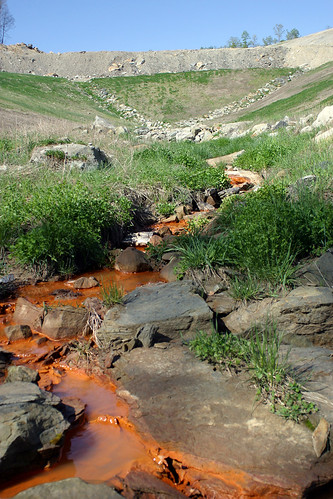
Toxic Runoff from a Valley Fill in Eastern KentuckyA plethora of recent scientific research has shown that conductivity higher than about five times the normal level downstream from valley fills is associated with severe impairment of the ecological communities in Appalachian headwater streams. The photo to the right that I took below a valley fill in Magoffin County, Kentucky, illustrates the trouble these standards create for coal companies. According to a huge compilation of scientific studies that the EPA simultaneously released with their guidance, conductivity levels below Appalachian valley fills average around 10 times normal levels. The bright orange water coming out of this valley fill indicates enormously high levels of iron, which in turn suggests both high conductivity levels and high levels of toxic and heavy metals regulated under the Clean Water Act.

To be sure, the EPA's move is a big first step that provides immediate protection to Appalachian families threatened with new mountaintop removal permits above their homes. It's a tourniquet that will stop the hemorrhaging, but here are five reasons why this guidance doesn't immediately or permanently put an end to mountaintop removal:

  1. The EPA's action will not affect permits that have already been issued. Moreover, an excellent piece of reporting by Charleston Gazette reporter Ken Ward revealed that those existing permits will allow some companies to continue mountaintop removal operations without a hitch for the next couple of years.
  2. Not all mountaintop removal mines require valley fills and coal companies are already using loopholes by which they can obliterate miles of streams without the need to obtain a valley fill permit. The million or so acres of wholesale destruction that coal companies drove through a narrow loophole in the Surface Mine Control and Reclamation Act since 1977 is testament to their skill and creativity at exploiting loopholes.
  3. Some valley fills will still be allowed under this guidance and the EPA even provided a set of "best practices" by which companies can do mountaintop removal in a manner consistent with it. Moreover, there are a number of recent cases where coal companies went ahead and constructed valley fills without even bothering to obtain a permit.
  4. While the guidance takes effect immediately, it is a preliminary document released in response to calls from coal state legislators and coal companies for greater clarity on how the EPA was basing its decision whether to grant a valley fill permit for an Appalachian surface mine. The EPA plans to initiate an extended public comment period before the guidelines will be finalized.
  5. An agency guidance document is different from a formal rule and can be easily overturned by a new administration. Even if this guidance proves to be effective in curtailing mountaintop removal, environmental and community advocates still need to ask what happens when a hypothetical President Palin enters the White House in January of 2013 or 2017.

There are any number of laws and regulations that affect surface mining, and so there is no single mechanism to ensure mountaintop removal is stopped permanently. But the first and most important step is for Congress to pass a strong law that prohibits the dumping of mine waste into streams.

In 2002, Representative Frank Pallone of New Jersey introduced just such a bill called the Clean Water Protection Act (H.R. 1310). Pallone, together with Republican Cristopher Shays, introduced this bipartisan bill in response to the Bush Administration's catastrophic "fill rule," which made it easier to permit mountaintop removal mining and for coal companies anywhere to dump waste into streams. Since then, people and organizations across Appalachia have supported Pallone's bill by carrying a simple message to universities, church groups and Rotary Clubs across America: they're blowing up our mountains and there oughtta be a law!

Over the past eight years, the nationwide organizing efforts led by groups in Appalachia have generated a remarkable 170 co-sponsors of the Clean Water Protection Act - more than almost any other bill before Congress. Unfortunately, the bill continues to be held up in the House Transportation and Infrastructure Committee, with West Virginia Congressman Nick Rahall recently claiming credit in a West Virginia newspaper for bottling it up.

If Rahall's contention is true, it's a powerful testament to the level of influence he has accumulated, given that the bill has more cosponsors than any other of the 323 bills currently before the Transportation and Infrastructure Committee. More importantly, Rahall does not actually have the power to prevent the bill from being heard except through his influence over Chairman James Oberstar of Minnesota, who is the only one with the actual power to decide whether the bill is brought up in his committee.

It's particularly unfortunate that House Democratic leaders and committee chairs like Oberstar would give Rahall so much power over national policy, given how poorly his own constituents have fared under his leadership. After 33 years in office, Rahall's district ranked 434th out of all 435 Congressional districts in Gallup's recently-released 2009 well-being index rankings (see map below).

WellBeing_2009Rankings

The only district that ranked lower was Hal Roger's neighboring district in eastern Kentucky. Notably, Rogers' is the only district that has suffered more destruction from mountaintop removal mining than Rahall's.

A big question in the wake of the tragedy at Massey Energy's Upper Big Branch mine is whether the obescience of coal state legislators toward the coal industry will change after the disaster. Traditionally, the pandering of Congressman Rahall and Senator Rockefeller toward Big Coal has been almost embarrassing to watch - kind of like witnessing an overly-exuberant public display of affection on a park bench. But when it comes to the safety of the guys in the hardhats, these gentlemen strike a very different tune.

Given that the same company, Massey Energy, is by far the largest operator of mountaintop removal mines, was assessed the largest penalty in the history of the Clean Water Act, and has a record of environmental violations to which their horrible safety record pales in comparison, these legislators have a unique opportunity to lead their constituents in a new direction. And Senator Byrd of West Virginia has paved the way.

One of the most under-reported elements of the EPA's announcement was that Administrator Jackson specifically mentioned the EPA had worked with Senator Byrd to develop their new guidelines. She would not have said that without explicit approval from Senator Byrd. While Byrd has not explicitly called for an end to mountaintop removal or co-sponsored legislation to do that, his leadership in promoting a more thoughtful and reasonable view on climate and the future of coal in his state represents a sea change from the public statements of statewide elected officials over the past few decades. Rahall and Rockefeller would serve their constituents and their country far better if they followed Byrd's lead.

Is Passing a Law in this Polarized Congress Realistic?

More important than the enormous number of cosponsors that legislation to stop mountaintop removal enjoys is the fact that the support is bipartisan. Immediately following the EPA's announcement, Senator Lamar Alexander, Republican of Tennessee, said in a press release:

"The new EPA guidelines are useful in stopping some inappropriate coal mining in Appalachia but Congress still needs to pass the Cardin-Alexander legislation that would effectively end mountaintop removal mining."

Alexander, together with Senator Ben Cardin of Maryland, introduced the Appalachia Restoration Act (S. 696) last year, a Senate companion to the Clean Water Protection Act designed to eliminate mountaintop removal (or at least permanently curtail it - we'll see what the final language says after mark-up). That bill got a boost the same week of the EPA announcement when coal-state Senator Sherrod Brown of Ohio announced he would become the 11th co-sponsor of the bill.

Whether the Senate bill can survive the committee mark-up process in a form that Appalachian citizens groups can support remains to be seen, however. The Nashville Tennessean recently published an editorial that gave voice to the concerns many coalfield citizens have about forms of mining that may not be covered by the Senate bill, particularly cross-ridge mining. Cross-ridge is a type of mountaintop removal mining that requires little or no valley fill and is based on the assumption that a mountain can be put back more or less how it was after it's been blown up - kind of like putting Humpty Dumpty back together again.

Runoff from a "Reclaimed" Mountaintop Removal mine in  KentuckyThe photo to the right illustrates one of many problems with the theory that mountains can be put back together without causing major ecological degradation. While the type of mining shown in the photo would not be classified by state agencies as mountaintop removal (only part of the ridgeline has been removed and there is no valley fill at the headwaters of this stream), the impact of this mining on water quality is indistinguishable from the impact shown in the previous photo below a valley fill.

Some insiders have also expressed concern that the EPA's strict new guidance will take the wind out the sails of the campaign to pass a law, but from the perspective of Appalachian groups that have been working to ban mountaintop removal for decades, that concern is misplaced. The citizens of Appalachia have led this fight from the beginning, and have a much more vested interest in making these protections permanent than any group in Washington, D.C.

It may be that some big environmental groups that have only recently made mountaintop removal a priority will move on to other priorities once the Administrative decisions are played out - and make no mistake that the contributions of those groups over the past few years in pressuring the Obama Administration to take action were exceedingly welcome and timely. But it was not the Big Greens that made mountaintop removal a national issue or whose organizing in communities across America has generated such broad bipartisan support of the Clean Water Protection Act and Appalachia Restoration Act.

The people of Appalachia aren't sitting around waiting for beltway insiders to tell them whether or how to pass a law, they're just doing it. The legislative effort is led by the Alliance for Appalachia, an alliance of thirteen local and regional organizations that formed several years ago with the mission of ending mountaintop removal and bringing a prosperous new economy to the Appalachian coalfields that is based on sustainable industries.

The Alliance for Appalachia represents by far the greatest number of people impacted by mountaintop removal mining, and the alliance is composed of some organizations that have been fighting Appalachian strip mining for decades. The battle to end mountaintop removal will not be over until the Alliance for Appalachia says it is, and I'm confident that won't happen until, at a minimum, President Obama signs a law banning the practice.

So What's Next?

There is a window of opportunity right now to pass a strong law that will rein in mountaintop removal permanently. Also, with coal demand down dramatically due to the recession, now is the time to begin replacing mountaintop removal coal with aggressive energy efficiency and renewable energy policies in states like North Carolina, Georgia and Virginia that are most dependent on this source of coal.

From a local perspective, more delays, half-measures and uncertainty about the future of mountaintop removal will only lead to a myopic approach to rebuilding the Appalachian economy and bringing new jobs and new industries to the region.

And from a global perspective, at a time when America is finally getting serious about addressing climate change and moving toward a 21st century energy future built around renewable energy, isn't it absurd that we're still fighting to stop the wholesale destruction of the most biologically diverse forests and streams on the continent in order to mine climate-destroying coal? Can we really address climate change if we can't even stop mountaintop removal?

For people around the country that want to see mountaintop removal end - and that should be anyone concerned about climate change, human rights, clean water or endangered species - a great place to start is by telling your Senators and Representatives that the time to pass legislation to end mountaintop removal is now. There are plenty of tools on the web to make it easy.

Let's keep up the momentum, pass a strong law, and relegate mountaintop removal to its rightful place as just another tragic episode in American history books.

Cross-posted with iLoveMountains.org and HuffingtonPost.com

Follow Matt Wasson on Twitter: www.twitter.com/forthemountains

Read more!

Over 100 Student Body Presidents Urge Congress to Support Energy Education

FOR IMMEDIATE RELEASE
April 28, 2010

Contact: Teryn Norris
Phone: 510-593-3716
Email: norris -at- leadenergy.org

WASHINGTON, DC, APRIL 2010 -- A group of more than 100 university and college student government presidents submitted a letter (PDF download) today urging Congress to launch a national program for clean energy science and engineering education. The presidents – representing more than one million American students –warned Congress that advanced energy education is critical for U.S. leadership in the global clean energy industry.

“The United States is rapidly falling behind in the burgeoning clean energy industry – especially in comparison to China – and our educational system and workforce is not prepared to compete,” declared the 107 presidents, including dozens of the country’s top universities. “American students are ready and willing to rise to this national challenge, and we need the federal government to support our education and training.”

The letter, organized by Americans for Energy Leadership and the Associated Students of Stanford University, calls on Congress to support the RE-ENERGYSE (“Regaining our Energy Science & Engineering Edge”) proposal, which would invest tens of millions of dollars annually in energy science and engineering education programs at universities, technical and community colleges, and K-12 schools. It was originally proposed by President Obama in April 2009 and is currently under consideration in Congress as part of the Department of Energy's 2011 budget request.


“RE-ENERGYSE represents the nation’s first comprehensive federal program to support clean energy education programs and train thousands of new energy scientists and engineers,” wrote the presidents. “We believe it is a critical step toward creating new energy industries and jobs while regaining American leadership in the global clean energy industry, which promises to be one of the largest new growth sectors.” RE-ENERGYSE was rejected by Congress last year, despite support from dozens of universities and professional associations.

Teryn Norris, Director of Americans for Energy Leadership, said the letter represents an overwhelming demonstration of support from the country’s young leaders. “The next generation of American leaders has delivered a unified message, and members of Congress should listen: the United States is failing to compete in a critical industry, and catching up requires a national strategy for advanced energy education.” Norris pointed to the report he recently co-authored with the Breakthrough Institute and Information Technology and Innovation Foundation, “Rising Tigers, Sleeping Giant,” as documenting the challenges facing the U.S. clean energy sector.

“Federal investment in advanced energy education, including RE-ENERGYSE, will more than pay for itself,” said David Gobaud, President of the Associated Students of Stanford University for the 2009-2010 academic year. “These are long-term investments in our future. Higher education is a foundation for competitiveness and growth, and the clean-tech industry is one of our generation’s greatest opportunities. We can lead this industry by investing in the next generation of clean energy innovators, and Congress must take action.”

The letter observed that the government has started to address the need for “green-collar” technician training, such as jobs related to building retrofits and renewable energy installation, but the government “has not implemented a higher education strategy to keep the U.S. at the leading edge of energy science, technology, and entrepreneurship.” A recent report by IEEE on the energy workforce concluded, “We need more electrical engineers to solve industry challenges, and … to keep the nation’s electric power reliable, secure, safe, and competitive. Meeting these needs requires long-term investment now.”

Foreign countries are producing substantially larger portions of scientists, engineers, and researchers that will benefit their clean energy industries. According to the National Science Board, science and engineering make up only about one-third of U.S. bachelor’s degrees, compared to 63 percent in Japan, 53 percent in China, and 51 percent in Singapore. “The U.S. ranks behind other major nations in making the transitions required to educate students for emerging energy trades, research efforts, and other professions to support the future energy technology mix,” states the Department of Energy's RE-ENERGYSE proposal.

Economic studies have found that federal investment in higher education produces a high rate of return in GDP growth and long-term tax revenue. According to a report by the U.S. Congress Joint Economic Committee, the return on investment produced by the post-war G.I. Bill totaled above 400 percent over the course of 35 years. Most economists believe that technological innovation drove the majority of U.S. economic growth in the 20th century.

“This letter and RE-ENERGYSE are only the beginning,” said Norris, also a Senior Advisor at Breakthrough Institute and public policy student at Stanford University. “We will continue working with young leaders to develop proposals to advance American energy innovation, including a national education program on par with the post-Sputnik National Defense Education Act, and an increase in the federal energy R&D budget to the level of the National Institutes of Health. We look forward to working with members of Congress in the months ahead.”

###

Download a PDF version of this press release

Additional resources:

RE-ENERGYSE 2-page summary, FY2011 Proposal

President Obama Announces RE-ENERGYSE at National Academy of Sciences

“Press Release: Over 100 Groups Urge Congress to Support Obama’s Energy Education Initiative"
Breakthrough Institute, 07/22/09

"Winning the Clean Energy Race: A New Strategy for American Leadership"
Teryn Norris and Devon Swezey, The Huffington Post, Nov. 2009

"Rising Tigers, Sleeping Giant: Asian Nations Set to Dominate Clean Energy Race by Out-Investing the United States"
Breakthrough Institute and Information Technology & Innovation Foundation, Nov. 2009

For more information and media coverage, see here:
http://leadenergy.org/reenergyse/resources/

Read more!

Tuesday, April 27, 2010

WEBINAR: Climate Legislation in the US Senate: Will Obama Get a Bill?

Live Webinar May 6, 2:30 PM ET / 11:30 AM PT - REGISTER TODAY

Following closely on the Earth Day, April 22, release date of the proposed Kerry-Lieberman Senate legislation (until recently the Kerry-Graham-Lieberman legislation), The Energy Collective will bring together energy experts, a key legislator from the U.S. Senate, and the head of the Environmental Defense Fund to examine and debate the bill in an online, interactive forum. Click here to register for the free webinar today.

How will the Senate bill regulate large emitters and price greenhouse gas across the oil & gas, utility, and manufacturing industries as compared to the House-passed Waxman-Markey American Clean Energy and Security Act?

Among other questions, we'll ask:

  • Can the Democrats pass the Kerry-Lieberman bill in 2010? What's the strategy for bringing uncommitted Senators on-board?
  • What will the total emissions reductions be if the bill is implemented?
  • Industries will be regulated very differently from each other in the bill - why is comprehensive legislation still necessary?
  • What is the state of play on distributing free emissions allocations through the bill, which could be worth hundreds of billions of dollars over the course of the legislation?
  • Why are pricing fees for emissions preferred to an economy-wide emissions cap?
  • How does the bill address concerns over economic impacts of climate legislation?
  • How do nuclear energy policies and incentive differ from those in the House bill?
  • Your questions, submitted live during the event.
Featuring:

Senator Lamar Alexander (R-Tennessee) chairs the Senate Republican Conference and serves on committees overseeing education, clean air, highways, science, appropriations and the Tennessee Valley Authority. He is the only Tennessean ever popularly elected both governor and U.S. Senator. Sen. Alexander has been U.S. Education Secretary, University of Tennessee president, and professor at Harvard 's School of Government. He chaired the National Governors’ Association and President Reagan's Commission on Americans Outdoors. Recently, he is the author of Going to War in Sailboats: Why Nuclear Power Beats Windmills for America’s Green Energy Future.

Fred Krupp has been President of the Environmental Defense Fund for 25 years, and has overseen the growth of EDF into a recognized worldwide leader in the environmental movement. Krupp is widely acknowledged as the foremost champion of harnessing market forces for environmental ends. He also helped launch a corporate coalition, the U.S. Climate Action Partnership, whose Fortune 500 members – Alcoa, GE, DuPont and dozens more - have called for strict limits on global warming pollution. Krupp is coauthor, with Miriam Horn, of New York Times Best Seller, Earth: The Sequel. Educated at Yale and the University of Michigan Law School, Krupp was among 16 people named as America’s Best Leaders by U.S. News and World Report in 2007.

Marc Gunther is a veteran journalist, speaker, writer and consultant whose focus is business and sustainability. Marc is a contributing editor at FORTUNE magazine, a senior writer at Greenbiz.com, a lead blogger at the Energy Collective. He's also a husband and father, a lover of the outdoors and a marathon runner. Marc is the author or co-author of four books, including Faith and Fortune: How Compassionate Capitalism is Transforming American Business. He's a graduate of Yale who lives in Bethesda, MD.

Jesse Jenkins is Director of Energy and Climate Policy at the Breakthrough Institute, and is one of the country's leading energy and climate policy analysts and advocates. Jesse has written for publications including the San Francisco Chronicle, Baltimore Sun, Yale Environment 360, Grist.org, and HuffingtonPost.com, and his published works on energy policy have been cited by many more. He is founder and chief editor of WattHead - Energy News and Commentary and a featured writer at the Energy Collective. Jesse goes by @JesseJenkins on Twitter.

Click here to register for the free webinar now and mark your calendar.

Read more!

Thursday, April 22, 2010

Senate Climate Bill Trio Scrapping Oil and Gasoline Fee?

Originally posted at the Breakthrough Institute

[Update at end of post - 4/22/10 at 5:20 PST]

According to several reports, the trio of senators leading the effort to craft a climate and energy bill for release next Monday are back-peddling from earlier plans to implement a new fee on petroleum-based fuels such as gasoline amidst concerns that any new "gas tax" would trigger voter backlash.

Earlier reports of ongoing, private negotiations on a Senate climate and energy bill led by Senators John Kerry (D-MA), Lindsey Graham (R-SC), and Joseph Lieberman (I-CT) indicated that the trio were planning to drop the 'economy-wide' cap and trade plan included in the House-passed Waxman-Markey bill in favor of a 'three sector' approach to regulating emissions from power plants, industry, and petroleum-based fuels.

A cap would be implemented on the power sector to begin with, with industry phased in at a later date, while the oil sector would be exempted from the plan. Instead, petroleum-based fuels, including gasoline and diesel fuel, would be subject to a "linked fee" that would be tied somehow to the price of carbon pollution credits under the power sector cap and trade program -- in effect, a variable tax on gasoline and other petroleum products.

Now however, the Wall Street Journal reports that Sen. Kerry vehemently declares, "There is no gas tax, there was no gas tax and there will never be a gas tax."

Another Journal article similarly reports:

The senators had been discussing the idea of using an indirect tax on gasoline to substitute for emissions caps on the oil industry, according to people familiar with the discussions. The White House last week said President Obama wouldn't support an increase in the current federal gas tax of 18.4 cents a gallon, and Messrs. Graham and Kerry have disavowed the idea of a gas-tax increase.
As we await the release of the Kerry-Graham-Lieberman senate climate bill next Monday, there's thus little clarity about how, if at all, oil refiners and transportation fuels will fall under the bill's carbon regulations. The transportation sector is responsible for roughly one-third of total U.S. greenhouse gas emissions, the second largest sectoral share after power plant emissions.

UPDATE: Kate Sheppard at Mother Jones is fresh off a conference call with Senator Kerry which revealed a few more details of the yet-to-be-released Senate climate bill. According to Sheppard, Kerry says the bill should now have the backing of at least three of the five big oil majors as well as the Edison Electric Institute, a trade group representing the country's investor-owned utilities. And here's the current scoop on the oil and transportation sector, according to Sheppard:
There will be no fee--or "gas tax"--on transportation fuels. Instead, oil companies would also be required to obtain pollution permits but will not trade them on the market like other polluters. How this would work is not yet clear.
Looks like Kerry et al. are still trying to figure out how to increase the cost of gasoline through carbon fees without calling it a "gas tax." We'll see how that goes...

See also:

Read more!

Sunday, April 18, 2010

WATCH: China building ambitious "Solar Valley City" to advance solar industry

Cross-posted from Americans for Energy Leadership

China is building an ambitious "Solar Valley City" as a new national center for manufacturing, research and development, education, and tourism around solar energy technologies. as part of the Chinese government and industry's efforts to promote clean energy technology and grow the nation's global market share (see video below beginning at 10 seconds).

Solar Valley City is located in Dezhou, Shandong Province, where I visited last month as part of a delegation from Stanford University, and it is unlike any city you've seen before. The city houses over 100 solar enterprises including major firms like Himin Solar Energy Group Ltd, the world's largest manufacturing base of solar thermal products, and Ecco Solar Group. According to reports, around 800,000 people in Dezhou are employed in the solar industry, or one in three people of working age.


"China's solar thermal industry and Himin's complete industrial chain are examples for the rest of the world. That sounds brash, but it's true," said Himin's CEO Huan Ming in 2009, now one of China's richest men. Himin specializes in solar thermal technology, producing over twice the annual sales of all solar thermal systems in the United States, and it is quickly expanding into solar photovoltaics and other technologies.


Himin's portion of Solar Valley comprises nearly 1000 acres, where the company is currently constructing its manufacturing center, research and development center, education and training center, apartment complexes, and more. These facilities will host the 4th International Solar Cities Congress this year and boast a giant "solar architecture" hotel.

The Chinese government has offered substantial support for the project, including preferential tax benefits and other supporting policies, although the specifics are largely unknown. "The municipal government attaches great importance to the development of green energy," said the County Level Inspector of Dezhou People's Congress.

China_Solar_Valley_Stanford_Delegation

Our Stanford "China Energy Systems" class delegation visiting China's Solar Valley City (I'm in the front row, fourth one from left)

Solar Valley City has similarities to China's new "Electricity Valley" in the city of Baoding, which has consciously modeled itself after Silicon Valley. The city has transformed itself from an automobile and textile town into one of the fastest growing hubs of wind and solar energy equipment in China, housing nearly 200 renewable energy companies.

Overall, this project is yet one more example of how China is moving rapidly to lead the global clean energy industry while the United States falls behind. China is already the world's largest manufacturer of solar panels and wind turbines, and it is poised to lead in advanced batteries, high-speed rail, hybrid and electric vehicles, nuclear, and advanced coal technology.

As my colleagues and I documented in our "Rising Tigers, Sleeping Giant" report last year, China and other Asian nations will out-invest the United States in the clean energy sector sector by over three to one over the next five years, a finding that was recently confirmed by a large Pew report, "Who's Winning the Clean Energy Race?" As a group of ten U.S. Senators recently wrote in a letter to Senators Kerry, Graham, and Lieberman:
"We know that other countries, in particular China, have already started to vie for leadership in the new clean energy economy. China has already become the world’s leading manufacturer of wind turbines and solar panels. This is a contest that America cannot afford to lose. Our nation’s economic future depends both on our global competitiveness and access to reliable energy sources. We must not allow our nation to become dependent on foreign clean energy industries or squander the opportunity to compete successfully in the global clean energy marketplace."

What will it take for the United States to lead the global clean energy industry? Find out more in my article, "Winning the Clean Energy Race: A New Strategy for American Leadership," and check out the full list of recommendations in our report.

Read more!

Thursday, April 15, 2010

A Clean Energy Competitiveness Strategy for America

By Jesse Jenkins and Devon Swezey

Accelerating U.S. clean technology innovation, manufacturing, and market creation has become not just an environmental necessity but an economic imperative. A recent Pew study showed that the global clean energy industry has experienced rapid investment growth over the last five years. New clean tech investments in 2009 reached $162 billion, which is expected to grow 25 percent to $200 billion in 2010. With the global clean energy economy emerging as one of the largest economic opportunities of the 21st century, government policy and public investment will be critical determinants of which countries come out on top in the race to attract private sector investment in clean energy technologies.

The United States is currently behind other nations in this race, and lacks an effective national strategy to compete. Climate legislation proposed in Congress to date, with its low price on carbon, ineffective renewable electricity standard, and collection of efficiency regulations, will not be enough for the United States to catch up to countries like China in building the clean energy industries of the future. To regain leadership in the global clean technology industry, the United States must enact a comprehensive clean energy competitiveness strategy that prioritizes major public investments in clean energy innovation, manufacturing, market development, education, and infrastructure.

This was the topic of a presentation we gave at the World Energy Technologies Summit in New York City last month. The theme of the conference, which was sponsored by TIME Magazine, was providing a "Reality Check" on the current state of energy technology and policy. The two of us therefore presented a wake-up call about America's lagging position in the global clean energy race, uncovered the realities behind several common myths about U.S. clean energy competitiveness, and outlined what the United States government must do to truly compete for the clean energy industries and markets of the future. After the video of our presentation below, this post summarizes each of these three key topics.


If you are having trouble viewing this video in your browser, you can head here to watch it (scroll down to the 4:40 pm time slot to find our presentation)

The State of the Clean Energy Race

As we concluded in Rising Tigers, Sleeping Giant, our comprehensive report on the competitive cleantech positions of the United States, China, Japan and South Korea, the United States lags its economic competitors in the production of virtually all clean energy technologies, from solar cells to wind turbines, nuclear reactors to high-speed rail, and advanced vehicles and the batteries that power them. China currently leads the world in the production of solar cells and wind turbines, and China, Japan, and South Korea collectively control over 90% of the advanced battery market.
These Asian nations are also quickly commercializing and deploying clean energy technologies. China has doubled its installed wind capacity each year for the past five years, including in 2009, when it installed 13GW of new turbines, surpassing the United States as the largest wind market in the world. South Korea has recently become a major market for solar PV cells, increasing its new annual installed capacity six-fold to make it the fourth largest PV market in the world.

And while the U.S. has historically been a global leader in energy innovation, other nations are moving quickly to close the gap. The United States government now invests only slightly more than Japan in energy R&D, and as a percentage of GDP Japan and South Korea both invest far more. China is also rapidly developing it's capacity for "indigenous innovation," and recently announced the creation of 16 new energy R&D centers to develop wind, grid, nuclear and other technologies.

Each of these nations employing comprehensive government strategies to build domestic clean energy industries, which include major public investments in R&D, manufacturing, infrastructure, and market deployment. Indeed, the governments of these three nations will out-invest the U.S. government by three to one over the next five years, even if the United States enacts into law the House-passed Waxman-Markey climate bill.

Clean_Energy_Investments.jpg

[Caption: Comparing public investments in clean energy, 2009-2013. Source: Rising Tigers, Sleeping Giant.]

One emerging features of the clean tech race is the development of clean energy clusters in countries around the world, and China in particular. Clusters act as regional "innovation ecosystems" that connect research and innovation activities with manufacturing scale-up, commercialization, and policymakers. Research has shown that such clusters can create enduring competitive advantages at both the regional and the national level. One example of an emerging clean energy cluster is the Chinese city of Baoding, which is composed of nearly 200 renewable energy companies and operates as a platform that links China' clean energy manufacturing industry with policy support research institutions, and other social systems.

Myths and Realities About the Clean Energy Race

Since the publication of our report last November and a number of later reports confirming the decline in U.S. competitiveness in the global clean tech industry, a few myths have proliferated about the reasons that the U.S. is behind and what it must do to compete in this critical economic sector.

The first myth is that China has a command and control economy, and their economic system is no match for the liquidity of U.S. private capital markets and the entrepreneurialism of the U.S. economy. The U.S. therefore shouldn't lose too much sleep over mounting cleantech competition from China.

In reality, however, the public policy environment created in China has allowed China to attract more private investment in clean energy than the United States. And while the U.S. still leads in VC funding for clean energy technology, Chinese companies dominated clean tech IPO proceeds in 2009, with 69% of capital raised, and attracted more overall private sector investment in clean energy sectors in both 2008 and 2009.

The second myth is that all the United States needs to do to compete with countries like China is to put a price on carbon. Public figures like New York Times columnist Tom Friedman and venture capitalist John Doerr routinely argues that putting a price, any price, on carbon, is the most important thing to building a clean energy economy.

But the reality is that China, Japan, and South Korea are all out-competing the United States without a price on carbon. Instead they are implementing comprehensive clean technology investment strategies. Even in European cleantech leaders like Germany and Denmark whose power plants and factories fall under the EU Emissions Trading Scheme, it is the much more targeted and substantial feed-in tariff policies and other direct public investments and incentives that are driving clean energy deployment and giving European solar and wind companies a competitive edge. Indeed, the carbon price established by the House-passed Waxman-Markey bill would provide an effective subsidy of just 1.5 cents per KWh, which doesn't even match the production tax credit driving wind power adoption in the U.S. and is a much smaller incentive than any targeted deployment incentives of our competitors, such as China's feed-in-tariff or wind, or Germany's feed-in-tariff for solar.

Energy Policy Comparison Graph.png

[Caption: Not All Carrots Are Created Equal: Waxman-Markey's carbon price does less to close the clean tech price gap between clean energy and fossil fuels than more targeted policies in other nations.]

The third myth is that as the United States continues to slip further behind its economic rivals in the production and deployment of clean energy technologies, American will still, as Tom Friedman has written, "specialize in research and innovation."

In reality, other governments are quickly closing the innovation gap with the United States and developing national innovation policies to boost their internal competitiveness. There is also little reason to believe that innovation leadership won't follow market and manufacturing leadership. Private companies are already starting to re-locate clean energy R&D activities near to areas with the most manufacturing and the strongest markets. Case in point is U.S. firm Applied Materials, which built the world's largest solar R&D facility in Xian, China.

A Clean Energy Competitiveness Agenda for the 21st century

In the face of aggressive foreign competition in the clean energy industry, the United States urgently needs a comprehensive competitiveness strategy of its own to accelerate the development of a domestic clean energy industry and take advantage of emerging export opportunities. Such a strategy should prioritize large and sustained public investments in clean energy R&D, advanced clean energy manufacturing, innovative deployment, and clean energy education.

Clean energy technologies today are still too expensive relative to fossil fuels to be widely deployed at scale around the world. In the long term, relying on either high carbon prices or permanent ongoing subsidies to make clean energy competitive will effectively close off export opportunities to developing nation markets that will be unable to impose either high carbon fees or sustain large ongoing subsidies for clean energy sources.

If the United States wants to tap the multi-trillion dollar export opportunity that lies in meeting the rapidly growing demand for energy in the developing world, we much therefore focus on making clean energy technologies cheaper in unsubsidized terms. The overarching goal that should permeate all aspects of a new clean energy competitiveness strategy should be to make clean energy cheap.

In light of this goal, there is strong expert consensus around the need to dramatically boost public investment in energy R&D by at least $15 billion per year in order to invent new breakthrough technologies, and improve existing clean energy technologies and reduce their costs.

The U.S. government must also invest in the creation of a robust clean energy manufacturing industry in the United States, and should adopt an explicit manufacturing agenda. They U.S. government has consistently lacked a set of policies to help U.S. clean energy manufacturers scale up, reduce costs, and stay at the cutting edge. The government must help provide the financing necessary for the creation of expansion of clean energy manufacturing facilities here in the United States.

The government must also rethink the way that it structures its clean energy deployment policies. Currently policies like the wind production tax credit (PTC) are designed simply to drive more wind turbines into the ground. Rather, we need a set of policies that treat deployment as part of the innovation process and rationalize deployment around reducing the real costs of clean energy technologies. One proposed institution, the Clean Energy Deployment Administration (CEDA), would help achieve this goal, and has explicit technology and cost improvement goals as part of its mission.

Lastly, and perhaps most importantly, the United States must inspire and train a new generation of scientists and engineers and equip them with the tools necessary to solve our long-term energy, climate, and economic challenges. U.S. students consistently trail their peers in leading science and math education indicators. Securing long-term economic competitiveness will require major new investments in our energy workforce as clean energy emerges as one of the most promising economic opportunities of our time.

America can still be the world leader in new global clean tech industry. We remain one of the most innovative and entrepreneurial countries in the world. But without a comprehensive clean energy competitiveness strategy that can compete with those implemented around the world, America will lose out on one of the greatest economic opportunities of the 21st century.

Read more!

Tuesday, April 13, 2010

A "Primer" on Geoengineering

Over at Dot Earth, Andrew Revkin discusses geoengineering and includes this hilarious "primer" -- the epitome of education:

Read more!