And who get's the bulk of it? I'll give you a hint ... it's not the Deparment of Eduction.
Triple Pundit brings our attention to a wonderful graphical chart that proportionally illustrates the breakdown of pretty much everything the US government spent money on in 2004.
The chart displays the United States discretionary budget - all the money Congress has control over, so basically all the money taken out of your paycheck for the Federal Income Taxes (Corporate and Excise taxes contribute a small portion as well) - in a series of circles varying in size proportional the the amount of tax revenue spent on them.
A small version of the graphic is below the fold:

Not surprisingly, over half of the tax revenue - some $399 billion of the total $782 billion 2004 discretionary budget - goes to the Department of Defense and various "defense" spending. The remaining half - $383 billion - is divied up amongst social services and public infrastructure expenditures headed by the Departments of Education, Health and Human Services, Veteran Affairs, Housing and Urban Development, Agriculture, Interior and of course Energy and Transportation as well as the Deparments of State and Homeland Security - there are others, but those are the big ones.
This breakdown of spending is much more informative than those typically issued by the government which also include mandatory spending on Social Security, Welfare and Medicare/Medicaid. These 'official' government spending breakdowns are misleading as the mandatory spending items skew the picture and hide what your Federal Income Taxes are really going towards - you pay seperate Social Security and Welfare checks so you know where those taxes are going.
Charts like this one (True Majority offers a similar but simplified animation that gets a similar point across) serve to truly illustrate just where your elected officials are spending your money. Remember, you voted for these guys. Did you really want them to spend over half your money making war machines for "defense" purposes? If not, I suggest you speek up - both at the polls next time around (assuming you have much of a choice between the two candidates) or through communication with your representatives and grass roots action.
If you ask me, this chart is a perfect illustration of a nation with its priorities in entirely the wrong place.
[BTW, U.S. defense funding is more than all our allies and most of our enemies combined. Check out True MajorityM for more...]

Friday, January 20, 2006
Where Do All Your Tax Dollars Go?


News From the Other Portland: Maine Enacts Pioneering e-Waste Recycling Law

So this isn't exactly energy news, but its good news nonetheless. Grist reports today that Maine became the first in the nation to require manufacturers to cover the cost of recycling televisions and computer monitors.
Similar to e-waste laws already in force in Japan and some European countries, the Pine State's new rule allows municipalities to bill the expenses of recycling dumped screens to manufacturers. The aim is to make it less costly for these localities to keep televisions and computer monitors -- which can contain about five pounds of lead each, as well as mercury, cadmium, and other toxic chemicals -- out of landfills.
Maine's groundbreaking-for-the-U.S. move is inspiring about 15 other states to consider similar legislation.
So bravo to our fellow progressives over there in that other Portland! You may talk a little funny but we love you anyway.
There's more at the Portland Press Herald.
U.S. Greenhouse Gas Emissions up 2% in 2004

Green Car Congress reports that the latest figures from the Energy Information Administration (EIA) show that total United States greenhous gas (GHG) emissions are up 2% in 2004, increasing to 7,122.1 million metric tons of carbon dioxide equivalent (MMTCO2e) from 2003’s 6,983.2 MMTCO2e.
Accoring to the EIA, the large growth in 2004 is the result of a surging U.S. economy, which in turn resulted in more energy use. GCC reports that the economy grew 4.4% in 2004 - the fastest since 1999 - and this in turn increased the carbon dioxide generated from energy use by 1.7%. However, greenhouse emissions grew slower than the economy which indicates that the U.S. greenhouse gas intensity - the amount of greenhouse gas emissions per unit of economic output - decreased by 2.1% in 2004.
Since 1990 (the benchmark year for the Kyoto Protocol), U.S. greenhouse gas emissions have increased by 15.8%, for an average annual increase of 1.1%, according to the EIA.
GCC reports that the 2004 increase in total greenhouse gas emissions is attributable primarily to a 1.7% increase in emissions of carbon dioxide to 5,973.0 million metric tons, along with increases in emissions of nitrous oxide (5.5%) and methane (0.9%). Emissions of engineered gases - hydrofluorocarbons (HFCs), perfluorocarbons (PFCs), and sulfur hexafluoride (SF6) - also increased, by 9.6 percent. [Graphic: GHG Emissions by Sector]
As in other countries seeing increasing GHG emissions, sometimes despite commitments to reduction targets [previous post], transportation is the biggest culprit here. Transportation emissions of CO2 climbed 3.1% from 2003 to 2004, and account for the largest percentage of carbon dioxide emissions (32.4%).
Almost all (98%) of transportation sector carbon dioxide emissions result from the consumption of petroleum products: motor gasoline, 1,162.6 MMT (60% of total); middle distillates (diesel fuel), 428.2 MMT(22%); jet fuel, 237.4 MMT(12%); and residual oil (heavy fuel oil, largely for maritime use), 54.6 MMT (2.8%).
The growth in transportation-related carbon dioxide emissions in 2004 included increases in emissions from the use of motor gasoline (21.2 MMT, up 1.9%), diesel fuel (17.9 MMT, up 5.1%), residual fuel oil (10.0 MMT, up 22.7%), and jet fuel (8.2 MMT, up 3.6%).
These figures indicate that if we truly want to reduce greenhouse gas emissions, we have to start doing one or both of the following:
(a) reduce the amount of transport fuel consumed, either through more efficient vehicles or through reducing vehicle miles traveled - i.e. simply driving less; or
(b) start using different transportaion fuels, fuels with reduced GHG emissions per vehicle mile traveled (VMT) - options include electric vehicles and plug-ins, cellulosic ethanol or FT fuels from biomass, zinc-air fuel cell vehicles and of course, hydrogen. The source of feedstocks for each of these fuels is crucial and effects the resulting GHG emissions per VMT. (Some, i.e. hydrogen from average U.S. electrical mix via electrolysis could even increase GHG/VMT).
Finally, while U.S. GHG intensity is decreasing, there is still much more we could do in terms of efficiency in the industrial, residential and commercial sectors as well as an accelerated transition towards clean, non-emitting, renewable sources of power including solar, wind, tidal, geothermal and low-impact hydro (and perhaps even nuclear although I'm still not sold there).
Thursday, January 19, 2006
Flow Batteries For Energy Storage

I've been meaning to write a post on flow batteries for some time now and it seems that James Fraser at the Energy Blog has beat me too it.
Flow batteries are a very promising emerging energy storage option that are fully scalable for both power and energy capacity up into the MW and MWh ranges and have load leveling/peak shaving, uninteruptable power supply and power quality management applications and are well suited for coupling with intermittent renewable energy sources.
Rather than be redundant, I'll simply exerpt the beginnings of his post here and refer you to the full post at the Energy Blog for more:"Flow batteries are emerging energy storage devices that can serve many purposes in energy delivery systems. They can respond within milliseconds and deliver power for hours. They operate much like a conventional battery, storing and releasing energy through a reversible electrochemical reaction with an almost limitless number of charging and discharging cycles. They differ from a conventional battery in two ways 1) the reaction occurs between two electrolytes, rather than between an electrolyte and an electrode and 2) they store the two electrolytes external to the battery and the electrolytes are circulated through the cell stack as required. The great advantage that this system provides is the almost unlimited electrical storage capacity (MWh), the limitation being only the capacity of the electrolyte storage reservoirs."
Head here for the full article.
[Thanks to James Fraser for an excellent post.
Flow battery graphic from www.axeonpower.com/flow.htm]
Wednesday, January 18, 2006
U.S. Foreign Policy Needs to Get Over Fears of Implausable 'Oil Weapon' Says New Study by Roger J. Stern

PhysOrg carried a story today on a new study by Roger J. Stern titled "Oil market power and United States national security," which appears in the Jan. 16-20 online Early Edition of Proceedings of the National Academy of Sciences.
Stern's article argues that the the decades-old belief that petroleum-rich Persian Gulf nations must be appeased to keep oil flowing is imaginary, and the threat of deployment of an "oil weapon" - i.e. an OPEC oil embargo - is in fact toothless. His review of economic and historical data also presents the controversial claim that untapped oil supplies are abundant, not scarce.
From PhysOrg:...
Stern's analysis, titled "Oil market power and United States national security," appears in the Jan. 16-20 online Early Edition of Proceedings of the National Academy of Sciences. In the article Stern argues that the longstanding U.S. security concern that our oil supply could be threatened is wrong.
The real security problem, says Stern, comes from market power. Persian Gulf oil producers, he says, collude to command artificially high prices that could never exist in a competitive market. Excessive OPEC profits result, he says. These contribute to instability in the region, terror funding and the likelihood that a Persian Gulf superpower could emerge if one state captured the oil production of its neighbors. Because of these threats, the United States has concluded it must use military force to block state-on-state aggression in the region and to contain terrorism.
"U.S. appeasement of the oil market power not only helps create these problems, it makes them inevitable," said Stern, a doctoral student in the Department of Geography and Environmental Engineering. "Why do we follow this schizophrenic policy? We do it because we believe the 'oil weapon' might be used to reduce our supply if we somehow offend the OPEC countries. My research shows the oil weapon is completely implausible." According to the journal article, recent history shows that attempts to use an oil weapon have consistently failed. The idea, Stern says, dates back to the mid-1930s, when the League of Nations considered cutting off oil to Italy as punishment for its aggression in Ethiopia. The league realized the oil weapon couldn't work, however, because non-league nations could continue to supply Italy. Keeping oil out of Italy would have required a blockade, an idea dismissed as impossible to enforce. What was true for Italy then is true for the United States today, Stern says.
By the 1950s, Stern says, the low price of Persian Gulf oil imports jeopardized the profits of smaller U.S. oil producers. To restore shrinking market share, the U.S. oil industry successfully lobbied Congress to limit imports, arguing that reliance on foreign oil would undermine national security. U.S. producers argued that low-priced, abundant imports were dangerous because they might someday be withheld. "The oil weapon of U.S. politics descends from this confection," Stern writes in his article.
In the early 1970s, fear of the oil weapon moved to center stage once again. An influential article in Foreign Affairs predicted fuel shortages and economic disaster if the United States did not honor Middle East oil producers' wish that Israel's borders be redrawn. The United States defied this wish, and in 1973 Persian Gulf states unleashed the oil weapon in response. They vowed to cut supplies to the United States if Israel did not return to its 1967 borders. But because the United States could obtain fuel from elsewhere, Stern argues, and because the Persian Gulf nations were dependent on oil revenue, their "attack" was quickly abandoned. Panic buying kept prices high for a while, but actual supply fell only a small amount. Still, fear of a fuel cut-off remained. "Diplomats misread the market," Stern writes. "The oil weapon is impotent, but belief in it is not."
Stern's hypothesis is that "threats do arise in the oil market, but not from the oil weapon but from the (OPEC) cartel's management of abundance." Stern said his research shows that since 1970 the cost of extracting oil in Saudi Arabia has dropped by more than one-half, a clear sign of abundance. He argues that Persian Gulf oil prices are being kept artificially high in order to generate monopoly profits for these nations.
"Because of oil's enormous returns, Gulf states try to seize control of each others' fields," Stern says. "Iraq invaded Iran and Kuwait for this purpose. Our military is there today trying to keep regional peace and prevent a new superpower. Yet this policy allows aggressive oil states like Iran to grow ever-richer and more dangerous from the product they sell to us."
U.S. leaders, Stern says, must stop allowing fear of the oil weapon to dictate foreign policy. Instead, he says, they must find ways to reduce our fuel demand. "It's like we're holding a gun to our own heads: Our belief in the oil weapon constrains our concept of what we can and cannot do in the Middle East and in our own economy," he says. "It also blinds us to the huge opportunity to make ourselves more secure by reducing our oil consumption."
John J. Boland, an expert on utility economics and environmental policy who serves as Stern's faculty advisor, said the journal paper, part of Stern's doctoral thesis, raises important issues. "It's a pretty significant article," he said. "One thing Roger does is attack the perception that petroleum is scarce. That's a very unpopular position, one that is aggressively disputed by our government, even though other analysts have also raised this idea."
Added Boland, who is a professor emeritus in the Department of Geography and Environmental Engineering at Johns Hopkins: "This paper presents an unpopular perspective that has profound implications for our nation's energy policy and foreign policy."
If Stern's historical analysis of past OPEC oil embargoes is correct and that panic buying, not real significant reductions in supply was the main result, then he may have something here. However, I would argue that the world is quite a different place now than in, say, 1967.
According to the Transportation Energy Databook (TDB), U.S. oil consumption has nearly doubled between 1965 and 2003 (the latest year of data in the TDB) from 11.51 million barrels per day (mm bbl/d) to 20.04 mm bbl/d. Furthermore, U.S. domestic oil production has fallen from 7.8 mm bbl/d in 1965 to only 5.74 mm bbl/d in 2003. As would befit such a situation, our share of imported oil has also rissen dramatically from 32.2% to 71.4%, more than doubling since 1965.
Additionally, the worldwide demand picture looks completely different now with developing countries like China and India becoming major oil consumers and expanding their consumption rapidly. The TDB reports the developing nations (i.e. now OEDC countries) now account for over 30 mm bbl/d of demand, up from onl 8.33 mm bbl/d in 1965. Such countires now account for 38.7% of worldwide demand making the worldwide oil market an entirely different place than in the 1960s.
My point in all of this is to say that the United States is facing increasing competition for foreign oil supplies while its consumption is rising and its domestic production is falling. It may not be as easy for the United States to secure alternate supplies of oil in the event that OPEC nations would unleash the 'oil weapon' and embargo sales to the U.S.
Stern's point that OPEC countries depend upon oil revenues and would be loath to cut-off their most glutenous consumer is obviously correct, but when there are other consumers out there now that are gulping up oil nearly as fast as the United States, they may be able to find a suitable replacement for their U.S. sales revenue - I'm sure China wouldn't mind taking over our oil contracts in the Middle East.
As for the claim that oil supplies are plentiful, not scarce, I would have to see his reasoning, but that seems hard to believe to me. The Peak Oil debate is hardly uncontroversial, but there seems to be substantial evidence that world oil demand is outsripping additions to supply and this situation shows no real signs of changing.
Ultimately though, I firmly agree with Stern's conclusions that we must reduce our oil consumption. It is clearly in the United States' interests - from an economic, national security and environmental standpoint - to reduce oil consumption. This can be accomplished in a number of ways from hydrogen to synthetic- of bio-fuels to efficient vehicles to a transition to electric vehicles and plug-in hybrids. Let's start this before we face the threat of another 'oil weapon' or another war in the Middle East to secure our interests there.
Monday, January 16, 2006
Automakers Show Their Green Side at the 2006 Detroit Auto Show - This Year it's Hybrids Galore

Green Car Congress and the Toronto Star both present excellent summaries of the 2006 North American International Auto Show held last week in Detroit. I will in turn provide a summary of the event here:
As is befitting for a major auto show coming on the heels of a year many have dubbed 'the year of the hybrid', the Detroit Auto Show saw automakers scrambling to show off their latest innovations in hybrid technology. Noticably absent where the slough of fuel cell concepts that were the stars of previous Detroit Auto Shows and the hybrid car - present in many shapes and sizes - took their place in the spotlight at this years show.
Automakers seem to be dealing with a schizophrenic market, polarized between demand for ever greater power and performance on one end and greener machines with an emphasis on fuel economy on the other. To this end, the Detroit show saw automakers unveil quite a few new beefy luxury sedans and new full-size and cross-over SUVs as well as a variety of new hybrid concepts and production models. As Bob Lutz, GM’s vice chairman of global product development, cracked during the show:"It’s two markets. The whole country is schizophrenic. At one end of the spectrum, you have people who want ecology. At the other end, they want power. I would call this diversity."
The major automakers seem to see the necessity of pleasing both ends of the market and are unveiling vehicles to fit both philosophies.
Here's a rundown of what the each major company brought to the table this year:
GENERAL MOTORS"General Motors is on a continuing quest to reinvent the automobile and to remove our vehicles from the environmental debate.
Central to this is GM’s three-prong advanced propulsion technology strategy... which is focused on reducing tailpipe emissions, ultimately to zero…while significantly improving fuel economy.
As part of this strategy in the near term we’re improving the efficiency of both our gas and diesel engines...introducing advanced six-speed transmissions...and aggressively pursuing alternative fuels.
These strides have already helped make GM an industry leader in fuel economy."
—Tom Stephens, VP GM Powertrain
General Motors used the Detroit show to formally introduced the Saturn Vue Green Line hybrid sport-utility which will go on sale this fall.  The Vue hybrid utilizes GM's Belt Alternator Starter (BAS) system and features an electric motor/generator mated to a 2.4-liter VVT four-cylinder engine and four-speed transmission powertrain that delivers an estimated 27 mpg city and 32 mpg highway (29 mpg combined)—a 20% improvement in combined fuel economy compared to the conventional VUE with a smaller and less powerful 2.2-liter engine.
The Vue Green Line’s mild-hybrid system provides engine shut-off at idle, fuel cut-off during deceleration, electric motor/generator assist during acceleration and the capability to capture electrical energy through regenerative braking.
GM plans to offer the same system in the Chevrolet Malibu next year. GM also unvieled the new Chevy Tahoe hybrid. This two-mode hybrid is scheduled for introduction next year as a 2008 model. It's a full hybrid, incorporating two electric motors in the housing of a conventional transmission.
A 25 per cent reduction in fuel consumption is claimed when the system is combined with a V8 engine using GM's Active Fuel Management system.
A GMC Yukon with two-mode hybrid technology also is coming. DaimlerChrysler, with whom GM is co-developing the system, plans to subsequently offer the system in their full-sized Dodge Durango.
Dieter Zetsche confirmed that Mercedes-Benz is working on a diesel-hybrid variation on the theme, and BMW, which has joined the co-development team, is expected to offer a version, according to the Toronto Star.
GM also showed off its new Camaro concept that delivers 400 hp with a 6.0L V8 while getting an estimated 30+ mpg.
Other GM offerings included a new Buick Enclave SUV concept as well as two new full-size Cadillac production models - the2007 EXT sports utility truck and the 2007 ESV SUV. [Graphic from Green Car Congress]
FORD MOTOR COMPANY"The innovation you see here today is just a sample of what’s going on throughout Ford Motor Company. We’re pushing Ford Motor Company to be the most innovation automotive company on the planet in design, in technological solutions to environmental challenges, and in safety."
—Bill Ford, Chairman and CEO, For Motor"Well, small is big these days...I think that same mode of thought is going to be relevant to the auto industry as well."
—J. Mays, Group Vice President of Global Design
Ford's lineup for the Detroit show included one of the most exciting and one of the biggest duds, in my opinion. On the top of my favorites list for the show is Ford's new diesel-electric hybrid muscle car concept, the Reflex hybrid. The innovative concept features a diesel-electric hybrid system using diesel, electric and solar power. This combination of power can deliver maximum fuel economy – up to 65 mpg in the city, says Ford – without compromising performance.
Reflex stores electric power from regenerative braking and two small roof-mounted solar panels in a new generation lithium-ion battery pack. The front wheels are powered by the diesel-electric hybrid system with the 1.4 liter turbodiesel engine assisted by an electric motor. The rear axle is also powered by an additional electric motor providing this low-slung muscle car with all-wheel-drive capability.
Stylish curves, gull-wing style doors and an interior which incorporates mesh seat covers for maximum airflow and comfort, LED instrument displays, advanced safety features and insulation material made out of ground rubber from scrap athletic shoes, called Nike Grind, rounds out the Reflex's features. As exciting as the Reflex is, Ford's other 'green' effort, the F250 Super Chief tri-fuel truck went off as a major dud in my book. The F-250 Super Chief uses the same Ford 6.8-liter V-10 Triton engine deployed in the company’s E450 H2ICE trucks modified in this case to run on either gasoline, E85 ethanol blend or hydrogen making it a true 'tri-fuel vehicle'.
Sounds pretty good, but when you look at the mileage this thing delivers, you'll see why I call it a dud. The Super Chief gets only 12 mpg when running on gasoline, a pathetic 8.6 mpg with E85 and 13.6 miles per kilogram on hydrogen. Numbers like that are more fitting for a bus or a delivery truck than a full-sized pickup. Nice try, Ford, but you've still got some work to do on this one...
MAZDA, which Ford owns a controlling interest in (about 34% I've been informed), came to the show with two interesting vehicles. 
The first is a hydrogen ICE-electric hybrid concept version of its Mazda5 dubbed the Mazda5 RE Hybrid (the Mazda5 is known outside the U.S. as the Premacy). The concept combines Mazda's dual-fuel, hydrogen/gasoline rotary engine (RE) with an electric motor.
Mazda also showed its 2007 Tribute Hybrid, which shares its architecture and hybrid system with Ford's Escape.
Rounding out Ford's production line-up was the 2007 Edge/ and Lincoln MKX cross-over suvs, the 2007 Sport Trac sport utility truck and a new Shelby GT500 Mustang. Other concept cars featured at the show included the Lincoln MKS luxury sedan and a couple coupes - the Mazda Kaburo and the Volvo C30.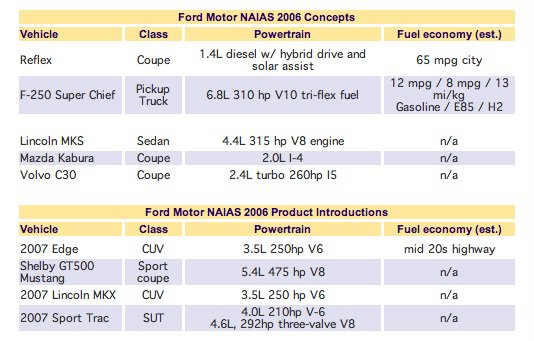 [Graphic from Green Car Congress]
CHRYSLER GROUP"The all-new 2007 Chrysler Aspen offers customers guilt-free indulgence. Loaded with premium features, stunning Chrysler design, fuel-saving MDS technology, standard safety features and best-in-class horsepower, torque and interior room, Chrysler Aspen offers more for less."
—Jeff Bell, Vice President, Chrysler
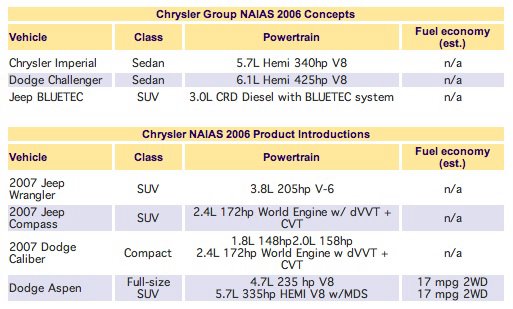
I'm not sure what exactly Jeff Bell means by 'guilt-free indulgence' in reference to the Aspen full-size SUV which gets only 17 mpg, but I do know that Chrysler was the only major automaker to show up at the Detroit show without a hybrid.
Chrysler seems to be banking on their clean high-efficiency diesel BLUETEC engines to carry their 'green' market segment demand. Chrysler plans for the BLUETEC to meet the most stringent emissions standards in the world and offer mileages competitive with hybrid vehicles.
Perfectly illustrating the current market polarization, Chrysler's Detroit concept line-up included a Jeep BLUETEC diesel concept SUV alongside two new beefy V8 sedans - the 340 hp Chrysler Imperial and the Dodge Challenger
Chrysler also showcased a new six-seater addition to their growing line of neighborhood electric vehicles (NEVs) offered through their wholly-owned Global Electric Motorcars (GEM) subsidiary. Their production models showed a similar split with the compact 2007 Dodge Caliber - which features a 1.8L or 2.4L version of Chrysler's WorldEngine with dynamic variable valve timing (dVVT) and a continuously variable transmission (CVT) - alongside several new Dodge and Jeep SUVs.
 [Graphic from Green Car Congress]
TOYOTA"As you know, there are many reasons why consumers are interested in a hybrid, not least of which includes the constantly fluctuating cost of fuel. But it is clear today, that hybrid technology has moved solidly into the mainstream especially among consumers who are environmentally aware, and want to make a difference for future generations.
But there is even more to it than that. What we have found is that owning a hybrid makes owners feel good about themselves. It’s the sheer delight of owning the latest high-tech advancement. It’s the gratification felt with fewer stops at the gas pump…and the lower cost for a fill-up. For Prius owners who are now into their second or third hybrid, it is the astounding re-sale value of their vehicles have maintained, and their industry-leading level of both customer satisfaction…and reliability.
In a phrase, hybrids are quickly establishing themselves as a critical factor in Pride of Ownership."
—Don Esmond, SVP Automotive Operations, Toyota Motor Sales
In a possible attempt to engineer a comeback for the minivan, Toyota brought their F3R minivan hybrid to the Detroit show. 
Trying to break the 'minivans are for soccer moms' mold, Toyota's F3R features a fairly boxy exterior that reminds me of the Scion xB (also targeted for the youth market) and an interior featuring three rows of reconfigurable stadium seats and a wrap-around backrest that creates a continuous couch from the dash panel along the passenger’s side of the van and around the back that allow you to turn the inside of the vehicle into a kind of “lounge,” creating a more communal space for occupants to watch movies or play games on the F3R’s two track-mounted flat panel video screens. [Lot's more pictures including a few of the innovative interior at Autoblog]
The F3R also features Toyota's Hybrid Synergy Drive under the hood.  Toyota official unvieled the 2007 Camry as well, including the much-anticipated Camry hybrid.
Featuring the newest version of the Hybrid Synergy drive, the Camry hybrid pairs a 105-kw electric motor with 199 lb-ft of torque with a lower-power (147 hp/110 kW), lower-torque (187 Nm) 2.4-liter Atkinson-cycle engine coupled to a continuously variable transmission. The result is a combined 192 hp (143 kW) from the hybrid system with 275 Nm of torque and an estimated fuel economy of 43 mpg US city, 37 mpg US highway (40 mpg US combined).
The hybrid Camry features a new ultra-small inverter and a specially designed compact 244.8-volt NiMH battery pack and transaxle.
Toyota expects to have the non-hybrid Camrys in showrooms in March, with the Camry Hybrid to follow several months later.
Not immune to the schizophrenic market, Toyota also showed up with their huge new 2007 FJ Cruiser which they hope will compete with the H3 as well as the 380 hp V8 Lexus 460 luxury sedan. Graphic from Green Car Congress]
HONDA"Honda has always led the way in reducing emissions, advancing fuel economy and developing alternative fuel technologies... we have considered it as our responsibility to produce the most environmentally responsible products and technologies possible ... even as we satisfy our customers.
Now ... to further advance environmental conservation, I think the entire auto industry must think of “we”—not just “me.” Each company must take responsibility and action by continuing to improve every product.
Toward this end, I want to challenge the entire industry, including Honda, to further improve fuel efficiency. So, let’s enter a race together. A race for the benefit of all customers and the global environment."
—Takeo Fukui, President and CEO, Honda Motor
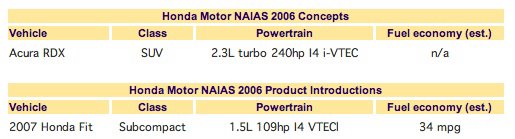
Honda didn't make a particularly impressive showing this year but also exhibited the market split in the two vehicles they did bring to the show. Honda showcased their Acura RDX concept SUV which features an innovative 2.3-liter four-cylinder turbocharged engine, Acura's exclusive Super Handling All-Wheel Drive, and is designed to combine sport utility with sports sedan handling and performance as Honda's entry into the premium SUV segment. This near-production prototype provides an advance preview of the all-new RDX that will go on sale this summer. On the other side of the market split, Honda also showed off its subcompact 2007 Honda Fit due to hit U.S markets this year. The US version of the Fit, already one of Honda’s hottest selling models in Asia and Europe (where it is sold as the Jazz), is fitted with a 4-cylinder 109 hp 1.5-liter VTEC engine coupled with a 5-speed transmission (available as an automatic or manual). Electronic Drive-by-Wire throttle control provides quick throttle response, smooth automatic transmission shifts (on automatic transmission models) and precise fuel delivery to the engine.
The 5-door hatchback delivers estimated fuel economy of 33 mpg US city, 38 mpg US highway (33.8 mpg US combined). Emissions levels are rated as Low Emissions Vehicle 2 (LEV-2) by the California Air Resources Board (CARB) and Tier 2 / Bin 5 by the EPA. Like the U.S. version of the new 2007 Toyota Yaris, the U.S. Fit sadly will not be available with the smaller engines offered in European and Asian models.
 Graphic from Green Car Congress]
OTHER AUTOMAKERS
Several other smaller automakers brought interesting new cars to the Detroit auto show as well.
BMW debuted a concept hybrid X3 cross-over SUV that is unique in its use of supercapacitors rather than batteries for energy storage.  The X3 concept is another performance hybrid SUV that combines a next-generation direct-injection inline six cylinder engine with an electric motor and supercapacitor energy storage that allows the SUV to accelerate from 0–60 mph in about 6.7 seconds. Fuel consumption compared to a conventional X3 is reduced by approximately 20% to an estimated 25 mpg US from the current 20 mpg US.
Supercapacitors offer much higher power ratios than the nickel-metal hydride or lithium-ion batteries typically used in hybrids and do not store power chemically allowing them to absorb and discharge energy much faster than batteries. A supercapacitor offers specific power density of approximately 15 kW/kilogram, compared to about 1.3 kW/kg in the case of a nickel-metal hydride battery. The disadvantage of supercaps versus the battery is the far lower energy density—but given the burst-mode design of the BMW hybrid, supercaps fit the bill quite nicely.
SUBARU brought to exciting vehicles to the table this year.  The first is the new B5-TPH hybrid concept which applies the company’s Turbo Parallel Hybrid (TPH) powertrain system and lithium-ion battery technology in a two-seat grand touring car that offers fuel economy of 40 mpg.
The Subaru TPH powertrain in the B5-TPH concept sandwiches a thin, 10-kW motor generator between a newly-developed 2.0-liter Miller cycle engine and the automatic transmission. The Miller Cycle turbo Boxer engine in the B5-TPH operates up to 30% more efficiently than a conventional gasoline engine and delivers 256 hp, with 343 Nm of torque while achieveing an estimated 40 mpg (combined). Compare this to the Toyota Camry which offers only 192 hp and achieves the same gas mileage and you'll see how exciting this concept is - granted, the 2-seater touring car is likely smaller and lighter than the Camry sedan but the B5-TPH nevertheless delivers excellent performance while simultaneously achieveing excellent gas mileage.
Subaru’s parent company, Fuji Heavy Industries, has been developing the TPH powertrain for future mass production and plans to test-launch TPH-powered Subaru Legacys in the Japanese market next year [let's hope they come to the U.S. soon as well].
The second 'green machine' Subaru showcased at the Detroit show was a test version of its R1e urban electric vehicle equipped with next-generation long-life lithium-ion type batteries from NEC Lamilion Energy.  Designed to meet the needs of city mobility, the subcompact Subaru R1e is projected to achieve an 80% recharge in about fifteen minutes. The resulting charge is expected to provide enough power to serve most daily commuting needs in congested urban areas. The current prototype [as of August] can be driven 75 miles (120 km) on a full charge, but the range is expected to be expanded to 124 miles (200 km).
NISSAN used the Detroit show to unveil two new additions to its growing line of cars featuring continuously variable transmissions or CVT - the compact 2007 Sentra and the 2007 Versa sedan. [Nissan already offers their 2006 Murano cross-over SUV with their Xtronic CVT transmission].
 The Sentra sedan features a 2.0L, 135hp four cylinder engine which when coupled with the CVT option now added to the choice of available transmission will deliver 32 mpg (combined) [a number of pics of the 2007 Sentra can be found here].
The Versa is new to the Nissan product line and is positioned below the Sentra as its new entry level vehicle and will price it starting at around $12,000 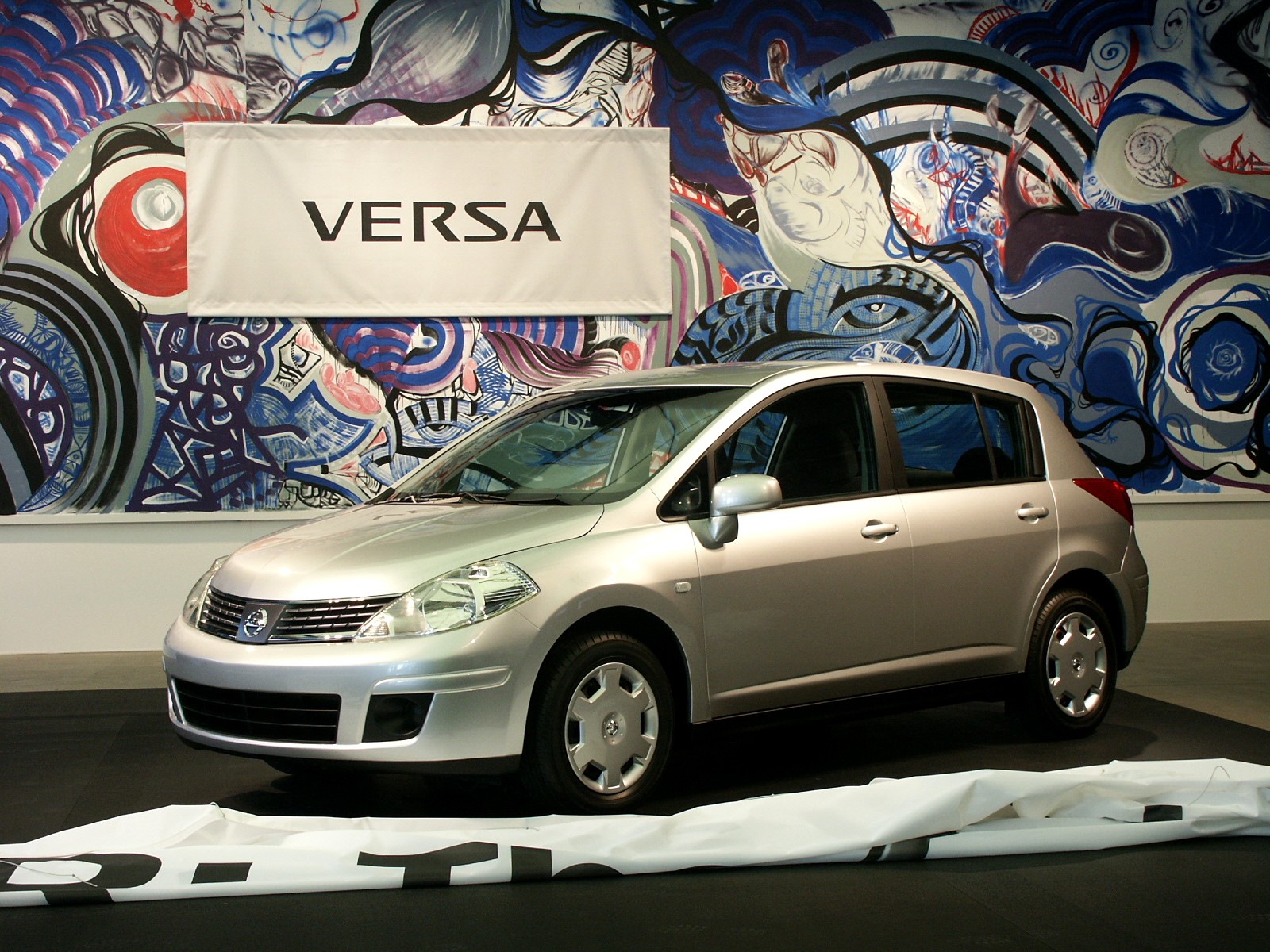 and maxing out around $15,000 while Sentra is pushed up half a knotch and gets a bit more size and content while remaining under $20,000. The Versa is available as a sedan and a hatchback and features a 1.8L four cylinder engine delivering 120 hp. The Versa will be avialable in three transmissions: a standard 6-speed manual, an available 4-speed electronically controlled automatic with overdrive and a version of Nissan’s Xtronic CVT which will offer the best fuel economy at an estimated 38 mpg combined city/highway.
Speaking on their expanded use of CVT at Detroit, Carlos Ghosn, President and CEO Nissan said: "Nissan remains the industry leader in CVTs, in experience, in units in operation, and in applications, with three separate CVT designs in production.
CVTs give customers smooth, responsive performance and a cost-effective way to improve fuel economy. For every one million CVTs in operation, we will deliver environmental benefits equal to 200,000 hybrids."Last but certainly not least, MITSUBISHI MOTORS brought perhaps the most exciting vehicle to the Detroit Auto Show, the Mitsubishi Concept CT series-parallel hybrid. The Concept-CT MIEV is a stylish five-door, four-passenger series-parallel hybrid that uses a compact gasoline generator and a bank of high energy-density lithium-ion batteries to power the in-wheel motors and drive each of its four wheels.
The 1.0-litre, three-cylinder gasoline engine is located behind the rear-seat passengers and ahead of the rear-axle line, with 20 kW (26.8 hp) electric motors in each of the four wheels yielding a combined output of 134 hp [the four in-wheel motors provide a total of 80 kW or 107 hp indicating that the gasoline engine does indeed provide some additional tractive power - about 27 hp - as well as generate electricity to charge the batteries, making the Concept-CT a true series-parallel hybrid -although more on the series side of things than, say, Toyota's Synergy Drive].
The Mitsubishi In-wheel Electric Vehicle (MIEV) hybrid powertrain is currently being tested in Japan in a 4WD Lancer Evolution prototype and was previously tested in a prototype based on the front-wheel drive Colt. Mitsu's goal is to bring an MIEV model, built around the core technologies of in-wheel motors and high-density lithium-ion batteries, to market by 2010 (perhaps as early as 2008).
More exciting still are rumors (supported by a comment from Mitsu VP for Marketing, Wayne Killan, quoted in the Chicago Tribune) that Mistubishi is working on a plug-in hybrid MIEV. The Tribune quoted Killan as saying, "We would expect the car to be used in electric-only mode only in cities, where you could have access to a quick charge," seemingly referring to plug-in capabilities. He also mentioned that the vehicle could be recharged in a scant 10 minutes suggesting the use of a quick-charge battery like those being developed by Toshiba, A123, NEC and others and featured in Subaru's R1e electric vehicle (see above).
CONCLUSION
Well that rounds out the list. All in all, the 2006 Detroit Auto Show had quite a few exciting new vehicles to offer (amongst a few duds and a bit more of the same old new full-size SUV crud). One thing seems to be certain: the auto industry is evolving at a pretty quick pace right now.
It also seems clear that the immediate focus for 'green' vehicle development has shifted from fuel cells to hybrids. I hope that this does not uneccessarily delay continued research on hydrogen vehicles and other alternatives for the long run but I'm glad to see more work being done on hybrids - hopefully with the eventual goal of plug-in hybrids on the market in a couple years.
It's also good to see a bit of work on electrics as well - notably not from the major manufacturers but from the smaller Mitsubishi and Subaru.
The trend with both hybrids and electrics seems to be moving towards incorporating lithium-ion batteries into production models soon which is good move in my opinion. Greater battery life and energy and power density than nickel-metal hydride batteries makes lithium-ion batteries much better suited to vehicle applications.
Now if I can just get my hands on a Reflex to tool around town in...
Sunday, January 15, 2006
China Now World's Second Largest Auto Market

In another indicator of China's rapid economic growth, the People's Daily reports that China has now surpassed Japan to become the second largest automotive market in the world. According to statistics issued by the China Automotive Industry Association (CAIA), China's auto sales were close to 5.92 million units in 2005, surpassing Japan's sales of 5.8 million to rank second in the world behind the United States.
The People's Daily reports that China's auto market continued to maintain a stable and fast growth last year, with total domestically-produced auto sales growing 13.54 per cent over 2004. Nearly all of the over 5.9 million units sold in 2005 were produced in China with auto imports only totalling 160,000.
According to the China View, the top three auto companies in China are all domestic companies with First Automotive Works (FAW), Shanghai Automotive Industry Corporation and Dongfeng Motor Corporation taking the top three market share positions with 983,100, 917,500 and 729,000 cars sold in 2005 respectively.
Green Car Congress reports that sales of vehicles in China from GM and its joint ventures jumped 35% in 2005 to 665,390 units. GM ended the year with an estimated Chinese market share of 11.2%.
According to the People's Daily, the passenger vehicle segment is driving overall industry growth with over 3.97 million passenger vehicles sold in 2005, a surge of 21.4 per cent over the previous year.
Despite the massive growth in the passanger vehicle segment, the People's Daily reports that slight negative growth for commercial vehicles appeared, likely influenced by the business cycle, oil price hikes and policy factors. China's auto market is now driven solely by passenger cars, instead of the previous "duoservo forces" of passenger and commercial vehicles. Statistics show commercial vehicle sales were 1.787 million units in 2005, down 0.75 per cent from 2004.
The Chinese auto industry has seen abosultely staggering growth in the past few years. The current sales figure of 5.92 million units in 2005 is more than double the 2001 sales total of 2.731 million units! Now clearly an integral part of the worldwide auto market, China's auto market growth accounted for 23.2 per cent of the total global growth, according to the People's Daily.
The People's Daily reports that the CAIA expects that the Chinese auto market to maintain a 10 to 15 per cent growth in 2006 with the year's auto sales reaching between 6.4 and 6.6 million units.
It seems to me that considering figures like this, it will only be a matter of time before Chinese-branded cars start appearing on U.S. streets.
The massive surge in passenger vehicles (and total vehicles) in China is becoming a major contributor to the country's growing greenhouse gas emissions. It also belies a rapid increase in petroleum consumption that ought to give the U.S. pause to reconsider their oil addiction. With another major economic power with a rapidly increasing thirst for oil on the scene, it seems clear that we ought to be securing domestic energy supplies (most preferably clean, renewable supplies of energy) and making a push to more efficienctly utilize that energy. If we don't, we will likely be looking at increasing competition for dwindling worldwide supplies of oil which will mean higher and higher prices and likely increased risk of geopolitical conflict.
On a slightly better note, at least China has adopted European standards for auto emissions, not the lax standards the U.S. has. If they had adopted our standards, things would be quite a bit worse - for China, the U.S., and the world.
[A hat tip to Green Car Congress]
Thursday, January 12, 2006
Bad News for the Buck - China Signals Plans to Move Away From the Dollar

While this isn't exactly energy news, it is closely tied to U.S. (and Chinese) energy policy and could have widespread ramifications:
The Washington Post reports this week that China, who's central bank currently holds around a half a trillion dollars invested in US Treasury bills and other dollar-based assets, is resolved to shift some of its foreign exchange reserves - now in excess of $800 billion - away from the U.S. dollar and into other world currencies in a move likely to push down the value of the greenback, according to a high-level state economist who advises the nation's economic policymakers interviewed by the Post.
The Post article goes on to say: As China's manufacturing industries flood the world with cheap goods, the Chinese central bank has invested roughly three-fourths of its growing foreign currency reserves in U.S. Treasury bills and other dollar-denominated assets. The new policy reflects China's fears that too much of its savings is tied up in the dollar, a currency widely expected to drop in value as the U.S. trade and fiscal deficits climb.
China now boasts the world's second-largest cache of foreign exchange -- behind only Japan -- and is on pace to see its reserves climb past $1 trillion later this year. Even a slight diminishing of the dollar as a percentage of those holdings could exert significant pressure on the U.S. currency, many economists assert.
In recent years, the value of the dollar has been buoyed by major purchases of U.S. Treasury bills by Japan, China and oil-exporting countries -- a flow of capital that has kept interests rates relatively low in the United States and allowed Americans to keep spending even as debts mount. Some economists have long warned that if foreigners lose their appetite for American debt, the dollar would fall, interest rates would rise and the housing boom could burst, sending real estate prices lower.
The comments of the Chinese senior economist, made on the condition of anonymity because the government disciplines those who speak to the press without express authorization, confirmed an analysis in Monday's Shanghai Securities News stating that China is inclined to shift some its savings into other currencies such as the euro and the yen, or into major purchases of commodities such as oil for a long-discussed strategic energy reserve.
In a report circulated this week, Stephen Green, senior economist with the bank Standard Chartered PLC in Shanghai, identified several signals that China is intent on limiting its exposure to the dollar -- not least, a recent pledge from the State Administration of Foreign Exchange to "actively explore more efficient use of our foreign exchange reserves."
"We believe this adds to the downside pressure the USD [U.S. dollar] is currently facing," Green wrote. "It is the first official expression from SAFE that they are looking at switching away" from the dollar.
The comments on SAFE's Web site reinforced earlier public warnings from Yu Yongding, an economist on the monetary policy committee of China's central bank, that the country's reserves are now vulnerable to a drop in the value of the dollar.
"The general trend for the U.S. dollar is continuously weakening," Yu said, speaking to reporters at a conference in Beijing last month. "Countries with huge foreign-exchange reserves will have their assets shrunken."
This news could be the first step in the beginning of a major collapse for the dollar often warned of by economists. America's current level of debt spending cannot continue indefinitely and is dependent upon other nations' willingness to float our debts. Such a scenario also leaves the United States' currency highly subject to the decisions of foreign governments.
If a major debt-holding nation percieves the dollar to be weakening, they may call in their marker and begin to shift their assets away from dollar-based assets. This would further depress the value of the dollar and give cause for more countries to drop their greenbacks as well in order to cut their losses. A world-wide panic could result with countries rushing to dump their dollars and the once stable value of U.S. currency collapsing. It could be Black Tuesday all over again but this time on a worldwide scale, the beginning of the end for the United States' economic dominance.
That's the doomsday scenario of course. However, the Post goes on to caution:Not all economists anticipate negative repercussions for the U.S. economy. Were China and Japan to engineer a significant fall in the dollar, those nations also would suffer the consequences -- sharply diminished exports as Americans lose spending power, plus a drop in the value of their dollar assets.
"It is thus extremely unlikely that China would do anything to harm its own balance sheet," wrote Stephen Jen, an economist with Morgan Stanley, in a research note distributed Monday.
It seems that the United States has borrowed money from so many countries that is has gauranteed itself a bit of safety ... or at least lets hope so.
I hope that China's move away from the dollar will at least serve as a warning for our nation's economic leaders that we cannot continue to increase the national debt and trade defecit indefinitely and that sooner or later, other countries are going to cash their chips and leave us in the lurch ... that is, unless we start to do something about it. A proactive policy to reign in our trade deficit and national debt would seem to be the wisest move to guarantee a stable U.S. economy.
And here's where the energy policy comes in (I told you this had to do with energy somehow): a large portion of our trade deficit is the result of the billions of dollars we spend each year to import oil from overseas to plug the gap between our rising thirst for oil and our decreasing national production. The Bush energy plan calls for the construction of hundreds of new natural gas-fired power plants (in addition to the coal and nuclear plants slated for construction) whose fuel will have to come from a massive increase in liquified natural gas imports, further adding to the trade deficit (incidentally, the bulk of world gas reserves lie beneath Iran, Qatar and Russia, not exactly the most stable nations in the world).
Such an energy policy heavily dependent on foreign sources of oil and natural gas leaves us prone to relying on military actions to defend our energy interests overseas as well. Estimates of military expenditures to defend U.S. oil interests in the Middle East range from $6 to $60 billion per year with a recent study by the National Defense Council Foundation putting the price tag at $49 billion per year for the defense of Middle Eastern Oil [see the Transportation Energy Data Book, pg 1-11]. This estimate does not include the costs of the latest Iraq War and occupation.
Furthermore, our dependence on foreign oil leaves our country's economy at the mercy of foreign oil-producing nations. A study by the Oak Ridge National Labs reports that the oil market upheavals caused by the OPEC cartel over the past three decades have cost the United States in the vicinity of $7 trillion (adjusted to 1998 dollars) in total economic costs! That happens to be roughly equal to the sum total of payments to the national debt over that time period.
A sensible energy policy that set this nation on its path towards energy independence and sustainability would thus go a long way towards bringing down the trade deficit and national debt, ensuring the stability of our economy as well as our energy supply.
It's time for our leaders in Washington to set this country in the right direction in terms of energy policy. I'd suggest reading this for starters...
[A hat tip to Past Peak for bringing this alarming news to my attention]