Cross-posted from the Breakthrough Institute
This week, we've been writing about President-elect Barack Obama's powerful mandate to build a new, clean energy economy and revitalize our nation's ailing economy. A new post-election poll from Zogby Interactive confirms that Americans overwhelmingly view new investments in clean energy as critical to revitalizing America's ailing economy.
The poll found that more than three out of four voters - 78% - support clean energy investments to revitalize the economy, with 50% saying they strongly agree that clean energy investment is vital to the nation's economic future.
Clean energy investments enjoy broad, bipartisan support as well, the poll found. According to Zogby:"While the vast majority of Democrats (96%) and independent voters (77%) view clean energy investment as a key means to boost the U.S. economy, more than half of Republican voters (58%) also said the same."
Support for clean energy investments is strongest among young voters, African Americans and latinos, three demographics that were critical to Obama's landslide electoral success. Zogby found that:"Support for clean energy investment is particularly strong among younger voters - 87% of those age 18-24 and 80% of those age 18-29 believe this type of investment is necessary to help improve the U.S. economy. African American voters (94%) and Hispanic voters (84%) also showed overwhelming support for clean energy investment."
"While the economy was the top issue in the 2008 election, clean energy clearly emerged as part of voter expectations for getting the economy back on track," said John Zogby, President and CEO of Zogby International. "Support for action on global warming, already strong in the 2006 election, was even stronger in 2008, particularly among young voters that are the future electorate."
The Zogby Interactive survey of 3,357 voters nationwide was conducted Nov. 5-6, 2008, and carries a margin of error of +/- 1.7 percentage points. The survey was commissioned by the National Wildlife Federation.

Friday, November 07, 2008
Post-election Poll Confirms Bipartisan Support for Barack Obama's Clean Energy Plans


President-elect Barack Obama's New Energy Mandate, Part 2
 Part 2: Dos and Don'ts
Cross-posted from the Breakthrough Institute
This is the second post in a continuing series delving into Barack Obama's opportunity to capture this political moment and provide a direction for energy policy and economic growth in the 21st century. Part 1 is here.
As Barack Obama assumes the mantle of President-elect of the United States of America, we are witnessing an historic realignment of the American political landscape. With the election of our nation's first African-American president, record voter turnout, and a dramatically redrawn electoral map, it seems that anything is possible now.
However, while Obama clearly has a new mandate to lead our nation, electoral mandates are fickle and even this one could fade in time. President-elect Obama has just 76 days to prepare for his inauguration. Then the real work of governing will begin, and what Obama decides to do in his first 100 days will either cement or erase the wave of popular support the President-elect rides today.
His job won't be easy. On January 20th, President-elect Obama will inherit the White House along with a plethora of pressing challenges all competing for his attention. There will be no time for baby steps, and President Obama must show bold and effective leadership right out of the gate. Furthermore, while the economic crisis will remain his top concern in the short-run, Obama cannot afford to ignore longer-term challenges and must develop synergistic solutions that can tackle multiple problems at once.
Thankfully, Barack Obama has stated that building a new energy economy will be his top priority upon assuming office. If he fully integrates this effort with his shorter-term economic stimulus plans, Obama could effectively tackle several priorities - economy recovery, energy security, and global warming - simultaneously. And getting this job done right could cement Obama's electoral mandate and pave the way for a truly transcendent presidency.
With the all the frantic focus on economic stimulus these days, it's easy to forget that Obama really faces two economic challenges. Yes, we need quick, effective, short term stimulus to pull our nation out of recession. But we also face a longer run economic revitalization challenge that is critical to ensuring our nation's prolonged prosperity.
For too long, we have neglected to invest in our nation. We've let or infrastructure crumble, our schools and universities want for funding, and we've neglected the once-solid pipelines of technological innovation that made us the envy of the world. Blinded by an era of cheap credit and unrestrained consumer spending and bound by a dominant and dogmatic market fundamentalist philosophy of governance, we've seen the light go out of our once vibrant economy. Rekindling the flame of American prosperity will no doubt be the defining task of the Obama administration.
Obama has already made it clear that he believes a new energy economy will be America's next engine of growth. That's smart. There are few (if any) other major growth sectors waiting to be spurred, and building a new energy economy knits together his central economic challenges with other national priorities. And if Obama makes the right decisions in the coming months, his short-term stimulus agenda can be an effective bridge to the longer-term investments necessary to build a new energy economy and secure prolonged American prosperity.
To get it right there a few things President-elect Obama should avoid doing:
- DON'T be afraid of deficit spending. Obama should ignore the counsel he will no doubt receive from deficit hawks and Clinton-era small-government Democrats to avoid deficit spending and stick to pay-go. And he should not listen if Greens council him to use a full-on cap and trade program to fund all of the spending for his new energy economy agenda. As the spender and lender of last resort during times of economic crisis, reining in government spending would be just as bad for the economy as raising taxes.
The fact is, deficit spending is necessary for effective stimulus and it's smart for longer-term investments that will net returns for the U.S. Treasury. And with so much demand for U.S. Treasury Bonds, yields on two-year bonds are just 1.3%. After factoring in inflation, that means the government can borrow money essentially for free. All this means that President Obama shouldn't be afraid to borrow and invest if it helps get our nation out of today's recession and lay the groundwork for a new energy economy. - DON'T focus on short-term stimulus only. That being said, Obama also cannot afford a myopic focus on stimulus alone or rely solely (or even at all) on cash rebate checks.
While quick-acting, cash rebate checks are not a particularly effective form of stimulus. In fact, initial studies find considerable evidence that most of the 2008 stimulus checks were put into savings or used to pay down debt. Furthermore, when they do work, rebate checks significantly under-perform investments in infrastructure and direct aid to state governments.
Perhaps most importantly, if Obama relies on rebate checks to stimulate the economy, he will miss the golden opportunity to make his stimulus investments a bridge to longer-term priorities, like sparking a new energy economy. Given the many challenges he faces as president, Obama cannot afford to miss that opportunity. - DON'T propose policies that raise energy bills. While a carbon price would be an important accelerator of clean energy investment and innovation, offering policies that raise energy prices at a time of economic insecurity is a risky political venture (to say the least). Instead, Obama should make the development of clean, affordable energy sources the explicit focus of his policies. To the degree that carbon pricing plays a role in his new energy agenda, President Obama must be clear that the revenue raised will be directly invested in programs that reduce the cost of clean energy alternatives and in energy efficiency programs that will slash the energy bills of households and businesses.
- DON'T promise short-term fixes to high gas prices. There simply aren't any, and Obama would be smart to use his new bully pulpit and impressive communication skills to make that fact clear to the American public.
The false promise of "Drill Baby, Drill!" is a disingenuous myth that President Obama should put to rest for good. Oil prices are set in a global commodity market, and the United States simply lacks sizable enough domestic production capacity to have a significant moderating effect on oil prices. If we want to moderate oil prices, we can't do it with a focus on the supply side of the equation, a fact Obama has correctly emphasized by repeatedly saying, "We can't drill our way out of our energy crisis."
If we want to expand domestic oil production, it shouldn't be motivated by false promises of lower gas prices. To the extent that we do expand drilling operations, it should be to raise revenues for public investment in a new energy economy, or to (modestly) enhance our trade deficit.
Obama also should make good on his promise to speak openly and honestly to the American people about the challenges we face: the American public needs to hear their President say that while gas and oil prices are low today, they will not remain so for long. According to the International Energy Agency, oil prices will rebound to well above $100 per barrel as soon as the global economy recovers, adding dead-weight just as our economy struggles to stand again. That means that today's temporary relief from $4.00/gallon gas is exactly the time to invest in new, affordable alternatives and efforts to sever our dependence on oil. If he's clear and honest about the challenge of oil dependency, Obama will have further reason to invest in a new energy economy and launch the critical, long-term effort to electrify transportation and create the clean, cheap energy sources we need. If implemented, this strategy will finally free our nation from the volatility of oil prices and the havoc gas price spikes wreck on our economy. - DON'T: separate out his clean energy and economic agendas. For too long, clean energy policy was the domain of a relatively isolated environmentalist agenda. Despite it's widespread impacts on issues of national security, economic prosperity and public health, clean energy failed to take it's rightful place as a core progressive issue.
Now, Obama has successfully transformed clean energy into a bread and butter economic issue. During the closing weeks of the campaign, Obama's clean energy agenda became fully intertwined with his economic recovery plans, and that's exactly where it should stay. A clean energy program will be most effective when fully integrated with the President-elect's economic recovery plans and it should remain a core component of his vision for renewed, long-term prosperity. Clean energy is an economic not environmental issue now, and that's exactly right.
Read more!
Thursday, November 06, 2008
President-elect Barack Obama's New Energy Mandate, Part 1
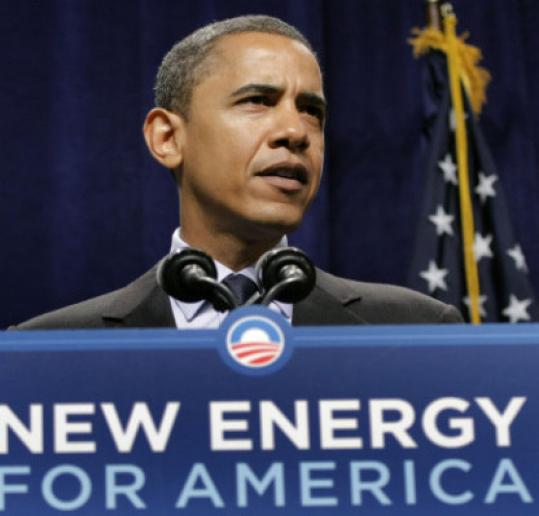 Building a New Energy Economy
Cross-posted from the Breakthrough Blog
Energy policy has never featured more prominently in a presidential election. Both candidates leaned strongly on their energy agendas during the campaign, frequently highlighting their plans to increase America's energy security, reduce energy prices and create jobs.
But while both candidates agreed that energy was a high priority and rhetorically supported an "all of the above" approach to new energy sources, the two candidates proposals actually differed sharply.
Furthermore, Barack Obama enjoyed the most success when his energy proposals were linked to his plans for economic recovery and couched in the rhetoric of job creation. That makes Obama's historic victory a clear endorsement of the President-elect's plans to invest in a new energy economy and argues for further integration of his energy plans into his economic recovery agenda.
While he claimed to support an "all of the above" energy plan, John McCain's energy platform revolved around increasing domestic production of oil and nuclear power.
McCain repeatedly touted nuclear power as his favorite (if not only) answer to our nation's energy challenge, and "Drill Baby, Drill!" practically became the all-encompassing mantra of the Republican party and it's presidential nominee.
McCain's repeated absence from key clean energy votes in the Senate and the selection of Sarah Palin as his running mate and supposed energy czar was the final proof that a McCain-Palin administration would focus centrally on expanding the old energy sources of the 19th and 20th century - oil and nuclear power - rather than the new energy sources of the future.
In contrast, while Barack Obama eventually embraced expanded drilling, he truthfully told the American people that "we can't drill our way out of our energy crisis." Similarly, he voiced conditional support for nuclear power, but made it clear that unresolved issues with nuclear waste and security needed to be addressed before nukes could play a central role in America's energy future.
Instead, Obama called for the creation of a comprehensive new energy economy, with a central focus on increasing vehicle fuel efficiency, electrifying transportation, expanding renewable energy production and retrofitting millions of homes and businesses to be more energy efficient. He considers this effort a new "national project" and promised to fund it to the tune of at least $150 billion over ten years.
Interestingly, Obama didn't really find his voice on energy policy until the economic crisis hit, unseating energy as the top campaign issue.
Back in September, when energy prices were the top election issue and Americans were shouting for quick fixes, Obama fumbled for an adequate response. In many ways, this was understandable, since there really are no quick fixes for high gas prices (that is, unless you consider the Bush energy plan - crashing the global economy! - to be a viable solution).
So while Obama had long-ago outlined a detailed and comprehensive energy plan that would spur the creation of clean and affordable new sources of energy in the long-term, he must have felt that telling the American people there was no short-term answer was a dangerous move. It certainly wasn't what Americans wanted to hear, but by remaining largely silent, Obama quickly found himself in the darkest days of the campaign.
Republicans had no qualms about proposing disingenuous solutions to spiking prices at the pump and quickly rallied around "Drill, Baby Drill!" It worked. McCain surged, taking the lead in the polls, and for the first half of September, it looked like Obama was headed towards defeat.
Then the economic crisis hit in all it's fury, and everything changed. The threat of global recession caused oil prices to fall almost as quickly as the Dow, and fears of another Great Depression displaced nearly every other concern.
That's when Obama realized that he was holding an ace up his sleeve: his energy plan.
In the closing weeks of the campaign, Obama hit his stride and brought his energy plan front and center. He touted opportunities to strengthen the American auto industry, bring manufacturing jobs back to American towns and save energy and money while creating new jobs in the energy efficiency sector. And in speech after speech, whenever he mentioned economic recovery and job creation, he talked about investments in clean energy and energy efficiency.
As he outlined his economic recovery plan on October 13th, Obama reiterated his pledge to "create 5 million new, high-wage jobs by investing in ... renewable sources of energy." He included funding for "energy efficient school and infrastructure repairs" in his Jobs and Growth Fund proposal and called on Congress to fast track "$50 billion in loan guarantees to help the auto industry retool, develop new battery technologies and produce the next generation of fuel efficient cars here in America."
In an October 22nd interview with Time magazine's Joe Klien, Obama clearly stated, "[Building a new energy economy] is going to be my No. 1 priority when I get into office," saying, "there is no better potential driver that pervades all aspects of our economy than a new energy economy."
A week later, Obama aired his thirty-minute October 29th TV special, "American Voices, American Stories." In it, he highlighted Seattle-based energy efficiency specialists, McKinstry Company as "a model for the nation," and again pledged to "invest $15 billion a year in energy efficiency and renewable sources of energy, like wind, solar, and biofuels, creating five million clean energy jobs over the next decade -- jobs that pay well and can never be outsourced."
In versions of his "closing argument" speech delivered across swing states in the final week of the election, Obama called for the creation of "an economy that rewards work and creates prosperity from the bottom up," exhorting America to "invest in... renewable energy for our future."
Finally, in his victory speech last night, he reiterated this theme, saying, "There is new energy to harness and new jobs to be created!"
History will record energy and the economy as the top issues of the 2008 presidential campaign. In the face of the mounting financial crisis, Barack Obama's calm assurance was the leadership the electorate was looking for. And as he successfuly united his clean energy and economic recovery proposals, Obama provided the vision of renewed prosperity Americans were hungry for.
Obama's landslide victory carries with it a clear mandate to build the new energy economy he so frequently spoke of. But he should be clear-eyed that this mandate derives from the economic crisis and continue to pursue his energy agenda hand-in-hand with his economic recovery plans.
With so many pressing concerns facing our nation, there will be little time for Obama to tackle issues one at a time. Instead, our nation's 44th President must find innovative and synergistic solutions that can address several priorities at once. We will see his abilities quickly tested. Even before Inauguration Day, Obama will be counted on to offer an economic stimulus agenda, and he'll be expected to act upon his self-selected No. 1 priority, - building a new energy economy - immediately upon assuming office. In fact, the fate of the Obama presidency may very well hang on his performance on this critical first test.
In Part 2 of this series, we will focus on how President-elect Barack Obama can get the job done right and advance an integrated clean energy and economic recovery agenda in his first 100 Days in office.
Wednesday, November 05, 2008
Quote of the Day: Obama Says "We can't solve global warming because I f---ing changed light bulbs in my house"
 Here's the full excerpt from Newsweek's behind the scenes "Special Election Project" reporting (via HuffPost). Obama is referring to an April 26th 2007 primary debate question from moderator Brian Williams:
The debates unnerved both candidates. When he was preparing for them during the Democratic primaries, Obama was recorded saying, "I don't consider this to be a good format for me, which makes me more cautious. I often find myself trapped by the questions and thinking to myself, 'You know, this is a stupid question, but let me ... answer it.' So when Brian Williams is asking me about what's a personal thing that you've done [that's green], and I say, you know, 'Well, I planted a bunch of trees.' And he says, 'I'm talking about personal.' What I'm thinking in my head is, 'Well, the truth is, Brian, we can't solve global warming because I f---ing changed light bulbs in my house. It's because of something collective'."He's right of course. We can't solve global warming without changing our leaders and not just our lighbulbs. What he should have said in the debate is this:
"Well Brian, My personal action was to run for President of the United States of America, so that I can make building a new, clean energy economy my top priority and lead the international community to tackle global warming. And I'm asking every one of you out there to make sure that your personal actions include active participation in our democratic process."We'll have to wait for that line in an upcoming Rose Garden speech, I guess... Read more!
Obama Says He’ll Be Represented at Poland Climate Talks
Props to 350.org, Greenpeace’s Project Hot Seat and all the others that worked to get this commitment:
Jamie Henn, an organizer at 350.org had this to say:We’re still trying to confirm Obama’s commitment to attend these important meetings. But one thing is clear: the invitations are working.
You can make your voice heard and invite President-elect Obama to the climate party in Poland by heading here: http://www.350.org/invite
Over 43,000 people from around the world have invited the Prez-elect to Poland for the UN Climate Meetings. We need to keep that pressure building and celebrate this election by getting our country back on the right track.
Waxman Challenges Dingell for Leadership of Influental House Committee
 Cross-posted from the Breakthrough Institute
Representative Henry Waxman (D-CA) plans to challenge venerable Representative John Dingell (D-MI) for chairmanship of the influential House Energy and Commerce Committee, according to a report from Roll Call.
"The move marks a major showdown between two Democratic powerhouses, with implications for a host of major legislation next year from health care to global warming to renewable energy. Waxman currently chairs the Oversight and Government Reform panel."
The House Energy and Commerce Committee has jurisdiction over a wide range of critical issues, including energy policy, health care, interstate commerce issues and most likely global warming policy as well. The committee will no doubt be a critical player in the legislative implementation of President-elect Obama's policy agenda.
Waxman and Dingell have taken two dramatically different stances on global warming and energy during the 110th Congress and a change in chairmanship could reshape the Congressional political landscape on these issues.
Reflecting their differing constituencies, Dingell opposed California (and 15 other states') efforts to set tailpipe emissions standards for greenhouse gases while Waxman led hearings to press EPA Administrator Stephen Johnson on why the agency had blocked California's efforts.
The difference is just as clear when it comes to federal climate policy. In March 2007, Waxman introduced the Safe Climate Act, still the most aggressive proposal for global warming pollution caps in the Congress. In contrast, Dingell and his committee waited until the final hours of the 110th Congress to release a draft outline for economy-wide greenhouse gas regulations.
Roll Call reports that a number of other key House leadership races were also underway, less than 24 hours after the polls closed.
UPDATE:Senate Majority Leader Harry Reid (D-NV) is planning to discuss with Joe Lieberman (I-CT) later this week whether or not to strip the Democrat-turned-Independent-turned-McCain booster of his committee chairmanships. Lieberman currently chairs the Senate Homeland Security and Government Affairs Committee and the Environment and Public Works subcommittee with jurisdiction over global warming regulations.
A hat tip to Brad Johnson at the Wonk Room on this one Read more!
Obama Landslide Means Mandate for Historic Clean Energy Investments
 By Jesse Jenkins and Adam Zemel, cross-posted from the Breakthrough Institute
The election of Barack Obama, an African American liberal with a Muslim middle name, will be remembered for generations as a historic moment in American history. Made possible by the financial crisis and economic recession, President-elect Obama will enter the White House in January of next year with a mandate to take bold action to revive the global economy and put American on the path to economic greatness.
It's hard to believe today, but back in early September, it looked like Barack Obama would lose. Senator John McCain was pulling away in national tracking polls as the chant, "Drill, Baby, Drill!" echoed across the nation. Record high gas prices were the top issue of the campaign, and as Republicans' united around a clear, powerful (yet disingenuous) call for expanded oil drilling, Democrats, including Obama, fumbled for a response.
But with the collapse of Lehman Brothers and the subsequent financial meltdown, everything changed. As the economic crisis spread panic and Americans looked beyond the current inhabitants of the White House for reassurance and leadership, Barack Obama emerged as the clear choice for the presidency. His calm and assured response to the unfolding crisis strongly contrasted with the McCain campaign's frenetic attempts to capture the political moment, and Americans finally put aside concerns about whether or not Senator Obama was ready for the White House.
Over the next weeks, as Americans watched hundreds of billions of taxpayer dollars put on the line to bail out Wall Street banks that weren't lending , they prepared for the inevitable worsening of conditions on Main Street. And they listened intently as Barack Obama found his closing argument: in speech after speech and ad after ad in the final week of the election, Senator Obama told Americans it was time to create "an economy that rewards work, creates jobs, and fuels prosperity from the bottom up." In short, he made the case that the time has come to invest in the long-term prosperity of Main Street America.
At the same time, he clearly articulated that his top priority was to create a new energy economy. From Time:"[Obama] wants to launch an "Apollo project" to build a new
alternative-energy economy. His rationale for doing so includes some hard
truths about the current economic mess: "The engine of economic growth for
the past 20 years is not going to be there for the next 20. That was
consumer spending. Basically, we turbocharged this economy based on cheap
credit." .... A new economic turbocharger is going to have to be found, and "there is no better potential driver that pervades all aspects of our economy than a new energy economy..."
Obama sees great potential in an Apollo-type energy project. Invest in a new energy system that will provide economic growth, increase national and economic security by reducing the amount we spend annually on foreign oil and take steps to mitigate climate change. These types of strategic investments could be the hallmark of Obama's domestic policy.
The economic crisis means that Obama's policy priorities must be changed to fit the current situation When the exit polls have been totaled, we will see that the economy was the number one issue for voters this year, and that is where Obama has a clear mandate and latitude to approach challenges in bold new ways. And that means it's time for the myopic definition of stimulus that has ruled in the past be left by the wayside.
Obama should start from scratch, and look for smart, strategic investments that can solve our short-term woes while creating an economy that's built to last. Given the suite of challenges facing our nation, it's time for investments not giveaways. There is incredible potential for Obama to create a new framework for progressive economic policy.
This is not the time to replay Clinton-era fiscal conservatism. Shrinking the deficit and cutting off spending will only worsen the coming recession. Nor can we simply recycle the nearly century-old programs of the New Deal. We face new 21st Century challenges that require new thinking and new solutions, and it's time to let go of old dogmas and philosophies and start from scratch.
It's time to leave behind the dogged commitment to PAYGO. Taxing one sector of the economy and spending it elsewhere does not stimulate the economy, and unlike 1993, when Clinton committed to buying down the deficit, the economy is entering a period of stagnation. If progressives want to be the party that creates broad based prosperity, they must embrace deficit spending, not new taxes on the middle class, until America is out of recession.
This hands-on economic approach should also be applied to other policy areas. It is high time to leave behind the dogma that the only role for government is to cut rebate checks and set carbon prices.
Paradoxically, the economic crisis that Obama will inherit when he is sworn in on January 20th will carry many opportunities. Strategic investments and expansive problem solving in Obama's first one hundred days could establish a positive character and broad role for progressives in governance well into the twenty-first century.
Saturday, November 01, 2008
People Power Fuels Obama's Campaign for Change
 [Note: this post has nothing to do with energy - except to the degree that the presidential campaign has everything to do with energy...]
There are two kinds of power in the world: money, and people. (And what I've seen today shows that when people pool their money, the latter can trump the former.)
I just returned from a thirteen hour shift at Barack Obama's Campaign for Change field office in North Berkeley, California. Tomorrow, I'll return for the second of four full days of get out the vote operations.
Our (relatively small) call office made over 20,000 calls today to voters in battleground states like Florida, Colorado and Nevada. That alone is pretty remarkable. But what is totally unprecedented is this: the entire office is people powered, fueled by the energy, money and time of hundreds of volunteers.
There wasn't a single paid staffer from the Obama Campaign or any other organization in our office today. Every call made, every list printed, and every byte of call data was made, printed and entered by volunteers.
In fact, with the exception of the main room, a bit of paper, a couple of computers, and a dozen old cell phones - which were paid for with campaign funds - the rest of the operation's costs, materials and equipment was provided by volunteers.
Hundreds of callers chatted away on their own cell phones and our data team typed away on their own laptops. When our volunteer numbers exceeded our wildest expectations - tripling our previous daily maximum! - we spilled over into a neighboring art studio, general contractor's office upstairs, the (rainy) backyard, and even commandeered a cafe across the street. All of that space was kindly donated by our neighbors. And of course, so much of the campaign funds that covered the rest came in the from of small individual donations from folks like those in our call center.
This is people power. It's Democracy in action. And it's why Barack Obama is going to win.
If you can't tell, I was floored by my experience today. Whether it was the half a dozen volunteers lined up this morning at 7:00 am to make calls, or the volunteers who happily made calls in the rain outside when things got crowded, and the volunteer GOTV managers, Meredyth and Molly, who kept things running smoothly all day, the energy of today was simply stunning.
And our one call center was just one of over five hundred across the country. That's not including the hundreds of ground-team offices in battleground states going door to door until the 4th, rounding up voters and getting them to the polls. I heard today from friends in North Carolina, Alaska, Colorado and Virginia who were pitching in at their local offices. Call centers in California alone made at least 1.5 million calls today to voters. And we'll all keep doing it for three more days.
I can't help but think that this incredible outpouring of grassroots, volunteer support has the potential to change the face of American politics. With friends like these - like the hundreds of thousands of volunteers devoting their time and money to helping the Campaign for Change - perhaps Obama won't need the kinds of friends George W. Bush has - Exxon, Enron and evangelical fundamentalists. And I can't see how a President Obama could run a White House as secretive and unresponsive to democratic pressure as the Bush White House.
When I talk about my excitement about Barack Obama, some chastise me as putting too much hope in one man. But it's not Barack Obama that gives me hope. It's the hundreds of thousands of dedicated volunteers and millions upon millions of voters who will elect him. It's what that kind of grassroots power means and how it will reshape the political landscape in this nation that gives me hope.
I'm not counting on Barack Obama to deliver the kind of change this nation needs all on his own. Putting our faith in one man is foolish, however inspirational that man may be. But the fire I see in the eyes of the volunteers in our call center, and the hope in their hearts is enough to give me faith. It's enough for me to believe that perhaps, at last, we may see the end of the cynicism that has pervaded American politics, depressing voter turnout and grassroots political participation - playing right into the hands of special interests.
It's enough for me to hope that we're seeing the restoration of Democracy in America. After all, what is Democracy but People Power. And that's exactly what I saw today.
It's not too late for you to go on down to your neighborhood campaign office. No matter which candidate you support - and I honestly mean that, whichever candidate - volunteering to help elect the candidate you support helps tip the balance of Democracy back to the side of We the People. There are three days left until what will no doubt be an historic election. Three days. No regrets.