Energy Collective blog power policy climate - the conversation happens here

Wednesday, January 21, 2009

Obama Puts Breaks on Bush's Midnight "Loot and Run" Environmental Tactics

[Correction appended, 1/22/09]

In one of his first actions upon taking office, President Barack Obama signed an executive order to put the breaks on all pending "midnight" regulations pushed by former President Bush in his waning days in office (God it feels good to write that!). That includes the slough of "loot and run" environmental regulations advanced by Mr. Bush, including efforts to relax air emissions standards for coal plants, make it easier for coal companies to expand the dastardly practice of mountain top removal mining, and more.

According to the Associate Press, "The order went out shortly after Obama was inaugurated president, in a memorandum signed by new White House chief of staff Rahm Emanuel."

All's fair in love and politics apparently: according to AP, Bush did the same thing when entering office in 2001, putting a halt to dozens of regulations and executive orders advanced by outgoing President Clinton, "who in his final 20 days in office issued 12 executive orders," AP reports, "including directives on migratory birds and the importation of diamonds from Sierra Leone."

Unfortunately, it was too late for some regulations, which Mr. Bush and his administration cronies were able to finalize before Obama's inauguration day, including rules regarding the Endangered Species Act.

AP reports:

In some cases, however, the Bush administration moved too fast for the incoming administration.

For example, just six weeks ago, the Bush administration issued revised endangered species regulations to reduce the input of federal scientists and to block the law from being used to fight global warming.

The Bush administration worked diligently to get the change in place before Obama took over, corralling 15 experts in Washington in October to sort through 250,000 written comments from the public on the revisions in 32 hours.

Obama has said he would work to reverse the changes. But because the rule takes effect before he is sworn in, he would have to restart the lengthy rulemaking process.

The changes would eliminate some of the mandatory, independent reviews that government scientists have performed for 35 years on dams, power plants, timber sales and other projects, a requirement that developers and other federal agencies have blamed for delays and cost increases.

The rules also prohibit federal agencies from evaluating the effect on endangered species and the places they live from a project's contribution to increased global warming.

There's some options available to President Obama however, as well as the Democratic Congress. According to AP, "For rules that have already gone into effect, the Democratic-controlled Congress might be able to help the Obama administration by using the Congressional Review Act, a legislative tool to bring new federal regulations under scrutiny."

There's plenty of work to be done to start digging out from the hole Mr. Bush seemed intent on placing America in. It's encouraging to see President Obama getting to work immediately to stop the damage and roll back Mr. Bush's efforts to gut dozens of environmental protections. Hail to the new Commander in Chief!

Correction (1/22/09): Several additional reports indicate that some of the worst environmental regulations propogated by the Bush Administration were too far along for a simple executive order from President Obama to stop. The LA Times reports today:

The list of Bush-era environmental rules that survived includes a major tweak to the Endangered Species Act, a first step in opening Western lands to oil shale development, leases for oil and gas drilling near some national parks, and the start of a process to allow new oil rigs off the Atlantic, Gulf, Alaska and California coasts.

Obama still holds several options for changing or reversing those decisions. All carry at least some degree of difficulty -- an apparent victory for an outgoing administration that explicitly tried to finish its rule-making early enough to tie Obama's hands.

The UK Guardian confirms that new rules easing restrictions on Mountain Top Removal are among those already finalized:

However, the majority of the so-called "midnight regulations" - such as diluting the powers of the endangered species act and relaxing the rules for mountain-top coal mining - have already come into effect and cannot easily be undone.

Noah Greenwald of the Centre for Biological Diversity welcomed the move but warned: "The majority of regulations threatening our environment, health and economy, however, will need to be undone by Congress, the courts or new rule-making."

Let's hope this is just a first step from President Obama then, and that he is committed to fully undoing the damage wrought by former President Bush. And don't forget that Power Shift 2009's lobby day is an excellent opportunity to take that message straight to your elected officials. Don't miss it!

Read more!

Tuesday, January 20, 2009

President Obama: We will harness new energy

Cross-posted on ItsGettingHotInHere

Today Barack Obama took the oath of office and became the 44th President of the United States of America. He identified grave challenges our nation faces and called on all of us to unite in facing them.

George Bush is moving back to Texas, Henry Waxman (D-CA) is the chair of the House Energy and Commerce committee and our movement is stronger than ever. What are we going to do with it? Now is the critical time to make big plans, build the movement and make all the changes that have been out of reach for eight years a reality.

President Obama explicitly referenced harnessing "the sun and the winds and the soil to fuel our cars and run our factories," but the message I heard is that we must harness a new American energy - the energy of an awakened citizenry sensing the urgency of this moment - to power a global transition to a more just and prosperous clean energy future.

We are that energy. Here are three things you can do today to harness it:

  1. Register now for Power Shift 2009 Feb. 27 - Mar. 2 in Washington, DC, get ten friends to come with you and visit your representatives in Congress where they work.
  1. Call your representatives in Congress today and tell them the stimulus package must include green jobs. Congressional Switchboard: (202) 225-3121. You can also send an email through MoveOn, 1Sky or Green For All.
  1. Start organizing a town hall on energy as a part of Focus the Nation 2009, a nationwide event to focus on our energy future on April 18th. Get your campus, your community and your representatives in Congress together and turn our national conversation on energy into action. Contact your regional organizer to find out more.

Read more!

Tuesday, January 13, 2009

On Obama's Stimulus: Don't Look Back, Forge Ahead to a New Century of Prosperity

By Adam Solomon Zemel. Cross-posted from the Breakthrough Institute

Last week, Obama announced his stimulus package, a plan to spend nearly 800 billion dollars on infrastructure projects, modernizing schools and health records, expanding clean energy production, providing much-needed relief for state budgets, and extending tax cuts to 95% of working Americans.

By most standards, this is a big stimulus plan that could do a lot to bolster confidence, increase consumer spending and unfreeze credit. And yet, as Paul Krugman put it last week,

"To close a gap of more than $2 trillion -- possibly a lot more, if the budget office projections turn out to be too optimistic -- Mr. Obama offers a $775 billion plan. And that's not enough.

... The bottom line is that the Obama plan is unlikely to close more than half of the looming output gap, and could easily end up doing less than a third of the job."

Krugman has taken great pains with his columns recently to explain why a stimulus package on the order of a trillion dollars or more is called for, and why the numbers Obama is talking about now are not close to sufficient. But where Krugman sees economic under reach, his fellow Friday Times columnist David Brooks sees political over reach:

"The conventional advice for presidents is: focus your energies on a few big things. Obama just blew the doors off that one.

Maybe Obama can pull this off, but I have my worries. By this time next year, he'll either be a great president or a broken one."

On the surface, it would seem that Brooks is correct--normally, a honeymoon period is not adequate cover for something so politically audacious. But on this issue, Brooks is stuck in the past. Much of the Democratic caucus representing moderate districts needs to see economic recovery as soon as possible, and liberal Democrats want to see Obama spending on good progressive causes. If anything, there has been a degree of political backlash from Democrats in congress that Obama is not doing enough.

So why is Obama planning a stimulus bill that falls short of what the economy needs?

The answer to this question seems to be the conventional wisdom that these projects must be "shovel ready"--in other words, spend as much money as possible and create as many jobs as possible as soon as possible. Anything that isn't shovel ready might not yield its peak economic benefits until more than two years from now, reducing the timely impact of the stimulus.

But economists are suggesting that this downturn will last much longer than two years--the Congressional Budget Office recently reported that we are in the midst of the worst recession since World War II. Perhaps it is time to discard the language of "jump-starts" that is impeding the path to true economic revitalization. Maybe now is not the time to limit ourselves to simple shovel-ready stimulus. Maybe it's time to start making big, long-term public investments in the areas that are essential for a prosperous, healthy, and equitable 21st Century in America. Invest in crucial necessities like clean energy, health care and education reform, and infrastructure and modernization projects like a smart grid and broadband. And let's not be limited to the immediately obvious but also invest in essential areas like spurring innovation and expanding educational services.

The goal of a "stimulus" is to put the economy back on the path it was on before the downturn started. But this should not be the goal of Obama's economic plan--to return us to the time when college grads went to Wall Street to make a quick buck by trading back and forth on dubious mortgages. It's time to stop looking backwards to 2007 and instead look forward, towards the new century still unfolding before us.

It is not easy to see what the future holds, but there are ways to prepare this country for it nonetheless. Krugman noted this week that one dollar of public investment can yield one and a half dollars of GDP. And that means that next week, when Barack Obama takes office, he can work to pass an economic revitalization plan that doesn't just create 21st Century schools and laboratories and grids and health information systems, but also lifts our economy out of recession and puts us on track to build a new American and global century of prosperity, health and democracy.

Read more!

VIDEO: Swan Pond Road - the Kingston Coal Disaster

The following video, produced by environmental activist Summer Rayne Oakes, takes a close look at the people and homes affected by the Kingston coal disaster...


Swan Pond Road: The Kingston Coal Disaster from SRmanitou on Vimeo.

Related posts:


Read more!

Thursday, January 08, 2009

Obama's Stimulus Plan: A Foundation for Growth?

By Adam Solomon Zemel. Cross-posted from the Breakthrough Institute

In Northern Virginia today, President-elect Barack Obama addressed the nation, introducing a few basic goals and guidelines for an economic stimulus package that could cost as much as a trillion dollars.

Well aware that the large price tag on the stimulus, referred to as the "American Recovery and Reinvestment Plan," Obama included language about setting a foundation for economic growth now in order to return to a place of fiscal responsibility as the economy gets back on his feet. However, Obama was not shy about the need for the government to step in and spend, now:

"It is true that we cannot depend on government alone to create jobs or long-term growth, but at this particular moment, only government can provide the short-term boost necessary to lift us from a recession this deep and severe. Only government can break the vicious cycles that are crippling our economy - where a lack of spending leads to lost jobs which leads to even less spending; where an inability to lend and borrow stops growth and leads to even less credit."

Obama's plans consist of programs for immediate relief and long term economic revitalization in six key areas:

"To finally spark the creation of a clean energy economy, we will double the production of alternative energy in the next three years."
  • Energy. Obama spoke about expanding America's production of alternative energy over the coming years, doubling its capacity by 2012. He also spoke about putting Americans to work retrofitting and weatherizing at least 75% of government buildings and 2 million homes to be more efficient. He also spoke about creating a dynamic and innovative alternative energy sector in America, saying, "we will put Americans to work in new jobs that pay well and can't be outsourced... and developing the new energy technologies that will lead to even more jobs, more savings, and a cleaner, safer planet in the bargain."
"To build an economy that can lead this future, we will begin to rebuild America."
  • Infrastructure. Referring to his infrastructure plans as "not just another public works program," Obama did say that part of the infrastructure spending would go to rebuilding roads and bridges and executing worthy and well-planned public works projects. However, Obama's framed these infrastructure investments as primarily about retrofitting America to compete in a 21st century global economy. This included the construction of a unified national smart grid that "will save us money, protect our power sources from blackout or attack, and deliver clean, alternative forms of energy to every corner of our nation." In addition, the President-elect mentioned the need to expand broadband across America, to rural areas and small towns.
"And it means investing in the science, research, and technology that will lead to new medical breakthroughs, new discoveries, and entire new industries."
  • Innovation. Obama also spoke of the need to build a new innovation infrastructure, saying he would invest in R&D to promote economic growth and breakthroughs that will create broad-based prosperity. Hopefully, Obama will pursue a robust innovation policy seriously, as technology and science innovations, along with increasing productivity, can create entire new industries and sectors of the economy.
"To improve the quality of our health care while lowering its cost, we will make the immediate investments necessary to ensure that within five years, all of America's medical records are computerized."
  • Healthcare. Obama confined his healthcare ideas to digitizing medical records. Not only will it reduce wasteful spending, he argued, but it will cut back on treatment errors, saving lives and creating a healthier America.
"To give our children the chance to live out their dreams in a world that's never been more competitive, we will equip tens of thousands of schools."
  • Education. Modernizing schools with new technologies and computers, along with new training for teachers, will play a role in the stimulus, ensuring the long term competitiveness of America's up and coming generations. Obama spoke about bringing 21st Century classrooms, labs and libraries to America's public schools, community colleges and public universities, "so that students in Chicago and Boston can compete with kids in Beijing for the high-tech, high-wage jobs of the future."
"Finally, this recovery and reinvestment plan will provide immediate relief to states, workers, and families who are bearing the brunt of this recession."
  • States and Citizens. The proposed stimulus plan would include a $1,000 tax cut for 95% of working families, the first stage of tax cuts that Obama pledged to make during his campaign. Obama also spoke about extending unemployment insurance and health care coverage to those who have already lost jobs and are having trouble reentering the workforce. And, while he said that governments would have to "tighten their belts," the federal government would also step in to avoid harmful budget cuts to states so that they can keep their public sector workers employed.

While Obama outlined a solid framework for stimulus and recovery, as usual, the devil is in the details, and the President-elect's speech was lacking in that capacity. For example, what does he have in mind when he talks about "alternative energy?" Is he only referring to the electricity sector, or does he have transportation and heating fuels in mind as well? Will doubling America's capacity for "alternative energy" include increasing the production of coal-fired power plants using carbon capture and storage technology? Does the baseline we're doubling from include hydropower? If hydropower is included, Obama is pledging to take "alternative energy" to around 20% of US electricity supply; if it's not we'll be taking it to just 7% of US electricity supply, so nuances like this can clearly make a big difference in the way we parse Obama's speech today.

Obama also provided very little specificity as to the policy tools he plans to use to accomplish these priorities. Will he beef up the clean energy production tax credit, or will the government invest directly in the production of energy with financing, procurement and fully refundable credits?

The lack of specificity in today's speech likely indicates that Obama still has a lot of details to work out with Congress, and it'll be important to watch as these details are unveiled in the weeks ahead.

But for what it was--a political speech laying the groundwork for Obama's vision of governance, it was a reassuring sign that the President-elect has the right objectives for stimulus spending. Obama identified six areas of domestic policy in which he would prioritize expending his political capital, each framed centrally around an effort to use stimulus spending to lay the groundwork for sustained economic growth. Investments in clean energy technology, innovation and R&D, critical public infrastructure like a unified national smart grid and broadband networks, digitizing medical records, building modern schools and research facilities, and helping out state budgets are all smart investments that create both short-term economic stimulus and lay the groundwork for long-term productivity and economic competitiveness.

He also included language about bipartisanship, and worked to appease perhaps his biggest barrier to a sizable stimulus plan, Congress's Blue Dogs. This faction of moderate Democrats from centrist districts who preach fiscal responsibility and adherence to pay-as-you-go fiscal standards seem receptive to Obama, and have already started rallying behind the stimulus.

Perhaps most importantly, Obama identified a vision for a brighter American future - a nation prosperous again, more competitive in a global 21st century economy, and powered by a cleaner, more efficient energy system - and then sketched out a plan that will put us on the road to that future. And, with Speaker Pelosi already saying that Congress will not be taking a recess until an economic stimulus bill has been passed into law, it seems that we might be starting down that road sooner rather than later.


Read more!

Tuesday, January 06, 2009

What's the Danger with Green Stimulus and Green Jobs?

Barack Obama's final appointments in December indicate a strong commitment to action on climate change. Steven Chu as Energy Secretary, Carol Browner as Energy & Climate Czar, John Holdren as Assistant for Science and Technology -- just to name a few recent selections -- are all proponents of vigorous action to cut U.S. global warming pollution and take leadership on a new international climate treaty. And Hilda Solis, Obama's new Labor Secretary, is a champion of "green jobs."

All is well on the climate front, it seems. Except that it's not.

Despite Obama's energy and environment cabinet appointments, cap and trade legislation still faces a very uphill battle, and in today's economic situation, climate advocates are still left to worry: is Obama really prepared to expend his political capital championing a policy that will increase U.S. energy prices in the midst of a recession?

It doesn't seem likely. And simply replacing sustained climate legislation with a short-term "green stimulus" program to create green jobs and perform energy efficiency retrofits is a dangerous possibility. Find out why by reading my recent column, written with my colleague Teryn Norris, at Huffington Post.

Full story is at Huffington Post here.

Read more!

Friday, January 02, 2009

Scenes From an Environmental Disaster: Photos of the Tennessee Coal Sludge Spill

Photojournalist Antrim Caskey documented the devastating scenes on the ground at the massive coal sludge spill that occurred on December 22nd near the town of Harriman, TN. The spill, which is one of the worst environmental disasters in U.S. history affected over 300 acres of land and water, contaminating fish and drinking water and destroying homes and ecosystems in this verdant corner of eastern Tennessee.


Antrim's images say it all, and below the fold you'll find a photographic journey through the scene of this environmental disaster...

(Mouse over the top of the slide show to see captions, describing each image)


You can find more of Antrim's photos, including images documenting the damages of mountaintop removal coal mining in Appalachia, at www.antrim-new.com.

Related posts:


Read more!

Tests Show Toxic Water Contamination After Tennessee Coal Sludge Disaster

Coal sludge contains dangerously elevated concentrations of arsenic, EPA says

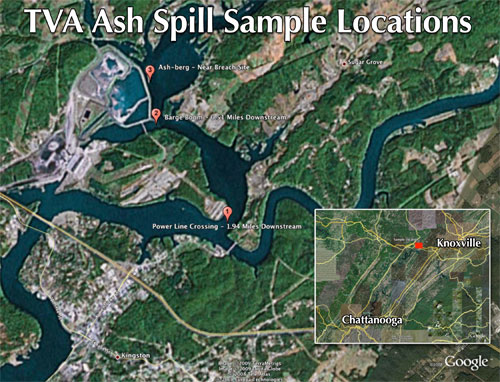
It's been nearly two weeks since a torrent of over a billion gallons of coal ash sludge spilled out of an impoundment pond near a massive coal plant in Harriman, TN, but the full horror of the disaster is still being revealed. Yesterday, preliminary results of independent water testing showed dangerously high levels of toxic heavy metals at three locations near the environmental disaster, which spans over 300 acres of land and water at the confluence of the Emory and Clinch Rivers in eastern Tennessee. And today, the EPA confirmed that elevated levels of arsenic can be found in the coal sludge now caked over the area.

[Aerial photograph of the coal slurry disaster, taken Dec 29th, 2008. The breached impoundment pond is at center with the TVA's Kingston coal plant above and massive slurry spill below. The Emory River can be seen next to the disaster site. Photo is copyright Antrim Caskey]

The Tennessee Valley Authority (TVA), which operates the Kingston coal plant previously said the spill shouldn’t cause “any adverse health effects” unless people “regularly drink untreated river water” downstream from the plant. EPA has also said preliminary testing results show the drinking water in the area is safe.

Now however, independent testing conducted on water samples from the Emory River by scientists working in coordination with Appalachian Voices and the Waterkeeper Alliance has found concentrations of eight toxic chemicals ranging from two to 300 times higher than safe drinking water limits. Tests were conducted using standard EPA procedures and results were analyzed by scientists at Appalachian State University.

“Although these results are preliminary, we want to release them because of the public health concern and because we believe the TVA and EPA aren’t being candid,” said Robert F. Kennedy, Jr., chair of the Waterkeeper Alliance.

While EPA still contends that drinking well and treated river water in the area does not pose a risk, they have confirmed that the sludge, which TVA had initially told residents was harmless, actually contains dangerously high levels of arsenic that would normally warrant a response under agency protocols. Arsenic is a natural element found in soil and minerals, but exposure to it can cause sickness, according to the National Institutes of Health.

Residents of the area are worried that when the coal ash dries, it will be blown around in the wind, easily filling their lungs with the arsenic-laden ash particles. "We have a 2-year-old daughter whose health is not worth the risk, even if it is a minuscule risk," said Suzanne Solomon, who rents a home about 2½ miles downwind. "I am an opera singer with mild asthma [and] I do not wish to expose [my lungs] to any dust which might become airborne. ... I do not see any way that they can keep all of this out of the air."

The coal sludge spill occurred on December 22nd, and covered over 300 acres of the eastern Tennessee county with several feet of inky black muck, destroyed three homes and damaged 42 other properties, and contaminating the nearby Emory River, a tributary of the Tennessee River which supplies drinking water for thousands. The disaster occurred 35 miles southwest of Knoxville, Tennessee.

[Aerial photo of spill used with permission from Antrim Caskey. See www.antrim-new.com/]

Read more!