Energy Collective blog power policy climate - the conversation happens here

Thursday, July 16, 2009

34 Nobel Prize Winners Write President Obama Urging Support for Clean Energy R&D

By Tyler Burton. Originally posted at the Breakthrough Institute

In a letter submitted to President Obama today, a group of 34 prominent Nobel Prize recipients decried the lack of clear support in "The American Clean Energy and Security Act" (ACES) for the President's own promise to establish a Clean Energy Technology Fund of $150 billion over the course of ten years. The Nobelists, including many of the world's most prominent physical scientists, are calling on Congress and the President to ensure the climate and energy bill currently being debated by the Senate includes adequate and sustained support for clean energy innovation.

This letter represents the best and the brightest of the American science community, and echoes a call long issued by the Breakthrough Institute for large investment in clean energy (see "Letter to Obama & Congress: $30 billion Annually Needed for Energy Technology" and "Top Energy Scientists Call for $30 Bi Annual Investment in Clean Energy").

In an effort to "invest in the clean energy jobs of the future", President Obama's website continues to call on Congress to "Invest $150 billion over ten years in energy research and development to transition to a clean energy economy." As President Obama has repeatedly stated, "The nation that leads the world in creating a new clean energy economy will be the nation that leads the 21st century global economy."

Yet the American Clean Energy and Security Act recently passed by the House of Representatives stripped President Obama's inital plan for $15 billion annually in clean energy R&D funding to roughly one-fifteenth of that. Instead of investing in a proactive clean energy technology and competitiveness agenda, the ACES bill gives away many of the pollution permits for free to entrenched interests (with powerful lobbyists) including electricity and natural gas utilities (supposedly on behalf of customers), coal plants, oil refiners, and heavy industry.

Leaving out a proactive clean energy investment fund "is a dangerous omission," said Burton Richter, the leader of the group of laureates who signed the letter and winner of the Nobel Prize in Physics. "Much can be done with the current generation of technologies. However, study after study has confirmed that to combine growing prosperity worldwide with sharply reduced production of greenhouse gases will require technological advances that are possible only through research."

Furthermore, if the United States is going to become a leader in the clean energy race, the scientists maintain, the clean energy R&D investments in the ACES bill are far too small.

The letter comes at a time of mounting concern about Asia's aggressive investments in clean energy technology. In a story published in today's Washington Post, "Asian Nations Could Outpace U.S. in Developing Clean Energy", Breakthough's director of energy and climate policy, Jesse Jenkins, is quoted as saying: "If the Waxman-Markey climate bill is the United States' entry into the clean energy race, we'll be left in the dust by Asia's clean-tech tigers."


July 16, 2009

The Honorable Barack H. Obama
President of the United States
1600 Pennsylvania Avenue, NW
Washington, DC 20500

Dear Mr. President:

You have repeatedly and appropriately called for a Clean Energy Technology Fund of $150 billion over ten years that could be funded from receipts collected from a greenhouse gas cap and trade program. The stable support this Fund would provide is essential to pay for the research and development needed if the U.S., as well as the developing world, are to achieve their goals in reducing greenhouse gases at an affordable cost.

This stable R&D spending is not a luxury. It is in fact necessary because rapid scientific and technical progress is crucial to achieving these goals, and to making the cost affordable.

We are concerned that "The American Clean Energy and Security Act" (H.R. 2454) that recently passed the House provides less than one fifteenth of the amount you proposed for federal energy research, development, and demonstration programs. The legislation provides no stable, specific funding for sustained research in the Department of Energy's (DOE) Office of Science, or for the energy research and associated technology development programs of DOE (at the Energy Efficiency and Renewable Energy, Electricity Deliverability, Fossil, and Nuclear offices).

Given the expected growing federal budget deficits, and the corresponding pressure on the government's discretionary budget, this is a serious deficiency.

We hope that you will urge the Congress to send you a bill that will invest in energy research, development, and demonstration at an amount approaching the stable $15 billion annual support that you have proposed.

We stand ready to assist you in any way we can.

Signed,

Paul Berg, Physics 1980
Stanley Cohen, Physiology or Medicine 1986
Robert F. Curl, Jr., Chemistry 1996
Johann Deisenhofer, Chemistry 1988
Val L. Fitch, Physics 1980
Jerome Friedman, Physics 1990
Sheldon Glashow, Physics 1979
Roy Glauber, Physics 2005
Dudley R. Herschbach, Chemistry 1986
Wolfgang Ketterle, Physics 2001
Roger D. Kornberg, Chemistry 2006
Herbert Kroemer, Physics 2000
Robert B. Laughlin, Physics 1998
Leon Lederman, Physics 1988
Anthony Leggett, Physics 2003
John Mather, Physics 2006
Marshall Nirenberg, Medicine 1968
George A. Olah, Chemistry 1994
Douglas Osheroff, Physics 1996
Arno Penzias, Physics 1978
Martin L. Perl, Physics 1995
William D. Phillips, Physics 1997
David Politzer, Physics 2004
Robert C. Richardson, Physics 1996
Burton Richter, Physics 1976
F. Sherwood Rowland, Chemistry 1995
Phillip A. Sharp, Physiology or Medicine 1993
George Smoot, Physics 2006
Horst Stormer, Physics 1998
Richard Taylor, Physics 1990
Daniel Tsui, Physics 1998
Steven Weinberg, Physics 1979
Frank Wilczek, Physics 2004
Robert W. Wilson, Physics 1978

Link to the original press release.

Read more!

Wednesday, July 15, 2009

Will Gillibrand Score a Home Run for Climate?

Cross posted from actionfactorydc.blogspot.com, author Julie Erickson.

Senator Gillibrand is a potential champion for the climate bill, with strong support for the process and international provisions. We're happy to support champions like Gillibrand and put a face on the youth who are calling for strong global warming solutions.
In their second public appearance on Tuesday, the Strongmen and women showed up in full force this evening at Guy Mason Field for the first ever Congressional Women’s Softball match. Why? To cheer on Senator Kirsten Gillibrand (D-NY) of course!

With climate-themed ball game cheers, the Strongpeople attracted much attention and joined Gillibrand’s staff in pumping her up throughout the game. She seemed to recognize the Strongpeople, having seen them in the morning at an Environment and Public Works hearing.

After the game, Gillibrand was excited to shake all of the Strongpeoples’ strong, muscular hands as they congratulated her on her excellent pitching and batting skills. The Strongpeople told her how much they are counting on her to “hit the climate bill out of the park too” and be a climate champion. They gave her a commemorative bat with information about ways to strengthen climate legislation and lead the US toward a global treaty in Copenhagen. The Senator thanked the Strongpeople for their advocacy and accepted the gifts graciously.
Senator Gillibrand is in a unique position to be a climate champion in the senate. She sits on the three committees that will probably play the largest role in piecing together a bill: Environment and Public Works, Agriculture, and Foreign Relations. To date, her statements on climate change are encouraging, including a recent indication that she “will use every bit of persuasive power” to restore the EPA’s authority to regulate pollution from old coal-fired power plants in the Senate version of the bill. This important EPA oversight is not included in the House-passed Waxman-Markey bill. Given that she sits on Foreign Relations as well as EPW, Gillibrand is also poised to help strengthen international finance provisions for adaptation and clean tech transfer. These oft-forgotten components of a US climate bill will mean a lot at international negotiations, and it whether or not Gillibrand will lead in these areas as well remains to be seen.

Tonight, Senator Gillibarnd played hard and even scored a run. The Strongpeople hope to see her do the same if not better in the Senate as the climate bill moves forward.

To learn more about the Avaaz Action Factories, see our website: www.actionfactories.org, our blog actionfactoridc.blogspot.com or twitter @actionfactorydc

Read more!

Tuesday, July 14, 2009

A Snowy Mountain Scheme for the 21st Century

The time has come for an aspirational new nation-building project to spur a prosperous, clean energy economy in Australia

By Leigh Ewbank. Originally published by On Line Opinion - Australia's e-Journal of social and political debate.

Last week marked the 60th anniversary of the momentous Snowy Mountains Hydro-electric Power Act - the first step in a 25-year journey to modernise our nation. Unrivaled in its ambition, the Snowy Mountains Scheme would meet the dual objectives of providing reliable electricity for our cities and towns, and water supplies to sustain food production along the Murray River.

Australia's largest-ever engineering project would spur social and economic development and benefit the cities and rural communities of Australia's southeast for generations. Without fanfare or media attention, Australia forgot to acknowledge a significant moment in our nation's history.

Today Australia faces new challenges: our climate is changing. And we must quickly transition to a clean energy economy to avoid the worst-case scenarios predicted by climate scientists. Alongside this comes the continued global economic change that is putting increased pressure on established industries. Our parliament must act to encourage the expansion of new industries and secure jobs for the future.

A new nation-building project on the scale of the Snowy Mountains Scheme is needed.

The backbone of a scheme for the 21st century will rewire the nation, laying the foundations for a clean energy revolution. Australia needs new transmission lines to connect population centres to our abundant renewable energy resources. Currently, our windy southern coast; our vast deserts; and our rich geothermal resources, are untapped. A renewable electricity grid can open up new regions to development, unleash private investment in renewable energy production, and allow for these new energy markets to flourish. It's needless to say that this comes with new jobs, prosperity, and the important benefit of mitigating climate change.

Importantly, such a scheme will overcome the deficiencies of the Rudd Government's so-called Carbon Pollution Reduction Scheme. Emissions trading will not build new electricity grids, particularly to remote places rich with renewable resources. High capital costs and the lack of short-term profitability of building this type of infrastructure is beyond the capacity of the private sector. Furthermore, building new grid infrastructure does not directly reduce emissions and will therefore not benefit from emissions offset markets. Our government must step in to provide the public investment and long-term vision required to carry out such a scheme.

While carbon reductions targets and "market-based" policies might captivate bureaucrats and policy wonks, they have failed to win the hearts and minds of Australian citizens. These policy tools say nothing about Australia's collective aspirations and abilities, and miss the opportunity to generate the public support necessary to build a clean energy economy. Because emissions trading are not directly linked to specific projects it is unable to capture the public's imagination the way that monumental, government-backed projects have in the past. The best examples of which include the Sydney Harbour Bridge and Snowy Mountains Scheme.

I'm not the first Australian to call for a massive nation-building project. In 2006, Professor Tim Flannery attempted to capture public imagination by evoking the spirit of the Snowy Scheme. He proposed the construction of a sustainable city in the heart of Australia called "Geothermia". The city would harness geothermal and solar energy to process mineral resources. New rail lines would connect key mines to the mineral-processing hub, and then to the port of Darwin for export. This was a big vision.

So why didn't Flannery's initiative gain traction? And would a similar proposal work now? Well, apart from Flannery's poor choice of name, I think there are two good reasons that explain the lack of interest, and the context has changed enough for a visionary project to succeed. First, the neo-liberal consensus was still strong in 2006. John Howard was the PM and the prevailing economic orthodoxy prohibited large-scale public investment. The financial crisis of 2008-9 has since undermined the neo-liberal consensus and governments around the world are now implementing massive public investment programs.

Second, climate change and environmental advocates did not support the plan. For too long climate change advocates have focused on technocratic and uninspiring policy proposals - a 20 per cent carbon reduction target by 2020 and the implementation of carbon trading. With several environmental groups now opposing the Rudd Government's CPRS and proposing a "Plan B", there is now a window of opportunity for these advocates to adopt a new campaign that focuses on building the enabling infrastructure of a clean energy economy.

I suspect environmental advocates are reluctant to employ a powerful myth because of the Snowy Scheme's environmental impacts. It's true that the scheme harmed the Snowy River, but this should not disqualify the use of Australia's myths and nation-building projects for responses to climate change. Environmental advocates must also overcome the false perception that "strong" reduction targets guarantee emissions reductions. On the contrary, because an effective response to climate change requires building the infrastructure for a clean energy economy, the Snowy Scheme is a better model than one that emphasises targets and trading.

Is Australia ready for a massive nation-building project to deal with the twin challenges of climate and global economic change? Yes it is. As the Parliament demonstrated 60 years ago, our political leaders must act in Australia's long-term interest to ensure that such a project becomes a reality.


Leigh Ewbank is a graduate of RMIT University's Bachelor of Social Science Environment degree with honours. He is a summer fellow at the Breakthrough Institute, an energy policy think-tank based in Oakland, California.

Read more!

Monday, July 13, 2009

High School Students Get Served...

...an amazing day of climate science and public speaking training, that is!

Check out some highlights from ACE’s (not ACES… the climate bill... which most folks who write here at Watthead can speak to!) student presenter training.

On June 16, 20 high school students descended upon the newly opened (and LEED-fabulous) David Brower Center in downtown Berkeley, CA, for a jam-packed day of training, networking, and general amazing-ness.

A big thank you to the SSC for joining us and providing our students with powerful training and skill building!


If you want in for our next training, August 11th 2009, email Ashlee Jensen as soon as possible. You won’t want to miss it! (that’s ashlee.jensen@climateeducation.org) Below the fold is a bit more about what our training covers.

You can also watch many more videos from ACE on Youtube here.

By attending the training, students will: establish trust and a sense of community among fellow student trainees, observe student climate presentations, learn climate science, learn and practice answers to common questions (take skeptic questions in stride), learn effective outreach skills, practice creating their own Personal Narrative, learn Powerpoint / Keynote, and receive a DVD of ACE’s student climate presentation to take into the world. They will also be able to contact ACE whenever, wherever, for ongoing help and support.

Our student presenters are going on to give presentations on their own, in their high schools and in their communities.

Read more about ACE: www.climateeducation.org

Read more!

Smart Microgrids: Discussing Efficient Energy Management Solutions with Valence Energy


Valence Energy is a fresh new technology company working to develop and deploy a package of energy management solutions for institutional campuses, universities or entire neighborhoods known as “smart microgrids.” A potential stepping-stone to a modern nationwide smart energy grid, smart microgrids combine a local energy system with a dose of IT ‘smarts’ to enable more efficient and dynamic management of both energy demand and on-site energy generation.

To explore the concept of smart microgrids and their potential, I caught up with Alexis Ringwald, Co-founder and Director of Business Development for Valence, for this interview. You can find the full interview only at the Energy Collective here.

Read more!

Join the Brita Climate Ride - Bike to Washington DC

This year’s 2nd annual Brita Climate Ride and “climate conference on wheels” will see 200 cyclists pedal 300 miles from New York City to the US Capitol in Washington DC to raise money and awareness to fight climate change. The ride takes place from September 26 to 30, 2009, and benefits critical projects at three climate and bike-related organizations: Rails-To-Trails Conservancy, Focus the Nation, and Clean Air – Cool Planet. The ride is an unforgettable experience and a unique opportunity to be part of the movement. The picture below shows Climate Riders biking into Washington DC during last September’s Brita Climate Ride.

Brita Climate Ride


Climate Riders are renewable energy experts, green organizers, environmental leaders, and everyday citizens coming together on a beautiful 5-day bike ride to tackle global warming, and learn about solutions to the climate crisis and how to transition to a new energy future. At the end of the event in Washington DC, climate riders will meet with their congressional representatives to summon a new natural resource: the collective political will to actually affect change in our nation’s capital.

This year, the ride will feature several notable expert climate speakers and leaders in the green movement, including:

Alison Gannett: world champion free skier, Patagonia Ambassador, founder of the Save our Snow Foundation, and star of Warren Miller ski films. Alison will be pedaling with the Climate Riders all the way to DC! In her free time, Alison converted the 1st Solar-powered SUV PHEV in the world to get 100+mpg. This amazing athlete also leads ski expeditions to Pakistan, Bolivia, Bhutan and India to document global warming.

Josh Dorfman, a.k.a. the Lazy Environmentalist, who has a new show on Sundance, will also return for his second year, to show that the Lazy E can ride 300 miles without training. (We don’t advise this for anyone but Josh!)

Friis Arne Petersen, Denmark’s Ambassador to the US, will be joining the ride on Night 4, right before the riders begin their journey to the US Capitol. Mr. Petersen will brief the group on the upcoming COP15 United Nations Climate Conference, which will be the next phase of the Kyoto Protocol being negotiated in Copenhagen Denmark this December. One Climate Rider will be chosen for an all-expenses paid trip to Denmark during the conference, courtesy of the Embassy of Denmark. (News Update–the Ambassador has decided to ride 3 days of Climate Ride!)

Check back with us at www.climateride.org to learn who else will be pedaling from NYC to DC.

Brita Climate Ride is the first multi-day, multi-city charitable bike ride that showcases the bicycle as a viable solution to climate change and the only such event that benefits climate and bicycle-related organizations. Riders pay a $100 registration fee, and then raise $2,400 to participate. The ride is fully-supported by a team of talented leader-hosts, bike mechanics, medics, and massage therapists. Climate Ride is also one of the ‘greenest’ multi-day charity ride events in the world. Riders are asked to bring no bottled water (recyclable water bottles will be used, and filtered water will be provided by the title sponsor Brita). There’s no disposable plateware or cups, the support vehicles are hybrids and vans that run on veggie grease, and every effort is made to recycle and compost materials used on the ride.

Registration is now open and riders can sign up or find out more information at the Brita Climate Ride website: www.climateride.org. Join us as we drive the ultimate carbon-free machine: the bicycle!


Read more!

Friday, July 10, 2009

Avaaz Action Factory helps Senators pump it up and make a STRONG climate bill

By Morgan Goodwin

With youth leading the workout routine, and the EPA spotting them with good oversight, the Senate can qualify for the Climate Olympics in Copenhagen.

Photo Credit: Christine Irvine
This week the bell sounded for round 2 of the US climate change legislative hurdling event with the opening hearing of Sen Boxer’s Environment and Public Works Committee. Over 100 youth organized by the Avaaz Climate Action Factory DC were there, in senators faces, showing them how to get a strong climate bill. Kanye West and Daft Punk provided the inspiration for the week with the theme: Harder, Better, Faster, Stronger.


Harder - oversight on coal plants.
Better - Renewable Portfolio Standard and investments in international adaptation.
Faster - emissions reductions targets.
STRONGER - leadership in the Senate and a stronger bill!


Tuesday, July 7th: first EPW hearing on Climate Bill
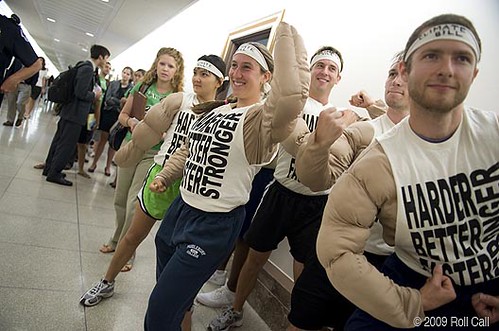
The Strongmen stormed the capitol! 6 activists in muscle costumes greeted senators going into the hearing, to flex their legislative muscles and strengthen the bill. Despite getting there at 7am for a 10am hearing, too many paid line-sitters were saving seats for lobbyists, preventing the Strongmen from entering. Their presence in the hallway was still impressive because it afforded the opportunity to talk to the press and flex for all the staff. The Strongmen also greeted energy secretary Steven Chu and Senators Kerry and Lugar walking in and out of the Foreign Relations Committee meeting room across the hall. Quote from Senator Kerry: “Stronger Climate Bill? Lets make it happen!”


Tuesday Afternoon: EPW Follow up
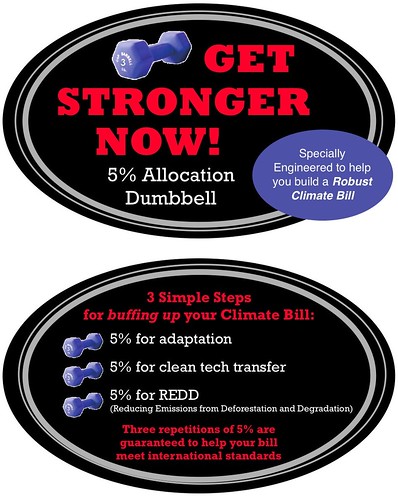
The Action Factory Strongmen visited 18 of the 19 senators offices on the EPW committee that afternoon to do personal workout routines. (Senator Inhoffe was skipped as he is too woefully out of shape to participate.) Workout routines consisted of three easy steps: 4 reps reaching high into the air to hit 40% reductions by 2020, three reps of five for 5% of allocations for international adaptation, 5% for REDD and 5% for clean tech transfer. And finally, since congress needs someone to spot them on the big lifts, we asked the EPA to provide oversight. Strongmen left bar-bells as presents in the offices, as well as teaching the receptionists how to do the workout for their bosses.

Thursday, July 9th: Aerial photo and more office visits:
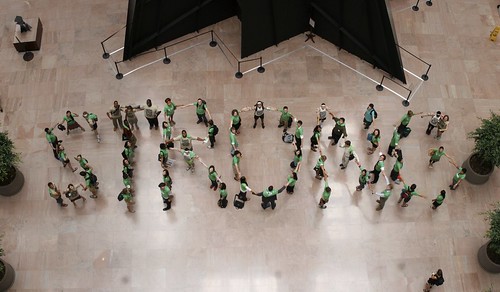
As part of the Campus Progress lobby day, the Action Factory stepped up to organize a mass-action involving over 60 people in a guerilla aerial photo. Co-organizing with Energy Action Coalition and Chesapeake Climate Action Network, a team of letter captains, 50 volunteers walked into the Senate Hart office building and formed a ‘flash-mob’ spelling out STRONG in front of the baffled police. (See above photo)

This rapid-response call for a STRONG bill was followed by a group of 30 in strongmen outfits, Harder, Better, Faster, Stronger shirts and Powershift09 shirts to visit the offices of primary targets in the fight for a strong climate bill: Senators Levin (D-MI), Snow (R-ME) and McCaskill (D-MO).

The visit to McCaskil’s office was particularly relevant because she has repeatedly expressed concern that the climate bill is ‘too strong’ (to paraphrase). With the Strongmen’s help, Claire can beef up her stance on climate, provide the green jobs Missourians want and the international leadership the world needs.

Avaaz Action Factories: www.actionfactories.org
Avaaz has formed action factories at two strategic locations in Europe and in Washington DC to gather and deploy youth climate activists. Each location houses 15+ 'Youth Climate Fellows' working as a team, and supported by Avaaz.org. These fellows are devoting their summer months to mobilizing stunts, lobbying campaigns, and other actions. The work of these activists will maximize the possibility of achieving a strong binding global climate treaty at Copenhagen, and will raise the expectations and demands of the global public that governments must achieve such a treaty.

Photos Here:
http://www.flickr.com/photos/dc_climate_action/

Media Coverage:

Roll Call - Covers news and gossip on Capitol Hill
http://www.rollcall.com/gallery/1_214/#

Slate.com - Online news magazine with broad national reach and diverse readership
http://www.slate.com/id/2222493/

Free Speech Radio News
http://www.fsrn.org/audio/us-senate-loggerheads-over-clean-energy-legislation/5012

Treehugger.com - national blog on green politics, lifestyle, products and issues
http://www.treehugger.com/files/2009/07/strongmen-capitol.php

Wonkroom - Center for American Progress blog
http://wonkroom.thinkprogress.org/2009/07/09/harder-better-faster-stronger/

CNN - Lou Dobbs - Brief appearance on environmental groups not having a fair fight against big-money lobbyists.
http://www.cnn.com/video/?/video/bestoftv/2009/07/08/ldt.sylvester.homeless.line.holders.cnn

Read more!

Thursday, July 09, 2009

New Report Calls for a Fresh Approach to Climate Policy

By Leigh Ewbank. Originally posted at Breakthrough Generation

A joint London School of Economics / University of Oxford report published today presents a new approach to post-Kyoto climate change policy. The report, How to Get Climate Policy Back on Course, coincides with this week’s G8 summit and Major Economies Forum on Energy and Climate, and calls on policy makers to abandon the failed Kyoto-style framework and instead focus directly on decarbonizing global energy systems.

The new report builds on Professor Gwyn Prins' and Professor Steve Rayner’s influential critique of the Kyoto Protocol, The Wrong Trousers: Radically Rethinking Climate Policy, and adds further weight to calls to scrap Kyoto.

How to Get Climate Policy Back on Course explains that the rise in the carbon intensity of the global economy since 2001 has occurred alongside efforts to limit carbon emissions—most notably the Kyoto Protocol and the EU emissions trading scheme. This correlation highlights the failure of emissions-centric policy. The report’s coordinating author Professor Gwyn Prins warns adherents of the Kyoto-style approach:

‘In the real world, indicators are moving stubbornly in the wrong direction. The world has been re-carbonising, not de-carbonising. The evidence is that the Kyoto Protocol and its underlying approach have had and are having no meaningful effect whatsoever.’

To overcome ineffective climate policy, Prins and his coauthors recommend policy makers adopt the ‘Direct Kaya Approach’. This approach would aim to reduce the carbon intensity of an economy through increasing energy efficiency and deploying low-carbon technologies. According to co-author, Professor Steve Rayner of Oxford University, this approach has the advantage of historical precedent:
‘The world has centuries of experience in decarbonising its energy supply and Japan has led the world in policy-driven improvements in energy efficiency. These are the models to which we ought to be looking.’

The report cites Japan’s recently approved ‘Mamizu’ climate strategy as the world’s first based on the Direct Kaya Approach. Japan’s emissions reduction target of 15% below 2005 levels by 2020 represents a 33% reduction in the carbon intensity of Japan’s economy—quite a target considering that Japan is already one of the most efficient economies. In sharp contrast to the Waxman-Markey bill, Japan’s target will be met through increased energy efficiency and deployment of clean technology, not through the use of dubious ‘offsets’.

Overall, the report underscores the need to adopt a new framework for an international agreement on climate change. The Breakthrough Institute’s Michael Shellenberger and Ted Nordhaus have called for massive global investment in new clean energy technology to replace the deeply flawed Kyoto-style framework. Targets for investment in renewable energy research, development and deployment, and a multilateral agreement for technology transfer and cooperation among the world’s largest emitters could form the basis of a new framework. Such policies can enhance the decarbonization model proposed in the Prins report.

----------------------------------------------------------------------------------------------------

‘How to Get Climate Policy Back on Course’ was coordinated by Professor Gwyn Prins and drew on the expertise of leading research institutes in Europe, North America and Asia.

Read more!