Energy Collective blog power policy climate - the conversation happens here

Tuesday, October 27, 2009

Kerry-Boxer "Clean Energy Jobs" Bill's Clean Energy Investments a Fraction of Expert Recommendations

By Jesse Jenkins and Yael Borofsky, originally at the Breakthrough Institute

The latest draft of the Kerry-Boxer "Clean Energy Jobs and American Power Act" would invest less than $10 billion of the bill's nearly $80 billion in annual cap and trade allowance revenue in clean energy technology, assuming EPA-projected allowance prices (note: all figures in 2009 constant dollars).

Over a range of likely allowance prices, the bill's clean energy investments could total as little as $8.6 billion and as much as $15.4 billion annually, a fraction of the at least $30-80 billion annually advocated by the Breakthrough Institute and an investment level dwarfed by the $44-66 billion annually China plans to invest in clean energy industries, infrastructure and technology over the next ten years (see graphic below).

Investments in the kind of clean energy research and development critical to make clean energy cheap and develop the low-cost, commercial clean energy technologies needed to drive deep emissions cuts and secure America's energy independence at an affordable cost will receive just $1.2-2.2 billion annually, over a range of likely allowance prices. That's just $200 million more than the House-passed Waxman-Markey "American Clean Energy and Security Act" (ACES) would invest in R&D at EPA-projected allowance prices. While this is a (very) small step in the right direction, the clean energy R&D investments in Kerry-Boxer still fall far short of filling the massive energy innovation gap and would boost R&D spending by as little as one-tenth of the $15 billion annually advocated by President Barack Obama - as well as a broad range of energy innovation experts, including a recent report by the Breakthrough Institute and Third Way. Funding for R&D under CEJAPA will be about a quarter to half as much as investments currently being made by the economic stimulus package, ARRA.

With more revenue devoted to ensuring deficit neutrality in the Senate bill, total investments in clean energy technology, broadly defined, are actually $1.2 billion less in Kerry-Boxer than in Waxman-Markey, at EPA-projected prices.

As the graphics below illustrate, the Kerry-Boxer climate and energy bill does not invest nearly as much as numerous experts have deemed necessary to make clean energy cheap and put us on the path to the clean energy economy, of which President Obama so eloquently speaks. Nor will this level of investment be sufficient to keep the U.S. competitive with Asian and European competitors, particularly China, who are surging past the United States with major direct investments to support their emerging clean energy technologies and industries.

The first graph focuses on investments in clean energy R&D, only. The second depicts investments in clean energy technology, broadly defined.

How do you think this draft of CEJAPA stacks up?

(click any of these to enlarge...)

KerryBoxer-ComparisonR&D-Graph-10-27-09.png


KerryBoxer-ComparisonTotalCEInv-Graph-10-27-09.png


KerryBoxer-ComparisonR&D-10-27-09.png


KerryBoxer-ComparisonTotalCEInv-10-27-09.png


Sources and Notes:
[1] See "Kerry-Boxer Climate Bill Allowance Allocation Breakdown," Breakthrough Institute (Oct. 26, 2009).
[2] See "Investing in the Next Generation of Energy Technologies," WhiteHouse.gov. President Obama pledges to "Invest $150 billion over ten years in energy research and development to transition to a clean energy economy."
[3] See "Jumpstarting a Clean Energy Revolution with a National Institutes of Energy," Breakthrough Institute and Third Way (Sept. 2009)
[4] See "34 Nobel Prize Winners Write President Obama Urging Support for Clean Energy R&D," Breakthrough Institute (July 2009)
[5] See "Top Energy Scientists Call for $30 Bi Annual Investment in Clean Energy," Breakthrough Institute (Dec. 2007). Call for $30 billion in clean energy technology RD&D investments
[6] See "Energy Discovery-Innovation Institutes: A Step toward America's Energy Sustainability," Brookings Institution (Feb., 2009).
[7] See "Budget and Performance," U.S. Department of Energy.
[8] See "Detailed Summary of Energy Investments in Stimulus," Breakthrough Institute (Feb. 2009).
[9] See "R&D in the FY2009 Budget," American Association for the Advancement of Science (March 2009).
[10] See "New Apollo Program," Apollo Alliance (March 2009).
[11] See "Fast, Clean, & Cheap: Cutting Global Warming's Gordian Knot," Harvard Law and Policy Review. Breakthrough Institute (Jan. 2008).
[12] See "China's Big Plan to Win the Clean Energy Race," Breakthrough Institute (July 2009)

Read more!

Turning Rhetoric to Reality?

Originally posted at the Breakthrough Institute

By Yael Borofsky and Jesse Jenkins

President Barack Obama spoke eloquently to an audience at MIT on Friday about clean energy, innovation, and the American entrepreneurial spirit. Unfortunately, the masterful public speaker was disappointingly vague about supposedly "historic" climate and energy legislation now in front of the Senate; legislation too weak to make reality out of Obama's rhetoric.

In his speech, Obama touted the clean energy investments made by the American Recovery and Reinvestment Act (ARRA) as the "largest investment in clean energy in history." He's right. Such investments are a prime example of the kind of proactive public investments that can transform the U.S. energy economy. That transformation is already underway, with these direct public investments expected to double U.S. renewable energy generation in the next three years and put hundreds of thousands of Americans to work in an emerging clean energy sector.

Unfortunately, the President then turns right around, just a few breaths later, and claims "all of this must culminate in the passage of comprehensive legislation that will finally make renewable energy the profitable kind of energy in America."

The irony is hard to miss. The House-passed "American Clean Energy and Security Act" (ACES) and its Senate sibling, the "Clean Energy Jobs and American Power Act" (CEJAPA), as they currently stand, will provide a much smaller boost for clean energy than investments already underway in ARRA. Both bills would slash clean energy investments levels to just one third of the over $30 billion per year invested by ARRA, devoting just $10 billion annually to clean energy technology, broadly defined.

ACES and CEJAPA would similarly fail to sustain what Obama accurately dubbed "the largest single boost in scientific research in history" begun by ARRA, investing just about $1 billion annually in the research and development critical to current and future clean energy technology advances, not to mention U.S. economic competitiveness. In fact, R&D investments under Congressional climate bills would not approach the level of investment Obama, himself, advocates on his website --"$150 billion over ten years in energy research and development to transition to a clean energy economy."

Instead of building on the direct investments made by ARRA with tens of billions annually to research, develop, and deploy clean energy technology, support the growth of prosperous American clean energy industries, and create millions of new jobs, the current bill relies heavily on a cap-and-trade system that sends too weak a signal to stimulate a major transformation of the U.S. energy system and a collection of weakened regulations. Thus, policy designed to stimulate economic growth directed significant funding to clean energy, but - and here's the irony - legislation solely dedicated to advancing a clean energy future is clearly inferior.

Perhaps what is most frustrating is that Obama has been getting the clean energy rhetoric right for nearly two years. He has literally carried the clean energy innovation fueled torch that Breakthrough, among others, have long cultivated and advocated, and for that he deserves much credit.

During the campaign and even in the first months of his presidency, this speech would not only have inspired, it would have been a portent of progressive legislation and ensuing clean energy innovation. (see here and here). But today, with real climate and energy legislation on the table, Obama's words are frustratingly hollow.

And yet the implications of this legislation stretch far beyond emissions reductions and energy independence. As Obama astutely points out, a competition to lead the world in clean energy innovation is at hand:

"From China to India, from Japan to Germany, nations everywhere are racing to develop new ways to producing and use energy. The nation that wins this competition will be the nation that leads the global economy. I am convinced of that. And I want America to be that nation. It's that simple."


If Obama truly wants to realize this goal, it is not obvious considering his engagement with the Congressional climate and energy policy debate to date. Some may be content to write off the clean energy race as handy rhetoric, but the targeted policies and direct investments in clean energy technology employed by Asian nations, like China, Japan, and South Korea, are very real, they are effective, and they do not look anything like the cap-and-trade-focused legislation currently before us.

Currently, the U.S. is poised to let ARRA's truly historic investments in clean energy technology and industries lapse as a one-shot deal, while China, for example, is surging ahead in the clean energy race with plans to build on its $170 billion stimulus investment in clean technology with new investments totaling $440-$660 billion over the next decade.

We still have a chance to meet and exceed the challenge China has posed, but not with the policies advanced by proposed legislation. It is time for Obama to insist that the substance of Congress's climate and energy policy match his rhetorical focus on clean energy innovation, technology and competitiveness, instead of skirting the large-scale commitments needed to achieve our energy and economic goals.

Until he does, the climate policy rhetoric will continue to stand at odds with the underlying policies - and we will not see the same shift in policy that we have witnessed in Obama's rhetoric. At Grist, prolific climate and energy blogger David Roberts (http://www.grist.org/article/2009-10-23-obama-energy-speech-mit-climate-change ) rightfully praises Obama's inspiring narrative but laments that the climate and energy discourse often wavers from it:

"...it is worth noting that this narrative--the narrative of innovation, American can-do spirit, and global economic competitiveness--is by far the strongest one Dems have going for them. They haven't always been consistent about sticking to that narrative. (If I hear one more reference to the "cap-and-trade bill"...)"


Yet, those who refer to it as the "cap-and trade bill" will continue to do so - and will remain accurate in their descriptions - as long as cap and trade remains at the centerpiece of the bill. Elites and the public, alike, will start referring to it as, say, the "clean energy investment bill" when the content reflects the narrative and direct investment in clean energy technology, innovation, and economic competitiveness is the prioritized policy initiative.

Obama's beautiful but largely empty oration fell on the rapt ears of some of the nation's brightest students and some of the highest hopes for a future economy built on innovative clean energy technology. His conclusion was designed to inspire their efforts:

"This is the nation that has led the world for two centuries in the pursuit of discovery. This is the nation that will lead the clean energy economy of tomorrow, so long as all of us remember what we have achieved in the past and we use that to inspire us to achieve even more in the future."

Yet, the current bill would hinder not expedite their achievements, and its predicted outcomes are far from inspirational.

Right now, Obama has the opportunity to intervene and a narrowing window in which to seize the misdirected climate debate by instructing Congress to deliver legislation that truly validates his vision.

We elected Obama to deliver on his rhetoric, not to deliver more rhetoric. Time is short. Stakes are high. The Senate is crafting the bill that could win or lose the clean energy race. That bill will either turn Obama's rhetoric into reality, or reveal it as nothing more than inspirational speaking. Ultimately this speech leaves us asking Obama: "What's it going to be?"

Read more!

Friends of the Earth: Raise Some Hell to Fix the Energy Bill

Well, it may not be quite as clever (or crude!) as the Daily Show... but here's a message, School House Rock-style, from Friends of the Earth. Like Greenpeace, they're calling on activists to raise some hell and fix the flawed House "clean energy" bill:

Read more!

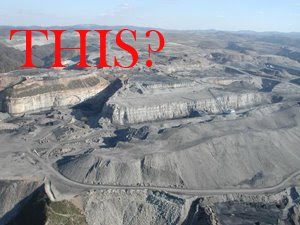
ALERT: Blasting Begins on Coal River Mountain

An update from Coal River Mountain Watch and Appalachian Voices. You can take emergency action here.

Mountaintop Removal Mining to Destroy 6,600 Acres-and Wind Potential

Appalachian community advocates and environmentalists across the nation are expressing outrage that mountaintop removal coal mining operations have begun on Coal River Mountain in West Virginia, a mountain that has become symbolic in the nationwide campaign to end mountaintop removal mining. The West Virginia Department of Environmental Protection told the Charleston Gazette on Monday that blasting had begun last week, confirming local reports of blasts and smoke that were witnessed on Friday near the Brushy Fork coal slurry impoundment, the largest slurry dam in Appalachia with the capacity to hold 8.2 billion gallons. Slurry is the by-product of coal washing and processing operations and contains high levels of toxic heavy metals like mercury, selenium and lead.

For the last two years, local residents have campaigned for the opportunity to place a commercial-scale wind farm on Coal River Mountain instead of the mountaintop removal mining that has been permitted by the state. The Coal River Wind campaign has focused on asking West Virginia Governor Joe Manchin to rescind the mining permits for Coal River Mountain. So far, Governor Manchin has denied the group's request.

"The Coal River Wind Campaign has been a symbol of hope for the people of the Coal River Valley," said Lorelei Scarbro, organizer for Coal River Mountain Watch. "My neighbors are excited about the idea of jobs that allow them to produce energy in a way that is sustainable. Coal River Mountain, the last standing mountain in the valley, should remain intact as a symbol for a new day in the Appalachian coalfields."

With no response from Governor Manchin's office, residents and environmental groups are now looking to the Obama administration to intervene.

A wind resources assessment and economic study commissioned by Coal River Mountain Watch in 2008 revealed that Coal River Mountain-which has the highest peaks ever slated for mining in the state-has enough wind potential to provide electricity for over 85,000 homes and would create more jobs over the expected life of the turbines than the proposed mountaintop removal mine. The study also stated that the proposed wind farm would help diversify the local economy in an area historically dependent upon temporary coal mining jobs, and would pump $20 million per year in direct local spending during construction and $2 million per year thereafter.

Current plans for mountaintop removal operations would eventually impact 6,600 acres on Coal River Mountain and fill in 18 valleys with the resulting waste and debris. Over 10 square miles of what environmentalists call the most bio-diverse ecosystem in the United States would be affected. Bo Webb, a resident of town of Peach Tree-a community directly downhill from an existing mountaintop removal operation near Coal River Mountain-said, "My community is already being forced to endure silica blasting dust, boulders, mudslides and floods from a mountaintop removal operation on Cherry Pond Mountain. The annihilation of Coal River Mountain will leave us trapped in the middle beneath both mountains of destruction."

In addition to the economic and environmental concerns, residents are worried about the stability of blasting less than two hundred yards from a coal sludge impoundment. According to coalimpoundment.org-maintained by Wheeling Jesuit University-the Brushy Fork impoundment is a Class C dam, in which "failure would cause possible loss of human life." If the Brushy Fork impoundment were to fail, the first communities in danger would be the towns of Pettus and Whitesville, where residents would have 12-18 minutes to evacuate before they were overtaken by floodwaters and slurry. The emergency evacuation plan, should the dam be breached, calls for notifying residents "personally," or "by loudspeaker or bullhorn, or other means deemed necessary."

In 2000, a coal slurry impoundment owned by a Massey subsidiary failed and spilled over 300 million gallons of slurry into the Big Sandy River in Martin County, KY. The EPA called the dam failure the "worst environmental disaster east of the Mississippi." According to EPA testing, the spill-more than 30 times larger than the Exxon Valdez disaster-destroyed destroyed nearly all aquatic life for more than 50 miles downstream of the spill. And in 1972, a 132-million gallon impoundment in Logan County, W.Va., failed, killing 125 people and leaving over 4,000 more homeless.

The permits for mining on Coal River Mountains are owned by Massey Energy, one the largest coal mining companies in central Appalachia. In 2008, Massey paid $20 million to the U.S. Environmental Protection Agency in the largest settlement to date for violating the Clean Water Act more than 4,500 times in seven years.

According to a recent story by Associated Press reporter Vicki Smith, Google Earth has taken interest in the plight of Coal River Mountain and created a video about the Coal River Wind Project to present at the climate talks to be held in Copenhagen in December.

"What kind of message will it send to the international community if this priceless mountain with so much renewable energy potential is currently being destroyed for a decade's worth of coal?" asked Matt Wasson, Program Director for Appalachian Voices, a regional environmental organization. "It would look a lot more like a continuation of the last administration's policies, rather than a commitment to a new energy future."

For more information, please visit www.coalriverwind.org and www.iLoveMountains.org/coalriver.


- - - - - -
Contact:
Lorelei Scarbro, Coal River Mountain Watch, (304) 854-2182
Matt Wasson, Appalachian Voices, (828) 262-1500
- - - - - -

Read more!

Monday, October 26, 2009

Kerry-Boxer Climate Bill Allowance Allocation Breakdown

Originally at the Breakthrough Institute

Late Friday night, Senator Barbara Boxer's Environment and Public Works Committee released a new draft of the Kerry-Boxer "Clean Energy Jobs and American Power Act" (S.1733), the first version of the legislation to detail how emissions allowances created by the bill will be divvied up. These allowances, which give polluters the right to emit greenhouse gases under the bill's cap and trade program, will be worth nearly a trillion dollars over the first ten years of the program alone.

Breakthrough Institute staff worked over the weekend to dig through the new legislation and get an accurate picture of the allowance allocation pie [see summary tables and graphics below and click here to download a comprehensive spreadsheet of allowance allocations in both Kerry-Boxer and the House Waxman-Markey/ACES bill. Note: updated after initial posting to convert EPA forecasts to 2009 constant dollars. Hat tip to Jason at 1Sky for catch].

Overall, the allowance allocation scheme mirrors the bill's House-passed sibling, the American Clean Energy and Security Act (ACES), aka the Waxman-Markey bill (HR 2454) [for a side-by-side comparison of the two bills, click here].

K-B_Allocations_Chart.jpg

ACES_Allocations_Chart.jpg
(click either graphic to enlarge)


Depending on the value of emissions allowances under the cap and trade program, an average of roughly $70 billion to $126 billion in emissions allowances will be created and distributed on each year under the first ten years of the bill's cap and trade program, 2012-2021.

Of that value, by far the largest share, roughly 64% of the total allowances, will be distributed for free to shield energy consumers and industry from the higher energy prices driven by the establishment of a price on carbon dioxide and other greenhouse gases under a cap and trade system. This includes both direct rebates to end consumers and low-income energy assistance, as well as free allocations to electric and natural gas utilities (aka "distribution companies"), which they are directed to use "on behalf of" their customers. It also includes direct transfers of billions of dollars in free allowances to various industries, ranging from the relatively defensible (11.3% of allowances to heavy industries vulnerable to international competition), to the pretty indefensible, (e.g. a windfall-profit generating allocation of over 3% of the allowances -- worth at least $2 billion annually -- to the "merchant" operators of conventional coal plants).

By contrast, only about 13% of the value of allowances will be invested in various clean energy technologies, including incentives for the deployment of carbon capture and storage technology (aka CCS, given 2.2% of permits on average each year), federal, state and local government funds to incentivize renewable energy and energy efficiency (6.4%), and investments in advanced clean vehicle technologies (1.7%).

Just 1.9% of the allowances are dedicated to critical clean energy research and development (R&D) efforts, which amounts to an investment of just about $1.4 billion annually under EPA-projected allowance prices (in 2009 constant dollars).

Overall, the "Clean Energy Jobs and American Power Act's" investments in clean energy technologies will total under $9.5 billion per year under allowance prices projected by the EPA.

4.5% of the allowances will be devoted to various other public purposes, including efforts to adapt to the public health, infrastructure, wildlife and natural resource impacts of an already-changing climate and training programs to expand a skilled energy efficiency, renewable energy and nuclear energy workforce.

Another 7.5% of the permits will be allocated to fund various supplemental emissions reduction efforts, with the largest share (4.2%) going to fund efforts to slow deforestation overseas. Efforts to reduce emissions in the U.S. agriculture and forestry sectors will receive 1.2% of emissions allowances and 2.1% of the allowances will be devoted to reducing vehicle-miles traveled and emissions in the transportation sector (e.g. through public transit expansion and more proactive metropolitan area transportation planning).

Just over 10% of the allowances will be set aside to ensure the cap and trade program does not increase the federal deficit (i.e. is "deficit neutral"). This is the largest difference between the allocation scheme in the Kerry-Boxer bill and the House-passed ACES legislation, which dedicated just about 3.1% of the allowances over the first ten years to deficit reduction.

Senate legislation is given a more rigorous test for budget impacts, with legislation required to have no major impact on the deficit over the next fifty years, while House legislation only examines impacts on the budget over the first ten years. The larger set-aside required to keep the bill deficit neutral means overall allocations for most uses are slightly lower in Kerry-Boxer than in ACES (for the strong-of-heart, see this wonky explanation of Congressional Budget Office scoring rules). Since House-passed legislation would eventually have to be made consistent with Senate budget scoring rules before concurrence and final passage by both chambers, ACES arguably over-promises the allowance allocations, which Kerry-Boxer attempts to correct.

The following table provides a detailed breakdown of the average annual allowance allocation over the first ten years of the cap and trade program (2012-2021), including percentage of total allowances and the dollar value under three likely allowance prices described below [click here for pdf version].

K-B_Allowances_Table.jpg
(click to enlarge)


You can download a spreadsheet (.xlsx file) detailing allowance allocations under both the Kerry-Boxer (S.1733) and Waxman-Markey/ACES (HR 2454) bills here. Allowances are detailed from 2012-2032 and summarized in several ways to aid comparison and analysis.

Notes:

Allowance price scenarios:

The first allowance price scenario is the floor price for permits established by the legislation, which begins at about $11/ton (in 2009 dollars) in 2012, and rises at 5% per year, resulting in an average allowance price of $13.91 during the first 10 years of the program. Note that carbon market research firm Point Carbon projects that due to modest emissions reduction targets, a slower-than-expected U.S. economy, and the permitted use of large numbers of offsets, allowance prices will likely remain at the allowance price floor through at least 2019. The resulting price is $13.91/ton on average for 2012-2021.

The second allowance price value is consistent with the EPA's preliminary analysis of Kerry-Boxer, which projects allowance prices unchanged from their analysis of ACES. 2005 constant dollar values reported by EPA have been updated to 2009 constant dollars for ease of comparison. The resulting price is $15.42/ton on average for 2012-2021.

Finally, to aid comparison with the House's ACES bill, Breakthrough calculated a price roughly consistent with the Congressional Budget Office's (CBO) price estimates under ACES. To provide a higher-range price, this scenario, labeled "CBO-equivalent," projects permit prices 180% higher than the floor price under Kerry-Boxer, which is consistent with proportionate difference between CBO's projections under ACES and the ACES floor price scenario. The resulting price is $25.04/ton on average for 2012-2021.

On "discrepancies" with Environment and Public Works Committee summary of allowance allocations:

The Senate EPW Committee published a summary of allowance allocations under S.1733 here. Some percentages reported in this document will differ from those reported in the analysis here, and in fact are somewhat confusing. Here's why:

Under Kerry-Boxer, allowances for some uses, like deficit reduction, stocking the Market Stability Reserve and other selected uses come "off the top" as a 'set aside' before the percentages reported for most of the other uses are calculated. About 16% of the allowances are set aside off the top in this manner. So when the EPW document (or the bill language) says elsewhere that a given percentage of the allowances are allocated to a particular use, say the allocation of 10.35% of the 2012 allowances to investments in renewable energy and energy efficiency, that is in reality 10.35% of the 84% of permits left over after the 16% of allowances set-aside, or really about 8.7% of the total permits (10.35%*84%).

This makes determining the true percentage of total allowances created under the bill somewhat challenging, requiring the kind of detailed reading and "spreadsheet work" conducted by Breakthrough here.

Note that the same was true for ACES, which set aside 1-3% of the permits each year "off the top" to stock the bill's Strategic Reserve pool, but with such a relatively small amount of total permits set aside this way, it did not have as significant an impact on the reported percentages allocated to other uses; Kerry-Boxer by contrast sets aside nearly 16% of permits in this manner, which has a noticeable impact on the percentages reported for other allocations.

On over-allocation of allowances under Kerry-Boxer:

Astute observers will note that the sum total of all Kerry-Boxer allowance allocations under this report total to roughly 101% between 2012-2021 (actual value is 100.65%). I've attempted to double check my calculations and identify the source of this over-allocation (potential typo?). However, at this time, it appears that the slight over-allocation may actually be based on an accurate reading of the bill language. It could be a simple oversight, given the complicated calculation of actual percent allocations discussed above. I will update this post if I identify the source of the over-allocation, but given how small it is (just 0.65% of total permits), it should not significant impact any of the figures above.

Questions: contact Jesse Jenkins, jesse[at]theBreakthrough.org.

Read more!

Friday, October 23, 2009

Friday Factoids: So You Want To Spur a Clean Energy Revolution?

Originally at the Breakthrough Institute
Friday Factoids time again...

As President Obama challenges the U.S. to lead in the global clean energy race today, here's a quick comparison of methods that can drive clean energy deployment. Which do you think will be more effective...


  • Average CO2 prices under the cap and trade system that would be implemented by the House-passed Waxman-Markey bill are expected to be roughly $15 per ton average through 2020.

    Ignoring for a moment free allocations that could undermine these permits, that will raise the price of coal-fired power plants and natural gas fired power plants against which clean energy must compete by roughly $15 per MWh and $8 per MWh respectively. A typical coal plant emits roughly 1 ton CO2 per MWh and a natural gas plant emits about 40% less.

  • The production tax credit that has driven the rapid expansion of the wind industry (when it isn't expiring every other year...) drives down the cost of wind power by roughly $20 per MWh.

  • Feed-in tariffs responsible for rapid growth of the solar industry in Germany lower the net cost of solar power by over 50 cents per kilowatt-hour, or $500 per MWh. In the U.S., an investment tax credit nocks off a full 30% of the cost of solar projects and state-level incentives offer even greater support in big solar states like California, Pennsylvania and New Jersey. The value of solar renewable energy credits (SRECs) supplied to solar energy generators in New Jersey has averaged well above $400 per MWh over the last few years.

  • This year and next, new wind, solar and other renewable energy projects can enjoy a cash grant in lieu of these tax credits worth 30% of the total cost of the projects, funded through the stimulus bill. That incentive is expected to drive up to $10 billion in grants supporting over $33 billion in clean energy projects.

In summary: CO2 price from cap and trade = effective clean energy subsidy of $8-15/MWh. Current PTC is worth $20/MWh. Solar incentives typically top $400-500/MWh. The stimulus bill is driving big investments with cash grant worth 30% of clean energy project costs. How again is the House-passed cap and trade program going to spur a clean energy revolution?

Incentives.jpg
Click to enlarge

*All figures in this post are approximate and meant for comparison purposes only.

Read more!

SPEECH: Obama Challenges Americans to Lead in Clean Energy Technology

Quick post with the text of President Obama's speech today at MIT, challenging Americans to lead the global economy in clean energy technology.

Once again dead-on rhetoric from Obama, but absolutely no indication that there's a real commitment to the kind of policies that will give the U.S. an edge in the global clean energy race. With China, Japan, South Korea, the EU and many more racing ahead with real policy support for clean energy technology development and demonstration, manufacturing, and direct and targeted incentives for the deployment of a suite of emerging technologies, the economic stakes are high and time is short.

America elected Obama to deliver on his rhetoric. Not to deliver more rhetoric. The Senate is crafting the bill that could win or lose the global clean energy race right now. That bill will either turn Obama’s rhetoric into reality, or prove it nothing much more than inspirational speaking. What’s it going to be?

Here's the text of President Obama's remarks (I've cut out all the introductory remarks and thank yous and yatta yattas...)

REMARKS BY THE PRESIDENT CHALLENGING AMERICANS TO LEAD THE GLOBAL ECONOMY IN CLEAN ENERGY
Massachusetts Institute of Technology
Boston, Massachusetts

12:44 P.M. EDT

THE PRESIDENT: Thank you very much. Please, have a seat. Thank you. Thank you, MIT. ...

[SNIP]

Now, Dr. Moniz is also the Director of MIT's Energy Initiative, called MITEI. And he and President Hockfield just showed me some of the extraordinary energy research being conducted at this institute: windows that generate electricity by directing light to solar cells; light-weight, high-power batteries that aren't built, but are grown -- that was neat stuff; engineering viruses to create -- to create batteries; more efficient lighting systems that rely on nanotechnology; innovative engineering that will make it possible for offshore wind power plants to deliver electricity even when the air is still.

And it's a reminder that all of you are heirs to a legacy of innovation -- not just here but across America -- that has improved our health and our wellbeing and helped us achieve unparalleled prosperity. I was telling John and Deval on the ride over here, you just get excited being here and seeing these extraordinary young people and the extraordinary leadership of Professor Hockfield because it taps into something essential about America -- it's the legacy of daring men and women who put their talents and their efforts into the pursuit of discovery. And it's the legacy of a nation that supported those intrepid few willing to take risks on an idea that might fail -- but might also change the world.

Even in the darkest of times this nation has seen, it has always sought a brighter horizon. Think about it. In the middle of the Civil War, President Lincoln designated a system of land grant colleges, including MIT, which helped open the doors of higher education to millions of people. A year -- a full year before the end of World War II, President Roosevelt signed the GI Bill which helped unleash a wave of strong and broadly shared economic growth. And after the Soviet launch of Sputnik, the first artificial satellite to orbit the Earth, the United States went about winning the Space Race by investing in science and technology, leading not only to small steps on the moon but also to tremendous economic benefits here on Earth.

So the truth is, we have always been about innovation, we have always been about discovery. That's in our DNA. The truth is we also face more complex challenges than generations past. A medical system that holds the promise of unlocking new cures is attached to a health care system that has the potential to bankrupt families and businesses and our government. A global marketplace that links the trader on Wall Street to the homeowner on Main Street to the factory worker in China -- an economy in which we all share opportunity is also an economy in which we all share crisis. We face threats to our security that seek -- there are threats to our security that are based on those who would seek to exploit the very interconnectedness and openness that's so essential to our prosperity. The system of energy that powers our economy also undermines our security and endangers our planet.

Now, while the challenges today are different, we have to draw on the same spirit of innovation that's always been central to our success. And that's especially true when it comes to energy. There may be plenty of room for debate as to how we transition from fossil fuels to renewable fuels -- we all understand there's no silver bullet to do it. There's going to be a lot of debate about how we move from an economy that's importing oil to one that's exporting clean energy technology; how we harness the innovative potential on display here at MIT to create millions of new jobs; and how we will lead the world to prevent the worst consequences of climate change. There are going to be all sorts of debates, both in the laboratory and on Capitol Hill. But there's no question that we must do all these things.

Countries on every corner of this Earth now recognize that energy supplies are growing scarcer, energy demands are growing larger, and rising energy use imperils the planet we will leave to future generations. And that's why the world is now engaged in a peaceful competition to determine the technologies that will power the 21st century. From China to India, from Japan to Germany, nations everywhere are racing to develop new ways to producing and use energy. The nation that wins this competition will be the nation that leads the global economy. I am convinced of that. And I want America to be that nation. It's that simple. (Applause.)

That's why the Recovery Act that we passed back in January makes the largest investment in clean energy in history, not just to help end this recession, but to lay a new foundation for lasting prosperity. The Recovery Act includes $80 billion to put tens of thousands of Americans to work developing new battery technologies for hybrid vehicles; modernizing the electric grid; making our homes and businesses more energy efficient; doubling our capacity to generate renewable electricity. These are creating private-sector jobs weatherizing homes; manufacturing cars and trucks; upgrading to smart electric meters; installing solar panels; assembling wind turbines; building new facilities and factories and laboratories all across America. And, by the way, helping to finance extraordinary research.

In fact, in just a few weeks, right here in Boston, workers will break ground on a new Wind Technology Testing Center, a project made possible through a $25 million Recovery Act investment as well as through the support of Massachusetts and its partners. And I want everybody to understand -- Governor Patrick's leadership and vision made this happen. He was bragging about Massachusetts on the way over here -- I told him, you don't have to be a booster, I already love the state. (Applause.) But he helped make this happen.

Hundreds of people will be put to work building this new testing facility, but the benefits will extend far beyond these jobs. For the first time, researchers in the United States will be able to test the world's newest and largest wind turbine blades -- blades roughly the length of a football field -- and that in turn will make it possible for American businesses to develop more efficient and effective turbines, and to lead a market estimated at more than $2 trillion over the next two decades.

This grant follows other Recovery Act investments right here in Massachusetts that will help create clean energy jobs in this commonwealth and across the country. And this only builds on the work of your governor, who has endeavored to make Massachusetts a clean energy leader -- from increasing the supply of renewable electricity, to quadrupling solar capacity, to tripling the commonwealth's investment in energy efficiency, all of which helps to draw new jobs and new industries. (Applause.) That's worth applause.

Now, even as we're investing in technologies that exist today, we're also investing in the science that will produce the technologies of tomorrow. The Recovery Act provides the largest single boost in scientific research in history. Let me repeat that: The Recovery Act, the stimulus bill represents the largest single boost in scientific research in history. (Applause.) An increase -- that's an increase in funding that's already making a difference right here on this campus. And my budget also makes the research and experimentation tax credit permanent -- a tax credit that spurs innovation and jobs, adding $2 to the economy for every dollar that it costs.

And all of this must culminate in the passage of comprehensive legislation that will finally make renewable energy the profitable kind of energy in America. John Kerry is working on this legislation right now, and he's doing a terrific job reaching out across the other side of the aisle because this should not be a partisan issue. Everybody in America should have a stake -- (applause) -- everybody in America should have a stake in legislation that can transform our energy system into one that's far more efficient, far cleaner, and provide energy independence for America -- making the best use of resources we have in abundance, everything from figuring out how to use the fossil fuels that inevitably we are going to be using for several decades, things like coal and oil and natural gas; figuring out how we use those as cleanly and efficiently as possible; creating safe nuclear power; sustainable -- sustainably grown biofuels; and then the energy that we can harness from wind and the waves and the sun. It is a transformation that will be made as swiftly and as carefully as possible, to ensure that we are doing what it takes to grow this economy in the short, medium, and long term. And I do believe that a consensus is growing to achieve exactly that.

The Pentagon has declared our dependence on fossil fuels a security threat. Veterans from Iraq and Afghanistan are traveling the country as part of Operation Free, campaigning to end our dependence on oil -- (applause) -- we have a few of these folks here today, right there. (Applause.) The young people of this country -- that I've met all across America -- they understand that this is the challenge of their generation.

Leaders in the business community are standing with leaders in the environmental community to protect the economy and the planet we leave for our children. The House of Representatives has already passed historic legislation, due in large part to the efforts of Massachusetts' own Ed Markey, he deserves a big round of applause. (Applause.) We're now seeing prominent Republicans like Senator Lindsey Graham joining forces with long-time leaders John Kerry on this issue, to swiftly pass a bill through the Senate as well. In fact, the Energy Committee, thanks to the work of its Chair, Senator Jeff Bingaman, has already passed key provisions of comprehensive legislation.

So we are seeing a convergence. The naysayers, the folks who would pretend that this is not an issue, they are being marginalized. But I think it's important to understand that the closer we get, the harder the opposition will fight and the more we'll hear from those whose interest or ideology run counter to the much needed action that we're engaged in. There are those who will suggest that moving toward clean energy will destroy our economy -- when it's the system we currently have that endangers our prosperity and prevents us from creating millions of new jobs. There are going to be those who cynically claim -- make cynical claims that contradict the overwhelming scientific evidence when it comes to climate change, claims whose only purpose is to defeat or delay the change that we know is necessary.

So we're going to have to work on those folks. But understand there's also another myth that we have to dispel, and this one is far more dangerous because we're all somewhat complicit in it. It's far more dangerous than any attack made by those who wish to stand in the way progress -- and that's the idea that there is nothing or little that we can do. It's pessimism. It's the pessimistic notion that our politics are too broken and our people too unwilling to make hard choices for us to actually deal with this energy issue that we're facing. And implicit in this argument is the sense that somehow we've lost something important -- that fighting American spirit, that willingness to tackle hard challenges, that determination to see those challenges to the end, that we can solve problems, that we can act collectively, that somehow that is something of the past.

I reject that argument. I reject it because of what I've seen here at MIT. Because of what I have seen across America. Because of what we know we are capable of achieving when called upon to achieve it. This is the nation that harnessed electricity and the energy contained in the atom, that developed the steamboat and the modern solar cell. This is the nation that pushed westward and looked skyward. We have always sought out new frontiers and this generation is no different.

Today's frontiers can't be found on a map. They're being explored in our classrooms and our laboratories, in our start-ups and our factories. And today's pioneers are not traveling to some far flung place. These pioneers are all around us -- the entrepreneurs and the inventors, the researchers, the engineers -- helping to lead us into the future, just as they have in the past. This is the nation that has led the world for two centuries in the pursuit of discovery. This is the nation that will lead the clean energy economy of tomorrow, so long as all of us remember what we have achieved in the past and we use that to inspire us to achieve even more in the future.

I am confident that's what's happening right here at this extraordinary institution. And if you will join us in what is sure to be a difficult fight in the months and years ahead, I am confident that all of America is going to be pulling in one direction to make sure that we are the energy leader that we need to be.

Thank you very much, everybody. God bless you. God bless the United States of America. (Applause.)

END
1:03 P.M EDT

Read more!

Thursday, October 22, 2009

Greenpeace: Climate Legislation More Likely to Perpetuate Fossil Fuel Economy than Spur Swift Transition to Clean Energy

Originally at the Breakthrough Institute

Climate change legislation recently passed by the U.S. House of Representatives and now under consideration in the Senate will "succeed in perpetuating business as usual and fail to avert catastrophic climate change," according to a new Greenpeace report quietly released yesterday.

Titled "Business as Usual," the report was prepared on behalf of Greenpeace by David Sassoon, who publishes the climate news site, SolveClimate. It is written as a "plain-spoken" analysis meant to be "a call to action to the President of the United States," according to the document.

"In order for federal climate legislation worthy of this nation to pass Congress, we see no alternative to active and principled engagement from the Oval Office," Greenpeace writes.

The report levels five key criticisms of current Congressional legislation, calling attention to what Greenpeace describes as "five points of maximum danger" that the environmental group argues must be addressed to ensure climate legislation is capable of spurring "a swift transition to a clean energy future."

While we certainly don't share Greenpeace's position on all (most) climate matters, this new report levels a pointed and impassioned critique of current Congressional climate action well grounded in the details of the pending legislation. Here's a 'Cliffs notes' version of the full report below the fold...


  1. "Congress is threatening to preempt the Clean Air Act from regulating greenhouse gas emissions from the biggest sources in the nation."

    Greenpeace is referring to a section of the House-passed Waxman-Markey bill that would prevent the U.S. Environmental Protection Agency from regulating point-source emitters of greenhouse gases under existing provisions of the Clean Air Act (e.g. emissions performance standards or new source review).

    After a 2007 Supreme Court ruling that deemed greenhouse gases were a harmful pollutant, the EPA has been moving ahead with regulations under existing Clean Air Act authority to limit greenhouse gas emissions from major stationary sources such as coal plants. Environmental groups have argued that such regulatory authority is critical to protect public health even if Congress moves to establish a cap and trade system to limit economy-wide emissions of greenhouse gases. "Absent EPA authority," Greenpeace writes, "large loopholes and handouts in both the Senate and House version of the climate bill will make it difficult, if not impossible, for the nation to depart from the trajectory of business as usual for decades. EPA involvement is not an either-or proposition."

    As Greenpeace notes, initial drafts of the Senate's "Clean Energy Jobs and America's Power Act" refrains from limiting EPA's authority to regulate emissions. "This is perhaps the most significant difference between the House and Senate versions of the legislation and a critical issue of paramount importance," Greenpeace writes.

    While the House-passed bill does establish a new emissions performance standard for coal-fired power plants that would eventually require the capture and storage of CO2 emissions, the upcoming standards "grandfather," or exempt, close to 40 new coal plants now in the permitting or construction process, according to Greenpeace.

    Referring to coal plants similarly grandfathered into the Clean Air Act, the report contends, "It is yet another bubble of special case coal plants whose burden will be felt for decades to come and slow the arrival of the clean energy future, unless the EPA remains empowered to do its job on behalf of ordinary citizens."

  2. "[B]oth the House and Senate's [emissions reduction] targets are weak and timid in the short term and wishful thinking in the long term."

    Greenpeace criticizes Congressional climate legislation's 2020 emissions reduction targets - 17% below 2005 levels in the House bill and 20% below 2005 levels in the Senate bill, or just 4-7% below 1990 levels - as "far short both of what science demands and what our European allies have committed to achieve." The EU has committed to cut emissions 20% below 1990 levels by contrast, Greenpeace notes, and the Intergovernmental Panel on Climate Change has recommended cuts of 25-40% below 1990 levels.

    While the Breakthrough Institute has long argued that a focus on emissions reduction targets and not concrete, actionable plans to drive clean energy technology development and deployment is misguided, the report accurately notes that modest emissions targets undermine the carbon price signal intended to drive a transition to cleaner energy sources under the legislation's cap and trade program. Both the U.S. EPA and Congressional Budget Office project carbon prices under the House's Waxman-Markey bill will remain between $10 and $20 per ton for at least the first decade of the bill's cap and trade program - equivalent to a change of just 10-20 cents in a gallon of gasoline, for reference.

    "[W]e are being asked to make a leap of faith," Greenpeace writes, "that a carbon price signal--however weak--will conspire with market forces to squeeze carbon out of our economy. It is impossible to ignore the reality that the weak cap undermines the foundation of the theory, fundamental to its integrity. It is as if we are imposing a price on carbon that nobody really has to pay..."

    With the economic recession driving U.S. emissions levels significantly lower than historic 2005 levels, the House bill's emissions cap may not require any emissions cuts at all for up to five years, likely collapsing carbon prices to at or near the lowest levels permitted by the legislation, according to Breakthrough Institute analysis.

  3. "There is probably no better indication of the persistence of business as usual than the fact that both the House and Senate climate legislation prioritize support for the primary industrial source of greenhouse gases... coal."

    Greenpeace notes that 9% of the value of emissions permits created under the Waxman-Markey bill's cap and trade program are devoted to the coal industry, while just 6% are invested in energy efficiency and renewable energy. This includes not only incentives for the commercial deployment of carbon capture and storage technology at coal-fired power plants, but also billions in windfall-profit generating free allowances for the merchant operators of existing, conventional coal-fired power plants. (see Breakthrough's updated Waxman-Markey allowance allocation summary here.)

    In addition, the House-passed bill establishes a new utility-industry-run Carbon Storage and Research Corporation funded with $10 billion raised from electricity ratepayers over the next ten years. According to Greenpeace, $500 million of this funding is "designated simply for 'administrative expenses' to be spent at the discretion of [the] new corporation's officers."

    Greenpeace accurately notes, "There is no parallel provision in the bill to set up a federally created corporation to support solar or wind or geothermal energy development, even though the House legislation is called the American Clean Energy and Security Act." Likewise, no other low-carbon energy technology enjoys the kind of bonus allowance allocation devoted to CCS deployment under the House bill's cap and trade program.

  4. "Handouts and loopholes are legion."

    Greenpeace notes that the bill's already modest emissions reduction objectives are further undermined by "the set of provisions permitting an enormous number of offsets to substitute for pollution reduction." Both the House and Senate bills allow regulated polluters to purchase up to two billion tons of offsets each year instead of reducing their own emissions.

    "It is as if a man with heart trouble and diabetes who weights 360 points is encouraged by his doctor to pay someone else to go on a diet for him," Greenpeace writes, lampooning the logic of offsetting. "To be fair," the report continues, "the economic thinking behind offsets has a narrow theoretical validity."

    However, actual experience with offset markets indicates that fraud and gaming are difficult if not impossible, from a practical perspective, to eliminate. As Greenpeace writes, "The fact is that the allure of immense profits has mostly produced massive instances of cheating in the offset market, with the environment left to suffer the consequences." Extending their metaphor, they continue, "The fat patient will stay fat; the other man paid to go a diet will do no such thing; and the doctor will walk away satisfied."

    If offsets played a limited role in the functioning of the cap and trade system, likely fraud and policing challenges would potentially be minor issues. But as Greenpeace notes, "The number of offsets pending legislation authorized on an annual basis is truly astonishing: Two billion tons worth. That is equivalent to one quarter of annual US emissions--or the first 75 poinds of flesh our fat man would shed on a diet." Greenpeace accurately notes that the practical implication of such massive offsetting would be to delay any required cuts in actual U.S. industrial emissions "for almost another two decades. If that is not business as usual, nothing is," Greenpeace concludes.

    Greenpeace pointedly notes that some "have found ways to rationalize the offsets as necessary, even playing the role of apologist for bad policy." (Gee, who could they be talking about...). They continue:

    "They make the argument about offsets that there simply won't be enough to go around. ... They are saying, in essence, don't worry, offsets won't be a problem, they don't really exist. ... We would be naive to assume that corporate lobbyists secured authorization for two billion tons of offsets without having a plan for where to find them and how to use them. It is money that no profit-maximizing organization is going to leave on a table unclaimed..."

    Greenpeace identifies hydrofluorocarbon (HFCs), an industrial gas and very potent "super greenhouse gas," and forest preservation projects as potentially huge sources of offsets for U.S. and global markets. Furthermore, as Congressional legislation has moved forward, more and more sources of offsets have been permitted in successive drafts, including expanded agricultural offsets in the House bill and various sources of methane in the Senate bill.

  5. "What is especially dangerous, and frankly Orwellian, is that the American Clean Energy and Security Act and the Clean Energy Jobs and American Power Act both provide insufficient and grudging support to clean energy!"

    Greenpeace finally notes that the bill provides very little effective support for renewable energy. "What state governments and private enterprise are doing to promote the adoption of clean energy already surpasses what the federal government is now proposing to do," the report states.

    The report cites yet another analysis, this one from ICF International, concluding that "existing organic growth of business as usual in the clean energy sector will be enough to surpass the target" in the House bill's renewable electricity standard. After exemptions are included, Greenpeace notes, as Breakthrough has, that the bill's nominal 20% "Combined Efficiency and Renewable Electricity Standard" amounts to a real requirement of less than 10%, "a goal that the states alone will achieve with current RPS policies."

    The report notes the disparity between financial support and direct public investments provided for renewable energy -- and research and development in particular -- relative to incentives for CCS in the House bill, and support for nuclear power expected to be included in the Senate bill . But as Breakthrough has noted, overall investments for all low-carbon energy sources, including CCS, totals just $9 billion per year from allowance revenue in the House bill (at a $15/ton average price) - a figure that appears in the report via a quote from the Brookings Institution's Mark Muro.

    Greenpeace contrasts this level of support, less than one-fifth what Breakthrough advocates, with President Obama's remarks to the UN General Assembly that "the US will move forward with investments to transform our energy economy."

    "The climate bill undermines this aim," Greenpeace contends. The report points to direct and proactive incentives provided for renewable energy deployment in Germany, a feed-in tariff "financed by a modest rate increase spread across the entire population," as an alternative approach to accomplish President Obama's objective "to make clean energy the profitable kind of energy."


In concluding, Greenpeace notes that a good number of both "optimists" and "apologists" within the climate advocacy community have continued to support, even champion, current Congressional climate legislation.

"The optimists seem to believe that a price signal, no matter how weak or undermined by handouts and loopholes, will provide the impetus to help us get started to turn the corner on climate change," Greenpeace writes, noting that the Clean Air Act and Social Security legislation are often referenced "as federal measures that started out weak and grew effective over time."

This historical analogy is "ultimately unpersuasive," Greenpeace contends. "The Clean Air Act, for example, did not send hundreds of billions of dollars in handouts and loopholes to the very polluters it was trying to regulate," the report points out. "The pending legislation does."

Greenpeace further rejects oft-repeated appeals to, "Don't let perfect be the energy of the good." That line of reasoning is "a good argument used to poor purposes," Greenpeace says, retorting, "Rather, let us stand firm not to adopt legislation that locks in a permanent and endless fossil fuel future, let us insist that this constellation of great leaders be the enemy of impending catastrophe."

"There are apologists who go a step further than the optimists," Greenpeace continues, those who "argue suddenly that it doesn't matter if you allocate carbon credits for free, rather than auction them; or that offsets might not be [a] bad thing after all; or that the big bet we're placing on technology to capture and bury carbon emissions will actually bring the demise of coal as an energy source."

Greenpeace writes:

"There is all manner of spinning--well-intentioned, disingenuous, self-serving--among supporters of climate action, and it has become almost impossible to separate political calculus from scientific necessity. ... Many supporters of climate action find themselves forced to grasp a flimsy hope--that we just need to get something started--anything--and strengthen it later. And so we witness the cheerleading to which we cannot lend our voice. ... Politics as usual will only produce its corollary, business as usual."

Well there's certainly at least one voice amongst the climate community who won't pull any punches as the Congressional debate moves forward.

Read more!