Energy Collective blog power policy climate - the conversation happens here

Thursday, December 03, 2009

Bloomberg: China topping U.S. in clean energy investment

Cross-posted from LeadEnergy

An article at Bloomberg today, "Copenhagen Failure Defied by $200 Billion in Green Investments," highlights the fact that China is now receiving more clean energy investment than the United States:

China Tops U.S.

Clean-energy development isn’t flowing to all countries equally, according to an October report from Deutsche Bank. Investment risks are lower in countries such as China and France that offer stronger incentives.

Investors spent $16.7 billion on clean energy in China in 2008, excluding stimulus funds, topping the U.S. total of $15.2 billion for the first time, said Jesse Jenkins, director of energy and climate policy at the Breakthrough Institute, an Oakland, California-based consulting firm.

Wind-energy producers in China get a premium for the electricity they supply to help make it competitive with cheaper power from burning coal or natural gas, he said.

Unfortunately, the article doesn't draw clear conclusions about the critical role of government investment in driving these markets, as we explain in "Rising Tigers, Sleeping Giant." Instead the article cites Ralph Izzo, CEO of Public Service Enterprise Group Inc. as saying "U.S. companies are falling behind in clean technology because the country lacks a binding limit on carbon emissions, as would be required under a global treaty." While it is true that a carbon cap would drive some private investment in clean technology, it would still be dwarfed by the direct public investments being made by China, South Korea, and Japan. Carbon capping and pricing is no substitute for a robust clean-tech innovation strategy, as we explain:


"The U.S. government should provide sustained and targeted investments to spur a full suite of promising clean energy technologies, with a particular emphasis on closing the price gap between clean energy and incumbent fossil fuel energy sources. Pricing carbon can play a role here, but raising the costs of carbon-intensive energy sources through an economy-wide carbon price will not by itself provide the targeted support necessary to overcome technology specific price gaps and other key barriers that inhibit the deployment of a full suite of clean energy technologies at scale. Asia’s clean tech tigers are supporting clean energy technology adoption through a variety of targeted public policies, including technology-specific production incentives, government procurement offers and sustained and long-term lines of credit in the form of low-cost "nancing and credit guarantees. The U.S. government should similarly provide sustained financial and policy support for the deployment of clean energy at scale. Such incentives must be considered integral to any U.S. clean technology development and economic competitiveness strategy."

There are a several limitations to a carbon pricing strategy, including (1) political constraints on carbon pricing; (2) the significant price gap between most low-carbon technologies and fossil fuels; (3) carbon pricing helps deploy mature technologies but does less for early-stage and more expensive technologies like solar PV; (4) infrastructure and enabling technology barriers; (5) even high carbon pricing doesn't solve the problem of knowledge spillover and long-term risks:
"Given each of these limitations, there is wide expert consensus around the need for significant, targeted public investment to overcome these key barriers, particularly to boost the performance of current clean energy technologies and decrease the cost of deploying them. Governments can help remove or overcome barriers to clean energy adoption by making investments that private investors are unable or unwilling to make and by shifting the incentive structure faced by private firms in order to encourage greater private investment in clean energy technologies. Public investments in research and development can help fill the innovation gap that results from a private sector constrained by risks of knowledge spillover and other market failures."

Read more!

My trip to the White House yesterday

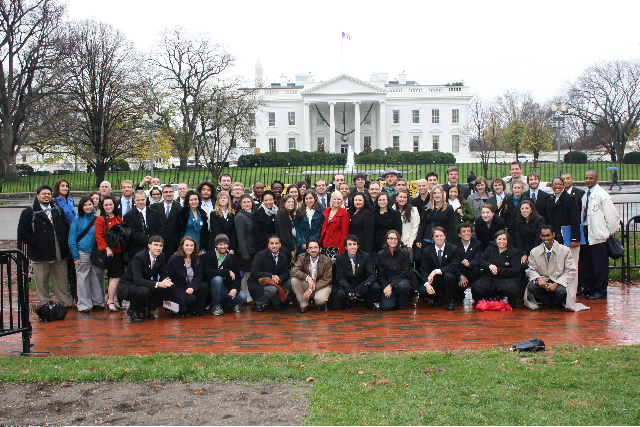
I went to the White House yesterday, as one of 150 youth climate leaders invited to take part in the Clean Energy Forum.

Let me repeat that: youth activists were invited to discuss climate policy with 4 cabinet secretaries. This is not the same movement it was two years ago, and I think the changes have been overwhelmingly positive.

A little more than two years ago, a nervous and exuberant Energy Action Coalition gathered 5,000+ youth in DC for Powershift07. Van Jones rallied us with, ‘remember, remember, the 5th of November...’ and we raised some eyebrows in DC. But mostly, we sparked the feeling of a movement in a whole new circle of leaders: young people who went home with a sense of urgency and a sense of the plan.


Two years later, a huge youth election campaign, another Powershift, 100 coal plant permits denied and a lot of green jobs created, a small selection of an amazing movement of people were welcomed to the White House as partners in crafting the clean energy future WE want to see.


The forum didn’t result in any game-changing policy commitments, but it wasn’t supposed to. It was a chance for the administration to showcase just how much better they are than the Bush administration (an underwhelming comparison, perhaps), and for them to present a convincing argument of why they are doing a great job. I think they accomplished that, acknowledging that they can do more to stop dirty energy and lead on the clean and just economy, while placing a large chunk of blame on the Senate for their deadly inaction.

The forum succeeded wildly in a different way, and an incredibly important way. We were all in the room together - a couple dozen administration staff, 80 or 90 youth leaders affiliated with the Energy Action Coalition, and another 40 or 50 clean energy leaders. We got to see what we look like, where we come from, and what issues really move us. With that focused cross-section of the movement, I realized more than ever, that we are such a diverse generation, and we are a diverse movement united in a very large goal.

Tonight, as I digest what happened yesterday, I feel most moved by the incredible diversity of the people involved in this movement and in the forum itself. Rio, a mountaintop removal activist from North Carolina asked when we can expect a fair, ambitious and binding climate treaty. A student identifying as a Chinook native from Washington state demanded to know what was being done about rampant nuclear, hydro and coal exploitation on native lands. Brett, an organizer in Missouri, asked Lisa Jackson directly: when will the EPA deny the 79 pending permits for mountaintop removal. A young leader from southern Chicago asked why the government was putting the profits of coal companies over the health and welfare of people in the neighborhoods downwind of the plants. I could go on and on.

We weren’t there to play up our own organizations, and we weren’t there to bask in the bright lights of the White House (although many of us took pictures behind the podium.) We were there to represent a huge, diverse and passionate movement that stands together in its pursuit of a comprehensive solution to the problems we see so clearly.
Alex Steffen at Worldchanging.com wrote an amazing piece a few weeks ago about why the youth of this country should be pissed.

To be young and aware today is to see your elders burning our civilization down around our ears. To hear scientists tell us we’re in the final countdown, with the risk of runaway climate change (along with the ecosystem collapses and horrific human suffering it will bring) mounting with every day we run business as usual. To hear nearly a chorus of credible voices—from doctors and scientists to retired generals and former bankers— warning that to lose this fight is to lose everything that makes our world livable and gives the future hope.


And in the face of that adversity, we grow stronger and more united, and smarter. By showing the administration who we are, how serious we are, and how smart we are, we’ve given them fuel for their work, and called them out where they fall short. And today’s event, watched by thousands of leaders and rippling outwards through the social media reflecting pool, showed a generation of activists that we are being taken seriously. The forum's genies was how it placed us firmly in the drivers seat to continue building larger and larger campaigns to the scale we need.

I know, its a bad week for news. This forum won’t get much coverage in the main-stream media. Afghanistan is a big topic, and today there’s the jobs forum. Copenhagen is starting, and a stupid incident of hacked emails is still poisoning public discourse on climate. Furthermore, its clear the world won’t sign a treaty in Copenhagen.

Two years ago, after Powershift, I watched nervously the reports coming from Bali, the COP13 conference. I felt powerless, a tiny speck while powerful negotiators changed treaty text for the worse and made snide remarks in the forums. I remember one night getting so frustrated that I had to walk away from a final paper I was writing, and stumbled around in the snow for a while. Three hours later, on a windy hill overlooking my college, I shouted at the wind in frustration and decided to increase my commitment to working for climate solutions.

The next day, the final day of Bali, bold words from Papua New Guinea forced the US negotiators to back down on a small point. This helped make the agreement to craft a binding climate treaty in two years. The agreement in Bali set the stage for Copenhagen to be the big kahuna, the conference when the successor to Kyoto would be signed and the world, with the US on board, would get serious about tackling climate.


We won’t get the fair, ambitious and binding treaty we need from Copenhagen. The best we can hope for is a strong interim agreement, and a binding promise to agree on a treaty in 6 months, by which time Obama can have a senate bill in hand and the world can move on. That’s the best case scenario. I’m not sure I need to get into the worse case scenarios, because no matter what happens, its clear that this movement needs to be bigger, smarter and ready to push harder.

Lets build off of the momentum of the White House forum. Lets be prepared to call Copenhagen a failure if it deserves it, and lets power through December to accelerate this movement into the fights ahead of us.

Read more!

Climate Conundrum Continues in Run-up to Copenhagen

Originally a the Breakthrough Institute

The United States may be stuck in the middle of a climate conundrum. A proposal to establish border tariffs to account for the carbon associated with the imported manufactured products, like steel, looks critical to securing the support of key swing Senators interested in protecting the competitive position of American manufacturing. ... Yet ... those same tariff provisions that could win passage of a U.S. climate bill are firmly opposed by China and other developing nations and could both damage Sino-American trade relations and fissure international climate negotiations.
Breakthrough's Yael Borofsky wrote that back in October, and this climate conundrum continues to present perhaps the thorniest negotiating point as world leaders prepare to meet for international climate talks in Copenhagen next week. Indeed, on the eve of the global climate talks, the negotiating positions of the United States and major developing economies, including China and India, appear to remain at loggerheads.

In a letter to President Obama today, nine moderate Democratic Senators, all key swings for climate legislation or ratification of any international climate treaty, reiterated their demands that any international climate framework U.S. negotiators sign in Copenhagen must include comparable action from all major economies and allow tariffs to adjust prices on imports from any nation that does not agree to bindings agreements to reduce emissions "in specific trade- and energy-intensive economic sectors."

"Climate change is a serious and growing threat to the United States and the world," the Senators wrote. "Smart climate change policies would guard against these risks while also spurring clean energy investments that promote economic growth and create good domestic jobs."

"Importantly, however, poorly designed climate policies could also jeopardize U.S. national interest," the Senators warned, "by imposing burdens on U.S. consumers, companies and workers without solving the climate challenge."

To address these challenges, the U.S. should seek to negotiate a new international climate agreement under which, "All major economies should adopt ambitious, quantifiable, measurable, reportable and verifiable national actions" to reduce emissions of greenhouse gases.

Furthermore, U.S. climate policy, the Senators wrote, should include provisions to implement border adjustment tariffs if necessary to help shield domestic industries facing international competition from countries that have not implemented carbon reduction requirements for their industrial sectors.

Here's the key excerpt from the letter, signed by Arlen Specter of Pennsylvania, Sherrod Brown of Ohio, Carl Levin and Debbie Stabenow of Michigan, Tim Johnson of South Dakota, Kay Hagan of North Carolina, Claire McCaskill of Missouri, Amy Klobuchar of Minnesota and Mark Begich of Alaska:
"Climate and trade policies should be designed to encourage all major emitting nations to take climate action and to deter the migration of polluting activities from one nation to another. Internationally, the United States' preferred and primary strategy ... should be to negotiate effective bilateral or multilateral agreements on reducing emissions in specific trade- and energy-intensitve economic sectors. Collectively, these new agreements -- whether negotiated under the United Nations, World Trade Organization or elsewhere -- should not only ensure emissions goals are reached but they should also integrate climate objectives into the international trade system, such as through border adjustments on imports from nations that have not yet adopted sufficient emissions control measures. ... Indeed, to promote equitable and effective global action any new U.S. climate change laws should establish a national system of border adjustments, in concert with emissions allowances or rebates to trade- and energy-intesnsive sectors of the economy. Any border adjustment policies should take effect by a date certain if appropriate international agreements have not entered force.
Simultaneously, two Indian newspapers reported over the weekend on a pre-Copenhagen summit in Beijing that included leaders of Brazil, South Africa, India and China, a group collectively dubbed the "BASIC" countries that includes the largest four emitters among the developing world.

The four BASIC nations reportedly agreed on a new draft of a negotiating position that sets all four nations up to collectively walk out on the Copenhagen negotiations if any of their "non-negotiable" planks are violated.

According to the Times of India, the four nations, along with Sudan as the head of the G77, a larger bloc of developing nations participating in the climate talks, agreed on a new draft negotiating position that argues that the Copenhagen framework should largely consist of an extension of the current Kyoto Protocol framework for a second commitment period running from 2012-2020. This seems to suggest that the carbon intensity targets recently announced by China and India would be voluntary goals, not binding commitments.

That runs counter to the U.S. negotiating position, which has remained adamant that the Kyoto Framework, which excluded commitments for developing nations including the big emitters amongst the BASIC countries, is not a workable framework. The United States rejected the Kyoto Protocol and has not participated in the international treaty's current commitment period set to end in 2012.

Furthermore, the BASIC nations' "non-negotiable" planks include a pledge to stand opposed to any global deal in Copenhagen that does not explicitly reject the use of carbon border tariffs or other measures to restrict trade in the context.

The Times of India reports (emphasis added):
Besides the elements of the Kyoto Protocol, there are "significant new features" in the draft proposal worked out by BASIC countries-Brazil, South Africa, India and China-at a meeting here on Saturday, Jairam Ramesh, minister of state for environment and forest said.

These countries have decided not to allow rich nations to make climate change an excuse to set up trade barriers or resort to trade protectionism. Rich countries should be ready to contribute funds for stopping the process of forest degradation including the one in Amazon valley in Brazil and also invest in the process of creating new forests.

The developing nations will also not accept any pressure from developed countries to establish legally binding emission targets at Copenhagen. Developing countries want to be allowed to reduce emissions voluntarily and take what they consider to be "nationally appropriate actions" he said.

Ramesh said India will under no circumstances accept the concept of a peaking year under which each country will have to indicate on what date they will reach the highest level of pollution before beginning to come down.

India will also not accept any unsupported mitigation actions without any effort by developed countries to provide funds and technology support to improve environment in developing nations.

New Delhi has also set its face against any international measurement, reporting and verification of the work done in India for environment protection.

The Indian minister said that China, Brazil and South Africa were also in agreement on these issues.
I have to note that China, India and the other BASIC countries' position on the border adjustments and emissions related to their exports is entirely inconsistent. They have continued to simultaneously argue that they should not be responsible for the emissions associated with the products they produce for export to developed nations and that the developed nations who buy them should be responsible. That's a fair and arguable point. But at the same time, the BASIC countries vehemently object to any border adjustment tariffs which would be a clear way for importing developed nations to take responsibility for the emissions associated with their imports (e.g. by internalizing the price of pollution associated with them).

The key, of course, is that China, India, Brazil and South Africa each put their economic development first and foremost, and border tariffs equal less exports. That's simply unacceptable to them (for easy to understand reasons).

I'm not exactly sure how this issue resolves, and it seems nearly impossible to imagine a U.S. Senate ratification of a treaty, let alone passage of a climate bill, that does not address the tariffs issue. At the same time, I can scarcely imagine China, India and the BASIC countries backing down on this issue given the central role exports play in each nation's economy.

Stay tuned. I don't envy the negotiators now embarking for Copenhagen...

Read more!

Foreign Manufacturers Compete for U.S. High-Speed Rail Cash

Originally Posted at the Breakthrough Institute

European and Asian high-speed rail manufacturers are courting U.S. government officials in hopes of securing contracts for some of the $8 billion dollars of federal stimulus funds ear-marked for domestic high-speed rail (HSR) projects.

According to Greenwire, foreign manufacturers are hosting country visits for federal and state government officials to see their high-speed train technologies, as well as dropping not-so-subtle hints that they will build new domestic manufacturing facilities, or expand existing ones, if they are awarded contracts.

States are also feverishly competing for federal funds. According to NPR, forty states and the District of Columbia have already filed applications requesting more than $100 billion for high-speed rail projects. The most ambitious project is a proposed $40 billion, 800-mile HSR network in California spanning from Sacramento to San Diego. Although the Federal Railroad Administration has yet to award any of the $8 billion in government funds to any state or project, companies from Germany, France, Canada, Japan, and China are hoping that early efforts to charm government officials will pay off down the road.

Notably absent from those promoting their HSR technologies are American companies. That's because the United States ceded international leadership in the transportation technology in the 1960s, when Japan became the first nation to construct a national high-speed rail network.

A recent Breakthrough Institute report, "Rising Tigers, Sleeping Giant," notes that the United States has no domestic manufacturers of high-speed rail technology, and "will rely on companies in Japan or other foreign countries to provide rolling stock for any planned high-speed rail lines." By contrast, the other countries examined in the report--China, Japan, and South Korea--all have domestic high-speed rail designs.

Indeed, most of the HSR technology and equipment that will be used in new U.S. high-speed rail projects will come from other countries. While the U.S. stimulus's "Buy American" provision would require most of the assembly of the rolling stock to occur in the United States, according the Greenwire story, "most of the work that lies at the heart of the system would be done outside the United States, with firms simply revamping existing technology to meet the needs of the U.S. market."

The Breakthrough Institute study notes that any domestic HSR projects will require international imports, but that the United States could decide to pursue a strategy of domestic technology development and technology transfer arrangements in order to localize the production of high-speed rail technology. Similar strategies in China and South Korea have enabled the successful development of domestic high-speed rail and nuclear power industries.

This seems to be the plan for at least one U.S. company. According to Greenwire, General Electric Co.'s transportation division, GE Transportation, recently announced a new high-speed partnership with China's Ministry of Railways in an effort to "catch up to the rest of the high-speed world." The plan would help GE gain technical competency in high-speed rail technology while giving China a foothold in the U.S. market.

Should state and federal governments in the United States decide to support the creation of a national high-speed rail network, a domestic technology development strategy could pay off for U.S. manufacturers, as such a network would require investments in the hundreds of billions of dollars.

Given that the United States is so far behind its competitors in high-speed rail technology, it may end up importing most if not all of the technology for new domestic HSR projects. But even if manufacturers decide to sit out the race for HSR markets in the United States and around the world, the U.S. experience with high-speed rail should serve as a cautionary parable for the perils of government complacency in growing clean tech markets.

The United States has sat and watched as Japan, Europe, and now South Korea and China have surged ahead with new HSR technologies, developing new domestic industries. We are now paying the price for our complacency with yet another clean tech import and a widening trade deficit in manufactured clean-tech products. Without more direct government investment to grow a domestic clean tech manufacturing base, the United States could see many more clean energy technologies, many of which were invented here, commercialized and widely produced elsewhere. The United States can ill-afford to allow this process to repeat itself if it hopes to compete in one of the largest future growth sectors of the global economy.

Read more!

Wednesday, December 02, 2009

David Kroodsma: Peddling to Copenhagen

[Update, 12/7/09: Dave is on his way to Copenhagen! He's been selected by HuffingtonPost as their Hopenhagen ambassador. Thanks to any WattHead.org readers who helped put Dave across the finish line.]

Writer, climate-energy expert, bicycle-adventurer, and WattHead.org contribute David Kroodsma is in the running to win the Huffington Posts' Hopenhagen ambassadorship. If he wins the contest, David will travel to Copenhagen as a citizen journalist, reporting for the benefit of all of us via the Huffington Post.

David has my strong endorsement in this contest, and I urge WattHead readers to click here and give him your vote (give him a 10!). It only takes 30 seconds to vote here.

It's fitting that Copenhagen has the world's highest use of bicycles--more than one third of residents commute to work by bicycle. I couldn't think of a better ambassador to the world's Bicycle City than David, who recently bicycled across 16 countries to gather stories and share his passion about climate change and clean energy solutions. As David peddled his bike across the United States and all the way to the southern tip of South America, he gave talks on climate change, listened to thousands of first-hand accounts of how a changing climate is viewed by the inhabitants of the Americas, and wrote about the subject for a variety of publications. Now, he has followed this amazing adventure by writing a book, The Road to Tierra del Fuego, which is due out in 2010.

David's bike and a 'friend' in the Andes of Peru, on his Ride for Climate across the Americas.

Below is an excerpt from David's forthcoming book where he talks about transportation and energy issues facing the developing world, and where he compares the city of Copenhagen with American cities. The excerpt is from David's chapter on Colombia, where he visits the city of Bogota. Bogata has promoted bicycle use and invested heavily in public transit over the past decade. This investment has had a noticeably positive effect on pollution and quality of life in the city. You can find more of David's writings at RideForClimate.com.

Something else remarkable has happened in Colombia over the past decade: the country has reduced its carbon dioxide pollution. Some of this reduction has been because of an increase in hydroelectric power—eighty percent of the country’s electricity comes from dams—and a decrease in coal-fired power.* But the Transmilenio and bikeways have also had a serious effect, perhaps decreasing Bogotá’s pollution by over half a million tons of carbon dioxide a year and cutting Bogotá’s total pollution by a few percent. Car use in Bogotá has dropped significantly, and nearly twenty percent of daily trips are via the Transmilenio, an efficient service that didn’t even exist a decade earlier. Bogotá shows that reducing pollution often has ancillary benefits. The city didn’t set out to reduce pollution. The city set out to make itself more livable, and consequently reduced fossil fuel use.

If cities in the developing world decide to copy Bogotá, how big of a difference would it make? In the next thirty years, almost all growth in greenhouse gas pollution is expected to come from developing nations such as Colombia—nations where living standards are rising rapidly. Cities in these countries are growing rapidly, and decisions made today will decide the transportation infrastructure for decades to come.

A city like Bogotá could look to U.S. cities like Los Angeles where the majority of commuters drive, or they could look to European cities such as Copenhagen where transit is evenly divided between personal automobiles, public transportation, and bicycles. Whereas the average citizen of Los Angeles produces about five tons of carbon dioxide per person through transportation, the average citizen of Copenhagen is responsible for less than one and a half tons per person from transportation.

Half of the world’s population now lives in urban areas, and the difference between these cities copying the transit system of Los Angeles versus copying the transit system of Copenhagen is thus a difference of about 10 billion tons of carbon dioxide. Given that global carbon dioxide pollution from fossil fuels is roughly 30 billion tons today, the difference between a world of Los Angeleses and Copenhagens is dramatic.
Please give David your support over at the Hopenhagen competition. You can view David's video submission to the contest here:


Read more!

Quote of the Day - December 2nd, 2009

"Attaining the 2 degree goal in the United States with existing technology will likely be very expensive. Doing so in the developing world with existing expensive technology is likely to be impossible. ...

While an emissions price is an absolute requirement for an efficient regulatory framework, it is likely not the sole requirement. Due to some imperfections in any market economy, price signals may be dampened or be short circuited. This is particularly true in the market for research and development, where it is well known that firms have incentives to under‐invest in research and development (R&D) due to the fact they cannot capture all the returns to R&D--some of those returns spill over to others in the market that did not invest as much. In this case, the emissions price cannot fully motivate the R&D market and therefore a well‐designed regulatory program will contain a role for government funding of R&D. ...

In addition to the economic rational for government support of R&D, there is a political case to be made. Spurring R&D and demonstration and deployment of financially risky technology investments may require an emissions price that is not politically viable (that is, it is too high to be politically acceptable). In this case, absent the market imperfections above, the price is simply too low to generate the needed investments and government must step in to support the required levels of from R&D and demonstration and deployment."

-Ray Kopp, Senior Fellow at Resources for the Future, in testimony before the Senate Energy and Natural Resources Committee, Dec. 2, 2009.

Read more!

Tuesday, December 01, 2009

Talking Points for Youth Clean Energy Forum

A friend of mine attending the Youth Clean Energy Forum tomorrow asked me to suggest some talking points (for the administration and fellow youth leaders) and pre-readings. Here’s what I wrote (cross-posted from LeadEnergy):

I. Any successful global climate treaty has to go beyond the traditional framework of binding emissions targets. Kyoto failed. China, India, and the rest of the developing world have made it unequivocal that they will not adopt meaningful targets. The right model is shared government investments in technology development and economic development — as per the creation of the EU and the Marshall Plan — not bindings emissions targets, which allow politicians to commit to distant targets they ultimately have little or no responsibility for achieving. The International Energy Agency says $10 trillion in global clean energy investment is necessary over the next two decades. The UN recently called for $500-600 billion annually in developing countries alone, including adaptation efforts. One alternative that could accommodate a technology and investment-centered strategy is a “carbon cap equivalency” framework, explained here by Julian Wong et al. Another has been dubbed the “Direct Kaya Approach,” a targeted, sectoral-based strategy to directly reduce the carbon intensity of economies. Another is a “national schedules” approach. Regardless, what is demanded now is massive and immediate investment to develop and deploy low-carbon energy technology across the world, without which the next global climate treaty will surely fail.

II. The Senate climate bill must be significantly strengthened, particularly its investments in clean technology development and deployment, and the Obama administration and broader climate movement (including Energy Action Coalition) should support these efforts. These issues must be addressed: (1) The bill’s greenhouse gas emissions cap is effectively non-binding for the first decade or more, due to the authorization of massive levels of offsets, and it is unlikely to drive significant near-term changes in the U.S. energy economy. (2) The bill invests far less in clean energy technologies and industries than either the American Recovery and Reinvestment Act (ARRA) or the direct investments being made by competing nations, including China, South Korea and Japan. (3) The carbon price signal established by the cap and trade program is expected to be modest and insufficient to pull emerging clean energy technologies into the market or spur significant investment in clean energy innovation. (4) The renewable electricity standard established by the bill will not ensure any increase in U.S. renewable energy deployment beyond already conservative business-as-usual projections. For a full summary of Breakthrough Institute’s 20-part analysis of ACES, which the Senate bill is based on, see here.


III. Young Americans have to get serious about the global clean energy race, and we need the federal government to invest big in clean energy education and workforce development. Without immediate action to launch a national energy competitiveness project based on large, direct, and coordinated innovation policies, we will effectively cede the clean energy industry to Asia and other competitors and miss a critical opportunity to rebuild our economy and correct the imbalances that caused the Great Recession. One of the key elements missing right now is federal energy education policy to develop the tens of thousands of young scientists, engineers, and entrepreneurs that will lead the energy innovation frontier. The Green Jobs Act and ARRA are investing good money in “green collar” technical workforce development. Now we need a large-scale federal effort to focus on energy innovation in higher education. President Obama’s RE-ENERGYSE proposal is a very important start, and a new student-led group called Americans for Energy Leadership is working to get it passed through Congress next year.

More suggested reading:

(1) “Scrap Kyoto”
http://thebreakthrough.org/blog/scrap%20kyoto.pdf

(2) “The Innovation Consensus”
http://theenergycollective.com/TheEnergyCollective/50750

(3) “Invest in New American Energy: Pathway to a Clean and Prosperous American Energy Economy”
The case for public investment: http://thebreakthrough.org/blog/BTI_Investment_Brief.pdf
Policy recommendations brief: http://thebreakthrough.org/blog/BTI_Investment_Policy.pdf

(4) “Winning the Clean Energy Race: A New Strategy for American Leadership”
http://stanfordreview.org/article/winning-the-clean-energy-race

(5) “To Make Clean Energy Cheaper, U.S. Needs Bold Research Push”
http://e360.yale.edu/content/feature.msp?id=2146

(6) “Want to Save the World? Make Clean Energy Cheap.”
http://www.huffingtonpost.com/teryn-norris/want-to-save-the-world-ma_b_173482.html

(7) “The Cap & Trade We Need”
http://thebreakthrough.org/blog/2009/04/the_cap_and_trade_we_need.shtml

More reading:
http://thebreakthrough.org/ideas.shtml
http://thebreakthrough.org/writing.shtml
http://leadenergy.org/resources/

Read more!

Senators Introduce Solar Manufacturing Jobs Creation Act

Originally posted at the Breakthrough Institute

Last month, U.S. Senators Debbie Stabenow (D-MI), Michael Bennet (D-CO), and Robert Menendez (D-NJ), as well as Congressman Dave Camp (R-MI) introduced the Solar Manufacturing Jobs Creation Act, intended to boost the international competitiveness the U.S. solar manufacturing industry. After introducing the legislation, Senator Stabenow said it was necessary to "help us win the global race against China and other countries to produce solar technology in the clean energy economy."

The bi-partisan legislation would extend the existing solar Investment Tax Credit (ITC), which offers a 30 percent tax credit for solar energy investment and deployment, to cover the construction of new solar manufacturing facilities as well. The ITC was recently given an eight-year extension in the Emergency Economic Stabilization Act (EESA) of 2008.

The new legislation would also give solar manufacturers access to the temporary cash grant program created by the American Recovery and Reinvestment Act (ARRA), which has successfully boosted the deployment of renewable technologies, primarily wind power.

The new U.S. legislation is the second in as many months that aims to support the domestic solar industry. In late October, the U.S. House of Representatives passed the Solar Technology Roadmap Act, which would require the U.S. Department of Energy to appoint a group of experts to create a long-term plan to guide solar energy R&D and the commercialization of next-generation solar technologies. While the bill only authorizes $2.25 billion for solar R&D over the next five years, it represents a sizable increase in funding and a move toward a more strategic and targeted approach to clean energy development.

If the U.S. is to regain its position as a global leader in clean energy technology, and solar in particular, much more targeted policy support is needed. Both the Solar Technology Roadmap Act and the Solar Manufacturing Jobs Creation Act are important first steps forward in developing a comprehensive clean energy economy strategy capable of revitalizing the U.S. economy and making the United States a world leader in clean energy technology once again.

U.S. Falling Behind Foreign Competitors in Solar Manufacturing

The United States has fallen behind international competitors in East Asia in the capability to manufacture and produce clean energy technologies on a large scale. China, Japan, and South Korea will build on their current advantages over the coming years and will out-invest the United States by a factor of three-to-one in clean tech sectors, according to "Rising Tigers, Sleeping Giant," a new report by the Breakthrough Institute and the Information Technology and Innovation Foundation (ITIF).

China already manufactures 30 percent of the world's solar cells, and is expected to lead worldwide growth in new solar cell manufacturing capacity, according to the report. Japan is redoubling its efforts to grow its domestic solar industry, and South Korea is emerging as a major solar manufacturer, with a focus on capturing new global market share in solar PV. By contrast, the United States' global share of solar cell manufacturing has fallen from more than 40 percent a decade ago to just 5 percent today. The Breakthrough/ITIF report concludes that without significant and targeted public investments to close the gap with its competitors, "the United States will import the overwhelming majority of clean energy technologies it deploys...which could jeopardize America's economic recovery and its long-term competitiveness while making it even more difficult to reduce the U.S. trade deficit."

Targeted Support for Clean Energy Technologies: A Strategy for a Clean Energy Economy

The "Rising Tigers" report comes at a time of increasing anxiety that the United States may lose out on the clean energy industries and jobs of the future. According to the report, the climate and energy legislation working its way through Congress, as currently formulated, will not be sufficient to close the widening clean tech investment gap between the United States and its economic competitors. Larger and more targeted public investments in clean technology will be needed for the United States to keep pace.

As we note in the report, multiple barriers inhibit the widespread deployment of, and discourage private investment in clean energy technologies. Four barriers in particular must be overcome to drive the widespread deployment of clean energy technologies. These four barriers include the significant price gap that exists between clean energy and fossil fuels, technology spillover risks that discourage investment in research and development, financial risk created by the large scale and long time horizon of most clean energy projects, and the need for new enabling infrastructure to accommodate the growth of clean energy technologies.

Not all clean energy technologies are created equal, and each of these barriers poses different challenges to different technologies. Therefore, public policy should be optimized to meet the needs of individual technologies. Other nations are making direct and targeted investments aimed at removing the barriers to clean technology adoption for specific technologies, which will give them an early advantage in the growing clean energy sector and allow them to attract much of the future private investment in clean energy technologies.

Remaining competitive in the global clean energy race will require a comprehensive federal clean energy economy strategy that invests directly in clean technology innovation, manufacturing, and deployment, as well as associated infrastructure. Both the Solar Manufacturing Jobs Creation Act and the Solar Technology Roadmap Act are commendable first steps forward as components of a broader clean energy economy strategy to help us compete with our rivals. We must build on these pieces of legislation and ensure that we have a suite of long-term and targeted clean energy technology policies on the scale necessary to match the aggressive policies of our economic competitors.

Read more!