Let's see how the "clean coal" PR hucksters at the American Coalition for Clean Coal Electricity try to spin this tragic news: a retention pond holding toxic coal ash slurry burst Monday in Roane County, Tennessee, releasing over half a billion gallons of potentially toxic sludge that swept into the nearby town of Harriman and contaminated tributaries of the Tennessee River. The resulting flood damaged 15 homes, injured one man as it knocked his house of its foundations, and has left over 400 acres of land covered by several feet of coal ash, mud and contaminated water (see video below).
Coal ash and slurry is the normal byproduct of coal-fired electricity generating, and is usually stored in giant retaining ponds near coal plants. The resulting coal slurry is frequently contaminated by heavy metals, mercury and arsenic.
Yesterday's tragedy struck at the coal ash impoundment associated with the Tennessee Valley Authority's Kingston coal-fired steam plant and released about 2.6 million cubic yards of slurry, the Tennessean reports. That's enough to fill nearly 800 Olympic-sized swimming pools, and is over 40 times more contaminated sludge than the infamous Exxon Valdez oil spill.
As usual, a picture is worth a thousand words - and a video is worth even more; you can see scenes from the environmental disaster at the photo gallery here and the video below:
Greenpeace has called for a criminal investigation into the disaster, noting that similar spills in the past have resulted in felony charges.
"Every facility like this is supposed to have a spill contingency plan to prevent this kind of disaster," said Rick Hind, Greenpeace Legislative Director. "The authorities need to get to the bottom of what went wrong and hold the responsible parties accountable."
The coal industry has a long and not-so-stellar record of coal slurry disasters.
"This is the kind of scary thing that people living with coal worry about every day," notes Dana, a West Virginia-based activist with the Student Environmental Action Coalition. At ItsGettingHotInHere.org, Dana writes:
In February 1972, Buffalo Creek Sludge Impoundment, [burst and released] a mere 132 million gallons, killed 125 people, left 5,000 homeless and thousands more with post traumatic stress disorder. In 2000, a 2.2 billion gallon coal waste dam failed in Martin County, Kentucky. The largest dam in the hemisphere is the Brushy Fork Sludge Impoundment, which holds 9 billion gallons of toxic coal waste.
The Sierra Club's Bruce Nilles, writing at DailyKos, notes:
So, this is the history coalfield residents hold in our hearts when we open our emails and see “Slurry Pond Bursts.” "There are literally hundreds of these sludge impoundments across the United States. As coal has dominated Appalachia, it has left behind a toxic legacy for residents, a legacy that will haunt the region for decades. For example, in Sundial, West Virginia, an elementary school sits just 400 yards downhill from a massive impoundment containing 2.8 billion gallons of toxic coal sludge."
Greenpeace notes that, like Exxon Valdez, the millions of gallons of coal sludge released Monday could take years to clean up, and some of the damage to the ecosystem could be irreparable.
"If the Exxon Valdez was a symbol of pollution 20 years ago, the Tennessee Coal Spill of 2008 is the symbol of it today," said Kate Smolski, Senior Legislative Coordinator for Greenpeace.
Smolski added that these local impacts represent only a small fraction of coal's negative impact.
"The really sad thing about this spill is that it's only a small example of the damage coal causes," Smolski added. "Add in global warming, tens of thousands of annual premature deaths from power plant pollution, and hundreds of mountains leveled across Tennessee, Virginia, Kentucky and West Virginia, and that's the real picture of coal."
Monday's tragic slurry spill puts the lie to the coal industry's recent multi-million dollar "clean coal" PR blitz. You simply can't argue with reality - at least not for too long.
See related posts:

Tuesday, December 23, 2008
This is "Clean Coal": Massive Coal Sludge Spill Dwarfs Exxon Valdez Disaster


Tuesday, February 03, 2009
Blasting Set to Begin Beside World's Largest Toxic Coal Sludge Dam
Activists Blockade Efforts to Begin Mountaintop Removal and Blasting Beside World's Largest Toxic Coal Sludge Dam
Originally posted at ItsGettingHotInHere.org and Front Porch blog
Please help save Coal River Mountain! Call Governor Manchin at 1-888-438-2731 and / or use our simple web form to email the governor.
Blasting Operation Endangers Community, Destroys Wind Energy Potential
Citizens of the Coal River Valley, accompanied by supporters from throughout Appalachia and supported by national allies incuding James Hansen, are blocking access to prepare Coal River Mountain for blasting. The blasting would be dangerously near to a nine-billion-gallon toxic coal sludge dam. Massey has begun work on a mountaintop removal operation on Coal River Mountain, with plans to blast over underground mines beside the sludge dam. Residents are advocating for a wind farm on the site as a safe alternative for cleaner energy and long-term jobs.
"The governor and county legislators have failed to act, so we're acting for them," Rory McIlmoil said. "Someone has to take a stand for common sense. They can't allow the wind potential on Coal River Mountain to be destroyed, and the nearby communities endangered, for only 17 years of coal. There is a better way to develop the mountain and strengthen the local economy that will create lasting jobs and tax revenues for this county, and that's with wind power."
"I fear for my friends and all the people living below this coal sludge dam," said Gary Anderson, who lives near the site. "Blasting beside the dam, over underground mines, could decimate the valley for miles. The 'experts' said that the Buffalo Creek sludge dam was safe, but it failed. They said that the TVA sludge dam was safe, but it failed. Massey is setting up an even greater catastrophe here." In 1972, a sludge dam operated by Pittston Coal Company failed and killed 125 people in Buffalo Creek, W.Va. In 2000, a sludge dam operated by Massey Energy in Martin County, Ky., released approximately 300 million gallons of coal waste that broke through into underground mines. The EPA called that the worst environmental disaster in the Southeast. Then, in December 2008, a coal ash sludge impoundment operated by the Tennessee Valley Authority (TVA) failed near Harriman, Tenn. That disaster released over one billion gallons of toxic sludge that destroyed three homes, damaged twelve more and covered 300 acres.
Residents have lost faith in their state government and taken their plea nationally. Climate expert James Hansen, the head of NASA's Goddard Institute for Space Studies, said, "President Obama, please look at Coal River Mountain. Your strongest supporters are counting on you to stop this madness."
"We can't sit by while Massey jeopardizes the lives and homes of thousands of people," said Vernon Haltom of Naoma. "Governor Manchin and the West Virginia Dept. of Environmental Protection have proven that they are unwilling to protect the citizens. What do they expect us to do? Will they wait until we're in body bags to take this threat seriously?" A 2008 report by the federal Office of Surface Mining revealed serious deficiencies in the WVDEP's regulation of coal waste dams (www.wvgazette.com/News/200901110512?page=1&build=cache). In November, WVDEP approved a permit revision allowing Massey to begin the mountaintop removal operation. Despite citizens' objections, DEP denied public participation in its decision process.
Anderson added, "We need to stop the madness and stop Massey from blowing up our beautiful mountain. We need to go with the better energy option, and that's a wind farm, which is perfect for Coal River Mountain. We could have a green energy future for the country, starting right here."
For updates, photos and video footage, go to http://climategroundzero.org
See related stories and posts:
Friday, January 02, 2009
Tests Show Toxic Water Contamination After Tennessee Coal Sludge Disaster
Coal sludge contains dangerously elevated concentrations of arsenic, EPA says
It's been nearly two weeks since a torrent of over a billion gallons of coal ash sludge spilled out of an impoundment pond near a massive coal plant in Harriman, TN, but the full horror of the disaster is still being revealed. Yesterday, preliminary results of independent water testing showed dangerously high levels of toxic heavy metals at three locations near the environmental disaster, which spans over 300 acres of land and water at the confluence of the Emory and Clinch Rivers in eastern Tennessee. And today, the EPA confirmed that elevated levels of arsenic can be found in the coal sludge now caked over the area.
 [Aerial photograph of the coal slurry disaster, taken Dec 29th, 2008. The breached impoundment pond is at center with the TVA's Kingston coal plant above and massive slurry spill below. The Emory River can be seen next to the disaster site. Photo is copyright Antrim Caskey]
The Tennessee Valley Authority (TVA), which operates the Kingston coal plant previously said the spill shouldn’t cause “any adverse health effects” unless people “regularly drink untreated river water” downstream from the plant. EPA has also said preliminary testing results show the drinking water in the area is safe.
Now however, independent testing conducted on water samples from the Emory River by scientists working in coordination with Appalachian Voices and the Waterkeeper Alliance has found concentrations of eight toxic chemicals ranging from two to 300 times higher than safe drinking water limits. Tests were conducted using standard EPA procedures and results were analyzed by scientists at Appalachian State University.
“Although these results are preliminary, we want to release them because of the public health concern and because we believe the TVA and EPA aren’t being candid,” said Robert F. Kennedy, Jr., chair of the Waterkeeper Alliance.
 While EPA still contends that drinking well and treated river water in the area does not pose a risk, they have confirmed that the sludge, which TVA had initially told residents was harmless, actually contains dangerously high levels of arsenic that would normally warrant a response under agency protocols. Arsenic is a natural element found in soil and minerals, but exposure to it can cause sickness, according to the National Institutes of Health.
Residents of the area are worried that when the coal ash dries, it will be blown around in the wind, easily filling their lungs with the arsenic-laden ash particles. "We have a 2-year-old daughter whose health is not worth the risk, even if it is a minuscule risk," said Suzanne Solomon, who rents a home about 2½ miles downwind. "I am an opera singer with mild asthma [and] I do not wish to expose [my lungs] to any dust which might become airborne. ... I do not see any way that they can keep all of this out of the air."
The coal sludge spill occurred on December 22nd, and covered over 300 acres of the eastern Tennessee county with several feet of inky black muck, destroyed three homes and damaged 42 other properties, and contaminating the nearby Emory River, a tributary of the Tennessee River which supplies drinking water for thousands. The disaster occurred 35 miles southwest of Knoxville, Tennessee.
[Aerial photo of spill used with permission from Antrim Caskey. See www.antrim-new.com/] Read more!
Scenes From an Environmental Disaster: Photos of the Tennessee Coal Sludge Spill
Photojournalist Antrim Caskey documented the devastating scenes on the ground at the massive coal sludge spill that occurred on December 22nd near the town of Harriman, TN. The spill, which is one of the worst environmental disasters in U.S. history affected over 300 acres of land and water, contaminating fish and drinking water and destroying homes and ecosystems in this verdant corner of eastern Tennessee.
Antrim's images say it all, and below the fold you'll find a photographic journey through the scene of this environmental disaster...
(Mouse over the top of the slide show to see captions, describing each image)
You can find more of Antrim's photos, including images documenting the damages of mountaintop removal coal mining in Appalachia, at www.antrim-new.com.
Related posts:
Tuesday, March 17, 2009
ATTN Matthew Wald at the NY Times: Does This Look Like "Environment-Friendly" Coal to You?!
 Writing today for the New York Times, Matthew Wald looks at the increased prospects for new coal plants that capture and store their CO2, due to investments in CCS demonstration plants included in the American Recovery and Reinvestment Act. Writing about Duke Energy's plans to build a new coal gasification plant that would demo carbon capture and storage (or CCS) technology in Edwardsport, Indiana, Wald writes:
"Duke Energy has high hopes for this two-acre plot: If all goes right, and there is a happy convergence of technology, money and federal energy policy, the construction project could become the first environment-friendly coal-fired power plant in the nation."Mnnnggggg! Sorry, wrong answer!
A coal plant that captures some (or even all) of its CO2 emissions is NOT "environment-friendly" by any stretch of the imagination. "Slightly-less-deadly," certainly. Maybe even "climate-friendly" if it captures most or all its emissions. But environmentally-friendly? Give me a break!
If we took the coal industry at their word, and actually wanted to clean up coal, we've got to look far beyond what comes out of the smokestacks. Coal is currently dirty from beginning to end, and we have to clean up each stage of the dingy fuel's lifecycle to even approximate clean.
Now, to be clear: I do not oppose research and demonstration of CCS technology. Given the scale of our global energy and climate challenge, I don't think we can afford to take the technology off the table before we even figure out if it'll work or if it'll open up a cost competitive option to accelerate the reduction of global greenhouse gas emissions. As long as CCS RD&D money doesn't come at the expense of full-scale investments in truly clean renewable energy technologies, I'm fine with a modest taxpayer investment in this technology.
What I am VERY opposed to is journalists, politicians and industry PR hacks touting "clean coal" without getting serious about what that would entail!
If we want to truly clean up coal, it's time to start with these three policies, each taking a major step (but by no means the only necessary step) to clean up one stage of the dirty-as-can-be coal lifecycle:
- 1. End mountaintop removal coal mining. How can we even start talking about "clean" coal when much of America's coal is mined by blowing the tops off of entire mountains and then dumping the rubble in streams and verdant valleys! That's about as far from "clean" as you can get, and the destructive and devastating practice should end immediately. The Clean Water Protection Act would reinstate real protections for streams and watersheds and ban the dumping of mountaintop removal rubble in these areas, a sensible step towards "cleaner" coal.
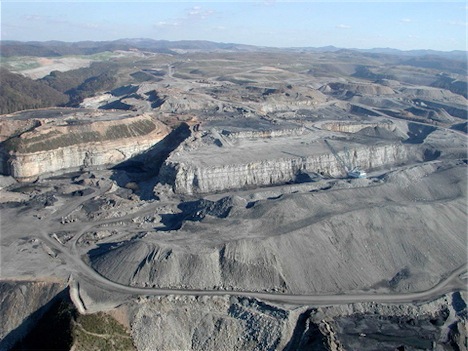 [Image: Scenes from a mountaintop removal coal mining site. Does this look clean to you, Mr. Wald?]
- 2. No new coal plants that do not capture and safely store their CO2 emissions. I'd say we start by requiring coal plants to emit less CO2 than efficient, combined cycle natural gas plants (that would require capturing and storing about 60% of their emissions) if they want to get an air permit. CA and WA have already implemented similar "emissions performance standards." Then phase up the requirement over time, to require 95%+ capture and storage before too long. After all, if new, high-tech coal plants that don't spew CO2 are right around the corner, we wouldn't to build any of those old-fashioned dirty plants then, right?
3. Require safe disposal of coal ash waste and slurry. After the devastating and massive coal sludge spill in Kingston, Tennessee just before Christmas 2008, we know too well that the dirty coal lifecycle doesn't end at the smokestacks. Even after coal is burned, we're left with billions of tons of coal ash and liquid coal slurry/sludge that must be stored and disposed of all across the country. The stuff is toxic, containing elevated levels of heavy metals like mercury and arsenic. And much of it is stored in the least safe-way you could imagine: in giant impoundment ponds of coal ash sludge and slurry, like the one that burst in Kingston, or the one that burst in Martin County, Kentucky in 2000, contaminating the water supplies of 27,000 residents, or worse-yet, the deadly spill in Logan County, West Virginia in 1972, which killed 125 people and injured over a thousand. If we're serious about "cleaning up" coal, it's time to require the safe disposal of coal ash in lined landfills, and launch a major effort to prevent future coal sludge disasters like the ones that have punctuated the history of the coal industry with far too much regularity.
 [Image: The Marsh Fork Elementary School in Raleigh County, West Virginia sits just below a major coal slurry impoundment like the one that burst in Kingston, Tennessee. Over one billion gallons of toxic coal sludge sit behind an earthen dam just 400 feet from the elementary school. Is this insane or what?]
So, Mr. Wald, until we're well on our way to implementing all of these actions, don't talk to me about "clean coal" or "environment-friendly" coal.
For more reactions to Mr. Wald's article, see "All the LTEs that's fit to print" at ItsGettingHotInHere.org Read more!
Monday, December 29, 2008
Kingston Coal Ash Sludge Spill Over a Billion Gallons: Time to Take a Hard Look at the Coal Industry
Cross-posted from It's Getting Hot in Here - dispatches from the youth climate movement, by Richard Graves, founder of Fired Up Media. One week ago, Kingston, Tennessee, woke up to find that over one billion gallons of coal ash sludge had surged out of a poorly built and poorly maintained containment pond, one of three at the Kingston Coal Plant, after the dam holding back acres of inky black and toxic coal ash sludge failed. The Tennessee Valley Authority, the federal corporation that operates the Kingston Coal Plant, first reported that 360 millions gallons of coal ash sludge had flooded over 400 acres of local watersheds and river, then the estimate was revised to 540 million gallons, and now the best estimate puts the amount as over 1 billion gallons. This puts the amount spilled as more than 100 times larger than the Exxon Valdez disaster and, in fact, more than every drop of petroleum used in the United States that day. This coal sludge spill is simply unprecedented in size and scale and should become the stunning example of exactly how dirty coal really is.
Numbers aside, as it is impossible to really comprehend the scale of the disaster in words - this is a very dramatic example of how our consumption and reliance on coal is quite literally reshaping our world. Whether by flooding 400 acres of beautiful Tennessee valleys and rivers with six feet of coal ash, or blowing the tops off of literally hundreds of mountains in Appalachia, or changing the global climate itself through massive releases of carbon dioxide - the coal industry has perhaps the greatest impact of any industry in the world - yet we barely know it.
Coal plants intake almost 20% of the United States' freshwater, uses almost half of our freight railroad capacity, and leaves behind scarred landscapes, poor and exploited communities, kills vulnerable people - in fact, the Kingston Coal plant is estimated to cut short the lives of over 149 people a year - and coal is the leading source of global warming pollutants from the United States.
Coal power devours landscapes, poisons the land and water, and yet it remains virtually unregulated in critical areas of impact. Smokestack emissions of sulfur dioxide (SOX), nitrous oxide (NOX), and mercury are regulated - to a certain extent - with SOX regulated through a Cap & Trade system that has been adopted by most large environmental groups as the mechanism to tackle global warming. However, federally mandated scrubbers on coal plants have led to the concentration of pollutants in coal ash, everything from arsenic, lead, mercury, thorium, and uranium. Yet, coal ash is not regulated as toxic waste - although the EPA is 'considering' doing so'.
The Bush Administration has even worked at redefining the word 'fill' to allow the coal industry to be unregulated by the Clean Water Act and allow the destruction of mountains and pushing the rubble into streambeds and valleys. Carbon dioxide is still unregulated, despite efforts to pass a federal climate bill and the Supreme Court ruling that the Executive Branch is obligated to regulate greenhouse gases under the Clean Air Act. Unregulated, unaccountable, and corrupt is the way that many coal companies operate. Little surprise then that TVA announced as a safety measure that residents impacted by the coal ash spill should boil their water - thereby concentrating the heavy metal contaminants - instead of providing safe drinking water to residents.
Wednesday, February 04, 2009
What If We Took the Coal Industry's "Clean Coal" Promises At Their Word
The coal industry has an image problem. They know it. And they've been spending millions of dollars on a PR ad push to convince the world that a "cleaner" variety of coal is around the corner. They can make something called "clean coal" a reality, they say.
Well, what if we took the coal industry's "clean coal" promises at their word?
First things first, we'd certainly want to get started right away on cleaning up the dirty realities of today's current coal industry practices, right? I mean, if there's some high-tech, new cleaner variety of coal coming soon, no sense continuing all these antiquated old dirty coal practices.
This video from Think Progress paints a clear picture of just one of the dirty realities of today's coal technologies:
[Note to the Reality Campaign people: this is the kind of ad you should be running!]
So if coal is going to be "clean" some day in the future, then I assume the coal industry would support new regulations to clean up and safely store all the toxic coal ash their power plants produce in the meantime, right? After all, the massive coal ash disaster in Kingston, Tennessee this December released over a billion gallons of toxic coal sludge across acres upon acres of beautiful eastern Tennessee. Studies now find high levels of toxic arsenic in the sludge that has already condemned several homes and sullied the waters of two tributaries of the Tennessee River. That sounds pretty clearly like dirty coal, not that "clean" coal stuff we've been promised, so we'd better get started on cleaning it up.
Similarly, the coal industry shouldn't mind when states like Washington and California - and maybe even the US EPA - enact emissions performance standards that ensure that the only new coal plants that can be built are those new plants that capture and store their carbon dioxide emissions you keep promising. After all, if "clean coal" is right around the corner, we wouldn't want to build any more of those dirty old-fashioned coal plants, right? So I hope you'll support us when we push for a ban on coal plants that spew millions of tons of global warming pollution into the skies.
And while the coal industry works on making good on their promises of "clean" coal, I'm sure they won't mind when states like Georgia, North Carolina and the US Congress consider (and hopefully pass soon) bans on the clearly dirty and devastating practice of mountain top removal coal mining.
You'll also support us, right, if we decide to keep our mountains intact and build wind farms instead that will provide more energy and more jobs than blowing up the mountains to get at the coal inside? That's what the Coal River Mountain Wind activists are proposing in West Virginia, and I assume since you support a clean energy future, you'll be happy to stop blowing up mountains and support clean wind power at Coal River Mountain instead.
Finally, while we wait for you to make good on that promise of "clean" coal at some point in the future, I really hope you don't mind if we turn to the clean, renewable energy sources that are already real today. Just this week alone, the Coal River Wind advocates in West Virginia were joined by folks in Michigan and Montana who also decided they'd rather get started on clean renewables and stop using dirty coal while they wait for you to roll out that fancy new "clean coal" stuff. And it's those real clean energy sources that are ready today that tens of thousands of young people will storm Washington D.C. to demand at the upcoming Power Shift 2009 summit in Washington DC, February 27th-March 2nd.
After all, the reality is that "clean coal" is still just a promise. And even if we take the coal industry at their world, it's all the more reason to get started today, cleaning up the dirty mess of today's coal technologies and deploying the clean, renewable energy sources that are already a reality today. Let's get started.
Tuesday, January 13, 2009
VIDEO: Swan Pond Road - the Kingston Coal Disaster
The following video, produced by environmental activist Summer Rayne Oakes, takes a close look at the people and homes affected by the Kingston coal disaster...
Swan Pond Road: The Kingston Coal Disaster from SRmanitou on Vimeo.
Related posts:






