Tuesday, March 31, 2009

Congressman Bob Inglis: How to Engage Republicans, even Skeptics, on Carbon Legislation

When the movement for a clean energy future looks for leaders, it often turns to rising activists like Billy Parish, environmental champions like Bill McKibben, outspoken atmospheric scientists like James Hansen, or international environmental justice heroes like Wangari Matthai.

Those who are serious about passing legislation that effectively manages carbon emissions through the United States Congress would be wise to listen to some very different voices: the 163 members of Congress (37 in the Senate, 126 in the House) who represent the “swing” votes that can make or break the effort to address climate change with federal legislation.

Congressman Bob Inglis, R-SC, gave an address for the kick-off event for Focus the Nation’s inaugural civic engagement campaign at Clemson University in 2008 and recently produced this video for the Nationwide Town Hall on Clean Energy taking place this April. In this statement and in a recent speech on the house floor, Congressman Inglis gives invaluable insight into the language and framing that can build consensus on the urgency and opportunity of managing carbon emissions with federal legislation in 2009.

Watch the video here, or read the complete transcript.

There are a few key points, and some more subtle messaging, that Congressman Inglis uses that could be of value to advocates for science-based carbon legislation. Each one can teach the movement toward a clean energy future an important lesson.

Key points:

  1. Carbon regulation is a national security issue.
  2. Climate modeling is complicated, but the chemistry of ocean acidification isn’t.
  3. Losing polar bears would be tragic; losing plankton could threaten humankind.

Subtler messages:

  1. Oil is an easy target - coming from hostile places overseas - coal is a touchy subject.
  2. Fossil fuels aren’t just dirty, they are “incumbent” technologies.
  3. Taxing carbon to invest in clean energy doesn’t necessitate a larger government.

Carbon regulation is a national security issue.

It’s a national security issue, it’s an employment issue, it’s a social justice issue, it’s a food issue and an agricultural issue, a business issue and a competitive issue, an environmental issue and an ethical issue. It’s the intersection of a lot of issues, and growing the number of voters and legislators interested in addressing it requires elaborating on more of those issues.

Climate models are complicated, ocean acidification isn’t.

The scientific consensus on climate change and it’s primarily human cause is nearly 100%, but that is based on incredibly complex models that can be challenged on the grounds of their complexity alone. Ocean acidification is a measurable effect of increased carbon in the atmosphere, and the chemical processes by which acid dissolves carbon is based on a simple chemical formula.

Losing polar bears would be tragic; losing plankton could threaten humankind.

While the existence of the polar bear is priceless, the existence of plankton has a price. It has a value easily measured in the amount of economic activity that healthy fisheries generate, and the billion or so human beings who depend on those fisheries for subsistence. Opening a hole at the bottom of the food chain could threaten a significant segment of humankind.

Oil is an easy target - coming from hostile places overseas - coal is a touchy subject.

America is ready to revolt against oil. It comes in large part from overseas dictatorships who we are occasionally at war with, and its volatile price is both a thorn in the side of middle and low-income Americans and a boon to oft-vilified oil companies. Coal, on the other hand, is a touchy subject in Congress, as America depends on it for 40% of it’s electricity.

Fossil fuels aren’t just dirty, they are “incumbent” technologies.

An incumbent enjoys an unequal advantage over challengers or newcomers. Fossil fuel based industries enjoy the advantages of deep political ties and influence, heavy government subsidies, and more than a century of practice at the art of getting their way at the expense of the public. Thinking of incumbent technologies as having an “unfair advantage” and of carbon regulation, which internalizes the external cost of carbon pollution, as a way to give new, clean energy industry a “fair chance” at competing is much more in line with conservative values than fighting “dirty” industries that “hurt” the environment.

Taxing carbon to invest in clean energy doesn’t necessitate a larger government.

While applying a price to carbon may be the most effective way to limit the amount of it released into the atmosphere, carbon regulation is not synonymous with big government. Innovative policies can both increase the price of carbon and reduce other government involvement in the market.

Full Transcript of Congressman Bob Inglis, R-SC, addressing the Nationwide Town Hall on Energy:

“Hey, Bob Inglis here from SC’s fourth district and I’m very excited to be with you. Thank you for doing this nationwide town hall meeting. It’s particularly exciting to have college students involved in this issue of climate change and solutions to our energy future because you’re the one’s who’re going to inspire the change and hopefully in labs across America and elsewhere, discover the solutions we need. So, I’m very excited to be with you and I’m excited about some ideas to pass on to you.

“What I’m finding here in Congress is some people are willing to face the science on this and cope with it…others really don’t want to talk about the science because they want to continue in some sort of state of denial. Well I think it’s getting harder to deny scientific facts about climate change. And particularly if you look at the issue of the ocean it becomes even more clear.

“What I’m trying to convince some of my colleagues of is this: even if you don’t buy the climate problems associated with our dependence on fossil fuels - especially the liquid ones that we use for transportation - even if you don’t buy that, buy the national security problems that we’ve got associated with crude oil and gasoline we get from it. If I can’t get through to them on that, then what I’m left with is trying to convince them of the science as well, and in that area what I’m finding is a lot of dispute about ‘this model or that model,’ and you can basically pick apart climate change models because it’s a great big globe, it’s a huge complicated system, and multiple systems. Modeling that is a very difficult proposition.

“What I’ve tried to do when I encounter somebody who simply wants to pick apart those models is point out to them that what’s happening in the ocean is much clearer. Even if you want to pick apart the climate change models, just consider the very simple equations, chemical equations going on in the ocean. If I’m near one of my science experiment jars, I’ll pull it out and show it to them: this, if you remember maybe seventh grade science, or eight or ninth grade, I don’t know when you did this experiment but you probably did it.

“This is an egg, a normal, regular egg from the grocery store that’s been sitting there in some vinegar. Vinegar, as you remember from high school science, is an acid, and when it encounters the calcium on this egg, the calcium gets dissolved by the acid of the vinegar. This is essentially the problem with carbon dioxide levels rising in the atmosphere and the ocean being a sink for that carbon dioxide. As it enters the ocean, it makes the ocean more acidic and that acidity causes, or will cause, the shells of calcium based plankton do dissolve, like the shell of the egg has dissolved in vinegar.

“What I go on to explain to my colleagues is that ‘wow, what a problem that presents. It’s one thing to lose somebody at the top of the food chain - we don’t want to lose polar bears or animals like that - but, if you open up a hole in the bottom of the food chain, you’ve really got a problem on your hands, because about a billion people depend on the ocean for food. So if CO2 levels in the atmosphere are causing the ocean to become more acidic, and potentially dissolve the shells of the calcium based plankton. We would open a hole in the bottom of the food chain, and the result would be a very serious impact in human life on this planet.

“The beauty of trying to, well, I guess it’s not so beautiful - the egg in the vinegar’s not so terribly beautiful - but the beauty of using an illustration like this, and I would commend you to try it with your friends and people who are doubting the models. Unlike the models which really are very complicated, this is really a very simple chemical equation, and it will happen any time you have calcium coming in contact with an acid. So it’s more certain and something that therefore should cause us to act.

“The thing that I hope also to pass on to you here today is an idea for a policy solution. There’ll be a lot of talk about cap and trade. The problem with cap and trade is that it’s a massive tax increase by itself in the midst of a recession and not very many economists recommend that. And then, it’s also got this problem of Wall Street being very disfavored at this point, and we’re talking in cap and trade of a credit system, and a federal reserve for carbon credits, and all of that sounds very familiar to the problems we’ve seen in Wall Street. If Lieberman-Warner got forty eight votes for Cloture in June 2008, I don’t see it going north of 48, I see it going downhill from 48. Of course you’ve got to get 60 in order cloture in the senate.

“While the democratic leadership may be able to push something of a cap and trade bill through the house, it’ll get over to the senate and stop. I think our goal should be to actually make law, to make progress on this, and to win the triple play of this American century. It’s our opportunity here to improve the national security of the United States by breaking free of this addiction to the fossil fuel called oil. It’s our opportunity to create jobs with new technologies and it’s our opportunity to do something about climate change.

“The way that I’d suggest we win that triple play is something better, I think, than cap and trade. It’s basically this: start with a tax reduction, that’s something conservatives can warm to, and make it a payroll tax reduction, something liberals are excited about. So, you reduce the taxes on payroll, and then in equal amount, apply a tax on carbon dioxide, so there’s no additional take to the government. There’s no tax increase there, it’s reducing one tax, and imposing a tax on something different. It’s reducing taxes on something we want more of which is Labor, Industry and income, and imposing a tax on something we want less of, which is carbon dioxide.

“If we do that, and then apply that mixture to imported goods as well as domestically produced goods, so we’re not simply exporting jobs and exporting the problem, what we can do is change the economics, so that incumbent technologies no longer have a free good in the air, and a free pass on the national security implications of that product. If you internalize those externals, attach those external costs to the products - to the fossil fuels - then the competing technology has a chance to win.

“At that point I think that we can do for energy what Microsoft and Apple did for the PC and the internet. We can break through to a future that’s not dependent on fossil fuels, and that uses newer, cleaner, job-creating fuels that also improve the national security of the United States. It really is the triple play of this American century, and I thank you for being interested in seeing that we get there, that we really do make the play, make it happen, so that we can improve the national security of the United States, create jobs and clean up the air.

“Bob Inglis here, thanks for being here, for being a part of it, and let’s see if we can win this triple play.”

By Alex Tinker, director of civic engagement, Focus the Nation

Read more!

Friday, March 27, 2009

WattHead's Jenkins Speaks on Climate Politics and Policy

I spoke about climate policy and politics on a half hour radio segment that aired March 27th on KPFA radio in the Bay Area. I joined Clear Air Watch's Frank O'Donnell to discuss the hard realities of climate politics and outline a policy strategy to make clean energy cheap that can overcome these realities.

Listen to the archived segment as streaming audio here (only available through April 10, 2009):

Terra Verde - March 27, 2009 at 1:00pm

Click to listen (or download)


Or listen to the segment as archived MP3 here.

Read more!

We're Talking Double Panes. Word. (MUSIC VIDEO)

Energy efficiency is so hot right now! Here's a little lighter fare for your Friday...


This is apparently the winner of a film competition for www.grassfedfilms.org by folks from Stanford University.

Performed by: Megan Kerins, Nick Schlag, Will Bishop,
Lyrics by: Will Bishop,
Directed by: Matt Harnack

Read more!

Thursday, March 26, 2009

U.S. Senators Introduce Bipartisan Bill to Halt Mountaintop Removal

The big news on the mountaintop removal front just keeps coming (see recent posts here and here): today, our friends at Appalachian Voices report that two U.S. senators from coal-producing states introduced bipartisan legislation yesterday to protect Appalachian streams, mountains and communities from the devastating impacts of mountaintop removal coal mining.

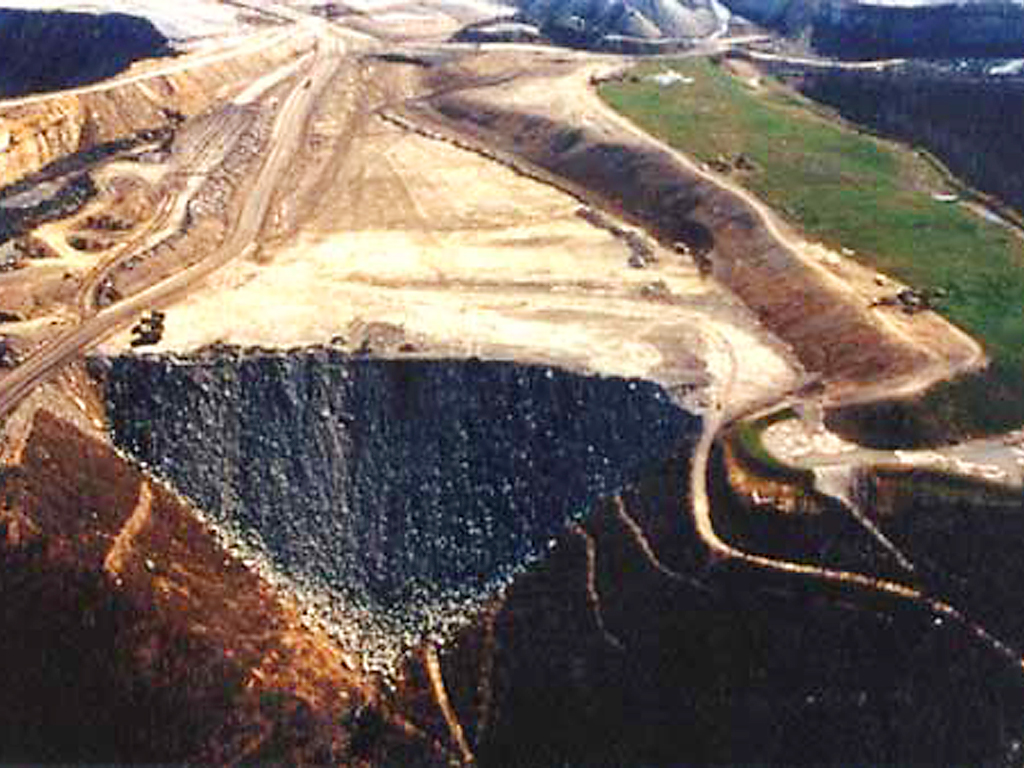
According to a recent press release, Senators Benjamin Cardin (D-MD) and Lamar Alexander (R-TN, pictured at right) introduced the Appalachia Restoration Act (S.696), which would amend the Clean Water Act to prevent the dumping of toxic mining waste from mountaintop removal coal mining into headwater streams and rivers. As incongruous as it seems, this practice of dumping the debris from entire decapitated mountains onto valleys, streams and watersheds (see image below) is commonly allowed under current (lax) interpretations of the Clean Water Act.

"It is not necessary to destroy our mountaintops in order to have enough coal," said Senator Alexander. "Millions of tourists spend tens of millions of dollars in Tennessee every year to enjoy the natural beauty of our mountains-a beauty that, for me, and I believe for most Tennesseans, makes us proud to live [there]."

As AppVoices explains:

Mountaintop removal coal mining is an extreme form of surface mining where explosives are used to blast up to 1000 feet of mountaintop in order to reach thin seams of coal. The remaining rubble, or overburden-which contains toxic heavy metals-is dumped into adjacent valleys, contaminating headwater streams where drinking water supplies originate for millions of Americans. More than 1200 miles of streams and over 500 mountains in the central and southern Appalachians have been devastated due to mountaintop removal.
"My goal is to put a stop to one of the most destructive mining practices that has already destroyed some of America's most beautiful and ecologically significant regions," said Senator Cardin, Chairman of the Water and Wildlife Subcommittee of the Committee on Environment and Public Works. "This legislation will put a stop to the smothering of our nation's streams and water systems and will restore the Clean Water Act to its original intent."

The new Senate bill is a companion bill (although not quite identical) to the Clean Water Protection Act (HR 1310) in the House of Representatives. The House bill was introduced March 4th by Demonctrats Frank Pallone (NJ) and John Yarmuth (KY) and Republican Dave Reichert of Washington and now has now has 134 bipartisan cosponsors. According to Ken Ward Jr. of Coal Tattoo,
Like the Clean Water Protection Act, pending in the U.S. House, the Appalachian Restoration Act would overturn the Bush administration’s changes to the CWA fill rule. But, this bill is much more narrow — it would not affect slurry impoundments, for example.


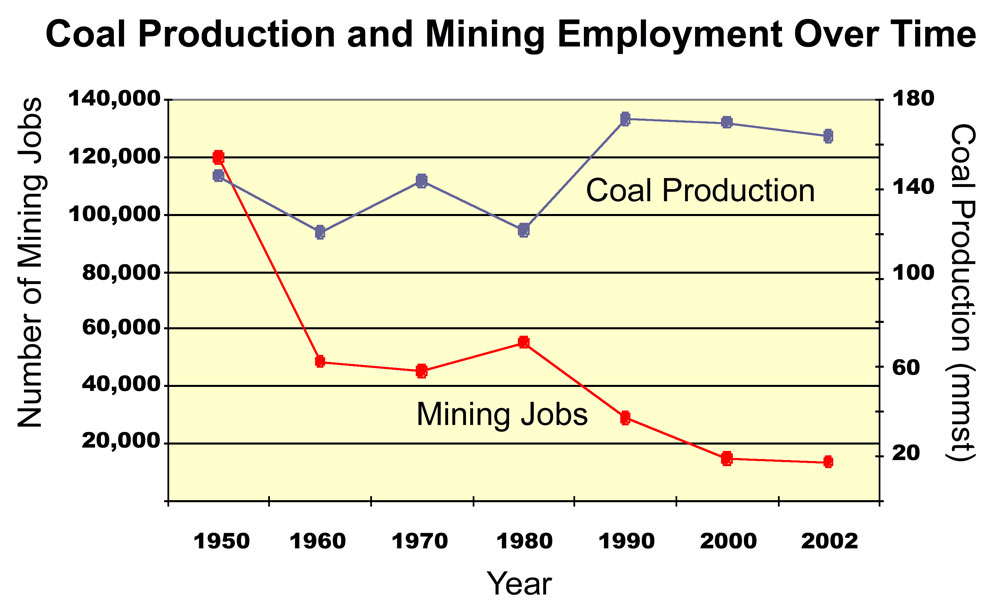
According to AppVoices, a number of recent studies, such as one by the Appalachian Regional Commission, report on the tremendous potential for employment growth in green jobs sectors, while employment in coal has been on a downward trajectory for decades. In West Virginia alone, coal mining once provided over 120,000 jobs, but that number has dropped to less than 20,000, a precipitous decline in employment driven in part by the replacement of traditional underground mining jobs with explosives-intensive and heavy-equipment-reliant mountaintop removal mining practices.


"This is not an either/or choice, it's about saving the environment and creating new jobs," said Dr. Matthew Wasson, Director of Programs at the environmental non-profit group Appalachian Voices. "Mountaintop removal does the same thing to our economy that it does to our mountains. Ending mountaintop removal will allow sustainable, long term economic growth to flourish in Appalachia."

According to U.S. Census Bureau data, counties with a high concentration of mountaintop removal mines are some of the most impoverished in the United States. (See recent post, "Mountaintop Removal Blow-Back" for more on jobs and mountaintop removal mining).


To learn more about the impacts of mountaintop removal coal mining (and to take action), visit ILoveMountains.org.

Related posts:
  • Press release from Appalachian Voices

  • "US Senate Takes on Mountaintop Removal" at ItsGettingHotInHere.org

  • "Senators one-up EPA on mountaintop removal" at Coal Tattoo

  • Read more!

    Wednesday, March 25, 2009

    Mountaintop Removal Blow-Back

    After yesterday's emotional roller-coaster ride on mountaintop removal, fueled by some bad reporting from the AP and two dueling and somewhat contradictory press releases from the EPA, we're happy to run this post from Appalachian Voices' Matt Wasson (originally posted at HuffingtonPost) taking a closer look at what's at stake in the fight over mountaintop removal. Jobs, ecosystems and communities are all on the line, so delve deep with Wasson's posts here...

    If you're a reader of the Huffington Post Green Page then you are almost certainly aware that the Obama Administration signaled a major shift yesterday in how mountaintop removal coal mining will be regulated. In brief, Obama's head of the EPA, announced a decision to delay and review permits for two mountaintop removal mining operations, an action that calls into question more than 100 additional valley fill permits now pending that threaten to bury hundreds more miles of headwater streams and destroy dozens more Appalachian Mountains.

    LINCOLN.-6.07.05

    In making this decision, President Obama also took another step in fulfilling his campaign promise to bring science back to it's rightful place in guiding the decisions of federal agencies. Over the course of eight years, the Bush Administration ignored the advice and analysis of the best scientists and systematically re-wrote the rules to allow companies to dump mine waste indiscriminately into streams. They also sought to allow higher levels of arsenic, selenium and other toxic metals from mine runoff in drinking water.

    Realizing that Bush's policies were wrong from the start, the coal industry and supporters in Congress quickly and conveniently rolled over and died.

    Not.

    Actually, the blow-back was immediate and fierce from the mining industry.

    Here's the response of the National Mining Association:

    This action, which applies to all mining-related 404 permits in the region, puts thousands of mining jobs and coal production in Appalachia at risk. While on the one hand the administration is spending billions in stimulus jobs, it is taking away the highest paying jobs in the region by delaying needed permit approvals. This is not good for jobs or for energy security.

    All of this pressure appeared to elicit an immediate backpedaling by the EPA, which issued a statement last night that seemed to contradict the early media reports. Moreover, West Virginia Governor Joe Manchin quickly took to grandstanding and went straight to Washington today to talk with Administration officials about impacts on West Virginia's economy.

    All of these conflicting reports have left opponents of mountaintop removal with a little whiplash, but they should not be distressed. There is no question that the EPA's move signaled a seismic shift from the Bush Administration's lax enforcement of environmental laws, and the back-pedaling doesn't change the fact that EPA is going to bring actual science back into the permitting process.

    One of the most valuable aspects of all of this is that we now have a very complete picture of the coal industry's justification for why Obama should allow the destruction of the nation's oldest and most biologically diverse mountains, and the pollution of the headwaters of many eastern rivers to continue under the Bush Administration's rules. Here's their reasoning:

    14,000 mining jobs are at risk.

    The savvy Huffington Post reader will probably be thinking: "14,000 jobs? Didn't the auto industry just layoff 100,000 employees? You're telling me that we are turning the oldest mountains in America into a parking lot for the sake of 14,000 jobs?"

    On the surface, this would certainly be a justifiable reaction. The numbers are miniscule compared to the total number of jobs in the region and the numbers we've been hearing about mass layoffs across the country over the past 6 months. According to a report from the Bureau of Labor Statistics,

    Employers took 2,769 mass layoff actions in February that resulted in the separation of 295,477 workers, seasonally adjusted, as measured by new filings for unemployment insurance benefits.

    But this misses a number of important points. In defense of the mining industry, 14,000 fairly high paying jobs mean a lot in this region, which is among the poorest in the country and already suffers rampant unemployment.

    But the most important point is that no jobs are being lost right away as a result of the EPA's decision. Anyone who says otherwise is posturing or bluffing.

    All the EPA's announcement means is that they will temporarily maintain the status quo that has been in place since March of 2007 when a federal district court judge suspended the permitting of most valley fills until the lax Bush Administration enforcement and evaluation standards were improved. There is not a single mine that will be shut down as a result of the EPA's decision.

    Presumably, mountaintop removal enthusiasts are really more concerned that new mountaintop removal mines will not come online as older mines reach the limits of their economically productive capacity and shut down. That is certainly what the author of this post would like to see happen, which may or may not make it a legitimate concern from the coal industry perspective, but it certainly changes the discussion dramatically in terms of impacts on the local economy.

    To be precise, if the EPA cracks down on mountaintop removal permitting what we're talking about is phasing out some proportion of 14,000 strip mining jobs in Appalachia over the next decade. But is this a significant number? Significant enough to justify what Vanity Fair has called "the greatest act of physical destruction this country has ever wreaked upon itself?"

    As an exercise - the EPA is not clear on how far they will go in reining in mountaintop removal - let's look at what might happen if the EPA completely eliminated all forms of surface mining, including mountaintop removal, in Appalachia over the next decade. I have created a number of PDF summaries of studies and reports on this subject that can be downloaded individually for those who want more detail, but here's a quick synopsis.

    1. The only study that directly addresses the question of how restricting valley fill permits would affect the economy was conducted by a well-respected coal industry consulting group called Hill & Associates (H&A) in 2001. According to the study, restricting valley fills to watersheds no larger than 35 acres in size (basically cutting the amount of mountaintop removal mining in half) would decrease overall coal production by about 15% in Central Appalachia. This reflects a 65% decrease in mountaintop removal with a 10% compensatory increase in underground mining.

    The employment impact of this change would be 1,345 jobs. Here's a graph showing the difference between a baseline projection and a projection based on restricting valley fills to less than 35 acres (again, meaning mountaintop removal coal production would be reduced by about 65%):
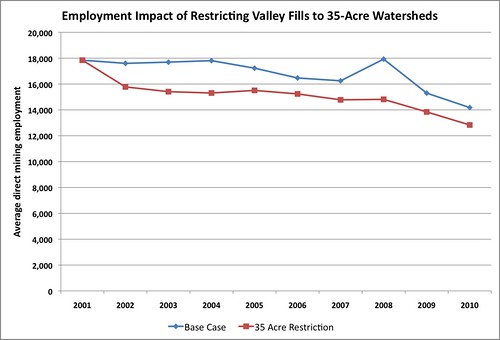
    Employment_HnA_study

    Another important point made by the H&A study is that even if no restrictions on permitting were put in place, both production and employment were projected to decline by 20-25% anyway because the most of the high-quality, easy to get coal is already mined out. Here's a quote from the study:

    "... the general downward trend of total tonnage from the study region under all cases is a result we see across many modeling projects.. [it]is exacerbated toward the end of the 10-year study period by the fact that significant blocks of higher-quality Central Appalachian reserves are starting to be exhausted. The better-quality coals in this region are slowly but surely being mined out."

    A final fascinating aspect of this study was that it also looked at how restricting mountaintop removal would affect the electric rates of consumers that rely on this coal for electricity. The impact would be somewhat less than 1% on electric bills.

    Let me repeat: reducing mountaintop removal by 65% would lead to a wholesale electric rate increase of less than 1% in states relying on this coal and an increase in residential electric rates even smaller than that.

    Here is my summary of the H&A study
    And here is the original study

    2. According to several coal industry insider publications, the decline in coal demand resulting from the recession is likely to lead to many more underground mines being idled. According to the February 16th edition of the Coal & Energy Price Report:

    Given the weak economy and downward pressure on coal prices, in general, the table suddenly has tilted in such a way that more underground mines will be in danger of falling off the cliff. Deep mine operators who have been reluctant to idle mines in the face of a potential forced shut- down of surface jobs might re-think their hesitation.

    Given that underground mines employ 1.5 times as many miners per ton produced as surface mines do, this almost certainly means that EPA's action will actually protect jobs in the short term. But other industry reports show why relying on more mining jobs is a poor response to the economic crisis anyway. Here's a quote from the March 23rd edition of the U.S. Coal Review:

    Most large producers have already announced sizeable trimming efforts, and reductions by smaller operators, while more difficult to estimate, are no doubt taking place. But in the current market environment in which demand is seriously slumping, the cutbacks are expected to continue in fairly big numbers.

    Here is a link to some more excerpts of recent coal industry news

    3. According to a 2005 report from the Appalachian Regional Commission, employment in the mining industry is one of the best predictors of poverty and other elements of "economic distress" in Central Appalachia. Here's an excerpt from the study:

    "Of all the regions in this analysis, Central Appalachia has been one of the poorest performers in relation to the ARC's economic distress measure over time. Furthermore, and unlike all other regions in the U.S., current and persistent economic distress within the Central Appalachian Region has been associated with employment in the mining industry, particularly coal mining."

    But people in Appalachia have long known that it's more than just "coal mining" that's the problem and that mountaintop removal specifically destroys far more jobs than it creates. If mountaintop removal created prosperity it should have done so decades ago. Instead, the counties where mountaintop removal occurs are among the poorest in the nation, with high unemployment rates and rapidly dwindling populations. The stark reality is that few industries want to follow mountaintop removal. After all, what entrepreneur wants to open a new business in a community where massive blasts are cracking the foundations of people's homes, where hundred-year floods are an annual affair, and where the tap water looks like tomato soup and smells like rotten eggs?

    This map, produced by Appalachian Voices, shows the dramatic correlation between mountaintop removal and poverty rates in Central Appalachia:
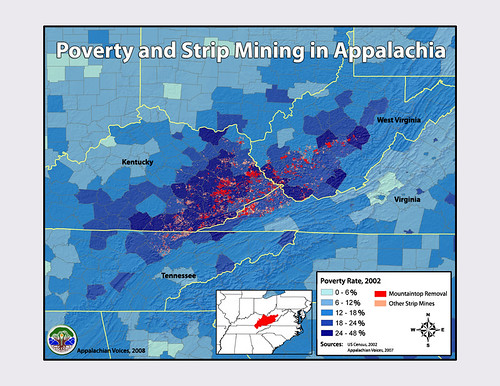
    PovertyMTRmap

    This ARC study also offered an excellent roadmap for Central Appalachian coal counties looking to improve their economic conditions:

    "The counties that have emerged from distress in the region have consistently had fewer jobs in mining and a greater number of jobs in manufacturing when compared to the counties that have remained persistently distressed."

    The study also said:

    "...regional economic development is most likely to take place when national policies create the conditions to support it. As such, addressing persistent distress would seem to require a renewed national commitment, similar to the one that inspired the establishment of the ARC and the regional development policies of the 1960s."

    Sounds like President Obama is already on the right track with his green jobs and economic stimulus plans (unlike the coal state politicians that have a remarkably single-minded focus on an industry that supplies less than 2% of the jobs, but a much higher proportion of campaign contributions).

    Here is a link to some more excerpts from the 2005 ARC report

    That sums up the first part of the argument why President Obama should ignore the sky-is-falling predictions, disingenuous arguments and plain, old-fashioned rigged numbers that the coal industry and their supporters are throwing at him. The subject of a later post will be all of the opportunities there are and initiatives already underway in Central Appalachia to create new green jobs and diversify the economy beyond such a heavy reliance on coal.

    As a preview, here's a link to another recent study by the Appalachian Regional Commission that came out just a few weeks ago. According to the story by Ken Ward at the Charleston Gazette:

    An estimated 15,000 jobs per year for the next five years could be created, for a total of 60,000 new jobs, the study said. Annual energy bill savings would be almost $800 million, with that amount rising to more than $27 billion per year by 2030, the study concluded.

    Now there's some job numbers that might really start getting out of the economic doldrums.

    More tomorrow...


    Read more!

    Tuesday, March 24, 2009

    President Obama and Secretary Chu Deliver Double Dose on Energy Innovation

    Originally posted at the Breakthrough Institute

    Both speaking to the public yesterday at separate events, President Barack Obama and Energy Secretary Stephen Chu highlighted the administration's plans to make unprecedented investments in clean energy innovation.

    Speaking at the White House, President Obama continued to advance his post-environmental, innovation and investment-oriented energy agenda.

    After a spot-on introduction from articulate energy innovation advocate and MIT President Susan Hockfield (see related post), President Obama highlighted the unprecedented energy innovation investments in the stimulus bill and reiterated his pledge to invest $15 billion annually in the development of new, clean and efficient energy technologies.

    Obama also promised a ten-year commitment to make the federal Research and Experimentation Tax Credit permanent in order to encourage greater private sector investment in the kind of innovation that truly drives long-term economic growth.

    Obama's speech yesterday though was less notable for the policy announcements, which outside of the pledge to make the federal R&D tax credit more reliable were hardly news. What was more remarkable was that the President appears to be refining and committing to a truly post-environmental energy agenda, one focused on energy innovation and spurred by public investments to support our nation's best and brightest minds.

    Obama has not only surrounded himself with advisers who truly get the energy innovation challenge -- both formal advisers like Secretary of Energy Steven Chu and his newly-confirmed chief science adviser, John Holdren, as well as informal advisers like MIT President Susan Hockfield and UC Berkeley energy expert Dan Kammen -- but he has repeatedly decided to put them front and center, as he did again yesterday, giving them the spotlight as chief advocates of the Administration's clean energy agenda.

    Furthermore, the President couches his clean energy plans in arguments about economic recovery, global competitiveness and energy security with increasing skill.

    In this latest speech, Obama even issued a Sputnik-Moment-like call for the nation's best and brightest innovators to tackle our energy challenges:

    "[I]nnovators like you are creating the jobs that will foster our recovery -- and creating the technologies that will power our long-term prosperity.

    So I thank you for your work. It's said that necessity is the mother of invention. At this moment of necessity, we need you. We need some inventiveness. Your country needs you to create new jobs and lead new industries. Your country needs you to mount a historic effort to end once and for all our dependence on foreign oil.

    And in this difficult endeavor -- in this pursuit on which I believe our future depends -- your country will support you. Your President will support you."
    President Obama now appears poised to make unprecedented and much-needed investments in energy R&D on the scale of $15 billion annually, exactly what is necessary to truly spark the kind of revolution in clean energy technology needed to overcome the climate and energy challenge.

    What remains to be seen is if he plans to pledge the full support and scale of public investments necessary to quickly take these technologies from the lab to the marketplace and rapidly drive the deployment of emerging clean energy sources; if he will usher in critical investments in enabling infrastructure, like a new 21st century electrical grid; and if he will coordinate all of these efforts to truly make clean energy cheap. Still, Obama's increasingly powerful calls for energy investment and innovation are highly encouraging.


    Backing Up Obama, Secretary Chu Speaks on Energy Innovation As Well

    Steven-chu-lab.jpg
    While President Obama spoke in Washington, Energy Secretary Steven Chu spoke at Brookhaven National Laboratory in Long Island to highlight a new $1.2 billion investment in basic science and innovation at the National Labs funded by the stimulus and continue to flesh out the Obama Administration's plans to spur economic recovery through energy innovation.

    Andy Revkin at the New York Times' Dot Earth blog summarizes Secretary Chu's remarks:
    After visiting various research buildings, he gave a pep talk on the energy revolution he said was vital if the United States and the world are to avoid conflicts over limited supplies of oil and eventual disruptive impacts from human-caused global warming.

    Over and over, in examples from the first transcontinental telephone call to the transistor to methods for synthesizing ammonia (and thus nitrogen fertilizer), Dr. Chu pointed out how great technological advances benefiting society grew out of fundamental breakthroughs in basic science.
    Revkin reports that Dr. Chu concluded his remarks by (again) echoing our call for a National Energy Education Act to train a new generation of talented scientists, engineers and entrepreneurs:
    Now, [Dr. Chu] said, the country's challenge is to grow a generation of energy innovators, a challenge made harder because innovation has never been much of a priority within the energy industry.
    To ensure we have the intellectual and human capital needed to tackle the grand energy innovation challenge, it seems Secretary Chu is in 100% agreement that it's high time for a major public investment in energy education.

    Read more!

    BREAKING: EPA Puts Breaks on Hundreds of Mountaintop Removal Mining Permits

    [Update and correction posted, 3/25/09:

    It seems that AP and about a dozen other news reports misinterpreted EPA's statements on mountaintop removal. EPA issued a grumpy and disheartening clarification statement late yesterday afternoon stating that they were only putting a hold on two permits filed by the US Army Corps of Engineers and as far as the hundred or so other permits held up until recently by 4th Circuit Court litigation, EPA says they "will take a close look" but they "fully anticipate that the bulk of these pending permit applications will not raise environmental concerns."

    WTF?! So EPA doesn't think that decapitating entire mountains then dumping their remains on top of verdant valleys, streams and watersheds might raise any “environmental concerns?!” I'd of course expect this from Stephen Johnson and Bush and Co's EPA, but I sat there at Power Shift 2009 when Lisa Jackson promised that EPA was "back on the job" and vowed that science, not industry interests would rule again at EPA. Guess some things don't change much...

    See the related stories at end of post for more analysis of yesterday's roller-coaster ride, courtesy of the EPA's dueling press releases.]

    BREAKING NEWS: EPA Administrator Lisa Jackson announced today that her agency would put the breaks on hundreds of permits for new coal mining projects using the devastating practice known as mountaintop removal. The process decimates entire mountains to get at the coal inside before dumping debris in adjacent valleys, burying watersheds and streams and displacing neighboring communities.

    According to AP:

    The Environmental Protection Agency is putting on hold hundreds of mountaintop coal-mining permits until it can evaluate the projects' impacts on streams and wetlands.

    The decision was announced Tuesday by EPA administrator Lisa Jackson. It targets a controversial practice by coal mining companies that dump waste from mountaintop mining into streams and wetlands.

    It could delay more than a hundred permits being sought by companies wanting to begin blasting mountaintops to access coal.

    The EPA also denied two permits the Army Corps of Engineers was planning to issue that would allow companies to fill thousands of feet of streams with mining waste in West Virginia and Kentucky.

    The agency says the projects could damage aquatic resources.

    This brief but much needed respite gives time for activists and affected communities to redouble efforts to press for a permanent end to mountaintop removal. Passage of the Clean Water Protection Act in Congress or administrative action by President Obama and the EPA could severely curtail or even permanently end this destructive practice.

    You can take action to hasten the end of mountaintop removal here and here. PowerPastCoal.org is also encouraging citizens to call the White House switchboard (1-202-456-1111) and write letters to the editor to their local papers (samples provided) thanking President Obama and the EPA for cracking down on mountaintop removal.

    Related posts/stories:

  • ItsGettingHotInHere.org: "EPA Puts Halt on Mountaintop Removal Permits"
  • ItsGettingHotInHere.org: "Mountaintop Removal Bummer Correction"
  • NRDC Switchboard: "Making Sense of EPA's Mountaintop Removal Action"
  • HuffingtonPost: "Mountaintop Removal Blow-Back"
  • Coal Tattoo: "Mountaintop Removal Moratorium -- NOT!"
  • Read more!

    Sunday, March 22, 2009

    Why We Must Make Clean Energy Cheap

    In the first of what will be regular monthly posts written exclusively for the Energy Collective, I explore the need for a new strategy to make clean energy cheap. I am now a featured blogger and editorial board member at the Energy Collective and will be joining the discussion there regularly. Power. Policy. Climate. The Conversation happens at the Energy Collective.

    Renewing America’s economy, responding to the threat of global climate change, and finally securing the nation’s energy independence all compel the transformation of United States energy system. Accomplishing this transformation requires the rapid development and deployment of a suite of clean, affordable, and scalable energy technologies.

    In short, we must make clean energy cheap, a strategy that represents a significant departure from traditional approaches to climate policy...

    For the full post, head to the Energy Collective here.

    Read more!

    Being Smart and Efficient on the Stimulus and Careers

    I've recently been working in St. Paul Minnesota on how we're applying the stimulus funding around efficiency. I wanted to call a tension to a potential hurdle for successful climate solutions: We need to make sure that initial investments actually help change the market.

    Minnesota is slated to receive about $131.5 million in federal stimulus funding for weatherization and energy efficiency to be spent over the next 18 months, plus about another $54 million in conservation block grants for the state. That's a lot of money coming in quickly, and energy efficiency is just one small part of a series of investments in renewable energy, job training, infrastructure improvements, and economic aid in the recent federal stimulus package.

    This is all very good news. Major investments in efficiency and weatherization are an excellent idea (I explain why at a note at the end of this blog post). The problem is that current market barriers are keeping energy efficiency, which ought to be a no-regrets, win-win-win solution, from being adopted at scale. No one in their right mind would let a 20% low-risk financial return go by, especially these days in a falling economy, yet we do exactly that every day by throwing money out the cracks in our doors and the cold drafts that blow through our un-insulated walls. There are many reasons that we are missing these opportunities - lack of information, lack of access to capital, obscure and complex auditing and contracting services, and little feedback as to how much energy, money, and carbon one is wasting. If we can solve these barriers, hundreds of billions of dollars of investment will flow towards this sector on a sustained basis, helping all Americans cut their energy costs and carbon emissions while creating long-term sustainable jobs. If initial investments (even the roughly $200 million dollars that the stimulus package might provide to Minnesota) only go towards paying for efficiency in some more houses, we will have just scratched the surface and end up with the same stunted efficiency market we have right now. The stimulus funding will only help solve that problem if it is deployed rightly.


    Part of the problem is the speed at which the money must be spent - within the next 18 months. For efficiency, this scale of funding means a factor 5 or more expansion of the workforce, meaning that several thousand new efficiency contractors will need to be trained and employed in record-breaking time (this also risks low-quality works). The problem is that unless funds are invested strategically to change the way the market works, in 18 months the funding will be gone, demand for efficiency will drop, and those thousands of people will be back out of work. $200 million just scratches the surface of the changes we could make in Minnesota alone.

    What we need to make the efficiency market work is:

    1. The creation of financial mechanisms that allow us to cycle funds and even generate a return. I did this at a small scale ($100,000) as a student at Macalester College through the Clean Energy Revolving Fund. There are a number of technical and policy strategies to do this at a much larger regional scale.This is the step necessary to make sure that funding is not a one-shot deal, and to attract much larger amounts of capital from the private sector over time.
    2. Build the capacity for growth and sustained interest through enterprises that do outreach through community networks - efforts that engage large numbers of people at the local level through peer-to-peer engagement strategies and relationships with existing community partners such as churches, schools, local business associations, and community organizations have been shown to create economies of scale, allow quality control of work, and create the motivation for sustained engagement.
    3. Create training programs that produce quality work at low cost, are accessible to new workers without advanced skill-sets, and focus on creating employees capable of not only insulating your walls, but helping you walk through and understand the process.
    4. Empower residents and neighborhoods as leaders of the clean energy economy by pursuing policy changes that make information more accessible (ie energy bills that are understandable and interesting), provide feedback through home smart meters and social norms, and encourage collaboration and innovation at the local level (advancing a smart-grid where all of us can manage, produce, and sell energy similarly as information flows in the internet).

    Basically, the stimulus should do more than throw money at the problem. It should invest strategically in the infrastructure that will provide a solution in the long term. A solution that will be many times larger than the quick infusion of funding provided by the stimulus, and that will put us on track for a revitalized economy.

    As my recent blog posts mention, I have been working with hundreds and thousands of young people for these types of solutions at both the state and national policy levels. In the realm of residential energy efficiency in particular, I have been going much deeper, working over the past year and a half to launch a start-up phase co-op (Cooperative Energy Futures) working with residents and neighborhoods to improve energy efficiency using a model that seeks to transform the energy efficiency market as described in the 4-point plan above. Recently, this adventure has taken me to the state legislature as the stimulus allocation plan is being developed, which is when I started to worry about the short-sightedness of the quick-fix stimulus approach.

    If you are interested in linking up with Cooperative Energy Futures to start applying this emerging approach with your neighbors or any group of interested friends, or want to work with us to figure out how to implement efficiency at scale, please contact us through our Interest Form.

    Here's why major investments in energy efficiency make so much sense:
    America's 112 million housing units make up 35% of our electrical consumption, about 1.145 trillion kilo-watt hours per year. If you multiply that by the 11.47 cents per kilowatt hour that the average American paid for electricity in 2008 (according to the DOE), that's $131.3 billion that residents are throwing to the coal industry, the nuclear industry, and other big energy providers (incidentally the fossil energy sector is the sector of the economy controlled by the fewest, biggest companies that have virtual control on the market, and create fewer jobs per dollar than most sectors of the economy while causing massive negative costs on society through air and water pollution, land degradation, and the wide economic impacts of climate change). And this isn't even counting small businesses, or other sectors of the built environment, or natural gas and other sources of home heating. If the big numbers make your eyes glaze over, go look at your energy bill for a reminder of how much money you are losing. For most Minnesotans, it is upwards of $2,000 per year - much more for very large homes. The impacts of this energy cost disproportionately affect lower-income Americabs, both because their energy bill takes up a larger percentage of a smaller paycheck, and because low-cost housing tends to be inefficient and poorly insulated - making it high on energy costs. Similarly, the long-term impacts of burning all of this fossil fuel hurt people without the resources to compensate the most - like lower-income residents of New Orleans or places you are less likely to hear about, like flooded Bangladesh or drought-stricken areas in Africa.

    The reason that investing so much stimulus money in efficiency is a great idea is that simple improvements (with paybacks less than 5 years) in home energy efficiency can cut energy usage in the range of 20-30%, helping keep money in our communities and reduces our collective investment in energy dependency and global warming. Deeper investments, with paybacks on the range of less than 10 years, can cut home energy usage by over 50%. The dramatic increases in home improvement trades like energy auditors, insulation contractors, and furnace replacers is also a huge boon for job creation - efficiency improvements yield far more jobs per dollar than any other source of energy (renewable energy creates several times more jobs per dollar than fossil fuels, and efficiency creates even more). It makes excellent sense to invest federal funds in this sector - it saves money for those who are struggling most in a tight economy, creates lots of job, improves our built infrastructure over the long term, and helps us start the journey to a post-carbon economy.

    Read more!

    Friday, March 20, 2009

    Obama Has the Power to End Appalachia's Agony

    [Updated: 3/20/09 at 2:20 pm PST, see below]

    I'm not sure how, but I missed this excellent editorial in the New York Times on Monday. The Times editorial board seems to have fully grasped the horror and tragedy of mountaintop removal coal mining. Remarking on an upsetting recent court ruling that paves the way for the devastation of more mountains, ecosystems and communities in Appalachia, the ed board writes in "Appalachia's Agony:"

    "The longstanding disgrace of mountaintop mining is now squarely in President Obama’s hands."
    Indeed it is. And it's high time for President Obama, who said during the campaign that he "did not support" the dastardly practice, to direct his administration to take action and end Appalachia's agony. Read on for the full editorial...
    Editorial
    Appalachia’s Agony
    Published March 16, 2009

    The longstanding disgrace of mountaintop mining is now squarely in President Obama’s hands.

    A recent court decision has given the green light to as many as 90 mountaintop mining projects in Appalachia’s coal-rich hills, which in turn could destroy more than 200 miles of valleys and streams on top of the 1,200 miles that have already been obliterated. The right course for the administration is clear: stop the projects until the underlying regulations are revised so as to end the practice altogether.

    Mountaintop mining is just what the name suggests. Enormous machines — bulldozers and draglines — scrape away mountain ridges to expose the coal seams below. The coal is then trucked away, and the leftover rock and dirt are dumped into adjacent valleys and streams.

    Both John McCain and Barack Obama vowed to end the practice during the 2008 campaign — even though no recent administration, Democratic or Republican, has been willing to take on Robert Byrd, West Virginia’s senior senator, or the coal companies, which insist without proof that there is no other cost-effective way to dispose of the waste.

    There is a long and tortured legal history surrounding mountaintop mining, but the essential question is this: Is dumping mine waste into streams a violation of the federal Clean Water Act?

    On its face the answer is yes, but various regulatory maneuvers have allowed this practice to proceed. The worst of these was a 2002 rule by the Bush administration that in effect removed mining waste from the list of the law’s prohibited pollutants. The rule has made it easy for the Army Corps of Engineers to issue mining permits and hard for the courts to deny them.

    A bipartisan group of 119 members of the House recently reintroduced legislation that would redefine mining waste as a pollutant. In so doing, Congress would reassert the original intent of the Clean Water Act and end the practice of dumping waste in valleys and streams. Until that bill becomes law — if, indeed, it ever does — a great deal more damage could occur in Appalachia. Two companies that have been awaiting the court’s go-ahead have now said that they will resume mining operations.

    The Obama White House can prevent that damage. Under the law, the Corps of Engineers can suspend the mining permits in the public interest. This in turn would give the administration time to review the rules and issue new ones that would be more protective of the environment. But the Corps of Engineers, always reluctant to reverse itself and historically friendly to industry, will not act without orders from on high.

    Mr. Obama promised to find better ways of mining coal “than simply blowing the tops off mountains.” The time to do so is now.
    Bravo to the New York Times ed board. You can take action to urge President Obama to put an end to mountaintop removal here.

    Congress also has the power to end mountaintop removal mining by passing the Clean Water Protection Act. Appalachian Voices and other coal-field advocacy groups brought hundreds of citizens to Washington D.C. to lobby for passage of passing the Clean Water Protection Act this week. You can add your voice to theirs here.

    [Update:] Ken Ward Jr. at Coal Tattoo (an excellent blog at the WV Gazette) that we should expect a decision from the Obama Administration shortly:

    President Barack Obama’s top aides will be making a decision “very soon” about what they will do about mountaintop removal, according to congressional testimony today from Nancy Sutley, chairwoman of the White House Council on Environmental Quality.

    Sutley told lawmakers her staff have been meeting with EPA, the Corps of Engineers, the Department of Justice and the Office of Surface Mining, discussing the issue, reviewing the February decision by the 4th U.S. Circuit Court of Appeals, and examining a flood of pending permits at the corps office in Huntington.

    “We’re trying to get a handle on what’s out there and what we may be able to do about it,” Sutley told the House Appropriations Committee’s Subcommittee on Interior, Environment and Related Agencies.

    (H/T to Rob Perks at Switchboard)

    Read more!

    Thursday, March 19, 2009

    The Challenge Ahead: More than a Third of Senate Now "Swing" Vote on Climate

    Originally posted at the Breakthrough Institute

    A high hurdle: of the 37 Senators identified as swing votes, all but seven must be convinced to vote "Yes" in order to secure passage of any climate policy in the U.S. Senate.

    There's been a spate of recent public announcements from moderate Democrats and Republicans alike, voicing caution about a proposed cap and trade program to place a price on carbon dioxide and cut global warming pollution. More than one third of the U.S. Senate now joins the fifteen moderate Democratic Senators we've dubbed the "Technology Fifteen" as vocal swing votes in the upcoming debate on climate policy.

    Below the fold is an updated tally of where the Senate stands on climate policy by my assessment, based on recent public announcements and past voting histories. With using budget reconciliation to bypass the 60-vote filibuster hurdle off the table, to secure passage of any climate policy in the U.S. Senate, all but seven of the 37 Senators I identify as swing votes must be convinced to support the proposal (joining the 30 Senators I classify as "Assumed Yes" votes).

    I provide the vote count below without further comment, and will delve into the implications of this tally in further detail in an upcoming post...

    The following codes after their names indicate factors considered in assembling this vote tally:

    *- Voted "Yes" on Lieberman-Warner cloture vote; ^- newly-elected Senator; T- "Technology Fifteen" (aka "Gang of Fifteen"); M- new group of moderate Democrats announced by Senator Bayh; B- Publicly opposed to using Budget Reconciliation process to override filibuster; italic- Republican Senators

      Swing Votes: 37
    Likely Leaning Yes: 9

    Baucus (D-MT)*B
    Tester (D-MT)*
    Carper (D-DE)*M
    Kohl (D-WI)*M
    Nelson (D-FL)*M
    Begich (D-AK)^M
    Hagan (D-NC)^M
    Shaheen (D-NH)^M
    Lieberman (I-CT)*M

    On-the-Fence: 20

    Stabenow (D-MI)*T
    Levin (D-MI)*TB
    McCaskill (D-MO)*TM
    Rockefeller (D-WV)*T
    Lincoln (D-AR)*TMB
    Pryor (D-AR)*TB
    Webb (D-VA)*T
    Bayh (D-IN)*TMB
    Bingaman (D-NM)*T
    Brown (D-OH)T
    Dorgan (D-ND)T
    Johnson (D-SD)T
    Conrad (D-ND)T
    Warner (D-VA)^M
    Bennett (D-CO)^M
    Udall (D-CO)^M
    Casey (D-PA)*B
    Specter (R-PA)
    Collins (R-ME)*B
    Snowe (R-ME)*


    Likely Leaning No: 8

    Byrd (D-WV)TB
    Landrieu (D-LA)MB
    Nelson (D-NE)*TMB
    McCain (R-AZ)
    Corker (R-TN)
    Murkowski (R-AK)
    Gregg (R-NH)
    Martinez (R-FL)*


      Assumed Yes Votes: 30
    Boxer (D-CA)*
    Reid (D-NV)*
    Cantwell (D-WA)*
    Cardin (D-MD)*
    Dodd (D-CT)*
    Feingold (D-WI)*
    Feinstein (D-CA)*
    Inouye (D-HI)*
    Kerry (D-MA)*
    Klobachar (D-MN)*
    Lautenberg (D-NJ)*
    Leahy (D-VT)*
    Menendez (D-NJ)*
    Mikulski (D-MD)*
    Murray (D-WA)*
    Reed (D-RI)*
    Akaka (D-HI)*
    Durbin (D-IL)*
    Harkin (D-IA)*
    Sanders (I-VT)*
    Schumer (D-NY)*
    Merkley (D-OR)^
    Whithouse (D-RI)*
    Wyden (D-OR)*
    Udall (D-NM)^
    Kaufman (D-DE)^
    Gillibrand (D-NY)^
    Burris (D-IL)^

    Kennedy (D-MA)
    Franken (D-MN)^
    (Depending on Kennedy's health and the results of the contested election in Minnesota, these two may or may not be able to cast votes in support of climate legislation; if they cannot, two more Swing votes must be convinced to support the policy)

      Assumed No: 33
    Alexander (R-TN)
    Barrasso (R-WY)
    Bennett (R-UT)
    Bond (R-MO)
    Brownback (R-KS)
    Bunning (R-KY)
    Burr (R-NC)
    Chambliss (R-GA)
    Coburn (R-OK)
    Cochran (R-MS)
    Crapo (R-ID)
    Ensign (R-NV)
    Enzi (R-WY)
    Grassley (R-IA)
    Johanns (R-NE)
    Hatch (R-UT)
    Hutchinson (R-TX)
    Inhofe (R-OK)
    Isakson (R-GA)
    Kyl (R-AZ)
    Lugar (R-IN)
    McConnell (R-KY)
    Roberts (R-KS)
    Sessions (R-AL)
    Shelby (R-AL)
    Thune (R-SD)
    Vitter (R-LA)
    Voinovich (R-OH)
    Wicker (R-MS)
    Cornyn (R-TX)
    Risch (R-ID)
    DeMint (R-SC)
    Graham (R-SC)

    Read more!

    Cap and Trade Going Under Down Undah

    Originally posted at the Breakthrough Institute

    It was with much fanfare and bravado that then-newly-elected Prime Minister Kevin Rudd of Australia announced at the 2007 Bali climate talks that his nation would abandon opposition to climate action and ratify the Kyoto Protocol. Better late than never, Rudd said and bravely declared, "I can unite the world on climate."

    To deliver on that bold promise, Rudd directed his ministers to put together a cap and trade program to limit greenhouse gas emissions and put a price on CO2. The outline of an Australian "Emissions Trading Scheme" was rolled out last week with plans to implement a cap and trade program in June 2010 aimed at cutting emissions 5 to 15 percent below 2000 levels by 2020.

    Now, the Australian Prime Minister's efforts to put a price on carbon and cap emissions are under fire from both Right and Left, and cap and trade is going under Down Undah.

    The pro-climate action blog SolveClimate has an honest report on the political opposition to Prime Minister Kevin Rudd's carbon pricing plans. [Editor's note: keep in mind as you read this that the Australian "Liberal" Party is the nation's major conservative, center-right party and the "Labor" Party is the real liberal, center-left party.]

    The battle offers a window into the complexity of making climate laws in a coal-fired country.

    Federal opposition leader Malcolm Turnbull is leading the charge on behalf of his center-right Liberal party, stepping up attacks on a scheme he once favored. He wants to delay ETS until at least 2012, and pile on extra industry hand outs. And he's employing a familiar weapon to win over Australians, the threat of job loss.

    It's a particularly cynical ploy on Turnbull's part in a drowning economy. Said Turnbull to Rudd this week:

    "Why are you putting people out of work?"


    There is no evidence that the ETS will "put people out of work," even in mining towns. But the story caught fire in the Australian media.

    And now it's clear that a majority of senators will vote against the ruling government's ETS, complicating all prospects for legislation that has yet to be introduced into Parliament.

    Rudd's in trouble. His center-left Labor party doesn't have a majority in the upper-house Senate. If the opposition blocks the bill, then he will need the support of Australia's swing-vote Greens.

    But the Greens now say they won't endorse the ETS, unless it is substantially "greened up."

    Specifically, they want the industry-friendly legislation to auction 100 percent of the emission permits -- a vital aspect of any effective cap and trade scheme -- rather than giving polluters a free ride, as the bill now does. They also want a strong reduction goal of 40 percent by 2020, not the current 5 percent target, or up to 15 percent in the event of a new global climate pact.


    SolveClimate's reporter chocks the failure of the Australian ETS plan up to "lobbying, partisan politics and the usual suspects (i.e., big coal)." The implication being, "Those darned knuckle-dragging champions of the status quo got the best of us again." Of there's truth to that. But it's also all to easy to dismiss the challenges facing Rudd's plans and conclude, "We've just got to battle harder and overcome the industry opposition next time."

    But that kind of response dismisses this story without grappling with the real lesson behind it. After all, this is the exact same situation facing cap and trade or carbon pricing plans in Canada, the EU and of course, the good old USofA.

    The story is fundamentally the same everywhere carbon pricing programs have been attempted. Carbon pricing plans run smack dab into an unshakable reality of the political economy of climate and energy: the public and policymakers (not to mention industry) are resistant to efforts to significantly increasing the price of dirty energy. That resistance is clearly even stronger in the midst of the worst global economic crisis in decades.

    The result: even when shot through with loopholes and industry giveaways, cap and trade and carbon pricing schemes are still not able to pass political muster, especially in coal-heavy economies like Australia (or much of the United States... or Eastern Europe... or China or India... or just about everywhere we need to reduce emissions most!).

    Kevin Rudd is thus stuck in a political dilemma that should be familiar by now to champions of carbon pricing proposals everywhere (a dilemma we call the Gordian Knot of climate policy): he must either further weaken the proposal (as the Liberal Party opposition calls for) in order to win passage while ensuring that the carbon price is insufficient to drive the major emissions reductions needed; or he can strengthen the proposal (as Australia's Green Party is calling for) and guarantee the bill's political failure.

    SolveClimate's reporter worries, "Any way you slice it, there will be a disappointing end to this cantankerous process," and concludes, "Let's just hope it's not a preview of what's to come in America, in the nation's own congressional battle over global warming legislation." But of course, this is exactly what will happen in the United States if President Obama and his green allies continue to push cap and trade and carbon pricing as the centerpiece of climate action. The Gordian Knot is most certainly not a uniquely Australian phenomenon, and it will inevitably ensnare U.S. carbon pricing plans as well.

    But there's a way out of this dilemma, a way to cut free of the Gordian Knot.

    If only at least one world leader (*cough*Obama*cough*) was willing to break from the carbon pricing orthodoxy and start leading a new emerging climate consensus, a strategy centered on the critical effort to make clean energy cheap, a strategy driven by innovation and investment, one finally able to overcome the fundamental constraints of the political economy of climate and energy and the powerful resistance to efforts to price our way to a clean energy future... If only...

    Read more!

    Tuesday, March 17, 2009

    ATTN Matthew Wald at the NY Times: Does This Look Like "Environment-Friendly" Coal to You?!

    Writing today for the New York Times, Matthew Wald looks at the increased prospects for new coal plants that capture and store their CO2, due to investments in CCS demonstration plants included in the American Recovery and Reinvestment Act. Writing about Duke Energy's plans to build a new coal gasification plant that would demo carbon capture and storage (or CCS) technology in Edwardsport, Indiana, Wald writes:

    "Duke Energy has high hopes for this two-acre plot: If all goes right, and there is a happy convergence of technology, money and federal energy policy, the construction project could become the first environment-friendly coal-fired power plant in the nation."
    Mnnnggggg! Sorry, wrong answer!

    A coal plant that captures some (or even all) of its CO2 emissions is NOT "environment-friendly" by any stretch of the imagination. "Slightly-less-deadly," certainly. Maybe even "climate-friendly" if it captures most or all its emissions. But environmentally-friendly? Give me a break!

    If we took the coal industry at their word, and actually wanted to clean up coal, we've got to look far beyond what comes out of the smokestacks. Coal is currently dirty from beginning to end, and we have to clean up each stage of the dingy fuel's lifecycle to even approximate clean.

    Now, to be clear: I do not oppose research and demonstration of CCS technology. Given the scale of our global energy and climate challenge, I don't think we can afford to take the technology off the table before we even figure out if it'll work or if it'll open up a cost competitive option to accelerate the reduction of global greenhouse gas emissions. As long as CCS RD&D money doesn't come at the expense of full-scale investments in truly clean renewable energy technologies, I'm fine with a modest taxpayer investment in this technology.

    What I am VERY opposed to is journalists, politicians and industry PR hacks touting "clean coal" without getting serious about what that would entail!

    If we want to truly clean up coal, it's time to start with these three policies, each taking a major step (but by no means the only necessary step) to clean up one stage of the dirty-as-can-be coal lifecycle:
      1. End mountaintop removal coal mining. How can we even start talking about "clean" coal when much of America's coal is mined by blowing the tops off of entire mountains and then dumping the rubble in streams and verdant valleys! That's about as far from "clean" as you can get, and the destructive and devastating practice should end immediately. The Clean Water Protection Act would reinstate real protections for streams and watersheds and ban the dumping of mountaintop removal rubble in these areas, a sensible step towards "cleaner" coal.
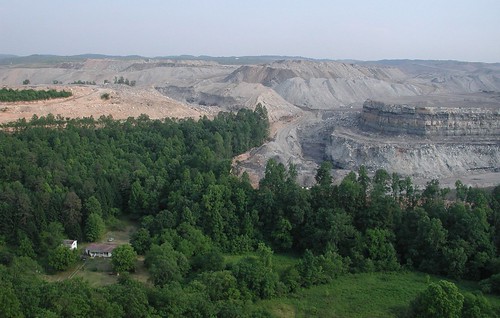
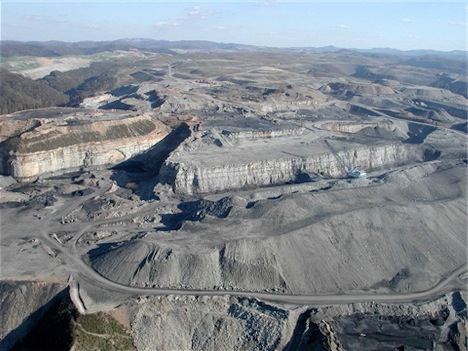
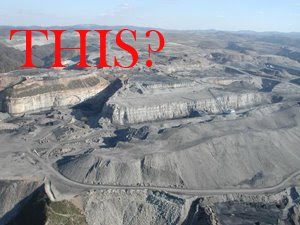
    [Image: Scenes from a mountaintop removal coal mining site. Does this look clean to you, Mr. Wald?]
      2. No new coal plants that do not capture and safely store their CO2 emissions. I'd say we start by requiring coal plants to emit less CO2 than efficient, combined cycle natural gas plants (that would require capturing and storing about 60% of their emissions) if they want to get an air permit. CA and WA have already implemented similar "emissions performance standards." Then phase up the requirement over time, to require 95%+ capture and storage before too long. After all, if new, high-tech coal plants that don't spew CO2 are right around the corner, we wouldn't to build any of those old-fashioned dirty plants then, right?

      3. Require safe disposal of coal ash waste and slurry.
      After the devastating and massive coal sludge spill in Kingston, Tennessee just before Christmas 2008, we know too well that the dirty coal lifecycle doesn't end at the smokestacks. Even after coal is burned, we're left with billions of tons of coal ash and liquid coal slurry/sludge that must be stored and disposed of all across the country. The stuff is toxic, containing elevated levels of heavy metals like mercury and arsenic. And much of it is stored in the least safe-way you could imagine: in giant impoundment ponds of coal ash sludge and slurry, like the one that burst in Kingston, or the one that burst in Martin County, Kentucky in 2000, contaminating the water supplies of 27,000 residents, or worse-yet, the deadly spill in Logan County, West Virginia in 1972, which killed 125 people and injured over a thousand. If we're serious about "cleaning up" coal, it's time to require the safe disposal of coal ash in lined landfills, and launch a major effort to prevent future coal sludge disasters like the ones that have punctuated the history of the coal industry with far too much regularity.
    [Image: The Marsh Fork Elementary School in Raleigh County, West Virginia sits just below a major coal slurry impoundment like the one that burst in Kingston, Tennessee. Over one billion gallons of toxic coal sludge sit behind an earthen dam just 400 feet from the elementary school. Is this insane or what?]

    So, Mr. Wald, until we're well on our way to implementing all of these actions, don't talk to me about "clean coal" or "environment-friendly" coal.


    For more reactions to Mr. Wald's article, see "All the LTEs that's fit to print" at ItsGettingHotInHere.org

    Read more!

    Friday, March 13, 2009

    Nevada Utility Dumps Coal Plant, Turns to Clean, Renewable Energy

    Here's some news to brighten your Friday! Proposed new coal plants have been dropping like flies over the past month, and yet another one bites the dust today, this time in Nevada. Citing strong local opposition and increased certainty that global warming pollution from coal plants will be regulated, energy developer, LS Power announced they will be "indefinitely postponing" plans to build the controversial 1,600 MW coal-fired White Pine Energy Center near Ely, NV.

    The news is even better than that though: after dumping their coal plant plans, LS Power has made the wise decision to instead turn to clean renewable energy to meet it's energy needs. The energy developer plans to focus its attention and investments on a new transmission project that will strengthen the intermountain region's ability to harness the area's abundant wind, solar and geothermal energy potential.

    Here's the full story...

    Another Nevada coal plant project bites the dust
    By Stephanie Tavares, In Business reporter
    Fri, Mar 13, 2009 (2 a.m.)


    LS Power has announced it is shelving plans to build the controversial White Pine Energy Center near Ely.

    The planned 1,600-megawatt coal-fired power plant received initial permits from the Bureau of Land Management three months ago.

    But the project has faced setbacks as business partners jumped ship, the BLM permits were appealed to the Interior Department’s Board of Land Appeals, public opposition mounted in two states and expected federal carbon-capture legislation threatened to drive skyward the price of generating electricity from coal.

    LS Power said in a statement it would shift its focus to completing the Southwest Intertie Project, a planned 500-kilovolt transmission line that will extend 500 miles from southern Idaho through eastern Nevada to the Las Vegas area.

    The project would allow developers to move forward with planned renewable energy resources in several rural areas, move electricity between Nevada’s two grids and fill a troublesome gap in the intermountain area’s electric transmission grid.

    The company expects to begin construction on the transmission line this summer.

    “As demand for renewable energy increases we are focusing more and more of our internal resources on providing transmission solutions for both renewable project developers and load serving entities,” LS Power President Paul Thessen said in a statement.

    The announcement that the coal plant would not be built in the immediate future was hailed by environmentalists, conservationists and renewable energy advocates, including Sen. Harry Reid.

    “I’m glad to see LS Power has seen the light and is now focusing its resources on creating clean energy economic opportunities, rather than the old combustion technologies of yesterday,” Reid said in a statement that praised the transmission line. “Nevada has an incredible opportunity to grow thousands of new jobs through increasing renewable power production from our solar, wind and geothermal resources and by encouraging strategic investments in improving transmission to get that power to the people.”

    The announcement came just days before two Public Utilities Commission hearings on whether the coal plant is needed.

    The company notified the PUC on March 5 it was suspending its application for a permit with the commission until it can obtain the necessary air permit from the Nevada Environmental Protection Division.

    Nevada law requires that before facilities of this type can be built, the PUC must determine there is a need for the plant, all regulatory approvals have been granted and the need for the plant balances any adverse environmental effects.

    Although the plant has strong support in the Ely area, it is opposed by environmentalists, health activists and clean air advocates across the West as well as supporters of National Parks and renewable energy.

    The company said in previous interviews that it anticipated a long and tough legal battle with groups opposing the plant.

    Dynegy, a company that partnered with LS Power under the moniker White Pine Energy Associates to build the plant, announced in January it was abandoning all coal plant development because of the lack of public support and regulatory uncertainty.

    The White Pine Energy Center is one of dozens of coal plants across the country to be postponed indefinitely or canceled outright in recent years.

    It is the second planned Nevada coal plant in as many months to fall victim to political and economic uncertainty.

    NV Energy announced last month it would not pursue the planned Ely Energy Center until emission controlling carbon capture technology could be deployed at a reasonable price.

    The third coal plant, planned near Mesquite, is still under environmental review by the BLM. It is widely opposed by residents.

    Meanwhile, federal permit activity for all three coal plants continues, according to BLM Nevada spokesman Chris Hanefeld.

    LS Power and the BLM are still preparing to defend the BLM’s permission to build the White Pine Energy Center.

    The decision was appealed last month by a consortium of environmental, health and parks groups wishing to get the project canceled.

    If construction on the White Pine Energy Center doesn’t begin within five years, the company would need to apply for a BLM extension of the permit or abandon plans to build the coal plant.

    NV Energy’s Ely Energy Center has an active BLM file, which is expected to be amended soon as the utility seeks to split the postponed coal plant from plans to build a large cross-state transmission line connecting the state’s electrical grids.
    In a related story, utility regulators in Louisiana ordered the utility Entergy to reconsider plans to build two coal and petroleum coke burning unites at a power plant near New Orleans. SolveClimate has the full story...

    Read more!

    Thursday, March 12, 2009

    Playing the Expectations Game as Copenhagen Looms

    Originally posted at the Breakthrough Institute blog

    It appears that there is an effort underway (whether coordinated or just coincident) from the Obama Administration, Intergovernmental Panel on Climate Change (IPCC) and United Nations to place a reality check on expectations for United States climate policy progress in advance of the international climate negotiations in Copenhagen this December.

    Yesterday, IPCC chairman Rajendra Pachauri told UK newspapers that Barack Obama would have a "revolution on his hands" if he tried to implement binding cuts in emissions on the scale that the IPCC's scientific consensus recommends.

    "He [Obama] is not going to say by 2020 I'm going to reduce emissions by 30 per cent," Pachauri said. "He'll have a revolution on his hands. He has to do it step by step."

    Pachauri's word's echo those of U.S. special climate envoy, Todd Stern, who recently stated that the 25-40% emissions cuts called for by the IPCC are "beyond the realm of the feasible" in the U.S. Congress. Stern called for a focus on "the art of the possible," saying "we need to be guided both by science and by common sense."

    Now, UN climate czar, Yvo de Boer tells Bryan Walsh in a TIME interview that he doesn't expect cap and trade from the U.S. before Copenhagen either.


    Here's the key excerpt from Walsh's interview with de Boer (emph. added):

    "[Walsh:] The conventional wisdom is that, with everything else on the government's plate, we're unlikely to see carbon cap and trade legislation passed in Congress before the Copenhagen summit at the end of the year. How important is it that something is in place by then?

    [De Boer:] I'd agree that legislation is not going to be passed by Copenhagen, but it will be well advanced by then. The international community is keenly interested in seeing what steps America is making at home to get its emissions under control, but it also wants to see what the Administration says it will do. If the Administration in Copenhagen commits to a target that is good enough for the international community, that will work. It's up to the U.S. see how the target will be implemented nationally."
    This I would say is good news. The UN's climate point person is essentially telling Obama that victory doesn't necessarily equal passing cap and trade before Copenhagen. De Boer seems to be trying to (subtly but critically) redefine expectations and reset the goal posts for Obama, giving him room to maneuver.

    De Boer is basically saying that it would be enough for Barack Obama to say the U.S. is aiming for a reduction of some target by some point, but the international community is going to give Obama some flexibility about what policies he wants to use to get there. Obama could even presumably say, "We're doing a national renewable electricity standard, efficiency standards and investments, and investment in clean energy technology development and deployment to get there and drop cap and trade" (for now, or forever).

    It seems there is a growing recognition that the widespread expectation that Obama would deliver a comprehensive climate bill before Copenhagen has set an impossible deadline for the American President. Now, key members of both the Administration and the international community are seemingly trying to temper expectations and open up some critical space for Obama to maneuver in.

    On expectations for the Copenhagen meeting itself, here's the excerpt:
    "Is Copenhagen still an "all or nothing" deadline? Or is there still wiggle room if the world fails to agree on a new treaty?

    You have to do it in Copenhagen. There is tremendous political momentum internationally to come to an agreement, and if you let that slip the momentum and enthusiasm will gradually dissipate and things will become more difficult. But having said that, I'm not under the illusion that every final little detail of how the agreement will work in practice will be finalized in Copenhagen. A certain amount of engineering has to be done."
    When asked if the global economic crisis will present a challenge for international climate efforts, de Boer says "don't think the enthusiasm has been dented. ... But clearly this is a difficult time to mobilize the financial resources for international cooperation, and that poses a challenge."


    Montreal Protocol or Global Marshall Plan?

    Finally, Walsh asks an excellent pointed question about the role of technology innovation and asks if the global transition to a new, low-carbon energy infrastructure should really be the primary focus, rather than commitments to emissions targets and timetables. De Boer unfortunately responds with rather conventional thinking about the role of regulation and carbon pricing in driving innovation, without even touching the potential of an international technology development effort to rapidly accelerate our transition to a low-carbon energy economy.
    There are those who say that climate change is primarily a question of technology -- that we need to change the way we use energy, and only research and development will do that, not UN mandates. Why is the UNFCCC process important?

    It's important because you have to drive change. Automakers will only begin to look for low emissions technology if they think the government is likely to regulate toward low emissions technology. There has to be a sense of urgency out there. We still live in a world where the cost of pollution is not yet part of the price, where you can as a factory emit unlimited greenhouse gases, without having to pay for the environmental consequences. Unless we begin to change that, there is no incentive to switch to more renewable energy and energy efficiency. Technology doesn't happen by itself.
    You're right Mr. do Boer, technology doesn't happen by itself. Nor does it happen without an active, engaged government role, making major public investments to drive innovation and the commercialization and widespread deployment of new technologies.

    De Boer and the rest of the leaders in the international climate talks should be reading up on the history of technology innovation and the relative roles of regulation and investment before they meet again at Copenhagen. And they should put aside the Montreal Protocol on CFCs and instead look for more relevant models of international technology, industry and economic partnerships. At it's root, the international climate and energy challenge is more about a new kind of sustainable global development partnership than it is about coming together to control something as trivial as an ozone-depleting refrigeration chemical, after all.

    We should be looking to initiatives like the Marshall Plan and the European Coal and Steel Partnership for more relevant models of international cooperation. These initiatives saw nations who were killing each other in the battlefields of World War II just a few years prior come together to make major common investments in their collective future, leading to decades of sustained peace and shared economic prosperity. After looking at examples like these, de Boer would likely have a different answer to Walsh's excellent question.

    After all, underneath all of the debates about targets and timetables lies the critical challenge of replacing the entire global energy infrastructure with a low-carbon energy system, all while increasing global energy supplies to power development in the Chinas, Indias and Brazils of the world. In short, our climate targets all rest on the success of a global effort to make clean energy cheap. It's still unclear if a discussion about how to accomplish that critical objective will even be on the table at Copenhagen. Stay tuned...

    Read more!

    Tuesday, March 10, 2009

    Can the Stimulus Lift the Clean Energy Sector Above the Economic Meltdown?

    That's the question considered in the latest annual report on clean energy sector trends from Joel Makower and his colleagues at CleanEdge. With an unprecedented investment in clean energy in the stimulus bill passed by Congress last month, you'd think things were looking up for the sector. They are, Makower concludes, but when you're climbing out of the general meltdown gripping the U.S. economy, there's a long way to climb. As Makower writes:

    The good news is that clean energy continues on a blistering rate of growth — increasing 53 percent from $75.8 billion in 2007 to $115.9 billion in revenues in 2008, based on our study of three key technologies: solar, wind, and biofuels. And the growth will continue. We forecast that by 2018, these three technologies will have revenues of $325.1 billion.

    The bad news: The clean-energy sector faces considerable challenges moving forward. A sinking stock market continues to plague the initial public offering markets, with only a small handful of energy-related IPO listings on U.S. exchanges in 2008. This means that venture capitalists and other investors are faced with a dearth of exit opportunities for their current portfolio companies, making it harder for new companies to garner investments.

    Severely tightened credit markets also began to take their toll. In late 2008 and early 2009, the extent of constrained credit became apparent, with a range of clean-energy companies delaying plans, laying off staff, or scuttling projects entirely.

    As Makower writes, despite the challenges gripping the sector, overall trends in three core clean energy sectors - wind, solar and biofuels - look robust:
    • Solar photovoltaics (including modules, system components, and installation) will grow from a $29.6 billion industry in 2008 to $80.6 billion by 2018. Annual installations reached more than 4 GW worldwide in 2008, a fourfold increase from four years earlier, when the solar PV market reached the gigawatt milestone for the first time.
    • Wind power (new installation capital costs) is projected to expand from $51.4 billion in 2008 to $139.1 billion in 2018. Last year's global wind power installations reached a record 27,000 MW. In the U.S., which accounted for more than 8,000 MW, wind installations represented more than 40 percent of total new electricity generating capacity brought online in 2008 — and moved the U.S. ahead of Germany as the world's leading generator of wind energy.
    • Biofuels (global production and wholesale pricing of ethanol and biodiesel) reached $34.8 billion in 2008 and are projected to grow to $105.4 billion by 2018. In 2008 the global biofuels market consisted of more than 17 billion gallons of ethanol and 2.5 billion gallons of biodiesel production worldwide. For the first time, ethanol leader Brazil got more than 50 percent of its total national automobile transportation fuels from bioethanol, eclipsing petroleum use for the first time in any major market.
    For more, check out the full report, Clean Energy Trends 2009 from CleanEdge.

    Read more!

    Want to Save the World? Make Clean Energy Cheap.

    The opportunity to advance transformative, progressive change has never been greater. Now, in the wake of the 2008 election and the historic Power Shift summit, young progressives have a unique opportunity to take a step back and look at the big picture: How can the we continue advancing bold solutions on energy and climate? What can young people do beyond energy and climate? And if national climate legislation succeeds, what’s the next “Big Idea” for the progressive youth movement?

    These are just some of the ideas we're exploring in a Special Breakthrough Issue – “After Power Shift: What’s Next?” – to examine the next steps for the progressive youth movement. The issue will include contributions from some of the country’s top young leaders throughout the week, and we hope you’ll join the discussion. Here's our first piece to kick it off.

    --------------------------------------


    Want to Save the World? Make Clean Energy Cheap.

    By Teryn Norris & Jesse Jenkins
    The Huffington Post

    Over 12,000 young adults attended the recent Power Shift 2009 summit in Washington, DC. Their goal? Building the largest youth movement in decades to save the world from global warming.

    Largely missing from Power Shift, however, was a critical group: young scientists, engineers, and entrepreneurs. Maybe it was mid-terms. Perhaps the event seemed too political. Or maybe the summit recruited too many traditionally-defined "activists."

    Whatever the cause, we have very little chance of overcoming climate change without enlisting young innovators at a drastically greater scale. Simply put, they represent one of the most important catalysts for creating a clean energy economy and achieving long-term prosperity.

    The reason is this: at its core, climate change is a challenge of technology innovation. Over the next four decades, global energy demand will approximately double. Most of this growth will happen in developing nations as they continue lifting their citizens out of poverty and building modern societies. But over the same period, global greenhouse gas emissions must fall dramatically to avert the worst consequences of climate change.

    Shortly before his untimely death in 2005, the Nobel Prize-winning physicist Richard Smalley coined this the "Terawatt Challenge": increasing global energy production from roughly 15 terawatts in 2005 to 60 terawatts annually by 2100 in a way that simultaneously confronts the challenges of global warming, poverty alleviation, and resource depletion.

    The single greatest obstacle to meeting the Terawatt Challenge is the high price of clean energy technologies compared to traditional fossil fuels. Critical low-carbon technologies like solar photovoltaics and advanced batteries for plug-in hybrid and electric vehicles have significantly higher costs than their market competitors. For example, the total generation cost of solar photovoltaic electricity is three to five times that of coal.

    In the absence of affordable and scalable clean energy sources, poor and rich nations alike will continue opposing significant carbon prices and will continue relying primarily upon coal and other fossil fuels to power their development. This will virtually assure massive climate destabilization.

    So the task is clear: to avoid climate catastrophe and create a new energy economy, we must unleash our forces of innovation - namely, scientists, engineers and entrepreneurs- to invent a new portfolio of truly scalable clean energy technologies, chart new paths to bring these technologies to market, and ensure they are affordable enough to deploy throughout the world.

    In short, to save the world we must make clean energy cheap.

    Making clean energy cheap and transforming the world's energy systems will require a long-term, herculean effort - or as Secretary of Energy Steven Chu recently described it, a "second industrial revolution" - and an entire generation of the world's best and brightest young engineers, scientists and entrepreneurs. Just like the "Sputnik" generation committed itself to the Cold War and led the information technology revolution, today's generation must commit itself to the Terawatt Challenge and lead the global energy revolution.

    So where do we start? An innovation-centric approach to climate and energy calls for several things. First, if you're an aspiring engineer or scientist, consider focusing your education and career on energy technology and science. If you're a budding entrepreneur hatching business schemes, direct your creativity toward smart ways to make clean energy profitable. If you're going into policymaking, learn everything you can about technology policy. If you're passionate about economics, become a pioneer in the emerging field of innovation economics. The list goes on, but the central point is that we need to become the "innovation generation" to tackle the Terawatt Challenge.

    Second, students should demand far greater educational resources related to energy technology and policy at their schools, including new professors, curriculum, career development opportunities and research. Every significant institution of higher education in the country should have an energy-related institute that incubates cutting-edge thinking, research and innovation. Indeed, the greatest contribution our nation's universities, colleges and vocational schools can make is educating and preparing tomorrow's leaders and promoting energy innovation. If you're a student activist looking to make an impact, consider organizing a campus campaign to launch a university-wide energy institute for new education and research.

    Finally, if our central goal is to make clean energy cheap, as young people we need to focus our advocacy on policies that will drive technology innovation as rapidly as possible. Yes, we need new regulations and a price on carbon. But consider this: the United States did not invent the Internet by implementing a cap and trade system on fax machines. We didn't invent microchips by taxing the slide rule, nor did we create the personal computer by regulating typewriters. Rather, your computer, your cell phone, your iPod -- all of these revolutionary and now ubiquitous technologies were originally invented by direct federal investments supporting the relentless innovation of scientists, engineers, and entrepreneurs just like yourself.

    Thus the policy model isn't so much past environmental regulations, but past federal investments in technology - like those in airplanes, microchips, the internet, and biotechnology. This requires public investments along each stage of the "innovation pipeline," from R&D to demonstration and deployment. Moreover, just like the federal government rose to the Sputnik Challenge with the National Defense Education Act, we need to confront the Terawatt Challenge with a National Energy Education Act. Obama's stimulus took a step in this direction, but as Secretary Chu put it last week: "Our previous investments in science that led to the birth of the semiconductor, computer and biotechnology industry added greatly to economic prosperity. And now we need similar breakthroughs in energy today. We already taking steps forward, but we need to do more."

    So, you want to save the world? Make clean energy cheap.

    Read more!

    Monday, March 09, 2009

    What the Press Didn’t Tell You About the Largest Youth Movement in Decades (Part Three)

    Part Three: An Expansive Movement and the Fight Ahead

    This is the part three of a three-part series taking an in-depth look at the youth climate movement and the stories the mainstream media missed at Power Shift 2009. For the introduction and links to the rest of the series, head here or see links at end of this post.


    If you’ve made it this far in this series, you’ve already read a couple thousand words about the “youth climate movement.” I’ve been using that term throughout this series, but after spending even a little time amongst this movement, it’s clear that “youth climate movement” is something of a misnomer, adopted for lack of a better word. You see, this movement is growing into something much more expansive than those words capture.

    What began partly as an environmental movement, brought together to prevent the ecological disaster of climate change, has morphed into a far-reaching movement tackling issues as far ranging as equity, justice, and economic reform.

    “We are having a broader conversation than just climate change, or climate science,” said Marcie Smith, a student at Transylvania University in Kentucky, testifying before the House Select Committee on Energy Independence and Global Warming. “This is a conversation about justice, equity and opportunity.”

    “All for green! Green for all!” has become one of the movement’s rally cries, a simple turn of phrase that has deep meaning for many pulled into this movement.

    Juan Reynosa, a 27-year old community organizer with New Mexico Youth Organized, testified before Congress and shared his vision of a clean, green economy strong enough to lift up the currently marginalized and disaffected.

    “It’s time to rebuild our communities,” Reynosa said. “This time we must include everyone in this new energy economy – single moms, drug addicts, ex-offenders. Everyone.”

    “We must ensure that clean energy economy brings jobs to current dirty energy sacrifice zones. If not, we will have failed,” added Smith.

    This isn’t a movement about saving polar bears or ice caps, these young activists make sure to tell you. Or more accurately, it’s a movement about that, but about so much more.

    This youth movement is setting out to dissolve the inequities and injustices of the current energy system, to empower and lift up communities, and to build the kind of economy they ultimately want to work and live in.

    While "youth climate movement" is the name it's taken on, this is simply a movement for a more sustainable, just, and prosperous future. But I guess it's hard for that to roll off the tongue...


    The Greatest Challenges Lie Ahead

    If Power Shift 2009 proves that the “youth climate movement” is growing up, then the real work is unquestionably still ahead.

    The oil, gas, and coal industries are well aware of the PR and political fight for survival now on their hands and are spending tens of millions each year to flood the airwaves and internet with advertising and crowd the halls of Congress with their lobbyists.

    Besides well-entrenched corporate interests, the path to victory on climate legislation also runs smack dab through a U.S. Congress that is divided on the issue along both partisan and geographic lines. In June 2008, the Senate briefly considered the Lieberman-Warner Climate Security Act. Despite the fact that the bill was considered woefully inadequate by many in the movement, the Climate Security Act still fell far short of the sixty votes needed to advance in the Senate.

    Photo Credit: Shadia Fayne Wood<

    Against the assembled forces of the status quo, and the inherent inertia of the U.S. Congress, the youth climate movement will certainly have its work cut out for it. Victory will no doubt require the best high tech savvy these young activists can muster, as well as a major dose of old fashioned ‘people power.’

    The good news is that those who attended Power Shift seem aware of these challenges and eager to embrace them.


    This is Only the Beginning

    At Power Shift 2009, each attendee received a credential badge that read “Leader.” Not participant. Not attendee. Leader. And that’s exactly what each of the 12,000 “Power Shifters” walking the halls of the D.C. Convention Center was: a young leader that has since returned to their university campus or home community to keep the pressure on – equipped now with new tools, new connections and allies, and a new energy to keep organizing until the power shift is complete.

    “Each one of these leaders will return home and recruit ten of their friends to join us in the next month, and each of them will recruit ten more in the next month,” promised Energy Action Coalition’s Jessy Tolkan.

    “This isn’t about one rally, or one lobby day, or one event,” added Billy Parish, calling for sustained engagement with elected officials over the coming year. “This is less like lobbying and more like, well, stalking!” he told the crowd at Friday’s keynote. “By the end of this, your elected officials should know every one of you by name.”

    Plans for sustained political engagement are already underway. When representatives and senators return to their districts for the mid-April congressional recess, young leaders will greet them ready to continue the conversation about clean energy solutions begun this weekend at Power Shift.

    Focus the Nation, an Oregon-based group with national aims, is helping students organize town hall meetings across the country during the April recess, creating forums to continue the discussion between elected officials and the young people who will be most affected by the political decisions made today.

    “On April 18th, students and community members are holding town-hall meetings in almost every Congressional district in the country,” said Alex Tinker, the civic engagement director with Focus the Nation. “They will be inviting their elected officials to join them to explore solutions to our nation’s climate and energy challenges.”

    Focus the Nation Executive Director Garett Brennan joins the Power Shift rally on the West Lawn

    The Energy Action Coalition and partner 1Sky are also working to identify leaders, both young and old, in every voting precinct in the country, enabling widespread and effective grassroots organizing all across the nation.

    Student activists also plan to join with affected communities and environmental NGOs to keep the fight against the impacts of coal’s mining and use active in the coming months.

    Protests targeting coal plants in Illinois and North Carolina and mountain top removal coal mining in West Virginia are planned for March and April (indeed, action is heating up at Coal River Mountain, slated for destruction soon). The advocacy group, Appalachian Voices, is bringing coalfield residents to Washington D.C. to lobby for the passage of the Clean Water Protection Act and an end to mountaintop removal this month as well. And on April 1st, Energy Action Coalition will join the international Rising Tide network to organize annual “Fossil Fools Day” actions nationwide.

    The fight is clearly just beginning, and the growing movement is ready. As Tolkan promises, a fiery commitment evident in her words, “We will not stop until we see the boldest possible climate legislation pass the U.S. Congress and land on President Obama’s desk.”

    Photo Credit: Robert vanWaarden

    ###


    The rest of the three-part series:

    Read more!

    Timothy Den Herder Thomas: Inspirational Clean Energy "Solutionary"

    Timothy Den Herder Thomas is a pioneering young activist who tirelessly works to advance innovative, community-scale, tangible solutions to our energy and climate challenges.

    Building on his success at Macalaster creating innovative financing mechanisms that capture the profitable nature of a clean, efficient energy economy and use the funds to accelerate the transition to a low-carbon future, Timothy is now helping launch a nationwide effort called Summer of Solutions, or SoL for short. SoL will combine time-tested community organizing techniques with cutting-edge clean energy social entrepreneuralism to build community, cut carbon and maybe even launch a network of "solutionaries" - solutions-oriented, innovative revolutionaries.

    After highlighting Timothy's story in my recent three-part series taking an in-depth look at the dynamic and inspiring youth climate movement, my attention was brought to this wonderful video about Timothy and his efforts produced for the Brower Youth Awards (Timothy is a 2008 Brower Award winner). Take a look, and let yourself be inspired by this soft-spoken, even goofy kid from Minnesota, my friend, Timothy:

    Read more!

    The Fight is on to End Mountaintop Removal Coal Mining

    An update in the fight to end mountaintop removal coal mining from our friends at Appalachian Voices. With the re-introduction of the federal Clean Water Protection Act last week (with a record 117 co-sponsors!) and a number of state-level efforts underway, there are many new fronts opening in the ongoing effort to stop the injustices of mountaintop removal. Here's the current tally of state and federal efforts underway...

    Although this is a bare bones post, here is some important information about state-level efforts to end mountaintop removal coal mining… Please check back here soon for updates!

    North Carolina: Appalachian Mountains Preservation Act
    House Bill
    Senate Bill

    Select news coverage:
    WUNC (North Carolina Public Radio)
    Winston-Salem Journal
    The Charlotte Observer

    Maryland: House Bill 743
    Bill Summary (PDF)
    NRDC Switchboard Blog: "Momentum Peaks Against Mountaintop Mining

    Georgia: Appalachian Mountains Preservation Act
    www.SoutheastGreen.com: "The Appalachian Mountains Preservation Act"

    Kentucky: The Stream Saver Bill
    Kentuckians for the Commonwealth: "Stream Saver Bill"
    Kentuckians for the Commonwealth: "I Love Mountains Day - 2009"

    Tennessee: The Scenic Vistas Protection Act
    Tennessee General Assembly bill summary
    Lindquist-Environmental Appalachian Fellow bill summary

    Still coming down the pipe soon...
    South Carolina, Maine, and New York!

    Oh, and in case you haven't heard, the federal Clean Water Protection Act is back!
    Get in on the action here!

    Read more!

    What the Press Didn’t Tell You About the Largest Youth Movement in Decades (Part Two)

    Part Two: Strength in a Diversity of Tactics

    This is the part two of a three-part series taking an in-depth look at the youth climate movement and the stories the mainstream media missed at Power Shift 2009. For the introduction and links to the rest of the series, head here or see links at end of this post.

    On display at Power Shift 2009 was the diversity of tactics employed by the youth climate movement. From rallies and protests in the streets, to well-informed citizen lobbyists penetrating the halls of Congress, this movement finds strength in a diversity of tactics. In their efforts, these young leaders draw on time-tested community organizing techniques as well as a suite of cutting-edge, 21st century technologies to unite the movement, grow at a rapid pace, and secure climate and clean energy victories.


    From the Streets to the Halls of Congress

    At 1:30 pm on Monday, March 2nd, I stood in the back of a congressional hearing room in the Rayburn House Office Building, listening to powerful testimony from five young leaders briefing the House Select Committee on Energy Independence and Global Warming [watch highlights from the hearing here]

    As the briefing commenced in the halls of the Rayburn House Office Building, thousands of students were in the process of holding over 350 lobby visits with elected officials from all fifty states.

    At 2:00 pm, I got a text message informing me that just blocks away, hundreds more Power Shifters had joined an estimated 2,500, both young and old, and taken to the streets of D.C. to march for an end to the injustices of our current dirty energy system.

    The march was the start of the Capitol Climate Action, and the assembled protesters soon surrounded the Capitol Plant, which heats the U.S. Capitol Building and the complex of congressional offices by burning a mix of coal and natural gas. The event’s organizers said they targeted the plant in a symbolic stand, calling for an end to dirty energy and a transition to a cleaner, more just energy system.

    Image Credit: Franziska Seel

    “This power shift, it has begun, we’ll get our energy from wind and sun!” chanted protesters, calling for an end to coal.

    Groups of protesters illegally blocked every gate to the plant and rallied in the streets surrounding the plant for hours, as speakers including Robert F. Kennedy Jr, author Wendell Berry, and outspoken climate scientist James Hansen addressed the crowd. These more well-known figures were joined by activists and citizens from regions affected by coal’s mining and use, including residents of Appalachian states and Navajo living near Black Water Mesa in New Mexico.

    The speakers all cited the many impacts and injustices of today’s dirty energy system – from asthma and mercury poisoning to the destructive impacts of surface mining and mountaintop removal, and of course, coal’s massive contribution to climate change.

    While there were no arrests made, the organizers of the event declared the action a success. “The police said so many demonstrators showed up that they had no hope of jailing them all,” writes author and activist Bill McKibben in his account of the day’s events. “So we merrily violated the law all afternoon.”

    The coincidence of Monday’s lobby day, hearing and civil disobedience evidences the diversity of tactics employed by this growing movement.

    "Youth are willing to lobby in the halls of Congress, but we're also not afraid to get arrested in the streets,” said Jaime Henn with 350.org, one of the more than forty groups sponsoring the Capitol Climate Action. “It's this diversity of tactics that will continue to make us effective.”


    Not Just Protesters of Injustice, But Practitioners of Solutions

    Energy Action Coalition executive director Jessy Tolkan has spent years registering and turning out voters, organizing events like Power Shift and campaigns like Power Vote, and fighting for a seat at the political table for today’s youngest generation. But as proud as she is of these efforts to amplify the movement’s political voice, she makes sure to point out that the efforts of this movement do not stop at lobbying the political process for change.

    “Over the course of the last three days, 12,000 of us gathered here in our nation's capitol ... and 24 million of went to the polls in November” Tolkan said at the Select Committee hearing. “But we are also in our communities as practitioners of the innovative solutions we are calling for.”

    In fact, the tactics employed by many in this movement may not even look like activism to the outside eye. What occupies much of Timothy Den-Herder Thomas’s activism, for example, looks a lot more like a new brand of socially and environmentally conscious entrepreneurialism.

    Thomas is a senior at Macalaster College and a leader with the Sierra Student Coalition. He wields financial spreadsheets and non-profit business models in addition to traditional tools of community organizing.

    On March 2nd, Thomas told Chairman Markey's committee about his successful efforts to establish a revolving clean energy loan fund at Macalaster. The fund enables investments in energy efficiency and clean energy projects at the Minnesota college, pooling the resulting energy savings to reinvest in more projects.

    The fund has been a huge success, cutting energy use and emissions at the campus while netting a forty percent annual return on investment in its first year. “That’s four times what the stock market performs,” said Thomas, pausing for a moment, ”when it’s NOT collapsing!”

    Thomas is now working with students as part of a program called Summer of Solutions to take the revolving fund model off campus and launch a new effort to “futurefit” entire neighborhoods – that’s Thomas’s word for the energy efficiency and clean energy retrofits that prepare homes and businesses for a clean, efficient energy future.

    “There are billions of dollars just sitting on the table,” Thomas said, referring to profitable energy efficiency opportunities in millions of American homes and businesses. “But we’re not picking that money up. We’re letting it sit there.”

    Summer of Solutions will be organizing efforts in at least a dozen communities this coming summer and similar initiatives are underway in other locations.

    All across the country, innovative young social entrepreneurs like Thomas are working to transform their campuses and communities, set up green jobs training programs and otherwise get busy creating the clean energy future they are calling for as activists.

    Their message: while we call on our elected officials to change laws, give us more resources, and invest in a clean energy economy, we’re not going to wait to get started building the future ourselves.


    A 21st Century Networked Movement

    This savvy youth movement draws from the long history of community organizing in the United States and the wisdom of past social movements, combining these time-tested tactics with cutting-edge 21st century digital organizing and communication tools with remarkable effectiveness.

    “Each one of you is a walking technological superpower,” said green jobs advocate Van Jones, speaking to the Power Shift crowd packing the cavernous main hall at the DC Convention Center on the event’s opening night. “You have more technology on your person right now than the U.S. government had when we put a man on the moon.”

    “Just think: ten years ago when a person could just sit on a bench and pull all of the knowledge of the world onto their laps, they’d be considered a god. Now, that’s just you, with a laptop, and Google!” Jones said, urging the crowd to “cease using those technologies as toys and start using them as tools.”

    The most networked generation in history, the members of this youth movement are already utilizing 21st century technologies to unite online and strengthen their offline organizing.

    Last April, as part of an annual nationwide day of action called Fossil Fools Day, hundreds of young activists traveled to stand with communities in Appalachia to protest the devastating impacts of mountaintop removal coal mining. Through online networks, these activists were able to unite with students located about as far away from the coal fields of Appalachia as you can get: Washington state.

    Student organizers with the youth-led Cascade Climate Network quickly launched a “photo petition” to stand in solidarity with their allies in Appalachia, snapping digital photos of hundreds of students at more than a dozen campuses holding signs reading “We can do better than coal!” and “Solar energy leaves the tops on mountains.” Through email, they collected the digital photos streaming in from across the state and quickly designed and produced a photo petition “yearbook” which students then delivered to members of Washington’s congressional delegation [click here to download the photo petition (PDF)].

    The Cascade Climate Network students urged Congressman Dave Reichert, a Republican, to co-sponsor legislation that would curb mountaintop removal by reinstating environmental regulations gutted by the Bush Administration.

    “Congressman Reichert had actually seen mountaintop removal flying from Washington DC to Seattle, but that was most likely the first time he had heard about mountaintop removal from his own constituents,” said JW Randolph, Legislative Associate with Appalachian Voices. “Students in Washington took up an issue that’s devastating communities in Appalachia thousands of miles away, and made it clear they weren’t going to tolerate injustice like that anywhere in this great nation. That’s what makes our elected officials take action.”

    Thanks in large part to the efforts of the Cascade Climate Network students, Congressman Reichert agreed to be one of three chief sponsors of the Clean Water Protection Act, which was re-introduced in the 111th Congress last Wednesday with a record 117 co-sponsors.

    The unprecedented, networked nature of this movement allows young activists across the country to connect with their peers, share information and best practices, discover and harness synergies, and grow in size and power faster than past movements.

    And they’ll have to do so quickly. As we’ll explore in Part Three of this series, the movement has a challenging road ahead. It’ll take the best combination of time-tested tactics and cutting-edge techniques, as well as a big dose of old-fashioned people power to win the battles ahead. Stay tuned for Part Three…

    The rest of the three-part series:

    Read more!

    Sunday, March 08, 2009

    What the Press Didn’t Tell You About the Largest Youth Movement in Decades (Part One)

    Part One: A Growing Movement Comes of Age

    This is the part one of a three-part series taking an in-depth look at the youth climate movement and the stories the mainstream media missed at Power Shift 2009. For the introduction and links to the rest of the series, head here or see links at end of this post.

    There were a lot of records claimed by Power Shift 2009. The largest gathering of youth climate activists in U.S. history; the largest citizen lobby day on climate change (for any age group); and at the separately organized but allied Capitol Climate Action, the largest-ever non-violent civil disobedience against the injustices of today’s energy system.

    But Power Shift didn’t emerge out of the blue. The weekend’s successful events are a sign that the youth climate movement, the largest and most sophisticated grassroots movement to emerge in decades, has finally come of age. It is now maturing quickly and gathering size, diversity and power, according to Billy Parish, founder of the Energy Action Coalition, the organization behind Power Shift 2009.

    The movement on display at Power Shift 2009 consists of literally thousands of student groups on hundreds of high school, community college and university campuses, a growing number of coordinated statewide networks, and dozens of official NGOs. The Energy Action Coalition (EAC) has become the movement’s torchbearer, playing a central role in coordinating and uniting these diverse organizations.

    Launched in 2004, EAC began by organizing several nationwide days of action against fossil energy dependence, each larger than the last. In 2005, EAC launched the Campus Climate Challenge to help students press for commitments to clean energy and climate neutrality at college campuses, an effort that has so far secured victories at over 550 campuses.

    These days, Energy Action Coalition has taken the jump off of campuses to assert the movement’s political voice in national climate and energy debates.

    EAC brought 6,000 young leaders together for the first Power Shift summit in November 2007. In the year that followed, EAC launched the nationwide Power Vote campaign and rallied nearly half a million young voters to turn out and cast ballots for climate champions in the 2008 election.

    "The youth of America turned out in record numbers to elect a new president and Congress in the last election,” said EAC executive directory, Jessy Tolkan. “We're here now to take our rightful seat at the political table.”

    The movement has indeed taken a literal seat at the political table. Tolkan joined four other young leaders to testifying at a congressional briefing held Monday by Congressman Ed Markey’s Select Committee on Global Warming and Energy Independence.

    “There will not be a more important hearing in Congress this year,” Chairman Markey declared after listening to powerful testimony on the young leader’s visions of a clean, just energy future and accounts of the work these activists are doing to make that vision a reality. “You are all the leaders of this clean energy revolution,” Markey said.

    The young members of the youth climate movement are part of the most civically engaged generation in three decades.

    That fact did not go unnoticed by the elected officials and Obama Administration officials speaking at Power Shift 2009. From Congresswoman Donna Edwards to Interior Secretary Ken Salazar, every one of the government officials speaking at the conference credited the record turnout of young people in November 2008 with their electoral success [you can watch these keynote addresses here].

    Those young voters are now organizing across the country to ensure they see the kind of change so frequently promised during the 2008 elections.

    “We celebrated on November Fourth,” Tolkan said, “but we know the real work began on November Fifth.”


    The rest of the three-part series:


    Image Credit: Matt Stern

    Read more!

    What the Press Didn’t Tell You About the Largest Youth Movement in Decades (Introduction)

    An Introduction: Beyond the Numbers (and the Irony)

    On February 27th-March 1st, 12,000 young leaders from all fifty states, every Canadian province, and about a dozen other nations convened at the Washington D.C. Convention Center for Power Shift 2009, the largest ever gathering of climate and clean energy activists in U.S. history. On Monday, March 2nd, fueled by a fiery passion no snowstorm could chill, thousands stormed Capitol Hill, braving subfreezing temperatures to rally, lobby and even risk arrest in their efforts to ignite a clean and just energy future.

    Image credit: Shadia Fayne Wood

    If you read the mainstream media’s accounts of this historic weekend, that’s about the extent of the story you likely read. The focus of most coverage was the numbers – 12,000 students, 2,500 protesters, 350 lobby visits – or the supposed irony of a climate rally held amidst a few inches of snow. But beyond the numbers and ironic headlines, there’s a far deeper story on display at Power Shift 2009 – if only the press knew where to look.

    I’ve been close to this movement for three years, as both a participant and as a writer and editor chronicling its progress at ItsGettingHotInHere.org, where voices from across the movement share their stories. Rather than wait for the mainstream media to write an in-depth expose on this dynamic and growing movement, I’ll take you behind the scenes to uncover the stories behind the numbers in this three part series.
    • Part One focuses on the history of the maturing movement on display at Power Shift 2009

    • Part Two takes a look at the diversity of tactics and cutting edge activism employed by the movement

    • Part Three looks at how the movement has grown into an expansive effort to build a more sustainable, just and prosperous future and on the challenging road ahead for these young leaders

    Read more!

    Thursday, March 05, 2009

    "Clean" Coal and "Healthy" Cigarettes - Coal Industry Huckster Won't Admit Burning Coal Causes Climate Change

    Joe Lucas has a hard job. He's the PR huckster that heads up the American Coalition for Clean Coal Electricity, the front group that shills for the coal industry.

    As you can see in the video below, no matter how many times he watches "Thank You for Smoking," Lucas just can't quite pull off the irresistibly charismatic charm of Aaron Eckhart's Nick Naylor, the movie's lead character who spins Big Tobacco's lies so effortlessly. To be fair, when your industry keeps bumbling around, letting off billion gallon toxic coal sludge spills, indescrimantly blasting the tops off of entire mountains, and buying off West Virginia judges, it's hard to stay ahead of reality.

    While he can't pull off the style, Lucas sure is taking notes from Big Tobacco when it comes to his talking points: in an interview on CNN last night, Mr. Lucas refused to answer a simple yes or no question about whether or not the burning of coal contributed to climate change.

    His answer? "I'm not a scientist." Nice dodge!

    Well Joe, neither am I, but I can read, and I'm pretty sure the science is in. The Intergovernmental Panel on Climate Change (which I'm pretty sure includes two or three scientists) stated with greater than 90% certainty that greenhouse gas emissions like the CO2 spewed from coal plants causes climate change. Check out the video below the fold (Lucas's BS is about 2:00 mins in)...


    Mr. Lucas was spurred to defend himself in a comment at Grist, where Kate Sheppard calls attention to his shenanigans.

    There are two sides to every story, and that is certainly the case when it comes to the CNN interview discussed above.

    When the interview aired, CNN played only part of a quote in which I said "I'm not a scientist" when asked whether or not emissions from coal plants contributed to climate change.

    Here's what you didn't hear: I pointed out that the United Nations International Panel on Climate Change (IPCC) has a whole list of things about which there is great certainty, other things about which there is some certainty, and still other things about which there is less certainty. We do know that there has been an increases in greenhouse gas emissions and that some warming has taken place.

    According to the IPCC, the exact extent that human-made emissions will contribute to climate change is less certain. However, the remaining uncertainties do not provide a reason to not take action.

    Especially when you take into consideration the advances that we are making with advanced clean coal technologies to capture and store CO2 from power plants.

    By focusing on technology to ensure a cost-effective means of meeting new emissions standards, we can reduce greenhouse gas emissions, promote energy independence, create jobs and keep energy costs affordable for American businesses and families.
    Ah shucks Joe...

    ...you almost, almost admitted that the industry you shill for is the leading contributor to climate change. Almost. It was a great effort, and I really appreciate it. Really.

    While you're here, Joe, I'm wondering if you can tell me what "advance clean coal technologies" you are working on to stop the unequivocally dirty and horrendously devastating impacts of the mountaintop removal coal mining your industry practices? I assume since you are a proponent of "clean" coal, you are in support of the Clean Water Protection Act introduced in Congress yesterday, which would reinstate sane environmental protections that, you know, prevent the dumping of entire mountains on top of streams and valleys. I assume you'll join me in championing the Clean Water Protection Act to help clean up the coal industry...

    And of course, when you say scientists are "less certain" that "human-made emissions will contribute to climate change" what you really mean is that they are more than 90% certain (rather than 100% certain I guess). Well you are right there. Remember though: this is scientific consensus, and expressions of scientific certainty don't get much stronger than that. Gravity is still a theory, after all.


    Hat tip to Josh Dorner at HuffingtonPost, Kevin Grandia at DeSmogBlog and Kate Sheppard at Grist for being all over this one like a PR huckster on a steaming pile of industry bull$ite

    Read more!

    Democracy Now Looks at What Power Shift is Really About

    Democracy Now interviewed students from around the nation (and the world) at Power Shift 2009, asking what brought them to the historic convergence in Washington D.C. Students share their stories about the injustices and impacts of our current dirty energy system and the need for a shift to a clean, just energy economy.

    Read more!

    Wednesday, March 04, 2009

    Congressman Ed Markey: "There's a giant Green Wave sweeping Washington D.C."

    [Update, 3/16/09: Video of Congressman Ed Markey's keynote address at Power Shift 2009 added, as well as intro video produced by Power Shift 2009/EAC video team (at end of post)]

    Jack Hidary at HuffingtonPost grabbed an excellent video interview with Congressman Ed Markey (D-Mass.), the chair of the House Select Committee on Energy Independence and Global Warming and the point person in the House, along with Henry Waxman for energy and climate policy.

    "I think the course of history is so dramatically different now," Markey said, calling for an ambitious agenda on climate and energy. "I don't think we should be anything less than really ambitious on the high goals we set," Markey said, speaking about a renewable electricity standard the House and Senate are set to debate.

    Here's Hidary's introduction to the video...

    We interviewed Congressman Markey at Powershift09 which took place in DC with over 12,000 students from across the US advocating for cleaner energy and climate change action.

    Markey gave a rousing speech to the students -- probably one of the most dynamic speeches a congressman has given - and got them on their feet holding up their cell phones as symbols of all the new solar panels and wind turbines that will come in the next few years [Editor's note: you can watch the speech at end of post below].

    Here is the interview (below the fold):


    Introducing Congressman Ed Markey:


    Congressman Ed Markey speaking at Power Shift 2009:


    Read more!

    Monday, March 02, 2009

    Sights and Sounds of Power Shift 2009

    By Jesse Jenkins, reporting for the Energy Collective and WattHead - Energy News and Commentary

    After a long weekend at Power Shift 2009, I'm pretty exhausted. I'll publish a full recap soon of today's historic events at Capitol Hill, which saw thousands of young activists brave snow to storm the Capitol to rally for a clean, just energy future and a robust new energy economy and hold more than 350 lobby visits with representatives from all 50 states. Several young leaders also delivered powerful testimony to the House Select Committee for Energy Independence and Global Warming while many more joined the 2,500 citizens who simultaneously risked arrest to protest dirty energy sources like coal at the Capitol Power Plant that heats the U.S. capitol with coal and natural gas.

    For now, here's a collection of sights and sounds from the weekend at Power Shift 2009 (many courtesy of the amazing Power Shift media team), including videos of keynote speakers including EPA Administrator Lisa Jackson, Secretary of the Interior Ken Salazar, Congressman Ed Markey and celebrated green jobs advocate, Van Jones, all below the fold...

    EPA Administrator Lisa Jackson:


    Secretary of the Interior Ken Salazar:


    Director of Green for All, Van Jones:


    Congressman Ed Markey, Chair of the House Select Committee for Energy Independence and Global Warming:


    Photos of the weekend from Flickr and the many attendees and citizen journalists snapping pictures throughout Power Shift 2009:


    Created with Admarket's flickrSLiDR.

    More videos here and photos here and here.

    Read more!

    Sunday, March 01, 2009

    Size, Diversity and Power: Billy Parish on the Growing Youth Climate Movement at Power Shift 2009

    By Jesse Jenkins, reporting for the Energy Collective and WattHead - Energy News and Commentary

    Billy Parish is an original co-founder of the Energy Action Coalition, the organizers of the historic Power Shift 2009 conference that has brought 12,000 young people together from the across the country this weekend in Washington D.C. this weekend. Billy is currently an Ashoka fellow working with Green for All, 1Sky, Energy Action Coalition and Black Mesa Water Coalition to help align efforts to advocate for a clean, just and sustainable energy future. I spoke with him Sunday evening as the thousands of young Power Shifters attended trainings where they prepared to ascend Capitol Hill tomorrow for the largest climate and clean energy lobby day in U.S. history.

    Jesse Jenkins: Thanks Billy for all your work, and for speaking with me at the end of a long weekend. Billy, in this youth climate and clean energy movement, you qualify as an aged veteran. You were an original co-founder and the first executive director of the Energy Action Coalition, and have been around to witness this movement grow and take shape. What are the key trends and changes you’ve witnessed, and how do you see them taking shape at Power Shift 2009?

    Billy Parish: Size, diversity, power. Those are the key trends. I see.

    On size, we’ve seen a doubling of the attendance in just over a year between Power Shift 2007 in November 2007 and this weekend’s Power Shift 2009. And we’ve actually seen that kind of pattern in the early Days of Action Energy Action Coalition organized, so maybe there’s something there. The first Campus Clean Energy Day had 70 campuses involved. The next had about 135 and then it went to 270 when we did it again. Now, we’re doubling in attendance from 6,000 to 12,000 for Power Shift.

    Looking around this weekend, I can also see how far we’ve come in terms of diversity, both when you look at attendees and speakers. That’s something that has been a real intentional focus and I think makes a huge difference and strengthens our power.

    Finally, there’s a recognition of our power now that wasn’t there when we organized Power Shift 2009. A lot of that has to do with the election, and young people’s role in driving change. In fact, we heard all of our political speakers this weekend, including Representatives Ed Markey and Donna Edwards and Obama cabinet members Lisa Jackson and Ken Salazar, attribute their victories young people’s pivotal role in the election. Furthermore, through our hard organizing, especially through Power Vote during the election, EAC has built a list now of over 400,000 young people across the country who are now connected to our efforts. That’s our growing power.

    In your keynote address on Friday night, you spoke about the necessity of sustained political engagement to secure a clean, just energy future. “It’s not about one rally or one lobby day or one event,” you told the audience of over 11,000, saying, “It’s less like lobbying and more like stalking… By the end of the year, your elected officials should know every one of you by name!” How do you suggest the young attendees of Power Shift 2009 sustain their engagement with the political process?

    Well short of standing outside in your Congressperson’s lawn! … The two immediate opportunities to start and continue that kind of sustained engagement: the Power Shift Lobby Day tomorrow, on Monday, which will be the largest lobby day on climate in U.S. history. The next great opportunity is the April Congressional recess, from the 6th to 19th. They should be meeting and introducing themselves to their representatives at Lobby Day on Monday and working between now and April to ensure they have a meeting then with their elected officials and as large a group as possible, whether through Focus the Nation, which is organizing town hall meetings in every congressional district in the country during the April recess, or just through a really big in-district visits to their offices.

    I also encourage everyone to sign up as Power Shift Leaders as part of Energy Action and 1Sky’s program to identify leaders and point people in every single voting precinct in the country with EAC and our partner 1Sky. We already had over 1,500 leaders signed up in just three minutes at Power Shift 2009! But we need more, and once the Power Shift 2009 event subsides, you will soon be able to to keep the Power Shift alive at http://local.PowerShift09.org [Editor's Note: look for the site to go live in about a week]

    What kind of message do you think Power Shift 2009 is sending to America at large?

    My feeling is that this is a very powerful demonstration that this next generation is ready to lead, ready to pull our weight, but we cannot do it alone. Our hope is that this event and our actions inspires others all across America to join us and help build a clean, just energy future.

    Read more!

    Beyond Caffeine: the energy of 12,000 people

    Cross posted from ItsGettingHotinHere

    Yesterday was a long day. From 8:00 am - 11:00 pm Power Shifters roamed the DC Convention Center to attend panels, workshops, network (sleep on the floor occasionally), and hear from speakers like Jerome Ringo, Jessy Tolkan, and Rep. Ed Markey.

    It was late by the time The Roots finished shaking up the crowd with their funk (especially Tuba Gooding Jr!!). I was ready for bed, and so were many around me. But as we wandered slightly dazed out of the main hall, a new energy ignited around us, and it was contagious.

    A fresh and fiery spark swept through the crowd and lifted us up in the name of that very clean energy revolution that brought us all here this weekend.

    Alliance for Climate Education brought Flip Video cams to try and capture moments throughout Power Shift and after last night, we definitely have some to share. Here's a video from the rally on the steps of the Convention Center (after we were politely asked to leave), getting ready to head to the White House to see if Obama was still awake:


    Check out below the fold for more!


    And backing up just a step, the sheer number of folks raising their voices inside of the Convention Center halls:


    Many people are sleeping on floors, sharing couches, rooms, or simply not sleeping at all! But the energy here is enough to keep us going right through the rally (in the snow) tomorrow.

    Read more!