Energy Collective blog power policy climate - the conversation happens here

Monday, January 26, 2009

Obama: "No single issue is as fundamental to our future as energy"

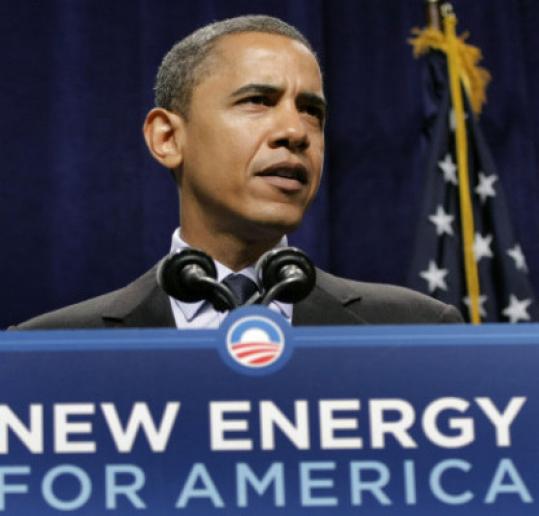
Today, Barack Obama announced several measures to increase America's energy independence and reduce the threat of global climate change. In a speech delivered at the White House, President Obama said, "These are extraordinary times," adding, "At a time of such great challenge for America, no single issue is as fundamental to our future as energy."

After briefly discussing the nation's economic challenges, Obama went on to link today's challenges to our dependence on oil and fossil fuels:

"America's dependence on oil is one of the most serious threats that our nation has faced. It bankrolls dictators, pays for nuclear proliferation and funds both sides of our struggle against terrorism. It puts the American people at the mercy of shifting gas prices, stifles innovation, and sets back our ability to compete.

These urgent dangers to our national and economic security are compounded by the long-term threat of climate change, which, if left unchecked, could result in violent conflict, terrible storms, shrinking coastlines, and irreversible catastrophe."
President Obama noted that every US president from Richard Nixon on has promised efforts to secure America's energy independence, saying:
"Year after year, decade after decade, we've chosen delay over decisive action. Rigid ideology has overruled sound science. Special interests have overshadowed common sense. Rhetoric has not led to the hard work needed to achieve results and our leaders raise their voices each time there's a spike on gas prices, only to grow quiet when the price falls at the pump."
Mr. Obama said that today, "America has arrived at a crossroads," adding that it is now the nation's time to "choose whether to risk the peril that comes with our current course or to seize the promise of energy independence. And for the sake of our security, our economy and our planet, we must have the courage and commitment to change."

President Obama then promised, "It will be the policy of my administration to reverse our dependence on foreign oil while building a new energy economy that will create millions of jobs."

He recognized that the challenge will not be easy. "I cannot promise a quick fix," he said. "No single technology or set of regulations will get the job done."

Obama then promised to "commit ourselves to steady, focused, pragmatic pursuit of an America that is freed from our energy dependence and empowered by a new energy economy that puts millions of our citizens to work. "

The president then went on to announce what he called "the first steps on our journey toward energy independence," including new investments in Obama's economic stimulus package to harness clean energy, a directive to move forward with new regulations to increase the efficiency of American cars and trucks passed by Congress in December 2007, and a new directive to the Environmental Protection Agency to allow California and 13 other states to set stricter standards for greenhouse gas emissions from the tailpipes of personal vehicles. "Each step," President Obama said, "begins to move us in a new direction, while giving us the tools that we need to change."

Here is the remainder of his speech:
"First we must take bold action to create a new American energy economy that creates millions of jobs for our people. The American Recovery and Reinvestment Plan before Congress places a downpayment on this economy.

It will put 460,000 Americans to work with clean energy investments and double the capacity to generate alternative energy over the next three years. It will lay down 3,000 miles of transmission lines to deliver this energy to every corner of our country. It will save taxpayers $2 billion a year by making 75 percent of federal buildings more efficient. And it'll save working families hundreds of dollars on their energy bills by weatherizing 2 million homes.

This is the boost that our economy needs and the new beginning that our future demands.

By passing the bill, Congress can act where Washington has failed to act over and over again for 30 years. We need more than the same old empty promises. We need to show that this time it will be different. This is the time that Americans must come together on behalf of our common prosperity and security.

Second, we must ensure that the fuel-efficient cars of tomorrow are built right here in the United States of America.

Increasing fuel efficiency in our cars and trucks is one of the most important steps that we can take to break our cycle of dependence on foreign oil. It will also help spark the innovation needed to ensure that our auto industry keeps pace with competitors around the world.

We will start by implementing new standards for model year 2011, so that we use less oil and families have access to cleaner, more efficient cars and trucks.

This rule will be a downpayment on a broader and sustained effort to reduce our dependence on foreign oil.

Congress has passed legislation to increase standards to at least 35 miles per gallon by 2020. That 40 percent increase in fuel efficiency for our cars and trucks could save over 2 million barrels of oil every day: nearly the amount of oil that we import from the Persian Gulf.

Going forward, my administration will work on a bipartisan basis in Washington and with industry partners across the country to forge a comprehensive approach that makes our economy stronger and our nation more secure.

Third, the federal government must work with, not against, states to reduce greenhouse gas emissions.

California has shown bold and bipartisan leadership through its effort to forge 21st-century standards, and over a dozen states have followed its lead.

But instead of serving as a partner, Washington stood in their way. This refusal to lead risks the creation of a confusing and patchwork set of standards that hurts the environment and the auto industry.

The days of Washington dragging its heels are over. My administration will not deny facts; we will be guided by them. We cannot afford to pass the buck or push the burden onto the states.

And that's why I'm directing the Environmental Protection Agency to immediately review the denial of the California waiver request and determine the best way forward. This will help us create incentives to develop new energy that will make us less dependent on the oil that endangers our security, our economy and our planet.

As we move forward, we will fully take into account the unique challenges facing the American auto industry and the taxpayer dollars that now support it. And let me be clear: Our goal is not to further burden an already struggling industry; it is to help America's automakers prepare for the future.

This commitment must extend beyond the short-term assistance for businesses and workers. We must help them thrive by building the cars of tomorrow and galvanizing a dynamic and viable industry for decades to come.

Finally, we will make it clear to the world that America is ready to lead. To protect our climate and our collective security, we must call together a truly global coalition. I've made it clear that we will act, but so too must the world. That's how we will deny leverage to dictators and dollars to terrorists, and that's how we will ensure that nations like China and India are doing their part, just as we are now willing to do ours.

It is time for America to lead because this moment of peril must be turned into one of progress.

If we take action, we can create new industries and revive old ones, we can open new factories and power new farms, we can lower costs and revive our economy. We can do that and we must do that.

There's much work to be done; there is much further for us to go. But I want to be clear from the beginning of this administration that we have made our choice: America will not be held hostage to dwindling resources, hostile regimes and a warming planet.

We will not be put off from action because action is hard.

Now is the time to make the tough choices. Now is the time to meet the challenge at this crossroad of history by choosing a future that is safer for our country, prosperous for our planet, and sustainable.

Those are my priorities, and they're reflected in the executive orders that I'm about to sign.

Thank you so much for being here."

Read more!

VIDEO: The Power Shift is Coming!


Register today for Power Shift 2009!

Read more!

Sunday, January 25, 2009

BREAKING: Obama Lets California and 13 States Regulate Global Warming Pollution from Cars and Trucks

Obama will also speed efforts to set federal fuel economy standards.

BREAKING NEWS: President Barack Obama will grant California and 13 other states the authority to regulate global warming pollution from cars and light trucks, setting standards that would require cars and trucks sold in those states to achieve higher fuel efficiency.

According to the New York Times:

President Obama on Monday will direct federal regulators to move swiftly to grant California and 13 other states the right to set strict automobile emissions and fuel efficiency standards, two administration officials said Sunday evening.

The directive makes good on an Obama campaign pledge and marks a sharp reversal from Bush administration policy. Granting California and the other states the right to regulate tailpipe emissions is one of the most dramatic actions Mr. Obama can take to quickly put his stamp on environmental policy.

The presidential orders will require automobile manufacturers to begin producing and selling cars and trucks that get higher mileage than the national standard, and on a faster phase-in schedule. The auto companies had lobbied hard against the regulations and challenged them in court.
The Washington Post also reports on the story here:
On Dec. 19, 2007, then-EPA Administrator Stephen L. Johnson blocked the efforts of California and more than a dozen other states to limit automobiles' carbon dioxide emissions, arguing that President George W. Bush had addressed the issue by signing a law that same day raising the corporate average fuel-efficiency standard to 35 miles per gallon by 2020. But California's tailpipe emissions rules would have effectively required even greater fuel-efficiency increases, by seeking to cut vehicles' greenhouse gas emissions by 30 percent between 2009 and 2016, something American automakers have resisted.
WattHead - Energy News and Commentary has reported on the long, long saga of the California Tailpipe Emissions Standards since California initially adopted the standards back in October 2005. We'll continue to bring you the latest news in this ongoing story.

The Times and Post also report that on Monday, Obama will make further announcements concernign federal efforts to improve vehicle fuel economy, reduce government energy consumption (and save taxpayers money). According to the Times:

In a White House announcement scheduled for Monday morning, Mr. Obama will also direct federal agencies to immediately begin work on making all government buildings more energy efficient, with an eye toward saving as much as $2 billion a year and reducing the emissions of carbon dioxide and other gases blamed for the warming of the planet.

He will also direct the Department of Transportation to immediately begin drafting automobile fuel-economy regulations to comply with a law enacted in December 2007. Former President Bush delayed implementation of the law and left office saying there was not sufficient time to write the rules.
The Post again has more detail, clarifying that:
The Bush administration never issued near-term guidelines for tighter fuel-efficiency standards: The Transportation Department circulated a proposal last fall that would have required auto companies to build new cars averaging as much as 31.8 miles per gallon by 2015, compared with the current level of 27.5 miles per gallon, but it announced less than two weeks before Bush left office that it would not issue formal guidelines. ...

Obama, who has consistently urged U.S. automakers to produce more fuel-efficient cars, is likely to accelerate the timeline for raising the nation's corporate average fuel economy for cars and trucks. The Transportation Department guidelines must be issued no later than April in order to affect the 2011 auto fleet.
However, as the Post reports, the waiver allowing California and 13 other states to move forward with regulations on CO2 emissions from cars and trucks may do more to accelerate increased vehicle fuel economy than the federal CAFE standards:
Granting a waiver for California to regulate tailpipe emissions would affect nearly half the U.S. auto market. Thirteen other states -- including Maryland -- and the District have already adopted California's proposal, while at least four others have pledged to do so. When EPA rejected the waiver, Obama issued a statement saying the decision "is yet another example of how this Administration has put corporate interests ahead of the public interest. If the courts do not overturn this decision, I will after I am elected president."

"Not only is the new president a man of his word, but he's making a dramatic break with the Bush administration's climate policy," said Frank O'Donnell, who heads the advocacy group Clean Air Watch. "It's a powerful signal that science -- and the law -- will guide his administration's decisions. This should prompt cheers from California to Maine."
Happy Sunday!

Read more!

Friday, January 23, 2009

Obama EPA Overturns Big Stone II (SD/MN) Air Permit

By Kai Bosworth, cross-posted from ItsGettingHotInHere.org

Just days after the inauguration of President Barack Obama, the new administration is already getting to work on cleaning up some of the weak rulings from the last eight years. For those of us in Minnesota and South Dakota, the change is already being felt as the air permit for South Dakota’s Big Stone II coal plant was revoked earlier today.

The proposed Big Stone II coal plant was located right on the border of Minnesota, and 45% of its electricity would have crossed the border. However, by locating the plant in South Dakota, Otter Tail Power and the other applicants avoided the stronger Minnesotan regulations. South Dakota’s regulators approved the environmental permits for the project months ago.

The final permit needed was a Certificate of Need from the Public Utilities Commission (PUC) of Minnesota for a powerline going from Big Stone II to eastern Minnesota. High voltage powerlines in Minnesota have always been contentious, and none have been built in the state since the 1979 powerline battle (fought over the CU line, which now brings coal to Minnesota from North Dakota…very familiar). After delaying the decision last June, the PUC commissioned an independent study to determine if the dirty coal power would be the cheapest for Minnesotans. The reviewers, Boston Pacific, released their report in October, which stated that Otter Tail Power’s cost estimates for future coal power were far too low, considering an impending carbon price. Additionally, two administrative law judges both recommended to the PUC that the project be nixed. Despite this evidence (and the overwhelming organizing effort of local youth and green groups, too many to name), last week the PUC voted 5-0 in favor of building the powerline.

But what a difference a week can make. Today, Obama’s EPA revoked the original OK given for the South Dakota air permit, citing worries about the plant’s contributions to global warming and inadequate emissions monitoring. This action took place on the dead last day for review for the plant’s application. Talk about good timing!

It’s unclear whether this will spell the end to Big Stone II, a coal plant five years in the making, or the powerline, which could be rerouted or extended to bring dirty energy from another proposed coal plant near Selby, SD (“It’s probably going to be the cleanest coal plant in the nation”). Otter Tail Power has 90 days to submit a revised application. Yet this is surely a good sign for activists across the country working to stop carbon-spewing projects like this one. Let’s hope it’s the first of many.

The press release from Clean Water Action and the Sierra Club can be read below.

FOR IMMEDIATE RELEASE:

CONTACT:

Virginia Cramer, Sierra Club 804-519-8449
Darrell Gerber, Clean Water Action 612-802-5372

Date: January 23, 2009

Big Stone II Sent Back to the Drawing Board
U.S. Environmental Protection Agency Concerned About Pollution, Global Warming

Washington, DC – Less than three days after the Bush Administration left office, the Environmental Protection Agency (EPA) has overturned the State of South Dakota’s approval of the massive Big Stone II coal-fired power plant. The EPA’s decision comes after the state failed to require state-of-the-art pollution controls for the coal plant that would address concerns about harmful soot, smog and global warming pollution.

“This is a great day not only for clean energy and people’s health, it’s a victory for the rule of law,” said Bruce Nilles, Director of the Sierra Club’s Move Beyond Coal Campaign. “EPA is signaling that it is back to enforcing longstanding legal requirements fairly and consistently nationwide,” added Nilles.

As the first major coal plant decision by the EPA since President Obama took office, this decision signals that the dozens of other coal plant proposals currently in permitting processes nationwide will face a new level of federal scrutiny. Sierra Club and Clean Water Action have been working to stop the Big Stone II project and ramp up clean energy investments in for more than three years.

“Today EPA took the first step toward restoring science and integrity to its work and recognizing the very real need to reduce air pollution from coal-fired power plants,” said Darrell Gerber, Clean Water Action Program Coordinator. “Downwind residents and the region’s natural resources will be better protected.”

This decision likely spells the end of Otter Tail Power’s Big Stone II coal plant. While for the past eight years the Bush Administration has refused to regulate global warming pollution, even after being ordered to do so by the US Supreme Court, President Obama has pledged that the US will cut global warming pollution and do its part to avoid the worst consequences of climate change. With coal-fired power plants accounting for almost 30% of our nation’s carbon dioxide emissions, burning less coal and investing in clean energy such as wind and solar instead is a common sense approach to helping meet global warming pollution reduction goals. The proposed Big Stone II 500-megawatt coal plant would have emitted more than 4 million tons of global pollution annually.

At a minimum, Otter Tail Power will have to go back to the drawing board and redesign the project to incorporate the best and maximum available control technology for pollution like soot and smog. Sierra Club and Clean Water Action will be pushing for EPA to set limits also for carbon dioxide, the main contributor to global warming.

“Otter Tail Power will now have to be responsible for the cost of its pollution,” said Nilles. “We hope that this increasing cost of coal will encourage Otter Tail Power, along with Governors Pawlenty and Rounds, to harness the clean and affordable wind resources available in the region. Minnesota and South Dakota should be leaders on the path to renewable energy independence, not laggards proposing 19th century coal plants.”

Read more!

Breaking: EPA Halts Proposed South Dakota Coal Plant

BREAKING NEWS: The U.S. Environmental Protection Agency put the breaks on Big Stone II, a major new coal plant proposed in South Dakota and intended to serve electricity consumers in Minnesota, North Dakota and South Dakota. Coming just days after former President Bush boarded his helicopter and departed our nation's capitol, this news could indicate renewed scrutiny for coal plant proposals from the EPA. Perhaps it's time EPA and it's new management will deserve that "Protection" word once again.

From Bloomberg news:

The U.S. Environmental Protection Agency placed a hold on approval of a coal-fired power plant in South Dakota, a move environmental groups say indicates increased scrutiny under President Barack Obama.

“This is a signal that the Obama administration is taking a much harder look at coal power from the previous administration,” said Darrell Gerber, a program coordinator at Washington-based Clean Water Action, which along with the Sierra Club opposed the plant.
The EPA said in a letter to the South Dakota Department of Environment and Natural Resources yesterday that the state didn’t meet requirements under the Clean Air Act in part of its proposed permit for the plant. The state has 90 days to respond to the agency’s objections.

Obama has pledged to fight global warming by cutting the amount of greenhouse gases released in the U.S. and pursuing clean-energy technology. Coal-fired power plants account for almost 30 percent of heat-trapping carbon dioxide emissions in the U.S., according to the Sierra Club.

...

The Sierra Club and Clean Water Action said in a joint statement that this is the first major coal-plant decision by the EPA under Obama, and it means other proposed plants will are likely to come under greater federal scrutiny.

Read more!

Public Opinion Cool on Global Warming

Cross-posted from the Breakthrough Institute

Public opinion on global warming lags far behind the rhetoric and apparent commitment shown by President Obama and other elected officials, according to reports today from Andy Revkin at the New York Times (in print and on his DotEarth blog).

"The latest in an annual series of polls from the Pew Research Center on people's top priorities for their elected leaders shows that America and President Obama are completely out of sync on human-caused global warming," Revkin writes, pointing out that "Mr. Obama stressed the [global warming] issue throughout his campaign and several times in his inaugural speech, mentioning stabilizing climate in the same breath as preventing nuclear conflict at one point."

As Revkin reports, the Pew poll found global warming ranked dead last among 40 concerns ranked by the 1,503 respondents of the poll:

pewpollNYTimes.jpg

"Here's the list from top to bottom, with the economy listed as a top priority by 85 percent of those polled and global warming 30 percent: the economy, jobs, terrorism, Social Security, education, energy, Medicare, health care, deficit reduction, health insurance, helping the poor, crime, moral decline, military, tax cuts, environment, immigration, lobbyists, trade policy, global warming."

It seems that with the economy in turmoil, Americans have pushed aside other concerns and, even more so than in calmer days, are spending little time worrying about global warming or the environment. According to Revkin:

"Only 30 percent of the voters deemed global warming to be "a top priority," compared with 35 percent in 2008.

"Protecting the environment," which had surged in the rankings from 2006 to 2008, dropped even more precipitously in the poll: only 41 percent of voters called it a top priority, compared with 56 percent last year.

In contrast, dealing with the nation's energy problems ranked sixth in the poll -- just behind education and social security -- with 60 percent of voters endorsing it as a top priority."

With gas prices falling precipitously over the last several months (prices at the pump seem to be the only thing falling faster than the value of people's retirement accounts), public concern for energy issues has also slipped somewhat from June, when it ranked #2 in a similar Gallup poll of top public concerns. Still, the salience of energy costs and energy independence still seems far higher than global warming for the American public.

The poll also makes abundantly clear that, above all else, Americans will clearly be judging just about every public policy proposal through the lens: "is this good for the economy and for my job?"

All this said, it's also fair to say that polls that silo complex and interlinking issues like "global warming," "energy," "the environment," etc. are not the best indicators of the potential success or failure of broad policy proposals. For example, President Obama or others could make a clear and convincing argument that a policy to reduce global warming pollution will raise revenue that we can invest in clean energy technologies, creating new energy industries and jobs, increasing the efficiency of our homes and business, cutting our oil dependency, etc. (Nancy Pelosi seemed to frame things that way in the Chronicle yesterday). In that case, the polling figures for "global warming" as an isolated issue will clearly not be the most accurate barometer of the proposal's popularity.

Still, Obama and other leaders beware: these numbers would seem to point to a very uphill battle for any proposal framed centrally or primarily as a "climate bill," rather than an "energy independence-economic recovery-and-climate bill." Perhaps more crucially, any proposal that can be painted as bad for the economy will also most certainly run right into a brick wall of public opposition..

Read more!

Thursday, January 22, 2009

Hope Is Not a Strategy

By Jake Brewer. Full post at HuffingtonPost

I'm sitting a couple blocks north of the White House and the buzz around here is intense. Still.

The sense that we are in the middle of a massively-historical moment is palpable, and there's a lot of talk about yesterday's inauguration ushering in new era for our country. To be honest, I'm as taken up as anyone with the hopeful possibilities that 2009 and beyond can bring.

I hear "new era," and I immediately start thinking about what those words can mean. My deep, personal hope is that this new era will be defined by the decision of our country to move boldly into the clean energy future we must achieve.

I'm even more hopeful after hearing these ideas inserted so prominently into President Obama's inaugural address.

But every time I have these feelings of hope, I'm reminded of something my dad always told me:

"Son, hope is not a strategy."

And as usual, he's right. The question clearly and powerfully before us is not what we hope for, but rather, what are we going to do to make our hopes actually happen. We need to act. Now. And just as we came together in record numbers to vote new elected officials into office, the young people of this country WILL act.

http://www.PowerShift09.org


Our response is bold. It is equal to this historic moment. It is audaciously hopeful, and infused with the energy and vitality of an entire generation of Americans ready to turn good intentions and rhetoric into reality.

37 days after President Obama lost the "-elect," we are going to bring 10,000 young people to Washington to hold our elected officials accountable for rebuilding our economy and reclaiming our future through bold climate and clean energy policy.

And whether this was your first election or your twentieth, we need you to be here with us. Or at the least, we need you to support us.

Power Shift '09 will be one of the "Where Were You Moments" of our generation. You can join us in DC starting February 27th for four days of learning, connection, music, inspiration, and the largest lobby day on climate and clean energy Capitol Hill has ever seen.

http://www.PowerShift09.org

For the full post, read on here.

Read more!

Wednesday, January 21, 2009

Obama Stimulus: For Clean Energy, a Patchwork of Investments

By Adam Solomon Zemel. Cross-posted from the Breakthrough Institute.

Barack Obama has finally been sworn in as the 44th President of the United States of America. For once, there is no debate among pundits or Capitol Hill insiders about what Obama's first priority will be as President. It seems like President Obama has been working on crafting an economic stimulus bill since November 5th, and now the real work begins in earnest.

Last week, despite reports from the Congressional Budget Office that our economy will likely face $2 trillion of lost production over the next two years, Obama rolled out a stimulus plan that only spends $825 billion to make up for this gap in production. A summary of the American Recovery and Reinvestment Act, released by the House Appropriations Committee, gives us the first detailed look at how this money will be spent and invested. Reading through the section devoted to energy in particular, a glaring lack of spending and the absence of any sort of cohesive guiding framework both give reason for pause.

Every dollar of public investment produces, on average, about one and half dollars of GDP, achieving a "multiplier effect" that makes federal spending ideally suited for maximizing stimulus investments - a critical criteria when facing such a massive economic shortfall. Considering the fact that only $550 billion of the stimulus will be in the form of spending and investment, it seems that the stimulus in its current form won't even attempt to address the full $2 trillion dollar economic gap. The other $275 billion contained in the stimulus will go to tax cuts, which economists reckon will have little to no "multiplier" effect and will likely make up for no more than $275 billion of lost production. As it stands, Obama's stimulus proposal may only address half of the economic shortfall projected by CBO (stimulating roughly $1 trillion in increased economic production). And it'll be worse if CBO's projections turn out to be optimistic (as scary a thought as that is!). That leaves economists like Nobel Laureate Paul Krugman concluding, "the Obama plan is nowhere near big enough to fill this 'output gap.'"

So given the risks of not doing enough, why does the Recovery and Reinvestment plan attempt to address just half of expected losses in economic production? Or as Krugman is left wondering, "Why isn't Mr. Obama trying to do more?"

Obama has hinted that the scale of public investments in the stimulus has been constrained by a lack of "shovel ready" projects, projects that are ready to go and will expend most of their money and hire most of the associated jobs within the next 24 months. Anything that isn't shovel ready might not yield its peak economic benefits until more than two years from now, reducing the timely impact of the stimulus, or so the argument goes.

So perhaps there is not enough that is "shovel ready." But looking at this stimulus summary, that's hard to believe. In addition to $22 billion for efficiency retrofits, Obama is only planning on spending $32 billion dollars on clean energy research and development, demonstration, deployment, and enabling infrastructure, such as a modern 21st century electricity transmission grid. All these projects and more are necessary and carry a much bigger price tag than $54 billion--even over the next two years. Robert Pollin's Green Recovery report, for example, outlined $100 billion in smart investments in clean energy projects over the next two years - double what is contained in the current stimulus plan.

Another sign that public investments have not been maximized can be found within the House's own stimulus summary. The section summarizing transportation investments explicitly states that while there are more than $65 billion in shovel ready, backlogged public transit and rail projects, the stimulus will only allocate about $10 billion to mass transit investments. This makes it pretty clear that "shovel ready" has not been the consistent standard for apportioning expenditures for the stimulus, and raises plenty of questions. If Obama is not spending to the full capacity of shovel ready projects on smart public transit investments, there is little evidence he has maximized public investments in other areas, especially the clean energy investments so critical to our economic, national security and climate objectives.

Underfunded or not, the series of clean energy investments included in this version of the stimulus reads like a laundry list of piecemeal tax breaks and incentives that simply do not cohere into any kind of unified plan. It seems that there is no coordination between the different intended energy expenditures and no central objective or strategy behind then, other than creating new jobs.

Given the momentous challenges facing America today, challenges that Obama spoke eloquently of in his inaugural speech today, he can ill afford to waste any opportunities to make stimulus investments pull "double duty" - making investments that both create jobs in the short term and set the foundation for smart, sustained growth towards a new 21st century economy.

So when it comes to clean energy investments, the stimulus must follow some kind of plan, designed to organize investments that are most effective at building the new energy economy we need. They should evidence a clear vision of the clean energy economy we're trying to create and follow a diagnosis of the key barriers and challenges standing in the way of that vision. Such a vision and diagnosis would in turn inform a strategy of framework to organize and guide where and how to best invest as much stimulus money as possible in spurring the transition to a new, clean energy economy.

The high price of clean energy technologies is currently the greatest obstacle hampering the transition to "harness[ing] the sun and the winds and the soil to fuel our cars and run our factories," an objective Obama spoke of today. We've therefore argued for a strategy to spur clean energy development and deployment designed to drive down the costs of clean energy - a strategy to "make clean energy cheap." If Obama were to sit down with his top-notch energy and economic teams and a red pen with a single goal in mind--"make clean energy cheap"--the energy section of the stimulus might suddenly expand in scope and have a new, cohesive and strategic focus.

The stimulus legislation is currently making its way through the House, and certain pundits have predicted that Congressional Democrats will bulk up the investment end of the bill before it is passed and sent over to Obama's desk. If this is true, there would be no better way to increase spending, to meet both short-term and long-term objectives, than increasing investments to make clean energy cheap and abundant.

It's President Obama now. For him, and our nation, the real work begins today. The stimulus is the first chance to get it right.


Read more!