In one of the tightest governor’s race in the country, two very different candidates for the highest state-level elected office in Oregon. One, Democrat John Kitzhaber, is a former Oregon governor who wants to build up the state’s green economy, protect public health and wildlife habitat, and continue Oregon’s leadership role in the fight against global warming. Meanwhile Republican Chris Dudley—a basketball player with no political experience—opposes regulating carbon, is open to offshore oil drilling along Oregon’s coasts, and isn’t sure whether global warming is caused by human activity. The choice for Oregon couldn’t be starker.
A few months ago during primary season, I wrote about some of the major energy and environmental challenges Oregon’s next governor will have to take on. Since that time the candidate widely regarded as most progressive on environmental issues, former Secretary of State Bill Bradbury, has been eliminated from the race. Bradbury lost the Democratic primary to John Kitzhaber, and I won’t pretend that wasn’t a disappointment to me personally. But here’s why I’m still excited to cast my ballot in a couple weeks:
John Kitzhaber, who’s been endorsed by the Sierra Club and the Oregon League of Conservation Voters, is a very green candidate. It just happens that in the primary, he was up against someone with even better energy and climate plans. Kitzhaber’s green credentials were outshone by Bradbury’s in the primary—but running against almost anyone else (or in anyplace other than Oregon), Kitzhaber would have been the clear environmental choice. This is certainly the case now that it’s come down to a race between Kitzhaber and Dudley.
Chris Dudley has gotten as far as he has in the governor’s race mainly by outspending Kitzhaber. When an early poll showed Dudley doing better than expected in the polls, big business poured money into his campaign. Dudley apparently feels secure enough with his monetary advantage that he agreed to only one in-person gubernatorial debate, showing he’s more interested in being seen as a smiling five-second presence on TV than in actually digging into issues and concerns Oregonians care about.
Dudley has repeatedly failed to respond to media inquiries about his environmental views, but what has emerged is extremely worrying. So far we know Dudley wants to weaken clean water rules, increase logging in Oregon’s forests, and backtrack on the state’s ambitious climate and clean energy goals. When asked during the one-and-only debate with Kitzhaber if he believes humans are over-heating the planet, Dudley said he wasn’t sure.
A win for Chris Dudley would be a disaster for environmental progress in Oregon. A win for John Kitzhaber means Oregon will be able to continue its leadership role on climate and clean energy issues. The latest polls show Dudley and Kitzhaber virtually tied in the governor’s race, so youth voters could make all the difference in deciding the outcome. Now is a historic moment for youth voters in Oregon: this year we’ll be the ones deciding one of the most important environmental elections in the country. Be sure to turn your ballot in when it comes in the mail.

Saturday, October 16, 2010
The Oregon Governor’s Race: Laying Groundwork for Progress on Clean Energy


Friday, October 15, 2010
Daily Dose of Sanity: Turning Headwaters into Toxic Sludge Dumps is Bad for Water and Wildlife -- EPA Administrator
 Here's your daily dose of sanity, courtesy of EPA regional administrator Shawn Garvin, who has recommended that the agency veto a Clean Water Act permit for the massive Spruce No. 1 mountaintop removal coal mine in Logan County, W.Va.
Mr. Garvin's commonsensical rationale? Apparently burying several miles of pristine Appalachian headwaters and replacing them with landfill and a toxic sludge dump will adversely impact downstream waters and wildlife.
No sh&#!
The West Virgina Gazette's intrepid Ken Ward Jr. has the story:EPA has posted a copy of Garvin’s recommendation here, and there are some companion documents online here. The recommendation concludes:
This isn't the end of the line for the controversial mountaintop removal project. EPA took pains to be clear that the agency "has not reached a final decision on this project," and promised to next "reach out to the mining company, the U.S. Army Corps of Engineers, and West Virginia State officials to engage in discussions about potential actions that can be taken to reduce impacts on the environment and to the waters that Appalachian communities depend on for drinking, swimming and fishing."… Region III has determined that discharges of dredged and/or fill material to Pigeonroost Branch and Oldhouse Branch for the purpose of constructing the Spruce No. 1 Surface Mine as currently authorized … would likely have unacceptable adverse effects on wildlife … [the permit] authorizes construction of valley fills and sedimentation ponds and other discharges into Pigeonroost Branch and Oldhouse Branch that will bury approximately 6.6 miles of high quality headwater streams.
The regional EPA administrator also concluded:
… Burial of Pigeonroost Branch and Oldhouse Branch would likely result in effects to downstream waters and downstream wildlife caused by the removal of functions performed by the buried resources and by transformation of the buried areas into sources that contribute contaminants to downstream waters. In addition, currently authorized discharges to Pigeonroost Branch and Oldhouse Branch would be likely to contribute to conditions that would support blooms of algae that release toxins that kill fish and other aquatic life …… Because construction of the Spruce No. 1 Mine and 11 additional mining operations would increase the percent of the sub-basin that is impacted by mining activity, it can be expected that these water quality effects will likely be exacerbated by these additional mines. EPA believes that the Spruce No. 1 Mine project, in conjunction with the other mining operations either under construction or proposed for the Coal River sub-basin, will be likely to contribute to the significant cumulative loss of aquatic resources and degradation of water quality.
Here's an idea: don't blow the tops off of mountains and dump their dessicated remains onto your headwaters valleys! We'll see if sanity prevails...
Update: more sanity from 50 members of Congress who wrote the EPA to support a stronger stance on protecting clean waters from the impacts of mountaintop removal mining operations, and to recommend the EPA's veto of the Spruce No. 1 mine. More here.
Thursday, October 14, 2010
Good News: Solar Power to Double in 2010
Wednesday, October 13, 2010
A New Era of "Post-Partisan Power"?
 Written by Daniel Goldfarb and Clifton Yin
“The new report calls for increasing federal innovation investment from roughly $4 today to $25 billion annually, and using military procurement, new, disciplined deployment incentives, and public-private hubs to achieve both incremental improvements and breakthroughs in clean energy technologies.”
Tuesday, October 12, 2010
"The Marines Go Green" and Civilians Gain
 By Daniel Goldfarb. Originally published at Americans for Energy Leadership
"In the last half-century, many of the United States' great technological breakthroughs have been made possible because of the demand created by large-scale government projects—which, in this country, has mainly meant military and space projects... In this same way, the military's demand for renewable-energy technologies today could create the conditions for a wide commercial market in the years ahead."Also important is his recognition of the policy advantages of housing such large scale projects within the Department of Defense. Whereas Department of Energy programs face financial uncertainty, see ARPA-E, DoD programs enjoy long term funding because of the uniquely insulated nature of defense spending.
Policy stability is currently one of the foremost concerns of the U.S. clean energy industry. With crucial stimulus initiatives set to expire and no new energy bills on the horizon, the military could be one of the few places for the clean energy industry to turn. As the Breakthrough Institute noted yesterday, military funding for the "advanced demonstration and early commercialization of promising clean energy technologies, particularly those with dual-use military applications," may be essential in the near future. It is the dual nature of DoD work - that its technology initiatives regularly benefit the national defense and civilian economy - that gives the DoD its unique freedoms. In the past, Kaplan shows, the DoD's unique attributes have allowed it to house long term and capital intensive projects when others were unwilling or unable:
"Congress is more likely to fund these projects precisely because they're related to the national defense. The United States has an elaborate nationwide highway system today because, back in 1956, President Dwight Eisenhower sold the program to Congress by calling it the National Interstate and Defense Highway Act (italics added)."As Adam Sieff and I wrote last week, the military's clean energy imperative is founded on the strategic and tactical risks fossil fuels pose to American soldiers. While it may be tough to swallow DoE energy initiatives with our currently ballooning deficit, there is no excuse for not making American troops more safe. Housing energy innovation in the DoD does not just make sense in terms of unique capabilities and policy insulation, it also comes down to one of the least contentious issues, national defense. As Kaplan notes:
"Congress today has little appetite for spending billions of dollars on solar power generators or biofuel labs under the rubric of energy independence or 'going green.' But to serve the war mission, and especially to protect the troops, no sum is too lavish—and that's why the road to going green, and to achieving energy independence, might very well be paved through the fighting fields and villages of Afghanistan."
Monday, October 11, 2010
Valley of Death Alive and Well for Clean Tech Firms
Originally Published at the Breakthrough Institute
More and more clean energy businesses are becoming trapped in the clean energy technology "Valley of Death"--the research phase after proof of concept but before commercial production--where companies often need continued funding to survive. Unfortunately, as a result of the bad economy and a lack of venture funding, "that valley is getting even deadlier," according to a new story in the San Francisco Chronicle:
Most [VC Fims] placed their bets with the expectation that they would cash out in five to seven years. In the new normal, that horizon is getting pushed out.
It has long been recognized that promising clean tech firms need more patient capital to navigate the Valley of Death. New federal institutions have been proposed to address this issue, but such proposals are languishing in Congress as the clock runs out on the Congressional calendar. One such proposal, championed by Senator Jeff Bingaman (D-NM), is the Clean Energy Deployment Administration (CEDA). CEDA would utilize a suite of flexible credit enhancement tools, including loan guarantees, securitization, and insurance, that would reduce risk for investors in cutting-edge clean energy technologies.
There is also a greater recognition that the Department of Defense can and should play a critical role in financing the advanced demonstration and early commercialization of promising clean energy technologies, particularly those with dual-use military applications.
Ultimately, a much greater role for federal investment is required, as even private sector financiers and investment bankers have come to recognize:
"Venture capital has been very good at driving technology," says [Goldman Sachs clean energy investment analyst] Bolster. But even VCs don't have pockets deep enough to pay for scaling up these capital-intensive businesses. "When it comes time to write that $500 million to $1 billion check, nobody's home."
With critical stimulus investments soon expiring, the success of the nation's clean energy entrepreneurs will depend on whether Congressional leaders can cut through the anti-government ideology threatening to take root in Washington and provide the investments necessary to build a robust clean energy economy.
Read more!Thursday, October 07, 2010
Three Cool Solar Power Competitions That Could Change Our World


Wednesday, October 06, 2010
The Military's Green Imperative
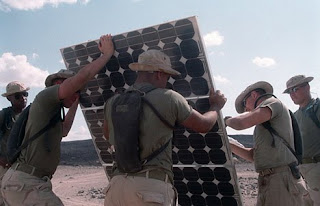
While much has been written on the strategic disadvantage of America’s reliance on fossil fuels, and that we fund a number of adversarial nations, until recently the tactical dangers have not gotten their due attention. Fossil fuels aren’t just forcing our military into geo-strategic wars, but also putting our soldiers at risk in the field of combat:
“Concerns about the military’s dependence on fossil fuels in far-flung battlefields began in 2006 in Iraq, where Richard Zilmer, then a major general and the top American commander in western Iraq, sent an urgent cable to Washington suggesting that renewable technology could prevent loss of life.”