Friday, July 31, 2009

Fraud? Identity Theft? Impersonation? All In A Day’s Work

How many lobbyists does it take to screw in a lightbulb up democracy?

Turns out, just one. This morning the Charlottesville Daily Progress reported that the lobbying group Bonner & Associates had sent deliberately forged letters to freshman U.S. Representative Tom Perriello from the local NAACP and Creciendo Juntos, stating opposition to the American Clean Energy and Security Act (ACES). In June, two weeks before the House passed the bill, six letters (copies here and here) supposedly sent from these two organizations urged Rep. Perriello to "Please don't vote to force cost increases on us, especially in this volatile economy."

The author of the letters was identified as an employee with Bonner & Associates, a firm noted for dubious astroturf lobbying, and has lobbied on behalf of utility companies in the past. The firm did not register to lobby on behalf of any company or organization against the cap-and-trade bill.

“They stole our name. They stole our logo. They created a position title and made up the name of someone to fill it. They forged a letter and sent it to our congressman without our authorization,” said Tim Freilich, who sits on the executive committee of Creciendo Juntos... “It’s this type of activity that undermines Americans’ faith in democracy.”

Rick Turner, the President of the local NAACP branch responded, saying:

“I am very appalled as the president that our organization has been misrepresented in this way by this bogus … letter,” Turner said. “I hope that whoever’s behind this will be brought to justice.”

In fact, Turner said, the NAACP supports the American Clean Energy and Security Act, as he said it would create good-paying jobs for blacks and reduce harmful emissions, particularly in urban areas.

“Clean energy creates jobs in the urban setting,” he said.

Events like this make me wonder, what else has been done in the name of legitimate organizations? It turns out, this is not the first time Bonner & Associates has been confronted with dishonest lobbying tactics. In 2002, Bonner and Associates was hired by the Pharmaceutical Research and Manufacturers of America to kill drug reform and used a front group to manipulate local minority organizations to oppose drug reform. In response to the Maryland prescription drug event, Jack Bonner said "It's democracy."

How are lies and deception 'democracy?'

Rep. Ed Markey, co-sponsor of ACES announced this morning a congressional investigation of the incidents:

This fraud on Congress shows that some opponents of clean energy have resorted to forgery and theft to block progress.

This is an appalling abuse, and Congressman Tom Perriello deserves great credit for seeing through it and casting a vote that will create clean energy jobs in Virginia and throughout the United States. I encourage all Members of Congress to be on the lookout for other suspicious and illegal materials.

Given that opponents are willing to resort to willful deception, lies and fraud, we must be all the more vocal in demonstrating public support a clean energy economy. We must strengthen our alliances to make sure this kind of organizational identity theft does not divide our movement. We must speak truth to power, like the Avaaz Action Factory is doing today, and make sure that this story is exposed for the scandal it is.

Cross-posted on It's Getting Hot In Here.

Read more!

Action Alert: DC lobbyists use naked fraud to oppose climate bill! Rapid response protest scheduled

BREAKING NEWS and ALERT from the Avaaz DC Action Factory

This morning the below story broke: LOBBYISTS FORGED LETTERS TO CONGRESS ON CLIMATE BILL

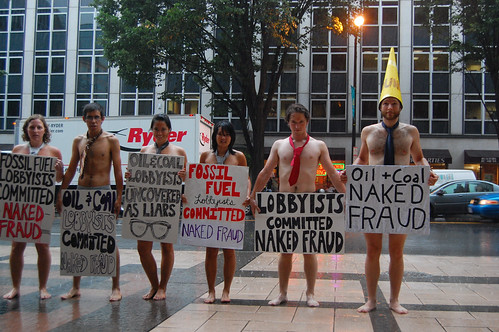
Update: see photos from today's protest of this naked fraud here.

A DC Lobbying firm stole the trademarked logo and organizational name of the NAACP and a community group in Charlottesville, VA and wrote a letter purporting to oppose the ACES bill in the house.

This is a prime example of dirty money fueling lies in DC. It is an affront to Democracy and a hindrance to passing the climate legislation our country desperately needs. We need to call them out and make this a national story.

RAPID RESPONSE ACTION:

What: Picket / Rally outside of the perpetrators' offices. Visuals will include "naked" lobbyists holding signs admitting to "naked fraud" and climate destruction.

Where: 1101 17th St NW (Near Farragut Square Metro stops)

When: 2:30 PM, Friday July 31.

Who: Avaaz Climate Action Factory and YOU!

For Inquiry: call David Sievers at 301-455-2357 or Morgan Goodwin at 413-884-5240

Resources: Download and view the forged and fraudulent letters here (NAACP) and here (Creciendos Juntos), [both pdfs].

Story from the Charlottesville Daily Progress.

Forged letters to congressman anger local groups
By Brian McNeill
Published: July 31, 2009

As U.S. Rep. Tom Perriello was considering how to vote on an important piece of climate change legislation in June, the freshman congressman’s office received at least six letters from two Charlottesville-based minority organizations voicing opposition to the measure.

The letters, as it turns out, were forgeries.

“They stole our name. They stole our logo. They created a position title and made up the name of someone to fill it. They forged a letter and sent it to our congressman without our authorization,” said Tim Freilich, who sits on the executive committee of Creciendo Juntos, a nonprofit network that tackles issues related to Charlottesville’s Hispanic community. “It’s this type of activity that undermines Americans’ faith in democracy.”

The faked letter from Creciendo Juntos was signed by “Marisse K. Acevado, Asst Member Coordinator,” an identity and position at Creciendo Juntos that do not exist.

The person who sent the letter has not been identified, but he or she was employed by a Washington lobbying firm called Bonner & Associates.

Gwynn Geiger Hegyi, a partner with the company, traveled to Charlottesville to apologize to Creciendo Juntos’ chairwoman Dilcia Colindres and sent a letter to Freilich.

“As I shared with Dilcia when I travelled to Charlottesville last month to personally apologize for the mistake which we discovered and contacted you about, we immediately fired the person on our staff responsible for the error,” Hegyi wrote in the July 22 letter to Freilich.

Hegyi and others at Bonner & Associates did not return two phone calls Thursday seeking comment for this story.

More than a ‘mistake’

In a letter notifying Perriello’s office about the matter, Freilich said he was “offended” by Hegyi’s characterization of the forged letter as a “mistake.”

“This was not a ‘mistake,’” wrote Freilich, who is also legal director of the Immigrant Advocacy Program of the Legal Aid Justice Center. “This was a deliberately and carefully forged letter that used the logo, address and name of Creciendo Juntos without authorization. Additionally, I understand from Ms. Hegyi that our organization was not the only Charlottesville-area organization whose reputations were used in an unauthorized manner to try to influence Congressman Perriello on this particular vote.”

After being notified of the bogus Creciendo Juntos letter, staffers in Perriello’s office realized that the wording of the letter sounded familiar.

The staffers dug through the stacks of thousands of letters, e-mails and faxes Perriello received about the bill — the American Clean Energy and Security Act of 2009 — and found five more forged letters, these purportedly from the Albemarle-Charlottesville branch of the NAACP.

M. Rick Turner, president of the local NAACP branch, said he checked his organization’s roster and found none of the five people who signed their name to the five faked letters.

NAACP ‘very appalled’

“I am very appalled as the president that our organization has been misrepresented in this way by this bogus … letter,” Turner said. “I hope that whoever’s behind this will be brought to justice.”

In fact, Turner said, the NAACP supports the American Clean Energy and Security Act, as he said it would create good-paying jobs for blacks and reduce harmful emissions, particularly in urban areas.

“Clean energy creates jobs in the urban setting,” he said.

The fake NAACP letters were faxed to Perriello’s office from the Arlington headquarters of a company called Professional Risk Management Services Inc. A representative of the company said she had no knowledge of why the fax would have been sent from her office, adding that at least 60 employees have access to the fax machine.

Perriello’s press secretary, Jessica Barba, said the congressman’s office knows of only the five forged letters, but there may be others they have not yet discovered.

“There could be more, but these are the only ones that we’re aware of right now,” she said.

With regards to the Creciendo Juntos letter, it is not known who — if anyone — hired Bonner & Associates to lobby against the bill, which also is known as cap-and-trade legislation. The staffer who the company said was fired may not have been working in any official capacity when he or she created and mailed the forgery.

Bonner & Associates was founded in 1984 by Jack Bonner and is considered a pioneer in the field of “strategic grassroots,” in which the firm manages grassroots campaigns on behalf of its clients, which have included Fortune 500 companies and national associations in all 50 states.

Artificial campaign

The AARP Bulletin reported in 2006 that the “60 Plus Association” hired Bonner & Associates in 2003 to manage what it called an “Astroturf” campaign against prescription drug legislation in Minnesota and New Mexico, meaning that it was an artificial version of a grassroots campaign.

Bonner & Associates hired callers to identify themselves as members of the 60 Plus Association and urge residents to ask their governors to veto the legislation. Pharmaceutical company Pfizer later admitted that it had paid Bonner & Associates to undertake the campaign, AARP reported.

An examination of lobbyist disclosure forms filed with the Office of the Clerk of the U.S. House of Representatives shows that Bonner & Associates did not register to lobby on behalf of any company or organization against the cap-and-trade bill.

However, a lobbying firm only needs to disclose their clients if the client pays them more than $3,000 in a filing period, at least one employee spends 20 percent of their time lobbying, and that employee made at least two lobbying contacts within the filing period. Managing a grassroots campaign might not require public disclosure of lobbying activities or clients.

Bonner & Associates has disclosed a few clients in recent years. For example, the company took in $150,000 to lobby on behalf of the Electric Utility Shareholders Alliance between 1998 and 2000,
according to the nonprofit Center for Responsive Politics.

In a report Wednesday, the Center for Responsive Politics revealed that oil and gas companies greatly increased their spending on lobbying between April and June, primarily because of the
cap-and-trade energy bill. During the second quarter of 2009, these companies spent $37.7 million on lobbying congress, representing a 30 percent increase over 2008.

Perriello ultimately voted in favor of the bill, which narrowly passed the House on June 26 in a 219 to 212 vote. The bill is now before the U.S. Senate.

Perriello’s vote has drawn the ire of some critics who say the measure will increase electricity bill costs and eliminate jobs.

Barba, however, criticized the bill’s opponents for the forged letters.

“It’s very unfortunate that opponents of this bill would resort to deception and made-up letters,” she said. “Spreading false information is not healthy for real debate in our democracy. Congressman Perriello voted in favor of the bill because of its potential to create clean energy jobs, which is why the NAACP and many other groups supported the legislation in the first place.”

Read more!

Thursday, July 30, 2009

Senate Rejects Obama's Energy Education Program

By Yael Borofsky, originally posted at the Breakthrough Institute

Yesterday the U.S. Senate passed the Energy and Water Appropriations Bill (H.R. 3183) appropriating $34.3 billion in energy spending for FY2010. The bill supports Barack Obama's campaign promise to shut down Nevada's Yucca Mountain nuclear waste facility and funds numerous water initiatives set-forth by the Army Corps of Engineers.

Notably absent, however, is any funding for RE-ENERGYSE (REgaining our ENERGY Science and Engineering Edge), Obama's proposed initiative to close the energy education gap by preparing young Americans to compete in the race for clean energy. From Obama's initial proposal of $115 million, the House and Senate Appropriations Committees rejected the program by cutting funding to $7 million and $0, respectively. The bill that passed through the Senate, by an 85-9 vote, contained no mention of the forward-thinking and much-needed education program.

By rejecting RE-ENERGYSE, Congress has ignored this critical component of President Obama's call for global competitiveness in clean energy technology. This decision is especially disappointing in light of the expression of "strong" opposition to defunding RE-ENERGYSE" voiced by the Office of Management and Budget (OMB) the day before the Senate bill passed.

Recent advocacy initiated by the Breakthrough Institute in support of RE-ENERGYSE, however, is reason to believe that there is still a future for this crucial education program. The signatures of over 100 universities, youth and student groups and other organizations on a letter to Congress urging the full funding of RE-ENERGYSE, demonstrate the widespread and growing constituency committed to training America's youth for leadership in the growing clean energy economy.

In an op-ed published in the San Francisco Chronicle on Monday, Breakthrough's Teryn Norris and Jesse Jenkins advocated for an aggressive commitment to bolstering energy education and innovation funding in order to bring a new generation into the clean energy workforce. Neglecting this obligation, they cautioned, could cause America to fall far behind its Asian competitors in the gathering clean-energy race.

Despite the disappointing lack of foresight displayed by Congress' rejection of Obama's RE-ENERGYSE program, the Breakthrough Institute will continue to lead advocacy efforts to garner support for this critical clean-energy initiative. If you are interested in supporting these ongoing efforts, contact Jesse Jenkins, Breakthrough Institute Director of Energy and Climate Policy at jesse[at]thebreakthrough[dot]org.

Read more!

Wednesday, July 29, 2009

Building a Climate Movement from the Seat of a Bike

Cross posted from Solve Climate, by Alisha Fowler

Back on May 18, nine cyclists left their homes in Seattle and headed out for a bike ride. Now, this might not sound like much of a story at first. But the thing is, these cyclists are still on the road. They have gained a few more team members since they began — cyclists from 11 other states have joined in — and they just arrived in the nation’s capitol.

The riders are young activists on a Trek to Re-Energize America. This week, they are meeting with members of Congress and calling for strong, immediate action on climate change.

"We started out saying we were 'building a movement from the seat of a bike,'” said Jolene Brink, the lead Minnesota Trek Organizer."What this has turned into is recognizing the movement that is already growing in towns and cities across the country, and the desire out there for change."

Over the past two months, the Trekkers have gathered hundreds of stories from American cities and towns about sustainability, climate change, energy and the future of life in America. They have found that Americans from all walks of life are ready for a clean, green economy but that they need more government support to make a full transition to a more sustainable future.

The riders are now taking that message from the streets to the halls of Congress.

Check out below the fold to read about Kokomo, Indiana, the Twin Cities, and a rally in D.C.!

Kokomo, Indiana

When JP Kemmick, one of the Trek’s main organizers, rode into Kokomo, he found a city fearing it could lose its main industry — making transmission parts for Chrysler. Kokomo was hit hard by the economic slump, as transmission orders sank and a stream of layoffs ensued. Rather than get stuck in the past, however, Kokomo began working to reshape itself into a new, greener hub of innovation.

Kemmick toured the city’s new sustainability initiative, a biodiesel facility that turns used vegetable oil from local restaurants into public and government fuel. The project began in response to climbing gas prices last year and stuck as residents reaped the benefits of a local, inexpensive fuel source and less waste in their sewers.

The city is now developing a blueprint for a sustainable economy and future, with residents and officials planning a transformation into a center of green innovation in the Midwest.
“The new green economy is coming. Towns like Kokomo, unafraid to be the first to experiment with new methods and approaches, are also going to be the first to see the benefits of going green,” Kemmick said.

Minneapolis and St. Paul

In Minnesota's Twin Cities, the Trekkers found another community searching for a clean, sustainable way forward.

The Summer of Solutions is comprised of high school students, college students and recent college grads who are experimenting with sustainability solutions on a variety of scales with targets ranging from urban agriculture to making neighborhoods more efficient to tackling green jobs and green manufacturing opportunities.

Kemmick sat in on one of their green jobs brainstorming sessions and was struck by how intrepidly the group explored the process of transforming a Ford plant into a green jobs manufacturing center and what such a change could mean for the community’s future. The energy in the room was palpable as the group discussed strategies for success, Kemmick said.

Innovators like these would go farther more quickly, he said, with stronger support from the federal government for research and transformation.

Kayford Mountain, West Virginia

Further east, mountaintop removal activist Larry Gibson hosted the Trekkers at his home on Kayford Mountain, a site his family has lived on since the 1700s. The area around Gibson's home has been devastated by mountaintop removal coal mining, a process that is literally leveling chunks of Appalachia, filling valleys with debris, and polluting the streams that area residents and wildlife rely on.

Amid the hardship found in so many communities, the Trekkers noticed a passion for innovation and sustainability, said Lucy Richards, Colorado Trek Organizer.

In Washington, D.C., this week, the group is taking that message into meetings with more than 30 members of Congress. They're sharing the stories of the American towns and cities they visited, and they're asked the federal government for strong, immediate action on climate change. Supporting clean energy innovation that can take the place of destructive and climate-changing fossil fuel use is a step in the right direction, Kemmick said.
“We let them know that all across the country, ordinary people are working in their communities to ensure a better, more sustainable future for everyone, and they need the federal government to get on board."


Read more!

Joe Romm's Strategy to Lose the Clean Energy Race

Now featured at HuffingtonPost, by Jesse Jenkins and Teryn Norris

On Monday, Joe Romm of Climate Progress publicly attacked us for publishing an op-ed in the San Francisco Chronicle -- called "Will America lose the clean energy race?" (a longer version was posted here at Huffington Post.). In that piece, we urged Congress to fully fund President Obama's energy education initiative and scale up direct pubic investments in low-carbon energy to accelerate our transition to a clean energy economy.

Romm asserted that our op-ed "attacks" President Obama and Democratic leaders, when in fact it calls on Congress to support Obama's RE-ENERGYSE energy education program and urges greater public investment in clean energy to compete with Asian challengers. Yet Romm never mentioned the central focus of the op-ed -- RE-ENERGYSE and our efforts to rally support behind it, including a recent sign-on letter with over 100 organizations -- and instead criticized us for what he called "willfully misleading nonsense" about Asian countries' planned investments in clean energy.

Romm proceeded to make several factually incorrect statements about Asia's plans for clean energy investment that contradict research in publicly accessible reports and analyses, including those by the Center for American Progress (CAP), which employs Romm. The Breakthrough Institute wrote a comprehensive fact check here to correct Romm's numerous misstatements and clarify the details of public investment plans in China, South Korea and Japan.

Romm also criticized us for asserting that Congress must strengthen the Waxman-Markey bill with greater investments in clean energy to compete with Asian challengers and accelerate our transition to a clean energy economy. Why? Because Romm apparently believes the Waxman-Markey proposal -- which would invest only $10 billion per year in clean energy and energy efficiency, a commitment of less than 0.1% of U.S. GDP -- is sufficient to win the clean energy race. It is not.

"Waxman-Markey would complete America's transition to a clean energy economy, which started with the stimulus bill," reads the title of a prominently featured post on Romm's website, a claim he has repeated multiple times. "Waxman-Markey would generate more clean energy action than any piece of legislation passed by any country in the history of the world!" exclaimed Romm in another recent post as part of his consistent and ongoing cheer-leading for the legislation.

Romm supports his assertion by arguing that Waxman-Markey would invest $14 billion per year in clean energy. This figure is in fact faulty. Romm relies on a House Energy and Commerce Committee summary of Waxman-Markey (rather than his own independent analysis), which relied in turn on an EPA analysis in April of the early draft version of the bill. However, according to the EPA's more recent analysis of the actual bill, Waxman-Markey would invest only $8 to $10 billion per year between 2015-2020, as we explain in detail here and as we stated in our op-ed.

But regardless of whether the number is $10 or $14 billion annually, this pales in comparison to China's planned investment of $44 to $66 billion per year and is clearly insufficient to "complete America's transition to a clean energy economy." A group of 34 Nobel Laureates recently submitted a letter to President Obama urging $15 billion per year in Waxman-Markey for R&D alone, and the Brookings Institution calls for $20-30 billion per year in R&D. The Breakthrough Institute strongly advocates a minimum investment of $30 to $50 billion per year in low-carbon energy research, development, demonstration and deployment, of which $15 billion should be for clean energy R&D, as recommended by President Obama and the nation's top scientists.

China, South Korea and Japan are all redoubling (re-tripling or re-quadrupling may be more accurate) their efforts to spur domestic clean energy industries, building on their stimulus investments by launching major, sustained clean energy investment programs. In the American Recovery and Reinvestment Act, the United States allocated over $60 billion to be spent over two years building American clean energy industries -- an excellent start. Yet the Waxman-Markey bill would slash that level of commitment by two-thirds. Romm is apparently content with letting U.S. investments in clean energy technologies and industries lapse. The Breakthrough Institute is not.

Ironically, in the face of massive direct public investments in countries like China, South Korea and Japan, both the Breakthrough Institute and the real policy analysts at the Center for American Progress believe the U.S. is falling behind in the clean energy race. A recent CAP brief noted that "competitors dominate green industries while America is left behind." CAP's Julian Wong and Andrew Light were some of the first analysts to highlight China's reported plan to invest $440 to $660 billion in clean energy over ten years. And in a report titled "We Must Seize the Energy Opportunity or Slip Further Behind," CAP analyst Ben Furnas argued that "when it comes to preparing our country to compete in the new energy economy ... we lag behind most of our competitors in the rest of the world."

The Breakthrough Institute believes the gathering clean energy race demands a vigorous and sustained commitment to clean energy technology and industries and has called on Congress to strengthen U.S. climate legislation, boosting clean energy investments from its current level of $10 billion per year to at least $30-$50 billion per year. In contrast, Romm ardently supports weaker legislation that would invest just $10 billion per year in clean energy and energy efficiency, less than one quarter of China's planned investments. That may be acceptable to Joe Romm -- but it is no way to win the clean energy race.

Read more!

DC Climate Bill Update (Via 1Sky)

Jason Kowalski, a policy expert with climate advocacy group 1Sky, has an excellent and handy update on the climate bill "situation report" from DC. Here's the skinny on upcoming Senate committee timelines, political posturing from critical moderates, and how the health care debate is impacting the climate scene:

1. Timeline

Environment and Public Works (EPW) Chairwoman Barbara Boxer (D-CA) has promised the release of her committee's discussion draft on September 8, the first day back from recess. By releasing a discussion draft after recess, EPW has the potential to positively influence other committee processes as titles get marked up before the September 28th deadline. The current schedule:

  • 8/8 - 9/7: Senate August recess;

  • 9/8: EPW discussion draft to be released;

  • 9/8 - 9/25: Committee mark-ups held;

  • 9/28: Majority Leader Harry Reid's (D-NV) mark-up deadline for all Senate Committees with climate jurisdiction.

2. EPW and Finance Committees

Aides from the EPW Committee have said that their draft of the bill will not include "detailed language" on allocations, as they may wait until the markup process before they tackle the allowance scheme (like Energy and Commerce Chairman Waxman (D-CA) did in the House).

Chairwoman Boxer is being pushed by climate champions like Sens. Sanders (I-VT), Lautenberg (D-NJ) and Whitehouse (D-RI) to strengthen short-term emissions reduction targets "beyond 17% by 2020" (in anticipation of attempts at weakening on the floor), while Sens. Carper (D-DE), Baucus (D-MT), and Specter (D-PA) want a more moderate bill from EPW. Carper has specifically said he wants a more "centrist" EPW draft.

Finance Chairman Max Baucus (D-MT) has been clear that his committee will mark-up the international trade and allocations provisions of the climate bill.

3. Posturing amongst the Moderates

Senators have begun posturing in anticipation of what will take place in September. Here's a brief rundown of some public comments we've seen since ACES passed in the House:

4. How Will Healthcare Delays Affect Climate?

Though healthcare floor action has been pushed until after the August recess, climate champions are insisting they will hold a vote this year. EPW Chairwoman Boxer and Agriculture Chairman Harkin (D-IA) have promised to stay on track with their committee pieces of the bill, and Foreign Relations Chairman Kerry (D-MA) is denying that the healthcare calendar will have any effect on climate (E&E). The White House is maintaining that both agenda items are the "valued children" of the Administration, and they will continue to press Congress to pass both this year.

Read more on:

Bottom line: Wins beget wins. A win on healthcare helps raise the political capital necessary to pass a strong climate bill before Copenhagen.

Thanks to Jason and 1Sky's Rhiya Trivedi for the update. Check out the 1Sky "Skywriter" blog for frequent updates.

Read more!

Tuesday, July 28, 2009

Obama Administration "Strongly Opposes" Senate's Attempt to Cut RE-ENERGYSE Program


By Devon Swezey,
Originally posted at the Breakthrough Institute

Today, the Office of Management and Budget (OMB) expressed "strong opposition" to the Senate's attempt to cut funding for two key Obama administration energy initiatives, which received no support in the recent committee markup of Energy and Water Appropriations bill. The bill significantly scales back support for the administration's Energy Innovation Hubs, and its completely zeroes $115 million in funding requested for President Obama's new energy education initiative, RE-ENERGYSE.

According to Congress Daily:

OMB raised concerns about certain provisions, saying it strongly opposes reductions in funding for Energy Innovation Hubs, and the science and engineering education outreach campaign RE-ENERGYSE program, among other concerns.

"The Hubs will advance highly promising areas of energy science and technology from their early states and RE-ENERGYSE will help develop the science and engineering workforce needed to bring those ideas to life by encouraging tens of thousands of American students to pursue careers in science, engineering, and entrepreneurship related to clean energy," OMB said.
The Breakthrough Institute recently organized a letter signed by over 100 institutions and universities urging Congress to fully fund the Re-ENERGYSE program, which they said "will train America's future energy workforce, accelerate our transition to a prosperous clean-energy economy, and ensure that we lead the world's burgeoning clean technology industries."

Yesterday, Breakthrough's Jesse Jenkins and Teryn Norris penned an op-ed for the San Francisco Chronicle warning that without a vigorous commitment to education and innovation in order to bridge the energy education gap, we will effectively cede the clean-energy race to our Asian competitors.

The full Senate took up the $34.3 billion Energy and Water Appropriations bill yesterday, and plans to clear it by the end of the week.

Read more!

Joe Romm Ignores Facts in Attacking Breakthrough Institute Op-Ed

By Devon Swezey. Originally posted at The Breakthrough Institute

On Monday, Joe Romm of Climate Progress publicly attacked the Breakthrough Institute for publishing an op-ed in the San Francisco Chronicle -- called "Will America lose the clean energy race?" -- which urged Congress to fully fund President Obama's energy education initiative and scale up direct pubic investments in clean energy to boost U.S. economic competitiveness and accelerate the nation's transition to a clean energy economy

Romm never mentioned the central focus of the op-ed -- President Obama's energy education program (RE-ENERGYSE) and the Breakthrough Institute's efforts to rally support behind this program -- and instead attacked it for what he calls "willfully misleading nonsense" about Asian countries' planned investments in clean energy while apparently defending the smaller investments in the proposed Waxman-Markey American Clean Energy and Security Act.

Romm asserts that the op-ed "attacks" President Obama and Democratic leaders, when in fact the op-ed is aimed at supporting the President's RE-ENERGYSE program and calling for larger public investment in clean energy to compete with Asian challengers. The RE-ENERGYSE initiative is currently in danger of being cut by Congress at a time when the U.S. is severely lagging in energy science and technology education, and last week the Breakthrough Institute organized over 100 universities, student groups and other organizations to submit a letter urging Congress to fully fund the initiative.

Romm makes several factually incorrect statements about Asia's plans for clean energy investment that contradict research in publicly accessible reports and analyses, including those by the Center for American Progress (which employs Romm). Here is a fact check to correct Romm's misstatements and clarify the details of investment plans in Asia:

1. The op-ed states, "China alone is reportedly investing $440 billion to $660 billion in its clean-energy industries over 10 years."

Romm's response:

"the China figure -- while it is certainly impressive and definitely should motivate U.S. action (as I have argued) -- is "reported" and cumulative over 10 years. It is part of their stimulus and NOT just R&D, but an investment in clean-energy industries broadly defined"

Facts: China's planned investment of $440-$660 billion over 10 years is indeed part of an economic stimulus package, but not the original $586 billion stimulus that is passed late last year, as Romm implies. The new investment, according to a recent paper by Andrew Light and Julian Wong of the Center for American Progress (CAP), is part of a planned second stimulus package that is "dedicated solely to new energy development over the next decade, including generous investments in wind, solar and hydropower." China is planning to make a sustained commitment to clean energy investment by building on the clean energy investments in their first stimulus package rather than being content with a one-time investment.

China's massive clean energy investment plan is indeed "reported," or planned. A top source for Breakthrough Institute's figures are analysts at CAP, who have repeatedly published the same figures, including recently in Congressional testimony. These numbers were reported early by the AFP and have since been republished several times, including recently by the Washington Post in an article similar to Norris' and Jenkins' op-ed, titled "Asian Nations Could Outpace U.S. in Developing Clean Energy."

The Breakthrough Institute has never suggested that China's investment is centered solely around R&D, nor have we suggested that U.S. clean energy investments should be solely focused on R&D, despite Romm's ongoing effort to misrepresent our position, which strongly supports direct public deployment of clean energy technology (see here for a summary of Breakthrough's clean energy investment policy recommendations).

2. The op-ed states: "South Korea is investing a full 2 percent of its gross domestic product in a Green New Deal."

Romm's statement:

"Note that South Korea's Green New Deal -- $38 billion cumulative over the next four years-- is a stimulus bill covering all environmental projects (not just clean energy) and includes, for instance, 'More than 2,500 miles of bicycle expressways.' As the Guardian reported in April, the SK government promises to spend only about $1.8 billion 'on research into low-carbon technologies' and 'the renewable energy spending share of South Korea's green new deal is a disappointingly low £80m [$120 million] mostly on solar-powered homes, photovoltaic heating and geothermal power sources for apartment blocks.'"

Fact: As Mr. Romm writes, the South Korean government announced a "Green New Deal" stimulus bill in January that totaled $38 billion, $30.8 billion of which was set aside for "green" investments, according to the investment house HSBC. However, a smaller portion of that spending, $1.8 billion, will go towards "renewable energy."

What Mr. Romm seems to have completely missed, however, is that South Korea has since announced an even larger investment of $85 billion over 5 years, or close to 2 percent of its 2008 GDP each year, dedicated to a "green growth" strategy primarily centered around clean technologies and industries. As Reuters reported on July 6, the new investment is "mainly for encouraging green growth industries and technologies such as renewable energy, LEDs (light-emitting diodes), smart power grids and hybrid cars, is expected to create up to 1.81 million jobs."

While it is unclear if the $85 billion includes, or is in addition to, the original $30.8 billion in "green" investment, the plan still represents at least a doubling of South Korea's commitment to creating a clean energy economy, with a primary focus on clean energy investment. It should also be noted that South Korea's economy is about 1/14th the size of the U.S. economy, and a "green investment" representing a comparable share of the U.S. economy would be in the range of $285 billion per year.

3. The op-ed states: "Japan is redoubling incentives for solar, aiming for a 20-fold expansion in installed solar energy by 2020."

Romm's statement:

"Note that Japan's investment is also from an expected "new stimulus plan," as Reuters explained in April article with the less than ominous headline, 'Japan solar subsidies lure fewer users than planned.' Note also the use of the key word 'aiming' for a 20-fold expansion. In fact, as Reuters explains 'A top economic and fiscal policy advisory committee said last month that Japan should increase its solar power capacity 20-fold by 2020 from 2005 levels.'"


Fact: While the green portion of Japan's economic stimulus spending to date has indeed been marginal -- $12.2 billion according to HSBC -- Japan has recently announced an ambitious goal to be "the number one solar power in the world." In order to accomplish this goal, Japan has launched a "Low Carbon Technology Plan" that includes $30b in new investments in low-carbon technology R&D over five years, and another plan, "The Action Plan for Achieving a Low-Carbon Society" which aims to significantly improve solar cell efficiencies and reduce generating costs to that of conventional energy. In order to spur demand for solar PV, Japan has re-instated aggressive residential PV installation subsidies and has proposed a new long-term deployment incentive for solar, equal to 50 cents/kWh. The vision to make solar energy cheap was articulated not just by "a top economy and fiscal policy advisory committee," as Romm asserts, but by Japanese Prime Minister Taro Aso, who announced in April a national goal to "increase the electrical output from solar power to 20 times the current level by 2020."


In reality, none of the statements in the op-ed concerning Asia's investments are misleading, and are in fact supported by news reports and studies far more current than the ones Mr. Romm cites, drawn from sources including the Center for American Progress.

Romm also relies on outdated analysis of the ACES bill, which will only invest around $10 billion per year in clean energy, broadly defined (~$9b from allowance allocations and ~$1b from the CCS Demonstration and Early Deployment fund). Romm writes that the ACES legislation would allocate 13% of allowances to clean energy and energy efficiency measures, equivalent "to nearly $14 billion a year -- not the $10 billion a year TBI says."

To arrive at this faulty figure, Romm relies on a House Energy and Commerce Committee summary of ACES (rather than his own independent analysis). That E&C summary relies in turn on an April EPA analysis of the early discussion draft version of ACES that estimates the price of carbon allowances to be $17-$22 from 2015-2020. However, as both Mr. Romm and the Energy and Commerce Committee surely know, EPA published a more recent update of their ACES analysis in June, reflecting numerous changes since the formal introduction of the ACES bill. That most recent EPA analysis projects a lower allowance price of $13-$16 between 2015-2020, as a result of "the looser 2020 cap and the expanded amount of international offsets allowed," EPA explains. At these more recent and updated figures, clean energy investments in ACES would amount to $8-$10 billion per year between 2015-2020, consistent with the Breakthrough Institute's analysis of ACES and statements in the op-ed.

However, regardless of whether the number is $10 or $14 billion annually, this clearly pales in comparison to China's planned investments of $44 to $66 billion per year. Breakthrough Institute strongly advocates a minimum investment of $30 to $50 billion per year in low-carbon energy research, development, demonstration, and deployment, of which approximately $15 billion should be for clean energy R&D, as recommended by President Obama and the nation's top energy scientists.

While the investments in the U.S. stimulus bill represented a large and unprecedented increase of public investment in the U.S. clean energy economy, it is clear that winning the clean energy race will require sustained investments of at least this amount or more, something that the ACES legislation recently passed by the House fails to deliver. While our Asian competitors are all planning to build on their existing stimulus investments with major sustained investments in their own clean energy economies, the U.S. is poised to move backwards, from ~$35b annually in clean energy investments in the stimulus to just $10b annually in the ACES climate bill. That may be acceptable to Mr. Romm. But it is no way to win the clean energy race.

Read more!

Monday, July 27, 2009

Study: Geothermal Could be Cost-Competitive for a Fraction of Oil and Coal's R&D Investments

By James Burgess. Originally posted at the Breakthrough Institute

A recent study at NYU's Stern School of Business analyzes the returns on government energy R&D investments and comes to the conclusion that geothermal and wind power could, for a relatively low price, become cheaper than fossil fuel electricity in a matter of years.

The study used a well-known method of analyzing technology cycles that predicts learning curves for emerging technologies. This "S-curve" heuristic guesses that the performance of new technologies, plotted against effort (i.e. total money invested) is shaped like an S.

Early in the life of the technology, improvements are gradual as the basic properties are worked out and an effective design is formed. Next comes a period of rapid growth as the now-stable technology captures "process innovations" and economies of scale. Finally, the rate of improvement slows as the technology becomes mature and improvements become hampered by the dominant structure of the technology and its industry - until the potential emergence of a new competing technology with its own S-curve.

Although such an analysis makes some major simplifications, these S-curve cycles are well-documented throughout history in technologies as diverse as disk drives, steam engines, semiconductors, and automobiles (to name a few).

With the S-curve model in hand, the authors of the report sought to determine the curves of some major alternative energy technologies in order to project how much investment is necessary to reduce the their marginal costs.

Their results show that the total sums are surprisingly small - in the context of energy R&D investments. Just over $3 billion would be necessary to make advanced geothermal technologies cost-competitive with fossil fuels, the authors conclude. (N.B.: that's "hot rock" or "enhanced" geothermal technology, which can be used essentially everywhere, not just at hot springs locations, see graphic.) This is because geothermal's S-curve is currently going steeply up - each additional investment causes a huge reduction in the cost of the technology.

That's $3 billion, total - not annually.

A landmark 2007 MIT study The Future of Geothermal Energy similarly concluded that for investments totally less than a half a billion dollars annually, advanced geothermal energy technologies could provide cost-competitive, carbon-free, baseload energy to rival coal. Compare this number with the $38 billion spent by the US government (dwarfed by the industry's own spending) on fossil fuel R&D between 1974 and 2005.

The authors of this paper also plot fossil fuel technologies onto S-curves. The data show overwhelmingly that fossil fuel technologies have reached the top of their curves. That is, having reached the limit of achievable cost savings, the marginal price on fossil fuels is almost entirely driven by market fluctuations - not innovation - making further R&D investments a far less effective use of funding than investments in less mature but potentially breakthrough technologies like advanced geothermal.

Given the need for non-emitting energy that is fast, clean, and cheap, and the poor return that we're getting on our annual fossil fuel investments, isn't it time to move our government's money to technologies with more promise?

Read more!

Sunday, July 26, 2009

Will America Lose the Clean Energy Race?

“Will America lose the clean-energy race?”

That’s the question my Breakthrough Institute colleague Teryn Norris and I raise in an op ed featured in today’s San Francisco Chronicle.

You can also read an extended version at the Huffington Post.

With China, South Korea and Japan all moving aggressively to corner the burgeoning global clean energy market, Asian competitors may dominate the clean energy sector if Congress doesn’t act now to strengthen the Waxman-Markey bill with much larger investments in our own clean energy economy and fully support President Obama’s energy education initiative, Teryn and I argue.

Last week, over 100 organizations joined the Breakthrough Institute in urging the Senate to fund Obama’s RE-ENERGYSE initiative, which would develop thousands of highly-skilled clean energy workers and new energy education programs around the country. The Senate is poised to cut the program to $0 from Obama’s $115 million request at a time with the U.S. is severely lagging in energy science and technology education.

Read the RE-ENERGYSE letter press release and the New York Times Dot Earth coverage.

Monday’s op-ed comes one year after Breakthrough proposed a similar National Energy Education Act, calling for an effort on par with the original National Defense Education Act of 1958, which invested billions each year to train and empower the young generation that won the space race and invented the technologies that catapulted the U.S. and the world into the Information Age.

It also comes two weeks after the Washington Post reported that “Asian Nations Could Outpace U.S. in Developing Clean Energy.”

Breakthrough Institute is planning to release a full report on the USA-Asia clean energy race within the next few weeks, so stay tuned.

As President Obama put it in his Congressional address in February:

“We know the country that harnesses the power of clean, renewable energy will lead the 21st century. And yet it is China that has launched the largest effort in history to make their economy energy efficient… New plug-in hybrids roll off our assembly lines, but they will run on batteries made in Korea. Well I do not accept a future where the jobs and industries of tomorrow take root beyond our borders -- and I know you don’t either. It is time for America to lead again.”
President Obama is right. However, as Teryn and I warn in today’s op ed:
“If America does not take immediate action to bridge its energy education gap - and if we fail to make substantially larger investments in our own clean-energy economy - we will effectively cede the clean-energy race to Asia. A decade from now, we may still find the burgeoning clean-energy economy promised by Obama and Democratic leaders. It will simply be headquartered in China.”
You can read the extended version of the op ed below...

"Will America lose the clean-energy race?"

This is an expanded version of an op-ed originally published in the San Francisco Chronicle on July 27, 2009, by Teryn Norris and Jesse Jenkins .

Forty years ago last week, the Apollo 11 mission touched down on the surface of the moon, and the U.S. won the space race. As we celebrate this historic moment, we are reminded that today America faces a new global competition that will have far greater implications for the future of our nation and the world: the clean energy race.

While Congress debates climate and energy legislation, Asian challengers are moving rapidly to win the clean energy race. China alone is reportedly investing $440-660 billion in its clean energy industries over 10 years. South Korea is investing a full two percent of its GDP in a "Green New Deal" to expand their share in cleantech markets. And Japan is redoubling direct incentives for solar power, aiming for a 20-fold expansion in installed solar energy by 2020.

In contrast, the United States would invest only about $1.2 billion annually in energy research and development and roughly $10 billion in the clean energy sector as a whole under the Waxman-Markey bill -- less than 0.1 percent of U.S. GDP. This funding level is so low that a group of 34 Nobel Laureates recently submitted a letter to President Obama decrying the lack of investment and calling on the president to uphold his promise to invest $15 billion annually in clean energy R&D -- fifteen times the current level in Waxman-Markey.

The U.S. is not only investing far less in our clean energy industries than Asian nations, but also falling behind in energy science and technology education. Only 15 percent of undergraduate degrees earned in the U.S. each year are in science, technology, math, and engineering (STEM) areas compared to 50 percent in China, according to the National Science Foundation -- all at a time when nearly half of our current energy workforce is expected to retire over the next decade.

This spring, the Obama administration proposed an initiative designed to bridge this dangerous energy education gap by inspiring and educating thousands of young Americans to pursue careers in clean energy. The program, called RE-ENERGYSE (REgaining our ENERGY Science and Engineering Edge), would fund new undergraduate and graduate energy curriculum and train up to 8,500 highly educated young scientists and engineers in the clean energy field by 2015 alone. Technical training and K-12 funding would support hundreds of programs nationwide to train thousands more technically skilled clean energy workers.

As President Obama announced in April, "The nation that leads the world in 21st century clean energy will be the nation that leads in the 21st century global economy... [RE-ENERGYSE] will prepare a generation of Americans to meet this generational challenge."

Unfortunately, the U.S. Senate and House recently rejected the Obama administration's energy education proposal, with the Senate cutting the program from $115 million to $0 and the House appropriating only $7 million.

If the U.S. had responded to the Soviet launch of Sputnik the way today's Congress is responding to the Asian energy challenge, America would not only have lost the space race, we would have been left behind in the technologies and industries that fueled a half-century of economic progress.

Indeed, the U.S. simply could not have won the space race without major federal investments in targeted education programs. Spurred on by the Soviet launch of Sputnik, Congress passed the National Defense Education Act in 1958, committing billions of dollars to equip a generation to confront the Soviet challenge. These investments developed the human capital necessary to put a man on the moon and invent the technologies that catapulted our world into the Information Age, from microchips and telecommunications to personal computing and the Internet.

Last week, a group of over 100 universities, student groups, and professional associations submitted a letter to each member of the Senate urging full support of RE-ENERGYSE. "America is in danger of losing its global competitiveness and the clean energy race without substantial new investments in science, technology, math, and engineering education," they wrote. "RE-ENERGYSE... will train America's future energy workforce, accelerate our transition to a prosperous clean energy economy, and ensure that we lead the world's burgeoning clean technology industries."

To win today's clean-energy race, the United States must respond with the same vigorous commitment to education and innovation that won the space race four decades ago. Congress should begin by strengthening RE-ENERGYSE to the full $115 million requested and pass energy legislation that invests $30 billion to $50 billion annually in low-carbon energy, including the $15 billion in energy R&D called for by our nation's top scientists.

If America does not take immediate action to bridge its energy education gap -- and if we fail to make substantially larger investments in our own clean energy economy -- we will effectively cede the clean energy race to Asia. Forty years from today, we may still find the burgeoning clean energy economy promised by President Obama and Democratic leaders. It will simply be headquartered in China.

Teryn Norris and Jesse Jenkins are Project Director and Director of Energy & Climate Policy at the Breakthrough Institute. They are co-authors of the National Energy Education Act proposal.

More resources:

Read more!

Friday, July 24, 2009

Clinton's Big Decision on Tar Sands

Secretary Clinton’s pen could prevent a new pipeline that would suck filthy tar-sands into the US. This morning, the Avaaz Action Factory in DC showed the State Department just how terrible the oil sands are, and how much of a climate hero Clinton can be.

During the DC morning rush hour activists with the Avaaz Action Factory headed to the State Department equipped with a kiddie pool of tar sands mixture, and a big banner stating: “Clinton be a Leader. Say No to Tar Sands, Stop Global Warming.” About 1000 State Department employees walked by a battle between Super Climate Clinton and the Tar Sands Monster on their way to work.
Action Factory members constructed a Boreal forest on the sidewalk in front of the State Department. There, the heartless corporate executives plotted to exploit US and Canadian dependence on oil by promoting tar sands extraction. The Tar Sands Monster, encouraged by the executives, awoke and dragged the oil-addicted US and Canada down into the dirty tar sand pit, pulling the rest of the world with them!


The world's only hope was Super Climate Clinton who faced a big decision: Should she rescue the countries trapped by the Tar Sands Monster? Or should she give in to the sleazy oil executives and approve an oil pipeline that would extend the U.S.’s dependence on dirty fossil fuels for decades to come?

Executives from Shell Oil and the Royal Bank of Canada, the largest financier of oil sands extraction, distracted and mislead Super Climate Clinton, knowing that if she examined the situation she wouldn't approve. But Clinton heard the loud calls for help from the United States, Canada, and Mother Earth. Once Clinton actually looked and saw the filthy destruction in the Boreal forests, she rescued the trapped countries, beat the dirty Tar Sands monster back and chased away the corporate executives.

Secretary Clinton has the power to stop a major expansion of dirty oil production, but she needs to act quickly. The Obama campaign has promised a transformative switch to a clean energy economy, but his administration's actions on mountain top removal coal mining and oil sands expansion have yet to live up to his word.

Furthermore, Secretary Clinton just returned from a highly publicized trip to India where the media reported that she ‘clashed’ with the developing nation over an agreement on reducing emissions. Denying this pipeline is a big opportunity for Clinton to come back from this blow and make crucial call to prevent expansion of oil sands extraction.

Clinton hopefully got our message, but she'll definitely get it if you join us in taking action:

What you can do:
Call the US State Department at (202) 647-4000 and ask for Secretary Clinton’s representative and ask her to turn down the Clipper Pipeline and say no to dirty energy expansion.

Then post to your facebook wall or tweet: I just called Clinton asking her to stop prevent a dirty #oilsands pipeline into the US. (link)


Today's action is part of a much larger effort involving the Rainforest Action Network, the Sierra Club and many more groups fighting to stop tar sands extraction.

From DirtyOilSands.org:

  • Oil Sands projects are the fastest growing source of greenhouse gas pollution in Canada.
  • Production of oil from tar sands bitumen produces between 3 and 5 times the greenhouse gas pollution of conventional oil production.

There has been a push to get off ‘foreign oil’ and stop sending money to the middle east. Whether you consider Canadian oil to be foreign or not (obviously it is), these discussions miss the point: Oil causes climate change, and we need to stop developing new sources of oil, new infrastructure for oil and instead focus on climate change solutions.

That’s why this pipeline is critical. A major piece of infrastructure will make it that much harder to phase out the use of dirty fossil fuels, which is one of the reasons the backers of this project are pushing so hard to get this through without even a public debate.

Clipper Pipeline

Enbridge wants to build a 1,000-mile pipeline to transport crude oil from the Alberta Oil Sands to Superior, Wisconsin. The 36-inch Alberta Clipper Pipeline would carry up to 450,000 barrels of crude oil a day from Hardisty, Alberta (Canada) to refineries in the United States — primarily in the Midwest.

Graphic: Minnesota Public Radio/Enbridge.

In the United States, the Alberta Clipper Pipeline would extend 326 miles from the U.S.-Canadian border near Neche, North Dakota across northern Minnesota to an Enbridge terminal in Superior, Wisconsin.
For more information on action to stop oil sands, check out DirtyOilSands.org and the Indigenous Environmental Network http://www.ienearth.org/
For more information about the Avaaz Action Factory, check out www.actionfactories.org

By Morgan Goodwin and Heather Kangas, Action Factory DC. Photos by Christine Irvine

Read more!

RE-ENERGYSE a New Generation of Clean Energy Innovators

Originally posted at SolveClimate.com

Forty years ago this week, the Apollo 11 mission touched down on the surface of the moon, and the U.S. won the space race. As we celebrate this historic moment, we are reminded that today America faces a new global competition that will have far greater implications for the future of our nation and the world: the clean energy race.

Unfortunately, instead of summoning the same vigorous commitment to innovation and education that won the space race four decades ago, Congress today is poised to reject a critical initiative to invest in the generation of young engineers, scientists and innovations who must win the clean energy race.

The U.S. simply could not have won the space race without major federal investments in targeted education programs.

Spurred on by the Soviet launch of Sputnik, Congress quickly passed the National Defense Education Act in 1958, committing billions of dollars to equip a generation to confront the Soviet challenge. These investments developed the human capital necessary to put a man on the moon and invent the technologies that catapulted our world into the Information Age, from microchips and telecommunications to personal computing and the Internet.

Today, the U.S. is again dangerously behind in energy science and technology education.

Only 15 percent of undergraduate degrees earned in the U.S. each year are in science and engineering compared to 50 percent in China, according to National Academies. This comes at a time when nearly half of our current energy workforce is expected to retire over the next decade, and several Asian nations are moving aggressively to corner the burgeoning global clean energy market.

This spring, the Obama administration proposed an initiative designed to bridge this dangerous energy education gap by inspiring and educating thousands of young Americans to pursue careers in clean energy.

The program, called RE-ENERGYSE (REgaining our ENERGY Science and Engineering Edge), would fund new undergraduate and graduate energy curriculum and research opportunities to prepare up to 8,500 highly educated young scientists and engineers to enter clean energy fields by 2015 alone. Technical training and K12 funding would support hundreds of programs nationwide to train thousands more technically skilled clean energy workers.

As President Obama announced in April,

“The nation that leads the world in 21st century clean energy will be the nation that leads in the 21st century global economy. … [RE-ENERGYSE] will prepare a generation of Americans to meet this generational challenge.”

Unfortunately, the Senate and House Appropriations Committees recently rejected the Obama administration’s energy education proposal, with the Senate cutting the program from $115 million to $0 and the House appropriating only $7 million.

The U.S. neglects investments in energy education at our peril.

As my colleague Teryn Norris, Director of Breakthrough Generation and a junior at Stanford University, declared,

“If the U.S. had responded to the Soviet launch of Sputnik the way Congress is responding to today's national energy challenge America would not only have lost the space race, we would have been left behind in the technologies and industries that fueled a half-century of economic progress.”

Seeing Congress dangerously close to rejecting President Obama’s RE-ENERGYSE initiative, the Breakthrough Institute partnered with the Association of American Universities to rally supporters for this critical investment in our nation’s economic and environmental future.

This week, a group of over 100 universities, student groups, clean energy advocates and professional associations submitted a letter to each member of the Senate urging full support of RE-ENERGYSE.

“America is in danger of losing its global competitiveness and the clean energy race without substantial new investments in science, technology, math, and engineering education,” they wrote. “RE-ENERGYSE … will train America’s future energy workforce, accelerate our transition to a prosperous clean energy economy, and ensure that we lead the world’s burgeoning clean technology industries.”

"Young people across America need Congress to act today and help prepare our generation to confront the nation's energy challenges," said Jessy Tolkan, Executive Director of the Energy Action Coalition, a coalition of 50 youth organizations and a supporter of the RE-ENERGYSE program.

Marc Perkins, President of the Johns Hopkins University student government added:

“Students across the nation are passionate about studying and confronting our energy challenge, but the educational resources are nonexistent or critically underfunded."

Nineteen-year-old Kelsea Norris, a student at the University of Georgia and chair of the Sierra Student Coalition, echoed that sentiment:

"So many young people like me are willing to devote their time and energy to solving this energy crisis. What we need is the education and training to do it, but our high schools, colleges, and universities aren't offering that to us."

If America does not take immediate action to bridge its energy education gap — and if we fail to make substantially larger investments in our own clean energy economy — we will effectively cede the clean energy race to competitors abroad who are more aggressively investing in clean energy education, innovation and technology.

"The question our Congress faces today," said Norris, "is this: Will they invest in a new generation of American innovators to win the global clean energy race, or will they allow Asia to take the lead?"

Read more!

Wednesday, July 22, 2009

Japan Plans to Make Solar Energy Cheap


By Devon Swezey, originally posted at the Breakthrough Institute

Motivated in part by its loss of dominance in the solar energy industry, Japan has recently announced a new national project for the widespread deployment of solar PV technologies in order to drive the price of solar energy toward that of conventional energy sources. In short, Japan plans to make solar energy cheap.

In a speech laying out the his strategy for Japan to lead the world in a "low carbon revolution", Japanese Prime Minister Taro Aso announced his vision for Japan to be "the number one solar power in the world." He also recognized that the principle barrier to widespread adoption of
solar energy was its high price:

How do we become number one in the world in terms of solar power generation? In order to achieve this, we must put an end to the following vicious cycle: costs are high because of lack of demand, and demand remains stagnant due to high costs. Above all else, I think a strong political will to create 'demand through policies,' is necessary.

In order to cut this vicious cycle, Japan has proposed to make solar energy cheap through a combination of energy innovation and government policies to spur demand-a straightforward and effective approach to drive both economies of scale and potentially transformative innovation. Prime Minister Aso has set a goal of increasing installed solar capacity by 20 times its current level by 2020, and 40 times by 2030.

The government is investing $30 billion over 5 years in energy research and development in order to develop new, innovative technologies and to improve existing technologies over the short-term. This includes using new materials and structures that may significantly improve solar cell efficiencies, with a goal of improving generating efficiency by over 40 percent and achieving a generating cost of only ¥7/kWh (7 cents/kWh) by 2030, close to the cost of conventional energy sources.

On the demand side, Japan will enact three particular policies that could substantially reduce the costs of solar energy by driving demand, which in turn gives private firms the confidence to capture economies of scale and invest their own funds in additional R&D and innovation. First, the government has reinstated a solar PV installation subsidy that it suspended in 2005, causing it to lose solar market dominance to Germany and Spain. The new subsidy of 70,000 ¥/kW ($749/kW) of equipment is expected to enlist 84,000 new applications for PV systems over the next year. Second, the government is providing a $980 million subsidy to deploy solar photovoltaic systems on the roofs of all 32,000 public elementary, junior high, and high schools nationwide by 2020. Lastly, the government has proposed a new feed-in tariff for solar electricity production that, if enacted, is expected to dramatically increase solar energy adoption. The "new purchasing system", announced by Prime Minister Aso, would require electric companies to purchase solar power at about twice the current (voluntary) price, or close to ¥50/kWh (50 cents/kWh). The feed-in tariff will likely be designed to gradually decrease as the cost of PV systems falls, in order to provide pressure for continued private sector innovation and cost reductions.

As the U.S. Congress debates cap and trade legislation to slightly increase the price of fossil fuel energy, the government of Japan has focused its efforts, as energy experts have argued is necessary, on making solar energy cheaper, in real, absolute terms.

Japan's ambitious plans for solar energy are yet another indication that without a more vigorous commitment to innovation and direct investment in clean energy deployment, the U.S. may lose the clean energy race to its East Asian competitors, as the Breakthrough Institute and others have recently warned.

Read more!

40th Anniversary of the Moon Landing - Lessons for the Clean Energy Race

By Leigh Ewbank, originally posted at the Breakthrough Institute

This week marks the 40th anniversary of Neil Armstrong's moonwalk, the event which made the US the first and only nation to accomplish one of the greatest technological feats in human history. While space-race aficionados will argue that US-Soviet competition continued beyond the 1969 moon landing, for the layperson, Armstrong's 'small step' marked the end of the space race.

In 2009, the United States faces a new global competition, one that will have far greater implications for the future of our nation and the world: the clean energy race

The dual challenges of climate change and increased economic competitiveness are driving nations to develop new energy technologies that harness earth's abundant renewable resources. This technology is increasingly viewed as central to our economic fortunes with renewable energy and other clean technologies poised to be the next big growth sector. On several occasions President Obama has acknowledged that:

'The nation that leads the world in creating new sources of clean energy will be the nation that leads the 21st century global economy.'
We've heard calls for a New Apollo project for renewable energy before, and I will not discuss the merits of such a scheme here. Instead, on this historic anniversary, I will compare the space race
of the Cold War era and the clean energy race of today--both similarities and differences are apparent, and both offer insights into America's current standing in today's clean energy race.


Differences

Unlike the space race, which was a competition between the world's two superpowers, the renewable energy race features several nations who quietly compete for the renewable energy technology edge. While it was arguably the US started the energy race in the 1970s when President Jimmy Carter implemented renewable energy research programs to deal with the oil shocks of the 1970s, nations with foresight have managed to position themselves at the head of the pack--and the US.

The US faces stiff competition from multiple nations, including:

China - In recent years China has established a strong foothold in manufacturing solar PV cells and wind turbines. The nation is set to strengthen this position with a multi-billion dollar investment package for renewable energy. Estimated at $440-660 billion over the next ten years, the investment will be unprecedented, and has the potential to secure a dominant position in renewable energy markets for years, if not decades.

South Korea - South Korea is starting from a low level of installed renewable energy capacity, but this formidable Asian tiger seeks to change this with its recently announced $84 billion investment in green technologies, including renewable energy, over five years. South Korea's 'Green New Deal' aims to catapult the nation into the top seven 'green powers' by 2020, and top five by 2050. The nation has set the international benchmark for public investment as a proportion of GDP--investing 2 percent of its national wealth annually for the next five years.

Japan - Japan was one of the leading nations for solar PV production but has rapidly lost market share over the last five years. To address this decline Japan has announced the goal to double its solar energy capacity by 2020 and become world's number one solar nation. To achieve their ambitious targets, Japan is redoubling the direct incentives offered for solar energy and financing the deployment of solar energy on thousands of schools across the island nation.

The European Union - Europe's renewable energy powerhouse Germany is a market leader in both wind turbine and solar PV technology. A combination of highly skilled workforce and successful feed-in-tariff policies has allowed the German renewable energy industry take root and provide a platform for clean energy exports. Denmark leadership in wind reinforces the European Union's clean energy capabilities, while Spain is a world leader in solar thermal electricity technologies. Denmark's Vestas Corporation is currently the world leader in wind energy with 20 percent market share, and Spain is home to numerous solar energy companies and the world's leading wind power developer, Iberdrola Renewables.


Similarities

The obvious parallel between the space race and clean energy race is the type of national focus and investment required to achieve ambitious technological goals. US investment in renewable energy R&D peaked in the late 1970s under the Carter Administration and has steadily declined since. As the Federation of American Scientists noted last week:
'Federal energy research in new energy technologies declined from 1980 to 2007 by more than 50 percent in real dollars, and corporate energy research has also declined significantly.'
Like the space race, the renewable energy race will require comparable national focus and effort, and a substantial sustained investment.

The Breakthrough Institute and President Obama have called for annual investment of $15 billion in clean energy R&D, sustained over at least a decade. The Brookings Institution, and top energy scientists recommend public investment of between $20-30 billion per year to ensure the development of breakthrough energy technology in the US. Even larger investments are needed to spur the deployment of clean energy, creating the strong demand that drives further innovation and price reductions.

Unfortunately, the United States will likely invest about $1 billion annually in clean energy R&D and roughly $10 billion in the clean energy sector as a whole, if the Waxman-Markey climate and energy bill passed by the House of Representatives in June becomes law. That level of clean energy investment simply does not measure up next to the $44-66 billion per year the Chinese are expected to commit to the clean energy race, nor the investments energy experts recommend. That level of clean energy spending is even dwarfed by NASA's $18.6 billion 2010 budget - forty years after the peak of the space race.

Some will cite the green stimulus measures of the Recovery and Reinvestment Act 2009 as enough to jump-start the domestic renewable energy industry. While the clean energy investments in the stimulus do indeed represent a great starting point, the stimulus must be followed by sustained public investment in clean energy, not the cuts in spending Waxman-Markey would codify. JFK didn't just put down a one-off payment on the mission to the moon and follow it up with market-based incentives to spur private sector lunar missions. The Kennedy and Johnson Administrations directly invested billions of dollars each year, and sustained these investments until the job was done. Around $200 billion (in 2007 dollars)--$20 billion per year--was invested in the national space program during the 1960s. To win today's clean energy race, the U.S. must respond with the same vigorous commitment to technology and innovation that won the space race four decades ago.


Waxman-Markey

In recent opinion pieces, co-sponsors of the ACES bill Rep. Henry Waxman (D-CA) and Rep. Ed Markey (D-MA) used the anniversary of the moon landing to rally support for their bill. They claim that the provisions contained in ACES present the best way for the US to win the clean energy race. While both Waxman and Markey correctly acknowledge the efforts of China and South Korea as clean energy competitors and note America's laggard position, they overstate the amount of revenue ACES will direct to clean energy. And both fail to mention that the bulk of the revenue generated will be directed to incumbent energy sources, not to winning the clean energy race. Furthermore, by associating ACES with the Apollo model of public investment, Waxman and Markey conceal the fact that the ability of market-based cap-and-trade schemes to deliver the type of technology innovation required is without historical precedent.


Will the US rise to the challenge?

So, will the US rise to the clean energy challenge? Some analysts like Michael Lind and TNR's Franklin Foer and Noam Scheiber would lead us to believe that President Obama is unlikely to act as boldly as JFK and LBJ. However, I think it's too early to tell whether he will or not. One thing is clear: Obama, with his remarkable communications skills and network of progressive Americans, has a great platform for launching an Apollo-like initiative for the 21st century. Putting America back on track with clean energy will start with a 'giant leap' in public investment.

Read more!

John Stewart: How A Bill Becomes a Horribly Compromised Law - the Story of the ACES Climate Bill

John Stewart does it again, in the way only he can:

The Daily Show With Jon StewartMon - Thurs 11p / 10c
Jon Stewart Jizz-Ams in Front of Children - Cap'n Trade
www.thedailyshow.com
Daily Show
Full Episodes
Political HumorJoke of the Day


Of course, as Stewart lampoons the ACES bill, he hits so much right on the head. Cap and trade, boring as zzzzz....

The Daily Show With Jon StewartMon - Thurs 11p / 10c
Greener Postures
www.thedailyshow.com
Daily Show
Full Episodes
Political HumorJoke of the Day


Finally, if that wasn't good enough, the Incredible Secretary Chu is the guest of the day as well. Don't make him angry!

The Daily Show With Jon StewartMon - Thurs 11p / 10c
Steven Chu
www.thedailyshow.com
Daily Show
Full Episodes
Political HumorJoke of the Day

Read more!

Tuesday, July 21, 2009

Over 100 Groups Urge Congress to Support Obama's Energy Education Initiative

FOR IMMEDIATE RELEASE
July 22, 2009


PRESS CONTACT:
Jesse Jenkins (510-550-8930 x465 or 503-333-1737)
jesse@thebreakthrough.org
Teryn Norris (510-550-8930 x464 or 510-593-3716)
teryn@thebreakthrough.org

A group of over 100 universities, professional associations, and student groups joined the Breakthrough Institute yesterday in submitting a letter urging the U.S. Senate to fully support the Obama administration's national energy education initiative. The initiative, named "RE-ENERGYSE" (REgaining our ENERGY Science and Engineering Edge), would produce thousands of highly-skilled U.S. energy workers and develop new energy education programs at American universities and K-12 schools.

The Senate is poised to reject the proposal in its FY2010 Energy and Water Development Appropriations bill by cutting the RE-ENERGYSE program's funding to $0 from the $115 million requested in President Obama's FY2010 budget. Mr. Obama announced the initiative in a speech to the National Academy of Sciences in April, stating, "The nation that leads the world in 21st century clean energy will be the nation that leads in the 21st century global economy... [RE-ENERGYSE] will prepare a generation of Americans to meet this generational challenge."

According to the Department of Energy, the program would develop between 5,000 and 8,500 highly educated scientists, engineers, and other professionals to enter the clean energy field by 2015, which would rise to 10,000 -17,000 professionals by 2020. The Technical Training and K-12 Education subprogram would create between 200 to 300 community college and other training programs to prepare thousands of technically skilled workers for clean energy jobs.

The letter, which was distributed to every Senate office on Tuesday, urged lawmakers to fund RE-ENERGYSE at the full $115 million request. "America is in danger of losing its global competitiveness and the [global] clean energy race without substantial new investments in STEM education," wrote the signatories, which included 53 colleges and universities and dozens of student and youth groups. "RE-ENERGYSE... will train America's future energy workforce, accelerate our transition to a prosperous clean energy economy, and ensure that we lead the world's burgeoning clean technology industries."

"The issues of energy and climate change are inspiring the interest of students on university campuses across the country," said Robert Berdahl, president of the Association of American Universities. "RE-ENERGYSE is the kind of program we need to capture that enthusiasm... Just as NASA inspired students to take an interest in science and space, the Department of Energy should develop and support new education programs aimed at encouraging and supporting students in energy-related fields."

"Young people across America need Congress to act today and help prepare our generation to confront the nation's energy challenges," said Jessy Tolkan, Executive Director of the Energy Action Coalition, a coalition of 50 youth organizations.

Teryn Norris, Director of Breakthrough Generation and a Junior at Stanford University stated: "If the U.S. had responded to the Soviet launch of Sputnik the way Congress is responding to today's national energy challenge America would not only have lost the space race, we would have been left behind in the technologies and industries that fueled a half-century of economic progress."

"Students across the nation are passionate about studying and confronting our energy challenge, but the educational resources are nonexistent or critically underfunded," said Marc Perkins, President of the Johns Hopkins University student government.

Nineteen year old Kelsea Norris, a student at the University of Georgia and Chair of the Sierra Student Coalition, echoed that sentiment: "So many young people like me are willing to devote their time and energy to solving this energy crisis... What we need is the education and training to do it, but our high schools, colleges, and universities aren't offering that to us."

The letter supporting RE-ENERGYSE comes on the 40th anniversary week of the Apollo 11 moon landing and as Asian competitors are launching major investment projects in clean energy. Last summer, Norris and his student colleagues at Breakthrough Generation proposed an initiative similar to RE-ENERGYSE, a National Energy Education Act, modeled after the National Defense Education Act of 1958 that helped train young scientists and engineers to win the space race. "The question our Congress faces today," said Norris, "is this: will they rise to this challenge and invest in a new generation to win the global clean energy race?"

###


Download a copy of this press release here (.doc) (.pdf)

Additional resources:


Read more!

What Can the US Do in 10 Years?

By Morgan Goodwin. Cross-posted from actionfactorydc.blogspot.com

[Update: View an awesome slide show of photos from this action here!]

I was one of 7 Astronauts who stood up in today's EPW senate hearing to deliver an unmistakable message to our senators, both allies and obstructionists: be as bold as the Apollo mission. Fully clad in space suits complete with the NASA logo, the Avaaz Action Factory stood up in the middle of the hearing and unfurled our banners.

"What can the US do in 10 years?" The first banner asked. "Put a man on the moon (check); cut co2 40% (dotted-line-check)." said the 2nd.

Responses in the room ranged from excited smiles and laughs to uncomfortable grimaces. Senators Boxer and Sanders didn't reach for the gavel to call for order. A confused capitol police officer kindly asked us to sit, but didn't kick us out. After 15 minutes, another officer asked us into the hallway but let us back in after a warning. Walking in and out of the hearing twice only added to our visibility because of the bright and shiny NASA suits we all had on.


Once we were let in a second time, we stood up on the benches in the back and raised the banners even higher. While that resulted us being escorted out of the building (it was time for a nap anyway!) it also resulted in more comments by the senators and staff.

Senator Klobuchar (D-MN) thanked us and repeated the message almost word-for-word. Bob Kiss, mayor of Burlington, thanked us for our antics, before laying out Burlington's success at reducing emissions and creating jobs. And to me it seemed we put smiles on many other young people wearing suits and working more 'serious' jobs who wished they could have joined us.

Young people were inspired by the Apollo mission, and it changed a generation. I want something that ambitious to strive for, to work for and to build my life around. I'm 25, and I've been working on climate change solutions/policy for 3 1/2 years since I realized this wasn't a time to count on 'somebody else'. I'm young, but I'm not getting younger, and 2020 is looking closer and closer. I'm getting worried about what's going to happen if we don't have serious cuts in emissions by then.

Cutting carbon 40% by 2020, and all the other equally bold provisions needed for a truly solutionary climate policy, would be massively transformative, and that's just the point. I'm not working for small solutions and a don't-rock-the-boat economic poicy, as some law-makers to call for . We didn't get to the moon by upgrading toasters and squabbling about the best kind of space helmets. We got there by embracing new industries and technology, as well as a national commitment to a goal. I want to watch out country catch a fever of innovation. I want to bring out the best in this country, because nothing less will do.

The Apollo program is a natural parallel for the current climate crisis, and any number of pundits have called for a comparable effort this week:
Read Henry Waxman: "As with the space program, this new mission will revitalize our economy, create jobs, and spur research, development, and innovation."
Or check out Adam Siegel of Get Energy Smart Now: When it comes to the challenges before us (the US and the globe), the Apollo analogy is a powerful one — the idea of a President setting an objective and a massive endeavor being put together to achieve something many thought impossible on an, well, impossible timeline. To take the United States from what seemed to be a position of disadvantage to one of advantage, to ‘win’ the space race. Many concerned about America’s economic challenges, our energy problems, and the looming catastrophes of global warming look to the Apollo Program for inspiration. From the eloquent power of Apollo’s Fire to the strong organizational power of The Apollo Alliance, there is an intense power to the appeal to the greatness of The Apollo Program’s quite tangible achievements as a model for tackling the very serious challenges before us (both the U.S. and all of us).

I'm proud of the work of the Climate Action Factory and our efforts to increase the pressure. Today was a great day for young people trying to figure out how to make an impact inside the beltway. We don't have millions to spend on lobbyists, nor do we have the insider connections or vested interests to get us into certain meetings. Our vested interest is our future, and our resource to spend is our time.

What we can do, are doing, and need to do a lot more, is clearly remind our legislators that we are going to continue to increase the pressure on them through the media, through lobbying visits, through local organizing until they get us the policy we want. We don't want compromises; we want climate solutions. And we're going to vote them out of office or run ourselves if our current lawmakers aren't up to the job.

The fight for a strong enough climate policy is heating up faster than ever. We're stepping up the action and the stakes here in DC. Can you step it up where you are? What's the next step? making that phone call you've been meaning to make? Asking 10 friends to make the call? Planning an August recess in-district meeting? Donating to the cause? Wherever you fall in terms of experience and engagement, I'm asking you to take the next step.

Read more!

Thursday, July 16, 2009

Washington Post: Asia's Clean Tech Tigers Surging Ahead in Clean Energy Race

By Yael Borofsky. Originally posted at the Breakthrough Institute

As Congress debates the Waxman-Markey climate bill, Asia is moving rapidly to win the clean energy race. So warns a new article in the Washington Post today that should serve as a wake-up call to America’s leadership at the highest level.

The new investigative article by Steven Mufson, entitled “Asian Nations Could Outpace U.S. in Developing Clean Energy,” confirms increasingly urgent warnings issued by many, including the Breakthrough Institute, that the United States must dramatically increase direct investments in a clean energy technology push, or be quickly left behind by China, South Korea, India, Japan and others.

Despite Obama’s intentions to increase America’s international competitiveness, the article reports that the amount and scale of investments in renewable energy programs coupled with ambitious renewable energy use targets are putting these Asian nations on pace to surpass programs set forth by both the U.S. economic stimulus package and the American Clean Energy and Security Act, the massive climate and energy bill recently passed by the U.S. House of Representatives.

Citing the Breakthrough Institute’s Jesse Jenkins, the article warns:

"If the Waxman-Markey climate bill is the United States' entry into the clean energy race, we'll be left in the dust by Asia's clean-tech tigers," said Jesse Jenkins, director of energy and climate policy at the Breakthrough Institute, an Oakland, Calif.-based think tank that favors massive government spending to address global warming.
Much of the G8 climate discussions last week were stymied by China and India’s outright refusal to accept an international (or any) ceiling on greenhouse gas emissions. Meanwhile, the Washington Post reports, both countries, as well as South Korea, are forging ahead with dramatic steps to ramp up their renewable industries in ways that will reduce their emissions while flexing their strengthening clean-tech R&D muscles.

The full article can be read below...

Asian Nations Could Outpace U.S. in Developing Clean Energy
American Markets' Slump Feeds Worry
By Steven Mufson, Washington Post Staff Writer
Thursday, July 16, 2009
President Obama has often described his push to fund "clean" energy technology as key to America's drive for international competitiveness as well as a way to combat climate change.

"There's no longer a question about whether the jobs and the industries of the 21st century will be centered around clean, renewable energy," he said on June 25. "The only question is: Which country will create these jobs and these industries? And I want that answer to be the United States of America."

But the leaders of India, South Korea, China and Japan may have different answers. Those Asian nations are pouring money into renewable energy industries, funding research and development and setting ambitious targets for renewable energy use. These plans could outpace the programs in Obama's economic stimulus package or in the House climate bill sponsored by Reps. Henry A. Waxman (D-Calif.) and Edward J. Markey (D-Mass.).

"If the Waxman-Markey climate bill is the United States' entry into the clean energy race, we'll be left in the dust by Asia's clean-tech tigers," said Jesse Jenkins, director of energy and climate policy at the Breakthrough Institute, an Oakland, Calif.-based think tank that favors massive government spending to address global warming.

Energy Secretary Steven Chu and Commerce Secretary Gary Locke are visiting China this week to discuss cooperation on energy efficiency, renewable energy and climate change. But even though developing nations refused to agree to an international ceiling for greenhouse gases last week, China and other Asian nations are already devoting more attention to cutting their use of traditional fossil fuels such as oil, natural gas and coal.

South Korea recently said it plans to invest about 2 percent of its GDP annually in environment-related and renewable energy industries over the next five years, for a total of $84.5 billion. The government said it would try to boost South Korea's international market share of "green technology" products to 8 percent by expanding research and development spending and strengthening industries such as those that produce light-emitting diodes, solar batteries and hybrid cars.

China and India are kick-starting their solar industries. India aims to install 20 gigawatts of solar power by 2020, more than three times as much as the photovoltaic solar power installed by the entire world last year, the industry's best year ever. And China's new stimulus plan raises the nation's 2020 target for solar power from 1.8 gigawatts to 20 gigawatts. (A gigawatt is about what a new nuclear power plant might generate.)

"China is trying to catch up in a global race to find alternatives to fossil fuels," the official China Daily said in an article last week.

"A lot of people underestimate how focused China is on becoming a global leader in clean technology," said Brian Fan, senior director of research at the Cleantech Group, a market research firm. China now provides a $3-a-watt subsidy upfront for solar projects, he said, enough to cover about half the capital cost. Fan said it is "the most generous subsidy in the world" for solar power.

China is also expected to boost its long-term wind requirement to 150 gigawatts, up from the current 100 gigawatt target, by 2020, industry sources said. Jenkins said China could provide $44 billion to $66 billion for wind, solar, plug-in hybrid vehicles and other projects. Fan said China also plans to make sure that many of the orders go to its own firms, Gold Wind and Sinovel.

The big Asian research and investment initiatives come as U.S. policy makers boast about their own plans, giving ammunition to those who say this country needs to do more.

"That R&D represents America's chance to become the world's leader in the most important emerging economic sector: energy technology," said House Majority Leader Steny H. Hoyer (D-Md.) in a May 13 speech to the U.S. Chamber of Commerce. "In the years to come, I hope that America will be selling clean technology to China and India and not the other way around."

Confident that the United States will develop top-notch technology, the House voted overwhelmingly on June 10 to oppose any global climate change treaty that weakens the intellectual property rights of American green technology.

"We can cede the race for the 21st century, or we can embrace the reality that our competitors already have: The nation that leads the world in creating a new clean energy economy will be the nation that leads the 21st century global economy," Obama said on June 29.

But countries in Asia are not standing still waiting for U.S. advances.

That both excites and worries U.S. manufacturers torn between opportunity and fear of a boost for Asian competitors at a time when the world's biggest market, the United States, has slowed down sharply. "This is heavy manufacturing business. The U.S. has had a great position over the last several years," said Vic Abate, vice president of renewables at General Electric, the world's number two wind turbine company. "If it slows down and if investment doubles down in China, it will be a lot harder to catch up."

"We have already been left behind in some areas," said Mark Levine, director of the environmental energy technologies division at Lawrence Berkeley National Laboratory. "But . . . there remain many opportunities," he said, adding that "the U.S. can carve out key areas in clean energy technology."

Although GE is the only U.S. company among the world's top 10 wind turbine makers (China has two, Germany has three), Levine said "there are areas in wind energy where we are likely to develop crucial technologies that we will both exploit and likely license to others." He cited advanced materials that would permit stronger rotors and techniques for taking advantage of higher wind speeds at greater heights.

Levine said the United States is unlikely to "become the or even a leading photovoltaic manufacturer. But our scientific talent . . . has a good chance of developing the next-generation PV systems which we could either manufacture in China or another country . . . or license to foreign companies. . . . Even if the manufacturing is done abroad, this will lead to very real and large benefits to the U.S. from licensing fees, not to say sales in the U.S. and elsewhere."

Read more!

34 Nobel Prize Winners Write President Obama Urging Support for Clean Energy R&D

By Tyler Burton. Originally posted at the Breakthrough Institute

In a letter submitted to President Obama today, a group of 34 prominent Nobel Prize recipients decried the lack of clear support in "The American Clean Energy and Security Act" (ACES) for the President's own promise to establish a Clean Energy Technology Fund of $150 billion over the course of ten years. The Nobelists, including many of the world's most prominent physical scientists, are calling on Congress and the President to ensure the climate and energy bill currently being debated by the Senate includes adequate and sustained support for clean energy innovation.

This letter represents the best and the brightest of the American science community, and echoes a call long issued by the Breakthrough Institute for large investment in clean energy (see "Letter to Obama & Congress: $30 billion Annually Needed for Energy Technology" and "Top Energy Scientists Call for $30 Bi Annual Investment in Clean Energy").

In an effort to "invest in the clean energy jobs of the future", President Obama's website continues to call on Congress to "Invest $150 billion over ten years in energy research and development to transition to a clean energy economy." As President Obama has repeatedly stated, "The nation that leads the world in creating a new clean energy economy will be the nation that leads the 21st century global economy."

Yet the American Clean Energy and Security Act recently passed by the House of Representatives stripped President Obama's inital plan for $15 billion annually in clean energy R&D funding to roughly one-fifteenth of that. Instead of investing in a proactive clean energy technology and competitiveness agenda, the ACES bill gives away many of the pollution permits for free to entrenched interests (with powerful lobbyists) including electricity and natural gas utilities (supposedly on behalf of customers), coal plants, oil refiners, and heavy industry.

Leaving out a proactive clean energy investment fund "is a dangerous omission," said Burton Richter, the leader of the group of laureates who signed the letter and winner of the Nobel Prize in Physics. "Much can be done with the current generation of technologies. However, study after study has confirmed that to combine growing prosperity worldwide with sharply reduced production of greenhouse gases will require technological advances that are possible only through research."

Furthermore, if the United States is going to become a leader in the clean energy race, the scientists maintain, the clean energy R&D investments in the ACES bill are far too small.

The letter comes at a time of mounting concern about Asia's aggressive investments in clean energy technology. In a story published in today's Washington Post, "Asian Nations Could Outpace U.S. in Developing Clean Energy", Breakthough's director of energy and climate policy, Jesse Jenkins, is quoted as saying: "If the Waxman-Markey climate bill is the United States' entry into the clean energy race, we'll be left in the dust by Asia's clean-tech tigers."


July 16, 2009

The Honorable Barack H. Obama
President of the United States
1600 Pennsylvania Avenue, NW
Washington, DC 20500

Dear Mr. President:

You have repeatedly and appropriately called for a Clean Energy Technology Fund of $150 billion over ten years that could be funded from receipts collected from a greenhouse gas cap and trade program. The stable support this Fund would provide is essential to pay for the research and development needed if the U.S., as well as the developing world, are to achieve their goals in reducing greenhouse gases at an affordable cost.

This stable R&D spending is not a luxury. It is in fact necessary because rapid scientific and technical progress is crucial to achieving these goals, and to making the cost affordable.

We are concerned that "The American Clean Energy and Security Act" (H.R. 2454) that recently passed the House provides less than one fifteenth of the amount you proposed for federal energy research, development, and demonstration programs. The legislation provides no stable, specific funding for sustained research in the Department of Energy's (DOE) Office of Science, or for the energy research and associated technology development programs of DOE (at the Energy Efficiency and Renewable Energy, Electricity Deliverability, Fossil, and Nuclear offices).

Given the expected growing federal budget deficits, and the corresponding pressure on the government's discretionary budget, this is a serious deficiency.

We hope that you will urge the Congress to send you a bill that will invest in energy research, development, and demonstration at an amount approaching the stable $15 billion annual support that you have proposed.

We stand ready to assist you in any way we can.

Signed,

Paul Berg, Physics 1980
Stanley Cohen, Physiology or Medicine 1986
Robert F. Curl, Jr., Chemistry 1996
Johann Deisenhofer, Chemistry 1988
Val L. Fitch, Physics 1980
Jerome Friedman, Physics 1990
Sheldon Glashow, Physics 1979
Roy Glauber, Physics 2005
Dudley R. Herschbach, Chemistry 1986
Wolfgang Ketterle, Physics 2001
Roger D. Kornberg, Chemistry 2006
Herbert Kroemer, Physics 2000
Robert B. Laughlin, Physics 1998
Leon Lederman, Physics 1988
Anthony Leggett, Physics 2003
John Mather, Physics 2006
Marshall Nirenberg, Medicine 1968
George A. Olah, Chemistry 1994
Douglas Osheroff, Physics 1996
Arno Penzias, Physics 1978
Martin L. Perl, Physics 1995
William D. Phillips, Physics 1997
David Politzer, Physics 2004
Robert C. Richardson, Physics 1996
Burton Richter, Physics 1976
F. Sherwood Rowland, Chemistry 1995
Phillip A. Sharp, Physiology or Medicine 1993
George Smoot, Physics 2006
Horst Stormer, Physics 1998
Richard Taylor, Physics 1990
Daniel Tsui, Physics 1998
Steven Weinberg, Physics 1979
Frank Wilczek, Physics 2004
Robert W. Wilson, Physics 1978

Link to the original press release.

Read more!

Wednesday, July 15, 2009

Will Gillibrand Score a Home Run for Climate?

Cross posted from actionfactorydc.blogspot.com, author Julie Erickson.

Senator Gillibrand is a potential champion for the climate bill, with strong support for the process and international provisions. We're happy to support champions like Gillibrand and put a face on the youth who are calling for strong global warming solutions.
In their second public appearance on Tuesday, the Strongmen and women showed up in full force this evening at Guy Mason Field for the first ever Congressional Women’s Softball match. Why? To cheer on Senator Kirsten Gillibrand (D-NY) of course!

With climate-themed ball game cheers, the Strongpeople attracted much attention and joined Gillibrand’s staff in pumping her up throughout the game. She seemed to recognize the Strongpeople, having seen them in the morning at an Environment and Public Works hearing.

After the game, Gillibrand was excited to shake all of the Strongpeoples’ strong, muscular hands as they congratulated her on her excellent pitching and batting skills. The Strongpeople told her how much they are counting on her to “hit the climate bill out of the park too” and be a climate champion. They gave her a commemorative bat with information about ways to strengthen climate legislation and lead the US toward a global treaty in Copenhagen. The Senator thanked the Strongpeople for their advocacy and accepted the gifts graciously.
Senator Gillibrand is in a unique position to be a climate champion in the senate. She sits on the three committees that will probably play the largest role in piecing together a bill: Environment and Public Works, Agriculture, and Foreign Relations. To date, her statements on climate change are encouraging, including a recent indication that she “will use every bit of persuasive power” to restore the EPA’s authority to regulate pollution from old coal-fired power plants in the Senate version of the bill. This important EPA oversight is not included in the House-passed Waxman-Markey bill. Given that she sits on Foreign Relations as well as EPW, Gillibrand is also poised to help strengthen international finance provisions for adaptation and clean tech transfer. These oft-forgotten components of a US climate bill will mean a lot at international negotiations, and it whether or not Gillibrand will lead in these areas as well remains to be seen.

Tonight, Senator Gillibarnd played hard and even scored a run. The Strongpeople hope to see her do the same if not better in the Senate as the climate bill moves forward.

To learn more about the Avaaz Action Factories, see our website: www.actionfactories.org, our blog actionfactoridc.blogspot.com or twitter @actionfactorydc

Read more!

Tuesday, July 14, 2009

A Snowy Mountain Scheme for the 21st Century

The time has come for an aspirational new nation-building project to spur a prosperous, clean energy economy in Australia

By Leigh Ewbank. Originally published by On Line Opinion - Australia's e-Journal of social and political debate.

Last week marked the 60th anniversary of the momentous Snowy Mountains Hydro-electric Power Act - the first step in a 25-year journey to modernise our nation. Unrivaled in its ambition, the Snowy Mountains Scheme would meet the dual objectives of providing reliable electricity for our cities and towns, and water supplies to sustain food production along the Murray River.

Australia's largest-ever engineering project would spur social and economic development and benefit the cities and rural communities of Australia's southeast for generations. Without fanfare or media attention, Australia forgot to acknowledge a significant moment in our nation's history.

Today Australia faces new challenges: our climate is changing. And we must quickly transition to a clean energy economy to avoid the worst-case scenarios predicted by climate scientists. Alongside this comes the continued global economic change that is putting increased pressure on established industries. Our parliament must act to encourage the expansion of new industries and secure jobs for the future.

A new nation-building project on the scale of the Snowy Mountains Scheme is needed.

The backbone of a scheme for the 21st century will rewire the nation, laying the foundations for a clean energy revolution. Australia needs new transmission lines to connect population centres to our abundant renewable energy resources. Currently, our windy southern coast; our vast deserts; and our rich geothermal resources, are untapped. A renewable electricity grid can open up new regions to development, unleash private investment in renewable energy production, and allow for these new energy markets to flourish. It's needless to say that this comes with new jobs, prosperity, and the important benefit of mitigating climate change.

Importantly, such a scheme will overcome the deficiencies of the Rudd Government's so-called Carbon Pollution Reduction Scheme. Emissions trading will not build new electricity grids, particularly to remote places rich with renewable resources. High capital costs and the lack of short-term profitability of building this type of infrastructure is beyond the capacity of the private sector. Furthermore, building new grid infrastructure does not directly reduce emissions and will therefore not benefit from emissions offset markets. Our government must step in to provide the public investment and long-term vision required to carry out such a scheme.

While carbon reductions targets and "market-based" policies might captivate bureaucrats and policy wonks, they have failed to win the hearts and minds of Australian citizens. These policy tools say nothing about Australia's collective aspirations and abilities, and miss the opportunity to generate the public support necessary to build a clean energy economy. Because emissions trading are not directly linked to specific projects it is unable to capture the public's imagination the way that monumental, government-backed projects have in the past. The best examples of which include the Sydney Harbour Bridge and Snowy Mountains Scheme.

I'm not the first Australian to call for a massive nation-building project. In 2006, Professor Tim Flannery attempted to capture public imagination by evoking the spirit of the Snowy Scheme. He proposed the construction of a sustainable city in the heart of Australia called "Geothermia". The city would harness geothermal and solar energy to process mineral resources. New rail lines would connect key mines to the mineral-processing hub, and then to the port of Darwin for export. This was a big vision.

So why didn't Flannery's initiative gain traction? And would a similar proposal work now? Well, apart from Flannery's poor choice of name, I think there are two good reasons that explain the lack of interest, and the context has changed enough for a visionary project to succeed. First, the neo-liberal consensus was still strong in 2006. John Howard was the PM and the prevailing economic orthodoxy prohibited large-scale public investment. The financial crisis of 2008-9 has since undermined the neo-liberal consensus and governments around the world are now implementing massive public investment programs.

Second, climate change and environmental advocates did not support the plan. For too long climate change advocates have focused on technocratic and uninspiring policy proposals - a 20 per cent carbon reduction target by 2020 and the implementation of carbon trading. With several environmental groups now opposing the Rudd Government's CPRS and proposing a "Plan B", there is now a window of opportunity for these advocates to adopt a new campaign that focuses on building the enabling infrastructure of a clean energy economy.

I suspect environmental advocates are reluctant to employ a powerful myth because of the Snowy Scheme's environmental impacts. It's true that the scheme harmed the Snowy River, but this should not disqualify the use of Australia's myths and nation-building projects for responses to climate change. Environmental advocates must also overcome the false perception that "strong" reduction targets guarantee emissions reductions. On the contrary, because an effective response to climate change requires building the infrastructure for a clean energy economy, the Snowy Scheme is a better model than one that emphasises targets and trading.

Is Australia ready for a massive nation-building project to deal with the twin challenges of climate and global economic change? Yes it is. As the Parliament demonstrated 60 years ago, our political leaders must act in Australia's long-term interest to ensure that such a project becomes a reality.


Leigh Ewbank is a graduate of RMIT University's Bachelor of Social Science Environment degree with honours. He is a summer fellow at the Breakthrough Institute, an energy policy think-tank based in Oakland, California.

Read more!

Monday, July 13, 2009

High School Students Get Served...

...an amazing day of climate science and public speaking training, that is!

Check out some highlights from ACE’s (not ACES… the climate bill... which most folks who write here at Watthead can speak to!) student presenter training.

On June 16, 20 high school students descended upon the newly opened (and LEED-fabulous) David Brower Center in downtown Berkeley, CA, for a jam-packed day of training, networking, and general amazing-ness.

A big thank you to the SSC for joining us and providing our students with powerful training and skill building!


If you want in for our next training, August 11th 2009, email Ashlee Jensen as soon as possible. You won’t want to miss it! (that’s ashlee.jensen@climateeducation.org) Below the fold is a bit more about what our training covers.

You can also watch many more videos from ACE on Youtube here.

By attending the training, students will: establish trust and a sense of community among fellow student trainees, observe student climate presentations, learn climate science, learn and practice answers to common questions (take skeptic questions in stride), learn effective outreach skills, practice creating their own Personal Narrative, learn Powerpoint / Keynote, and receive a DVD of ACE’s student climate presentation to take into the world. They will also be able to contact ACE whenever, wherever, for ongoing help and support.

Our student presenters are going on to give presentations on their own, in their high schools and in their communities.

Read more about ACE: www.climateeducation.org

Read more!

Smart Microgrids: Discussing Efficient Energy Management Solutions with Valence Energy


Valence Energy is a fresh new technology company working to develop and deploy a package of energy management solutions for institutional campuses, universities or entire neighborhoods known as “smart microgrids.” A potential stepping-stone to a modern nationwide smart energy grid, smart microgrids combine a local energy system with a dose of IT ‘smarts’ to enable more efficient and dynamic management of both energy demand and on-site energy generation.

To explore the concept of smart microgrids and their potential, I caught up with Alexis Ringwald, Co-founder and Director of Business Development for Valence, for this interview. You can find the full interview only at the Energy Collective here.

Read more!

Join the Brita Climate Ride - Bike to Washington DC

This year’s 2nd annual Brita Climate Ride and “climate conference on wheels” will see 200 cyclists pedal 300 miles from New York City to the US Capitol in Washington DC to raise money and awareness to fight climate change. The ride takes place from September 26 to 30, 2009, and benefits critical projects at three climate and bike-related organizations: Rails-To-Trails Conservancy, Focus the Nation, and Clean Air – Cool Planet. The ride is an unforgettable experience and a unique opportunity to be part of the movement. The picture below shows Climate Riders biking into Washington DC during last September’s Brita Climate Ride.

Brita Climate Ride


Climate Riders are renewable energy experts, green organizers, environmental leaders, and everyday citizens coming together on a beautiful 5-day bike ride to tackle global warming, and learn about solutions to the climate crisis and how to transition to a new energy future. At the end of the event in Washington DC, climate riders will meet with their congressional representatives to summon a new natural resource: the collective political will to actually affect change in our nation’s capital.

This year, the ride will feature several notable expert climate speakers and leaders in the green movement, including:

Alison Gannett: world champion free skier, Patagonia Ambassador, founder of the Save our Snow Foundation, and star of Warren Miller ski films. Alison will be pedaling with the Climate Riders all the way to DC! In her free time, Alison converted the 1st Solar-powered SUV PHEV in the world to get 100+mpg. This amazing athlete also leads ski expeditions to Pakistan, Bolivia, Bhutan and India to document global warming.

Josh Dorfman, a.k.a. the Lazy Environmentalist, who has a new show on Sundance, will also return for his second year, to show that the Lazy E can ride 300 miles without training. (We don’t advise this for anyone but Josh!)

Friis Arne Petersen, Denmark’s Ambassador to the US, will be joining the ride on Night 4, right before the riders begin their journey to the US Capitol. Mr. Petersen will brief the group on the upcoming COP15 United Nations Climate Conference, which will be the next phase of the Kyoto Protocol being negotiated in Copenhagen Denmark this December. One Climate Rider will be chosen for an all-expenses paid trip to Denmark during the conference, courtesy of the Embassy of Denmark. (News Update–the Ambassador has decided to ride 3 days of Climate Ride!)

Check back with us at www.climateride.org to learn who else will be pedaling from NYC to DC.

Brita Climate Ride is the first multi-day, multi-city charitable bike ride that showcases the bicycle as a viable solution to climate change and the only such event that benefits climate and bicycle-related organizations. Riders pay a $100 registration fee, and then raise $2,400 to participate. The ride is fully-supported by a team of talented leader-hosts, bike mechanics, medics, and massage therapists. Climate Ride is also one of the ‘greenest’ multi-day charity ride events in the world. Riders are asked to bring no bottled water (recyclable water bottles will be used, and filtered water will be provided by the title sponsor Brita). There’s no disposable plateware or cups, the support vehicles are hybrids and vans that run on veggie grease, and every effort is made to recycle and compost materials used on the ride.

Registration is now open and riders can sign up or find out more information at the Brita Climate Ride website: www.climateride.org. Join us as we drive the ultimate carbon-free machine: the bicycle!


Read more!

Friday, July 10, 2009

Avaaz Action Factory helps Senators pump it up and make a STRONG climate bill

By Morgan Goodwin

With youth leading the workout routine, and the EPA spotting them with good oversight, the Senate can qualify for the Climate Olympics in Copenhagen.

Photo Credit: Christine Irvine
This week the bell sounded for round 2 of the US climate change legislative hurdling event with the opening hearing of Sen Boxer’s Environment and Public Works Committee. Over 100 youth organized by the Avaaz Climate Action Factory DC were there, in senators faces, showing them how to get a strong climate bill. Kanye West and Daft Punk provided the inspiration for the week with the theme: Harder, Better, Faster, Stronger.


Harder - oversight on coal plants.
Better - Renewable Portfolio Standard and investments in international adaptation.
Faster - emissions reductions targets.
STRONGER - leadership in the Senate and a stronger bill!


Tuesday, July 7th: first EPW hearing on Climate Bill
The Strongmen stormed the capitol! 6 activists in muscle costumes greeted senators going into the hearing, to flex their legislative muscles and strengthen the bill. Despite getting there at 7am for a 10am hearing, too many paid line-sitters were saving seats for lobbyists, preventing the Strongmen from entering. Their presence in the hallway was still impressive because it afforded the opportunity to talk to the press and flex for all the staff. The Strongmen also greeted energy secretary Steven Chu and Senators Kerry and Lugar walking in and out of the Foreign Relations Committee meeting room across the hall. Quote from Senator Kerry: “Stronger Climate Bill? Lets make it happen!”


Tuesday Afternoon: EPW Follow up
The Action Factory Strongmen visited 18 of the 19 senators offices on the EPW committee that afternoon to do personal workout routines. (Senator Inhoffe was skipped as he is too woefully out of shape to participate.) Workout routines consisted of three easy steps: 4 reps reaching high into the air to hit 40% reductions by 2020, three reps of five for 5% of allocations for international adaptation, 5% for REDD and 5% for clean tech transfer. And finally, since congress needs someone to spot them on the big lifts, we asked the EPA to provide oversight. Strongmen left bar-bells as presents in the offices, as well as teaching the receptionists how to do the workout for their bosses.

Thursday, July 9th: Aerial photo and more office visits:
As part of the Campus Progress lobby day, the Action Factory stepped up to organize a mass-action involving over 60 people in a guerilla aerial photo. Co-organizing with Energy Action Coalition and Chesapeake Climate Action Network, a team of letter captains, 50 volunteers walked into the Senate Hart office building and formed a ‘flash-mob’ spelling out STRONG in front of the baffled police. (See above photo)

This rapid-response call for a STRONG bill was followed by a group of 30 in strongmen outfits, Harder, Better, Faster, Stronger shirts and Powershift09 shirts to visit the offices of primary targets in the fight for a strong climate bill: Senators Levin (D-MI), Snow (R-ME) and McCaskill (D-MO).

The visit to McCaskil’s office was particularly relevant because she has repeatedly expressed concern that the climate bill is ‘too strong’ (to paraphrase). With the Strongmen’s help, Claire can beef up her stance on climate, provide the green jobs Missourians want and the international leadership the world needs.

Avaaz Action Factories: www.actionfactories.org
Avaaz has formed action factories at two strategic locations in Europe and in Washington DC to gather and deploy youth climate activists. Each location houses 15+ 'Youth Climate Fellows' working as a team, and supported by Avaaz.org. These fellows are devoting their summer months to mobilizing stunts, lobbying campaigns, and other actions. The work of these activists will maximize the possibility of achieving a strong binding global climate treaty at Copenhagen, and will raise the expectations and demands of the global public that governments must achieve such a treaty.

Photos Here:
http://www.flickr.com/photos/dc_climate_action/

Media Coverage:

Roll Call - Covers news and gossip on Capitol Hill
http://www.rollcall.com/gallery/1_214/#

Slate.com - Online news magazine with broad national reach and diverse readership
http://www.slate.com/id/2222493/

Free Speech Radio News
http://www.fsrn.org/audio/us-senate-loggerheads-over-clean-energy-legislation/5012

Treehugger.com - national blog on green politics, lifestyle, products and issues
http://www.treehugger.com/files/2009/07/strongmen-capitol.php

Wonkroom - Center for American Progress blog
http://wonkroom.thinkprogress.org/2009/07/09/harder-better-faster-stronger/

CNN - Lou Dobbs - Brief appearance on environmental groups not having a fair fight against big-money lobbyists.
http://www.cnn.com/video/?/video/bestoftv/2009/07/08/ldt.sylvester.homeless.line.holders.cnn

Read more!

Thursday, July 09, 2009

New Report Calls for a Fresh Approach to Climate Policy

By Leigh Ewbank. Originally posted at Breakthrough Generation

A joint London School of Economics / University of Oxford report published today presents a new approach to post-Kyoto climate change policy. The report, How to Get Climate Policy Back on Course, coincides with this week’s G8 summit and Major Economies Forum on Energy and Climate, and calls on policy makers to abandon the failed Kyoto-style framework and instead focus directly on decarbonizing global energy systems.

The new report builds on Professor Gwyn Prins' and Professor Steve Rayner’s influential critique of the Kyoto Protocol, The Wrong Trousers: Radically Rethinking Climate Policy, and adds further weight to calls to scrap Kyoto.

How to Get Climate Policy Back on Course explains that the rise in the carbon intensity of the global economy since 2001 has occurred alongside efforts to limit carbon emissions—most notably the Kyoto Protocol and the EU emissions trading scheme. This correlation highlights the failure of emissions-centric policy. The report’s coordinating author Professor Gwyn Prins warns adherents of the Kyoto-style approach:

‘In the real world, indicators are moving stubbornly in the wrong direction. The world has been re-carbonising, not de-carbonising. The evidence is that the Kyoto Protocol and its underlying approach have had and are having no meaningful effect whatsoever.’

To overcome ineffective climate policy, Prins and his coauthors recommend policy makers adopt the ‘Direct Kaya Approach’. This approach would aim to reduce the carbon intensity of an economy through increasing energy efficiency and deploying low-carbon technologies. According to co-author, Professor Steve Rayner of Oxford University, this approach has the advantage of historical precedent:
‘The world has centuries of experience in decarbonising its energy supply and Japan has led the world in policy-driven improvements in energy efficiency. These are the models to which we ought to be looking.’

The report cites Japan’s recently approved ‘Mamizu’ climate strategy as the world’s first based on the Direct Kaya Approach. Japan’s emissions reduction target of 15% below 2005 levels by 2020 represents a 33% reduction in the carbon intensity of Japan’s economy—quite a target considering that Japan is already one of the most efficient economies. In sharp contrast to the Waxman-Markey bill, Japan’s target will be met through increased energy efficiency and deployment of clean technology, not through the use of dubious ‘offsets’.

Overall, the report underscores the need to adopt a new framework for an international agreement on climate change. The Breakthrough Institute’s Michael Shellenberger and Ted Nordhaus have called for massive global investment in new clean energy technology to replace the deeply flawed Kyoto-style framework. Targets for investment in renewable energy research, development and deployment, and a multilateral agreement for technology transfer and cooperation among the world’s largest emitters could form the basis of a new framework. Such policies can enhance the decarbonization model proposed in the Prins report.

----------------------------------------------------------------------------------------------------

‘How to Get Climate Policy Back on Course’ was coordinated by Professor Gwyn Prins and drew on the expertise of leading research institutes in Europe, North America and Asia.

Read more!

Wednesday, July 08, 2009

House Committee Cuts Funding for Obama's Energy Education Initiative

By Devon Swezey, Breakthrough Fellow
Cross-posted from Breakthrough Institute

President Obama's national energy education program designed to create a generation of clean energy innovators has been cut from $115 to $7 million by a House subcommittee. The cuts could mean that fewer than 100 scholarships, not 1,500 scholarships, will be available annually.

Energy analysts say that one of the key barriers to developing clean energy technologies that can compete with fossil fuels is the lack of scholarships both for young scientists to do basic research and for engineers seeking to apply discoveries in the real world.

The Administration's energy education program, called RE-ENERGYSE (REgaining our ENERGY Science and Engineering Edge), would have resulted in "the development of leading edge undergraduate and graduate programs and between 5,000 and 8,500 highly educated scientists, engineers, and other professionals to enter the clean energy field by 2015; and approximately 10,000 to 17,000 professionals by 2020," according to the Department of Energy (DOE). The initiative, which would be jointly supported by DOE and the National Science Foundation, was modeled after the Breakthrough Institute's National Energy Education Act proposal and would have been the largest federal initiative to focus exclusively on clean energy education.


President Obama announced the initiative as a way to "inspire the next generation of clean energy innovators", similar to the way that the launch of Sputnik and the space race inspired young people to pursue careers in science and engineering in the 1950s and 60s. In 1958, the government passed the National Defense Education Act (NDEA), which provided billions of dollars over 4 years to train a new generation of scientists to help America compete with the Soviet Union in scientific and technical fields. But in recent years, the number of science and technology professionals has been declining as a share of the labor force, a development that has education experts worried.

The cut to the President's energy education initiative comes as recent reports have expressed concern about the state of science, technology, engineering, and math (STEM) education in the United States. A number of recent studies show that the United States lags behind many of its economic competitors, particularly in higher education. According to a report by the National Academy of Sciences, in 2004 only 15% of American undergraduates received their degrees in natural science or engineering, while in China a full 50% of students received their undergraduate degrees in those subjects. American students are trailing their foreign counterparts in post-graduate STEM education as well; in 2004, 56% of engineering PhDs in the United States were awarded to foreign-born students.

Experts also worry that the lack of investment in STEM education will hamper America's ability to be a leader in an increasingly competitive global economy, particularly in the development of clean energy technologies. In recent weeks, a number of Asian countries have announced massive increases in clean energy investment. China recently announced it would invest $440-$660 billion over 10 years in renewable energy. South Korea has also committed $85 billion over five years--a full 2 percent of its GDP--for "green" investment. In August, China, Japan, and South Korea will meet to discuss ways they can work together on clean energy technology, according to Time Magazine.

By comparison, the American Clean Energy and Security Act (ACES), which recently passed in the House, provides $6-12 billion in annual investments in clean energy. A recent EPA analysis projects that the bill would actually result in less renewable energy deployment in 2020 than would exist without the bill.

In a letter urging a Senate appropriations subcommittee to restore funding for the RE-ENERGYSE program, Debra Stewart, the President of the Council of Graduate Schools, wrote that investing in human capital today was necessary for the U.S. to succeed in creating the clean and renewable energy resources of tomorrow.

"These investments in graduate education would invigorate research in "green" technologies and prepare the workforce necessary for the 21st century global economy", she wrote.

The full Senate Appropriations Committee will take up the DOE 2010 budget request tomorrow, when they will decide how much funding will be allocated to the RE-ENERGYSE program. Any differences will then be resolved in conference between the two chambers and approved before being sent to the President for his signature.

Read more!

China's Big Plan to Win the Clean Energy Race

By Johanna Peace with Leigh Ewbank and Devon Swezey. Originally posted at Breakthrough Generation

Historically, the United States has been the nation with the capacity and determination for large-scale investments in promising new technologies--but not this time. Now it’s China’s turn. In the coming weeks, China will unveil an unprecedented multi-billion dollar investment in renewable energy.

The details are sketchy, but China is reportedly developing a massive renewable energy investment plan. While little is known about the precise level of expenditure the Chinese will commit to research, development and deployment (RD&D), if it’s anywhere between the US $440-660 billion over ten years reported by AFP and the Center for American Progress then it’ll be an unprecedented investment in the new energy economy.

What Do We Know About China's Investment Plan?

A Chinese Energy Administration official has confirmed that the investments will number at least $440 billion over 10 years. However, there is still uncertainty about the range of investments and the date when the Chinese Government’s renewable energy plan will be revealed. A report by the state-run news service Xinhua identified China's top economic planning body, the National Development and Reform Commission, as responsible for drafting and implementing the plan. According to Shi Dinghuan of the Chinese Academy of Sciences, NDRC has already produced a draft of the renewable energy stimulus, though Breakthrough research has turned up no publicly available copy.

Meeting Ambitious Targets for Renewables

The money from this new renewable stimulus package will undoubtedly help China meet its ambitious goals for the deployment of clean energy technologies. Last month, NDRC vice-chairman Zhang Xiaoqiang said that China would easily meet its renewable energy standard (RES) of 15% by 2020, a target set by the Renewable Energy law of 2006. He predicted that China's renewable capacity could reach as high as 20% by that time.

On technology-specific targets, too, China is plowing ahead of schedule. Estimates say that China's installed capacity of wind power by 2020 could easily triple the previous target of 30 GW. Meanwhile, a recent Chinese announcement said the nation would surpass its previous 2020 goal of 1.8 GW solar PV power as early as 2011, on the way to a dramatically higher new target of 20 GW by 2020.

Investments Currently Underway

When details are released, the massive $440-660 billion spending package will come in addition to substantial existing investment in renewables by the Chinese government. According to The Climate Group, China invested $12 billion in renewable energy in 2007--second only to Germany.

On its way to blowing past previous wind energy targets, China will begin construction this month on its biggest wind power station yet. The "Three Gorges of Wind Power" development, valued at US $17.6 billion, will generate 20 GW of power by 2020. The government is also considering enhancing deployment incentives already in place to encourage the growth of the Chinese domestic solar market.

Looking Ahead

The US is yet to respond to China’s expanding lead in renewable energy investment.

While climate change advocates like Al Gore hail the Waxman-Markey bill as a display of leadership, the bill fails to provide sufficient investments in renewable R&D and increase deployment above business-as-usual scenarios. Breakthrough Institute analysis shows that "the House climate legislation would invest just $800 million to 1.4 billion in R&D" with "total investments in clean energy… likely to be just $6-9 billion annually between 2012-2025."

Not only does the scale of US investment pale in comparison to China’s proposed US $44-66 billion per year, it also falls short of the investments that energy experts recommend to spur innovation to meet the climate and energy challenge. It's time for America to join the race.

Read more!

Tuesday, July 07, 2009

China and India Launch New Solar Energy Projects

By Johanna Peace. Originally posted at Breakthrough Generation

While the US mires itself in controversy over the weakened cap-and-trade bill working its way through Congress, China and India have begun to look ahead with new government investment policies that rapidly expand solar power capacity in each country.

China recently announced a dramatic increase in its expected solar capacity target for 2011, planning to reach 2 GW within the next two years. Already, China's new renewable energy stimulus plan has expanded the nation's 2020 target from 1.8 GW to 20 GW--that's more than triple the amount of PV solar power installed in the entire world during 2008, the industry's best year ever.

The higher targets will be met by enhancing government subsidies and other deployment incentives, which currently stand at US $2.93/watt capacity for roof-mounted systems greater than 50 kW. Government officials have suggested that the current US $.16 per kWH feed-in tariff for ground-mounted PV systems may be adjusted in order to make solar power production profitable.

Last month, India also signaled that it sees solar as a crucial component of a future clean energy economy, when its New and Renewable Energy Committee announced a massive National Solar Mission. In what one Greenpeace India representative called "the most ambitious solar plan that any country has laid out so far," the National Solar Mission matches China by setting a new target of 20 GW solar capacity by 2020. What's more, India estimates that the plan could bring the now-prohibitive cost of solar down to US $.08-.10 per kWh by 2017-2020, making it cost-competitive with fossil fuels.

The cost of building rooftop systems and increasing local manufacturing capacity on the scale India has proposed would run about $20 billion over 30 years, economists say. India's solar plan will meet this cost by levying taxes on gasoline and diesel, as well as implementing other measures like a feed-in tariff, solar power purchase obligations, tax breaks for manufacturers, exemptions on tariffs for imported equipment, and a national renewable energy standard that mandates a certain percentage of India's power be generated from solar.

One part of the plan in particular has been making headlines: the provision that the Indian government will provide $100 billion in subsidies over 20 years to utilities for buying solar-generated power.

There are two lessons for the US as developing Asian economies continue to expand solar capacity. First, it's a clear opportunity for American investment. The Indian government will likely need help from developed countries to finance its huge subsidies plan; through US government investment and foreign direct investment in solar power plants, the US stands to profit while also contributing to India's clean development and the reduction of global GHG emissions. Such a mutually beneficial arrangement could be a focal point for a productive treaty between developed and developing nations in Copenhagen.

Second, in addition to facilitating international cooperation, the solar push by Asian nations should spark a sense of competitiveness for US domestic energy policy. Direct government investment in solar R&D, as well as subsidies and incentives for deployment of solar energy, could put the US in step with India and China as leaders in the deployment of this vital renewable energy technology. Despite a steadily growing solar PV industry with a current capacity of about 9000 mW, the US needs more solar deployment, and we need it to happen fast. China and India have shown us a model of how to do it.

Read more!

South Korea to Invest $85b in Green New Deal

By Johanna Peace. Originally posted at Breakthrough Generation

This week, South Korea has upped the ante for green public investment as it continues to make swift progress toward becoming a clean-tech economy. Already, a staggering 80% of South Korea's $38 billion stimulus package has been earmarked for green investments.

And today, the South Korean government announced that it will invest $85 billion more over 5 years to encourage the growth of green industries and technologies. That's more than doubling South Korea's recent promise to invest $40 billion over five years in a "Green New Deal," and the equivalent of 2% of the East Asian nation's total GDP. If the United States were to invest a comparable share of it's national wealth in clean energy technology, the sum would total over $275 billion annually.

As part of the investment plan, South Korea will raise $1.6 billion from the private sector to help green industry, using a suite of financial supports and incentives. According to Reuters:

"From the public sector, the state-run Korea Development Bank (KDB) and state-run pension funds plan to set up a 500 billion won ($395 million) private equity fund in the second half of the year, officials said.

The KDB also aims to set up a 300 billion won ($237 million) fund for research and development (R&D) for the industries. The government will increase a fund for smaller firms in the industries to 1.1 trillion won ($868 million) by 2013 from a 60 billion won ($47 million) this year.

South Korea plans to raise fiscal support for R&D in the industries to 2.8 trillion won ($2.2 billion) by 2013 from 2.0 trillion won ($1.57 billion) this year.

The government will increase credit guarantee support for such companies and projects to 7.0 trillion won ($5.52 billion) by 2013 from 2.8 trillion won ($2.2 billion) this year and triple export financing.

On Thursday, the government said it would help launch a 5 trillion won ($3.95 billion) fund aimed at providing financial support for investments by companies as part of plans to encourage corporate spending."

By expanding R&D funding for technologies such as LEDs, solar batteries, and hybrid cars, South Korea aims to raise its international market share of clean tech products to 8%.

South Korea knows that investing in clean tech industries creates an unstoppable growth engine for broader economic prosperity. Yet the US, a self-proclaimed leader in the drive toward a carbon-free global economy, has invested a paltry 12% of its own stimulus package in creating a clean energy economy at home. Not to mention the feeble climate bill that just passed the House, which totally misses the opportunity to harness revenues from the sale of emission allowances and direct them toward green industry stimulus measures like South Korea's.

Until the US government makes clean energy investment a national priority, America will have no answer to the clean tech challenges coming from Asia's emerging green economies.

Read more!

Monday, July 06, 2009

With $17.6b Project, China Surges Forward on Wind

By Johanna Peace. Originally posted at Breakthrough Generation

China's massive public investments in wind and other renewable energy technologies are edging the rapidly developing nation into the lead in the global clean energy race.

By mid-July, China will begin construction of a massive wind farm project in the northwestern Gansu province, at a total cost of US $17.6 billion. It will be China's biggest wind power station yet; according to local Development and Reform Commission official Wu Shengxue, it will reach an installed capacity of 20 GW by 2020. Eventually, the wind power capacity of the area is projected to reach 40 GW.

This development is the latest in what has recently been a major push by the Chinese to expand renewable energy use. Soon, Chinese officials are expected to reveal a new renewable energy stimulus plan of US $44-$66 billion per year over ten years, which will focus much of its resources on wind power. Under the plan, China will be on track to reach 100 GW of wind power capacity by 2020--more than eight times its current level.

By contrast, the American Clean Energy and Security Act invests only $6-12 billion per year in clean energy. As for the US "green stimulus," it includes a one-time clean energy spending boost of $112 billion--just half of China's $221 billion stimulus investment in green initiatives. Here's a sense of scale: If US investments in clean energy were on par with the Chinese in terms of percent GDP, we'd be spending $140-210 billion per year.

Right now, the US maintains an edge in wind power, with about 25 GW of installed capacity to China's 12 GW. But China has been at least doubling its wind power capacity each year for four years, and last year, China was second only to the US in added capacity.

Clearly, China is positioning itself to pull ahead as a leader in wind power and other renewable energy technologies. The major reason is a government commitment to substantial and sustained clean energy investment. The US needs to take note of this model, or watch its already razor-thin edge in clean energy tech getting thinner every day.

Read more!

Road to Copenhagen: The Need for a New Framework

By Johanna Peace with Devon Swezey and Leigh Ewbank. Originally posted at Breakthrough Generation

It's official: India won't accept binding caps on its emissions of greenhouse gases. Indian Environment Minister Jairam Ramesh made the case clear last Thursday:

“India will not accept any emission-reduction target--period,” Ramesh said. “This is a non-negotiable stand.”

India's announcement is the latest frustrating news for those following the efforts of climate negotiators as they struggle to eke out an international agreement by this December's UN summit in Copenhagen. It's frustrating because the fundamental dissonance between what developed countries demand and what developing countries are willing to give appears to be the single most intractable roadblock standing in the way of a successful treaty. In fact, this very problem has impeded progress on international climate negotiations for decades.

China is also predictably inflexible when it comes to emissions reduction targets. Its May 20 position paper on the Copenhagen conference makes no mention of reduction targets, and instead demands that industrialized nations cut their emissions 40% below 1990 levels by 2020. Chinese officials have repeatedly stated that China will not adopt binding targets because it does not bear the same responsibility as the developed world for historic greenhouse gas emissions.

The EU and the US favor domestic cap and trade systems and seek to expand them into a global carbon market. But in the developed world, this model hasn't worked. Under Kyoto, participating nations promised to reduce emissions below 1990 levels by 2012--instead, their emissions have been rising steadily. From 1990-2006, emissions increased in Japan by over 5 percent; in the US by 14 percent; in Canada by 20 percent; and in Australia by 30 percent.

The cap and trade model isn't likely to start working, either. Though supporters of ACES (the latest attempt to establish a domestic cap-and-trade system in the US) claim it will reduce emissions by 17% below 2005 levels by 2020, analyses by the EPA and the Breakthrough Institute reveal that the bill will not require any emissions reductions below projected business-as-usual growth for at least another decade.

Meanwhile, the developing world is looking on, and not surprisingly, they're opting out of the failed cap-and-trade model. China, for instance, has consistently argued that such a system would be incompatible with its institutions.

They might not be jumping on the emissions reduction bandwagon, but major developing countries are not dragging their feet either. Recent weeks have seen China and India sharpen their focus on another approach to addressing climate change: investment. The Indian government plans to invest $100 billion in solar energy production over the next decade, with a target of 20 GW by 2020. In China, officials will soon unveil a massive ten-year renewable energy investment plan on the order of $440-660 billion. This new stimulus spending will dramatically expand China's renewable energy capacity, and could triple the nation's 2020 targets for wind and solar power.

China is pulling ahead as the world's first renewable energy superpower, and India is poised to join it. This means they'll come to Copenhagen with major leverage over finger-wagging Western countries that press for emission cuts from developing nations but do little to invest in renewable energy at home. If China and India can point to substantial domestic renewable energy investment, they'll bolster their case for continuing to reject emissions reduction targets.

So surely it's time to stop fighting a battle we're not going to win. Instead, hope for achieving a successful agreement in Copenhagen lies in adopting an alternative framework that eschews emissions targets in favor of something more workable.

Fortunately, there are already indications that the outlines of such a framework may be emerging, at least for developing countries. China appears open to the idea of carbon intensity targets--essentially slowing the growth of emissions--and India has proposed creating global innovation centers for the rapid development and diffusion of zero-carbon technologies. Both nations have called on developed countries to share clean technologies to foster low-carbon development.

This alternative framework could focus on targets for clean energy investment and deployment. The greenhouse gas emissions displaced by new energy technologies could be calculated relative to a projected business-as-usual trend. By pushing for emissions reduction through targets for clean technology investment, such an approach would mollify developing country leaders wary of setting binding emissions targets, and also result in real emissions reductions in the short term.

Senior U.S. climate negotiator Jonathan Pershing hinted that negotiations could move in that direction when he proposed that, instead of emissions targets, developing countries like China could be asked to commit to actions such as energy efficiency and renewable energy deployment:

"We're saying that the actions of developing countries should be binding, not the outcomes of those actions."

This week in L'Aquila, Italy, the Major Economies Forum on Climate Change will bring together the world's largest emitters to continue climate policy negotiations. The meeting will foreshadow the likelihood of achieving a global agreement in December. If US negotiators put forth an alternative framework based on investment rather than emissions targets, there's still hope of aligning the interests of developed and developing nations in a binding agreement in Copenhagen. But if they stick to the failed framework of the past 20 years, prospects for achieving a global treaty will remain exceedingly grim.

Read more!

Thursday, July 02, 2009

Listen to the Discussion: What Will ACES (Waxman-Markey) Achieve?


The Energy Collective conducted a live, interactive webcast in which energy experts and TEC blogger board members Jesse Jenkins of the Breakthrough Institute and WattHead blog and John C. Whitehead of Appalachian State University dug into the details of the American Clean Energy and Security Act, the ACES climate bill, and provided insight into its likely effectiveness in a number of key areas...

Join the Energy Collective and listen to an archive recording of the discussion here.

Read more!

The Breakup

Join ACE this July 4 as we break up with oil!


Declare your independence from fossil fuels and sign The Declaration.

Read more!

Wednesday, July 01, 2009

Kowalski: Relieved ACES Climate Bill Passed But It Doesn't Do Enough, Fast Enough,

This week, WattHead has featured a number of reactions to the passage of the American Clean Energy and Security Act last Friday, particularly from young climate leaders. 1Sky's policy expert Jason Kowalski appeared on Al Jazeera this week to discuss the bill's passage and the hard work ahead to enact U.S. climate policy that can truly solve the climate crisis. Check it out:


See also:

  • "ACES In the House: Job, Well, Done." by Alex Tinker
  • "What Happened on Friday" by Morgan Goodwin
  • "Reflections on redefining ACES from out in the sticks" by Timothy Den Herder Thomas
  • Teryn Norris goes toe to toe with Henry Waxman on Montel Williams Across America
  • "Jesse Jenkins on KPFA: Is the Climate Change Bill in Danger of Being Ineffective?"
  • Read more!